Large Language Models: How to Deploy, Govern, and Optimize Them in Production
When you use a large language model, an AI system trained on massive text datasets to generate human-like responses. Also known as LLM, it powers chatbots, content tools, and internal automation—but only if you manage it like a real product, not a demo. Most teams start with a cool proof of concept and hit a wall when they try to ship it. Only 14% of LLM projects make it to production, not because the tech is broken, but because nobody planned for the hidden costs, legal risks, and scaling headaches.
That’s why you need to think about LLM deployment, the full lifecycle of running a language model in a real app, from infrastructure to monitoring. It’s not just about picking a model like GPT-4 or Claude. It’s about how you handle data residency, model weights, and inference servers. And if you’re serving users across borders, you can’t ignore LLM governance, the policies, tools, and audits that ensure your model doesn’t break laws or spread harmful content. California’s AI laws, GDPR, and export controls aren’t suggestions—they’re fines waiting to happen if you skip this.
Then there’s the money. LLM cost optimization, the practice of reducing cloud spend without losing performance, using autoscaling, spot instances, and smarter prompting isn’t optional. Your bill doesn’t depend on how many users you have—it depends on how many tokens they use, how often they hit peak times, and whether you’re running a 70B model when a 7B one would do. And if you’re using multiple providers, you’re risking vendor lock-in unless you’ve built in LLM interoperability, the ability to switch models or providers without rewriting your whole app, using tools like LiteLLM or LangChain.
This collection isn’t about theory. It’s about what works when the clock is ticking and the server bills are piling up. You’ll find real guides on trimming LLM costs by 60%, enforcing data privacy with confidential computing, measuring truthfulness with TruthfulQA, and avoiding compliance disasters with state-level AI laws. You’ll learn how to use RAG instead of fine-tuning, how to audit your supply chain for poisoned model weights, and how to keep your AI-generated UI consistent across teams. These aren’t blog fluff—they’re battle-tested tactics from teams who’ve already been burned.
Whether you’re a founder trying to ship fast, a dev managing cloud bills, or a compliance officer trying to sleep at night, the answers here are practical, specific, and built for the real world—not the demo room.
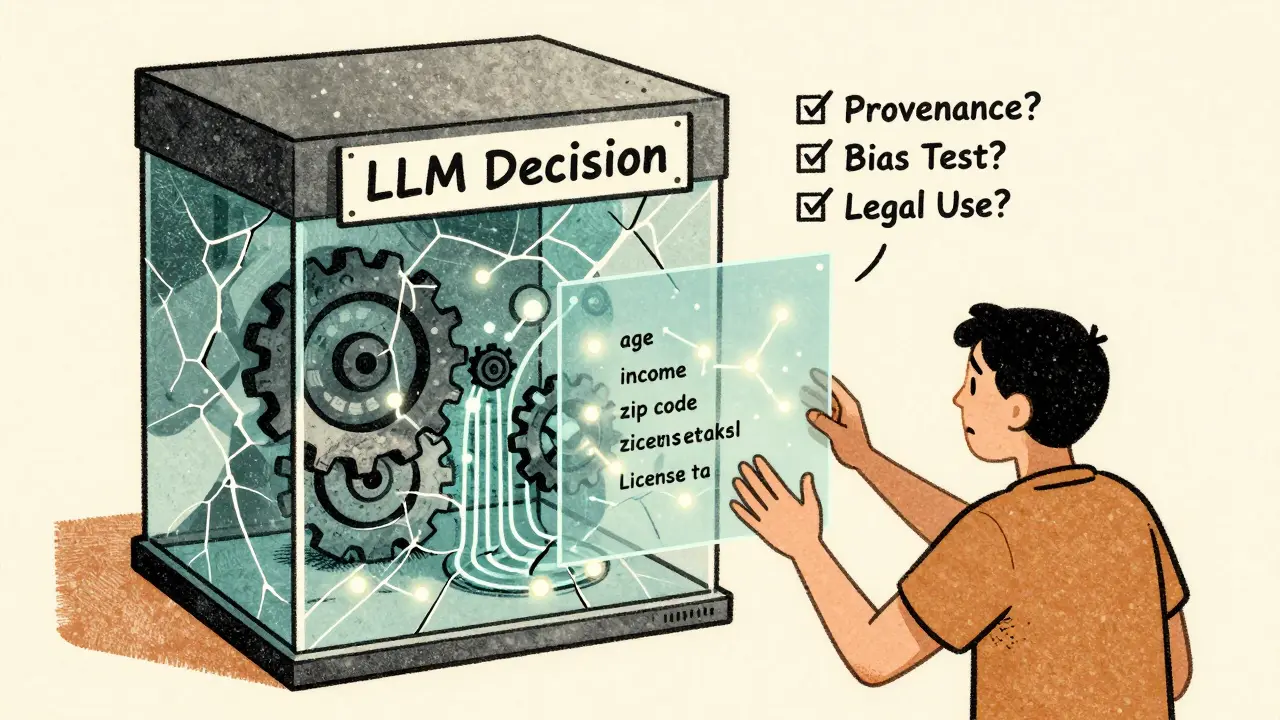
Transparency and Explainability in Large Language Model Decisions
Transparency and explainability in large language models are critical for trust and fairness. Without knowing how decisions are made, AI risks reinforcing bias and eroding public trust - especially in high-stakes areas like finance and healthcare.
Read More
Citations and Sources in Large Language Models: What They Can and Cannot Do
LLMs can generate convincing citations-but most are fake. Learn why AI hallucinates sources, how often they get it wrong, and how to use them safely without trusting their references.
Read More
Why Large Language Models Outperform Task-Specific Systems on Many NLP Tasks
Large language models outperform task-specific NLP systems on complex, context-heavy tasks due to their scale, architecture, and ability to generalize. But for simple, domain-specific tasks, traditional models still win on accuracy and efficiency.
Read More
Curriculum Learning in NLP: How Ordering Data Makes Large Language Models Smarter
Curriculum learning in NLP improves large language models by training them on data ordered from simple to complex, cutting costs, speeding up training, and boosting accuracy on hard tasks. Learn how it works and where it shines.
Read More
Model Parallelism and Pipeline Parallelism in Large Generative AI Training
Model and pipeline parallelism enable training of massive generative AI models by splitting them across multiple GPUs. Learn how these techniques overcome GPU memory limits and power models like GPT-3 and Claude 2.
Read More
Governance Policies for LLM Use: Data, Safety, and Compliance in 2025
In 2025, U.S. governance policies for LLMs demand strict controls on data, safety, and compliance. Federal rules push innovation, but states like California enforce stricter safeguards. Know your obligations before you deploy.
Read More
Multi-Head Attention in Large Language Models: How Parallel Perspectives Power Modern AI
Multi-head attention lets large language models understand language from multiple angles at once, enabling breakthroughs in context, grammar, and meaning. Learn how it works, why it dominates AI, and what's next.
Read More
Tool Use with Large Language Models: Function Calling and External APIs Explained
Function calling lets large language models interact with real tools and APIs to access live data, reducing hallucinations and improving accuracy. Learn how it works, how major models compare, and how to build it safely.
Read More
How to Build a Domain-Aware LLM: The Right Pretraining Corpus Composition
Learn how to build domain-aware LLMs by strategically composing pretraining corpora with the right mix of data types, ratios, and preprocessing techniques to boost accuracy while reducing costs.
Read More
Distributed Training at Scale: How Thousands of GPUs Power Large Language Models
Distributed training at scale lets companies train massive LLMs using thousands of GPUs. Learn how hybrid parallelism, hardware limits, and communication overhead shape real-world AI training today.
Read More