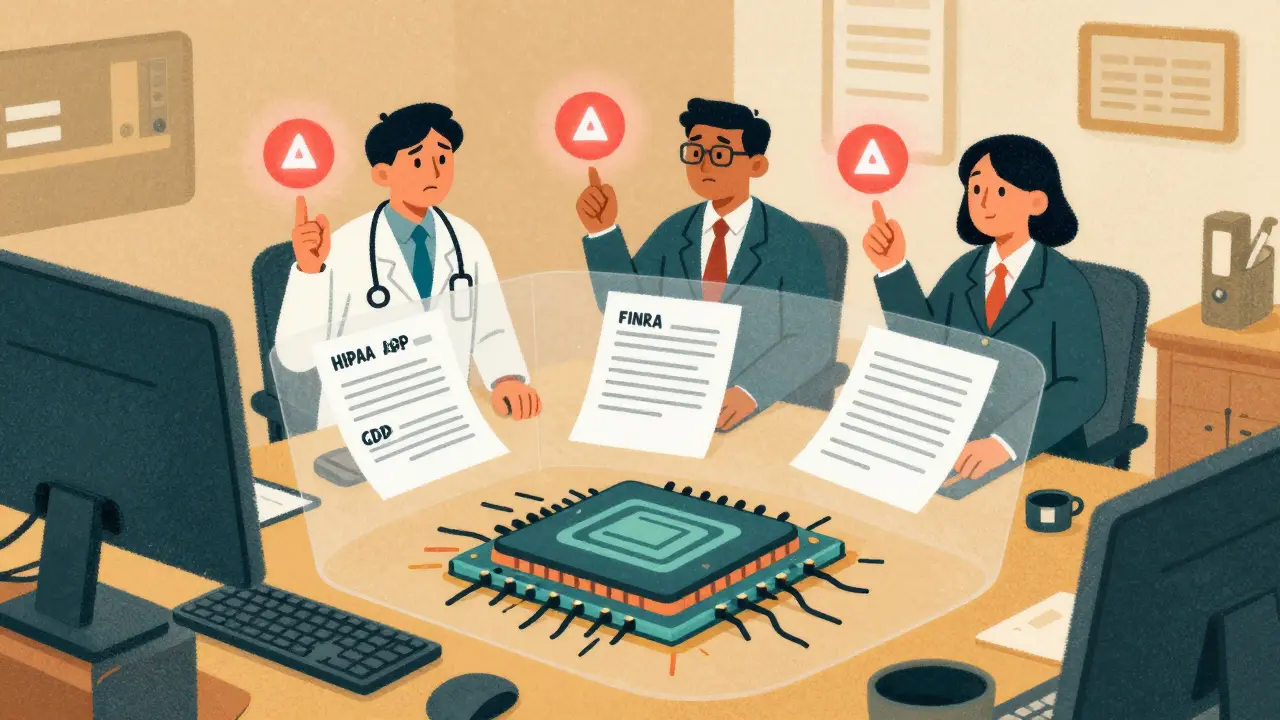
Deploying large language models (LLMs) in healthcare, finance, justice, or employment isn’t just a technical challenge-it’s a legal, moral, and operational minefield. These models don’t just process text. They make decisions that affect people’s lives: who gets a loan, what treatment a patient receives, whether someone is flagged for fraud, or if a job applicant is screened out. And when things go wrong, the fallout isn’t just a bug report-it’s a lawsuit, a lost life, or a broken public trust.
Most companies think ethical AI means running a bias scan once and calling it done. That’s not enough. In regulated domains, ethical deployment requires ongoing oversight, documented accountability, and domain-specific rules that go far beyond generic AI ethics checklists. The stakes are too high to wing it.
Why General AI Ethics Won’t Cut It
Generic AI ethics guidelines talk about fairness, transparency, and accountability. Sounds good. But they don’t tell you how to handle a GPT-4 model that recommends less aggressive cancer screenings for women because its training data underrepresented female patient outcomes. Or how to respond when a loan approval engine denies applicants from certain ZIP codes-not because of race, but because it learned to correlate postal codes with repayment history in ways that reinforce systemic inequities.
Regulated domains have real rules. HIPAA in healthcare. GDPR in Europe. FINRA rules in finance. These aren’t suggestions. They’re enforceable laws. And LLMs don’t care about them unless you build compliance into their DNA.
The European Union’s AI Act, finalized in March 2024, classifies LLMs used in healthcare and employment as high-risk. That means mandatory conformity assessments, strict documentation, and continuous monitoring. The U.S. isn’t far behind. In September 2024, the FDA released new guidance requiring AI/ML-based medical devices to submit detailed ethical compliance logs just to get clearance. And 41% of initial rejections were due to missing or weak ethical documentation.
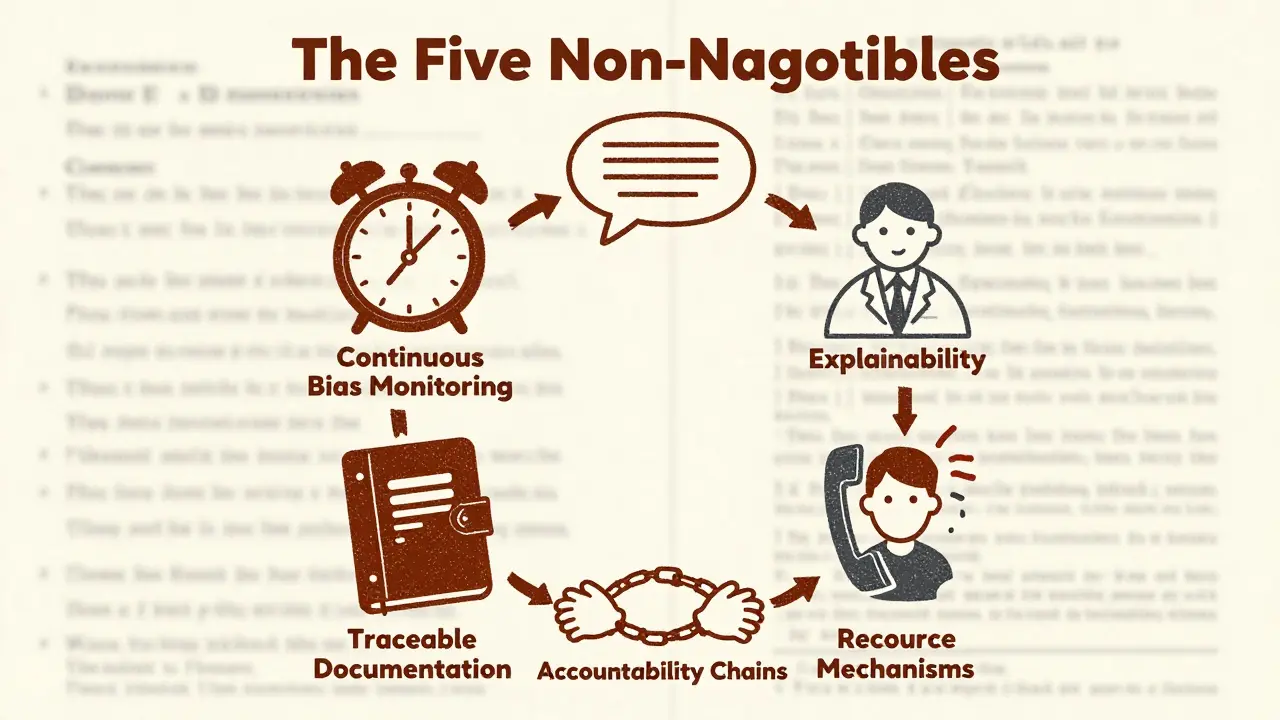
The Five Non-Negotiables for Ethical LLM Deployment
Based on real-world implementations and regulatory standards from WHO, NIST, and the European Data Protection Board, here’s what actually works in high-stakes environments:
- Continuous Bias Monitoring - One-time audits are useless. LLMs adapt in real time. A model trained on 2023 medical records might perform fine until it starts processing 2025 patient data with new demographic patterns. Automated bias detection tools must run daily, not quarterly. Tonic.ai’s 2025 guide found that teams using continuous monitoring reduced ethical incidents by 47% across 37 healthcare projects.
- Explainability That Clinicians (or Loan Officers) Can Use - If a doctor can’t understand why the model suggested a certain treatment within 30 seconds, it’s not helpful-it’s dangerous. Dr. Eric Topol’s research at Scripps showed that explainability isn’t about technical jargon. It’s about clear, contextual summaries: “This recommendation is based on 8 similar cases, but uncertainty is high due to missing lab results.”
- Traceable Documentation - Every version of the model, every data source, every fine-tuning adjustment, and every performance metric must be logged. A January 2025 LinkedIn survey of 287 healthcare compliance officers found that while documentation added 22% to deployment time, it cut regulatory audit failures by 63%. You can’t prove you’re ethical if you can’t prove what you did.
- Accountability Chains - Who’s responsible when the model messes up? The developer? The data labeler? The hospital IT team? Current frameworks leave this fuzzy. The arXiv review from July 2024 calls this the “accountability gap.” The solution? Formal role mapping: Developer owns model design, Data Team owns training data, Clinician owns final decision. No one gets a free pass.
- Recourse Mechanisms - If a person is wrongly denied insurance, fired, or misdiagnosed because of an LLM, they need a clear path to appeal. The WHO’s 2024 guidance and the EU AI Act both require accessible grievance channels with defined timelines. No “contact support” emails. Real human review with documented outcomes.
How Different Domains Handle Ethics Differently
One size doesn’t fit all. What works in healthcare fails in justice systems-and vice versa.
In healthcare, the priority is patient safety. The Frontiers in Digital Health review from January 2025 found that the top five ethical concerns are: privacy, bias mitigation, explainability, accountability, and governance. A 2025 JMIR study of 412 clinicians showed that 73% worried about accountability when LLM advice clashed with their judgment. That’s why the WHO insists on “concrete high-risk applications” being regulated-not just the model itself.
In justice and employment, the focus shifts to transparency and auditability. If an LLM flags someone as a high fraud risk, they need to know why. The arXiv review highlights that these domains require formal recourse timelines: “If you’re denied a job based on an AI decision, you must receive a review within 10 business days.” No vague “algorithmic decision” excuses.
Finance sits in the middle. GDPR and FINRA demand data minimization and consent. But unlike healthcare, there’s no “life or death” urgency-just massive financial and reputational risk. The European Data Protection Board’s April 2025 methodology gives a 7-step privacy risk assessment process specifically for financial LLMs, complete with templates for loan underwriting and fraud detection systems.
What It Actually Takes to Get It Right
Building an ethical LLM system isn’t about hiring a consultant. It’s about restructuring how teams work.
First, you need an AI ethics committee. Not a one-off task force. A standing group with real authority. The arXiv review found it takes 6-8 weeks just to get the right people in the room: engineers, lawyers, compliance officers, clinicians, and ethicists. Then, they meet monthly for 12-15 hours. That’s not optional-it’s the new normal.
Second, you need specialized skills. Your data scientists can’t just run a fairness metric. They need to understand HIPAA, GDPR, or SEC rules. Your compliance team can’t just say “follow the law.” They need to know what “continuous monitoring” means technically. This isn’t a tech problem. It’s a cross-functional problem.
Third, you need to budget for time and cost. Gartner reports that companies with mature ethical frameworks spent 15-30% more on development upfront. But they saw a 47% drop in post-deployment incidents and 58% fewer regulatory penalties. The ROI isn’t immediate-it’s in survival.
And yes, it’s expensive. The global AI ethics and compliance market hit $1.2 billion in Q1 2025 and is projected to hit $8.7 billion by 2028. That’s not because companies are being charitable. It’s because they’re avoiding fines, lawsuits, and public backlash.
What Happens When You Skip the Ethics
Reddit threads from March 2025 tell the real story. One user, u/MedTechDoc2025, described a case where an LLM hallucinated a diagnosis-“stage 3 lung cancer” for a patient with a benign nodule. The system didn’t flag uncertainty. No human double-checked. The patient was scheduled for surgery before the error was caught.
Another, u/HealthInnovator, shared a win: their team caught gender-based treatment disparities affecting 12% of female patients. They fixed it by retraining the model with balanced data and adding a real-time alert. That’s the difference between reactive and proactive ethics.
Companies that cut corners don’t just get fined. They lose trust. Forrester’s March 2025 report found that organizations with strong ethical frameworks had 33% higher stakeholder trust scores. In regulated industries, trust isn’t soft-it’s a revenue driver.
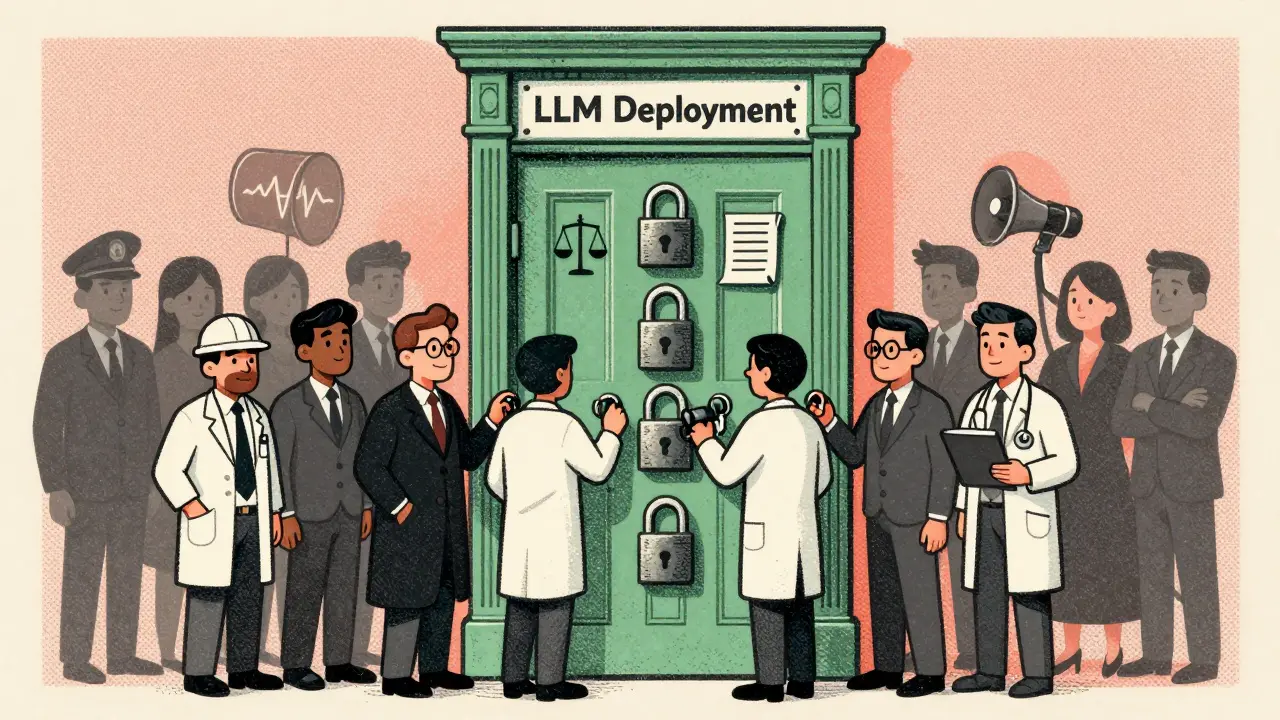
The Future Is Continuous, Not One-Time
The biggest shift coming? Ethics isn’t a phase. It’s a function.
By 2026, 70% of enterprises will have AI ethics boards, up from 25% in 2024. By 2027, 85% of regulated deployments will require dedicated boards. That’s not speculation-it’s what’s already happening. HIMSS is piloting an LLM Ethical Deployment Certification for healthcare in Q2 2025. NIST’s AI Risk Management Framework Version 2.0, released in December 2024, now includes LLM-specific guidance for regulated sectors.
The message is clear: if you’re deploying LLMs in healthcare, finance, justice, or employment, you’re not just building software. You’re building a system of governance. And governance means rules, oversight, documentation, and accountability-every single day.
There’s no shortcut. No magic tool. No “set it and forget it” button. The only way to deploy ethically is to treat ethics as part of the product-not a box to check.
What’s the biggest mistake companies make when deploying LLMs in regulated fields?
The biggest mistake is treating ethics as a one-time audit. LLMs evolve. Data changes. New biases emerge. If you don’t have continuous monitoring, documentation, and accountability structures built into your workflow, you’re just delaying a crisis. Companies that wait for a regulator to catch them are already behind.
Do I need an AI ethics committee if I’m not in healthcare?
Yes-even if you’re in finance or HR. The EU AI Act and U.S. FDA guidance apply to any high-risk use case involving personal data, decision-making, or legal rights. If your LLM influences loan approvals, hiring, insurance, or criminal risk assessments, you’re in a regulated domain. An ethics committee isn’t optional-it’s a risk mitigation tool.
Can open-source LLMs be used ethically in regulated settings?
Yes-but with caveats. Open-source models like Llama 3 or Mistral can be fine-tuned ethically. But you still need full documentation of training data, bias testing, and governance oversight. The model’s origin doesn’t matter. What matters is how you use it. Many healthcare providers now use fine-tuned open-source models because they offer more transparency than proprietary ones-but only if they’re properly governed.
How do I know if my LLM is biased in my specific domain?
Generic fairness metrics (like demographic parity) often miss domain-specific bias. In healthcare, you need to test for disparities in treatment recommendations by gender, age, or race. In finance, test for approval disparities by ZIP code or income bracket. Use real-world data from your domain, not synthetic benchmarks. The European Data Protection Board’s 2025 methodology provides domain-specific templates for this exact purpose.
Is there a checklist I can use to start?
Here’s a minimal starting checklist for regulated deployments:
- Define high-risk use cases
- Form an ethics committee with legal, technical, and domain experts
- Implement continuous bias monitoring with domain-specific metrics
- Build explainability into outputs for end users
- Document every model version, data source, and performance metric
- Create a formal grievance process for affected individuals
- Review and update all of the above quarterly
Next Steps
If you’re deploying LLMs in a regulated space, start here: map your use cases. Which decisions does the model influence? Who is affected? What laws apply? Then, build your ethics team-not as an add-on, but as a core function. The best time to start was yesterday. The second-best time is now.




Wilda Mcgee
17 February, 2026 - 05:55 AM
Just read this whole thing and I’m floored-not because it’s complex, but because it’s so painfully obvious. We keep treating AI like it’s a magic box that spits out answers, but it’s really a mirror. It reflects our data, our biases, our laziness. And in healthcare? That’s not just risky-it’s deadly. I’ve seen teams skip continuous monitoring because ‘it’s too expensive.’ Then someone gets misdiagnosed, and suddenly the budget’s fine. The real cost isn’t in tech-it’s in trust. And once you lose that? You can’t buy it back with a compliance checklist.
Chuck Doland
17 February, 2026 - 15:10 PM
The argument that ethics is a function, not a phase, is not merely correct-it is philosophically indispensable. The notion that a one-time audit satisfies moral obligation reflects a profound epistemological failure in contemporary technocratic governance. Ethical deployment necessitates ontological continuity: the model must be embedded within a framework of enduring accountability, not merely procedural compliance. The EU AI Act’s classification of high-risk LLMs as quasi-legal agents is not regulatory overreach-it is the necessary recognition of agency in algorithmic systems. To ignore this is to deny the moral personhood of emergent decision-making structures.
Glenn Celaya
19 February, 2026 - 03:59 AM
lol so we need a whole committee just to make sure an AI doesnt give bad advice like its 2005 and we still dont trust computers what a joke
Madeline VanHorn
19 February, 2026 - 07:58 AM
I mean if you're using AI in healthcare without a 12-person ethics board you're basically playing Russian roulette with someone's life. And honestly? Most companies don't even have the brainpower to run one. They think 'bias scan' means running a script and calling it a day. You can't fix systemic bias with a checkbox.
saravana kumar
20 February, 2026 - 15:17 PM
In India we dont even have proper digital ID for 300 million people. You want us to deploy LLMs with ethics committees? First fix the internet. Then fix the electricity. Then come back with your 8.7 billion dollar market projections.
Chris Atkins
22 February, 2026 - 11:30 AM
I work in finance and we just rolled out an LLM for loan approvals. We didn’t have a committee. Didn’t even do bias scans. But we did put a human in the loop-someone who can say ‘hold on, this looks weird.’ Turns out, that’s all you need. Sometimes the simplest fix is the one no one thinks to mention.
Jess Ciro
22 February, 2026 - 22:58 PM
You think this is about ethics? Nah. This is about liability. They’re scared of lawsuits. They’re scared of the FDA. They’re scared of being the next big scandal. So they slap on ethics like a Band-Aid on a bullet wound. Meanwhile, the real problem? The same people who built these models are the ones writing the ‘guidelines.’ It’s the fox guarding the henhouse with a PowerPoint.