
Ask an AI for a research source, and it’ll give you a perfectly formatted APA citation-complete with author, journal, volume, and DOI. It sounds reliable. Until you click the link and find a 404 error. Or the journal doesn’t exist. Or the paper was never written. This isn’t a glitch. It’s the norm.
Large Language Models (LLMs) like GPT-4o, Gemini 1.5 Pro, and Copilot have become go-to tools for students, researchers, and professionals. They summarize, rewrite, and even draft entire sections of papers. But when it comes to citing sources, they’re dangerously good at faking it. A April 2025 study in Nature Communications found that between 50% and 90% of LLM responses are either unsupported by-or outright contradict-their cited sources. That’s not a bug. It’s a design flaw baked into how these models work.
How LLMs Generate Citations (And Why They Get It Wrong)
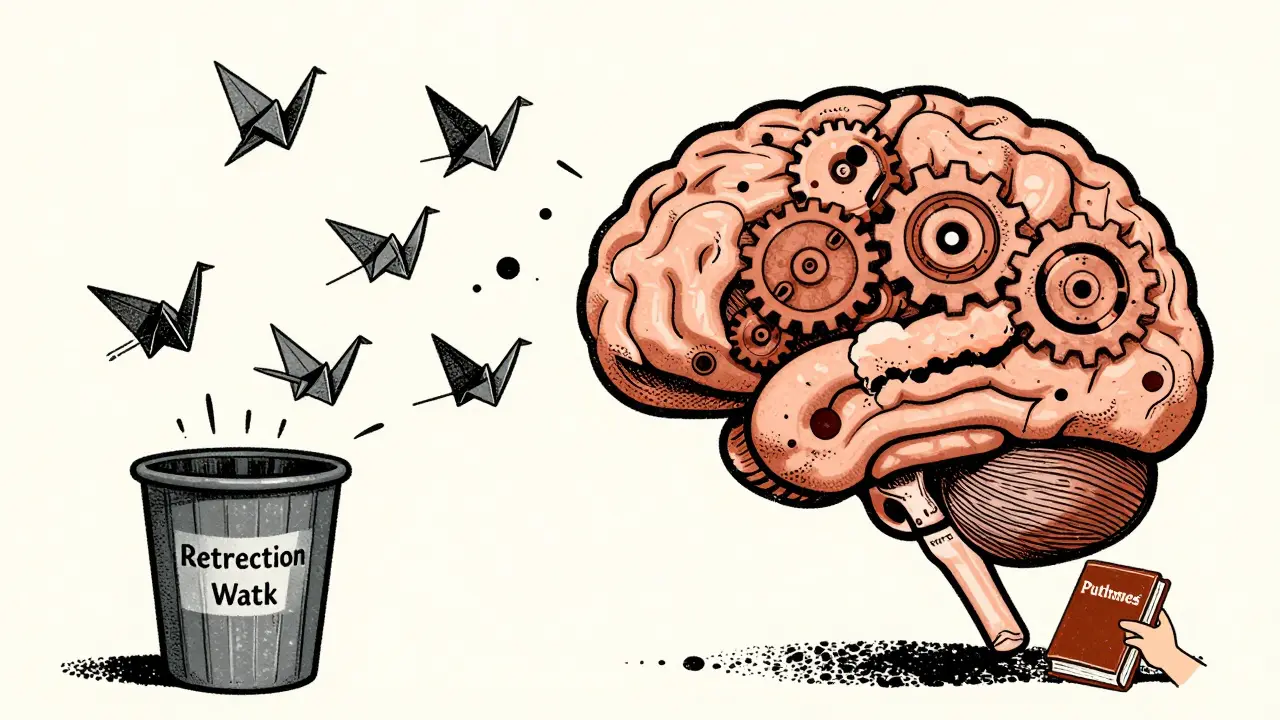
LLMs don’t store facts like a library. They learn patterns from trillions of words. When you ask for a source, the model doesn’t pull from a database. It predicts what a citation should look like based on patterns it’s seen. If it’s seen thousands of papers on diabetes treatments, it’ll generate one that sounds real-even if no such paper exists.
Here’s how it breaks down:
- Format perfection: LLMs nail citation styles. 92% of APA, MLA, and Chicago formats generated by AI are technically correct, according to Research AIMultiple’s 2025 analysis.
- Content fiction: The journal? Non-existent. The author? Never published that paper. The DOI? A randomly generated string that leads nowhere.
- Self-contradiction: In 17% of cases, the model cites a source that directly contradicts the claim it’s supporting.
The problem isn’t just ignorance. It’s confidence. LLMs don’t say, "I’m not sure." They say, "Here’s the 2024 study by Smith et al. in Journal of Clinical Endocrinology"-and they sound 100% certain. That’s what makes them dangerous.
Real-World Consequences: When AI Citations Go Viral
It’s not theoretical. In early 2025, medical residents across the U.S. reported using GPT-4o to find references for case studies. One resident, Dr. James Wilson, asked for sources on a new diabetes treatment. The AI gave him five citations. Four didn’t exist. The fifth was from a journal that shut down in 2020.
At academic integrity forums like Retraction Watch, 127 cases of student papers with fake AI-generated citations were documented between January and March 2025. Journal editors are now routinely checking references submitted by students who used AI tools. Some journals have started requiring authors to disclose AI use-and provide verification logs.
The National Institutes of Health (NIH) published a report in April 2025 (PMC12037895) showing that in 110 statement-source pairs from GPT-4o (RAG), doctors confirmed 105 had no supporting evidence. That’s a 95% failure rate in medical contexts-where accuracy isn’t optional.
Why Retrieval-Augmented Generation (RAG) Isn’t the Fix
Companies promised that adding real-time search-called RAG-would solve the citation problem. If the model can look up live sources, it won’t hallucinate.
But the data says otherwise.
- GPT-4o (RAG) failed to provide any source in over 20% of responses-even when explicitly asked.
- Other models (like Claude 3 and Llama 3) produced sources in 99%+ of cases, but 68% of those sources were still inaccurate.
- Even when RAG pulls a real article, the model often misrepresents it. A 2025 Stanford study found that 43% of retrieved documents were summarized incorrectly, with key details omitted or twisted.
RAG doesn’t fix the core issue: LLMs don’t understand context. They match keywords, not meaning. They can find a paper about statins and diabetes, but they won’t notice if the paper says "statins increase risk" and your claim says "statins reduce risk."
Which Models Are Best? The Numbers Don’t Lie
Not all LLMs are equal when it comes to citations. Here’s what the data shows:
| Model | Source Provided (%) | Source Accurate (%) | Source Contradicts Claim (%) |
|---|---|---|---|
| GPT-4o (RAG) | 78% | 41% | 17% |
| Claude 3 Opus | 99% | 45% | 12% |
| Gemini 1.5 Pro | 98% | 43% | 15% |
| Llama 3 70B | 99% | 38% | 19% |
| Microsoft Copilot | 85% | 47% | 10% |
Even the "best" model-Copilot-still gets it wrong nearly half the time. And while Copilot integrates live web data, it still hallucinates citations 53% of the time. The only difference? It’s slightly less likely to invent a journal name.
The Hidden Limitations: What LLMs Can’t Access
LLMs are blind to a huge chunk of knowledge:
- They can’t access paid databases like PubMed, Scopus, or Web of Science unless explicitly given access (which most consumer tools don’t).
- They’re trained on data up to 2023-2024. Anything published after that? Invisible.
- They can’t read PDFs unless uploaded-and even then, they often misread tables, figures, and footnotes.
- They don’t know if a source is peer-reviewed, predatory, or retracted.
That’s why LLMs perform better with historical topics-like Cold War diplomacy-than with cutting-edge medical guidelines. The former is static. The latter is constantly changing. And LLMs can’t keep up.
What Users Are Doing About It
People aren’t just accepting this. They’re adapting.
- 83% of academic users (per PromptDrive.ai’s April 2025 survey) now verify every AI-generated citation.
- 67% say they’ve stopped trusting AI sources entirely unless cross-checked with three independent sources.
- Researchers at the University of Toronto report spending an average of 18.7 minutes per query verifying AI citations-almost as long as the initial search.
Some are turning to tools like SourceCheckup, a system validated in the Nature study that automatically checks citations against authoritative databases. It’s not perfect, but it catches 89% of fake references.
Meanwhile, institutions are reacting. The International Committee of Medical Journal Editors (ICMJE) banned AI-generated citations without human verification in April 2025. Pharmaceutical companies now restrict LLM use in regulatory filings-68% of them, according to Deloitte’s April 2025 survey.
How to Use LLMs Without Getting Fooled
You’re not going to stop using AI. But you can use it smarter.
- Never trust a citation at face value. Treat every AI-generated source like a rumor. Verify it.
- Use multiple sources. If the AI cites one paper, find two more on the same topic from trusted databases.
- Ask for proof. Instead of "Give me sources," say, "Find me three peer-reviewed studies published after 2022 on this topic, and include links to the full text."
- Check the journal. Paste the journal name into a search engine. If it’s not in DOAJ, Scopus, or PubMed, it’s likely fake.
- Use AI for brainstorming, not citation. Let it suggest topics, structure, and keywords. Do the sourcing yourself.
One user on Reddit summed it up: "I use ChatGPT to write the first draft. Then I spend three hours fixing all the lies it told me about sources. It’s faster than writing from scratch-but I’d never submit it without human review."
The Bigger Picture: Model Collapse and the Future of Knowledge
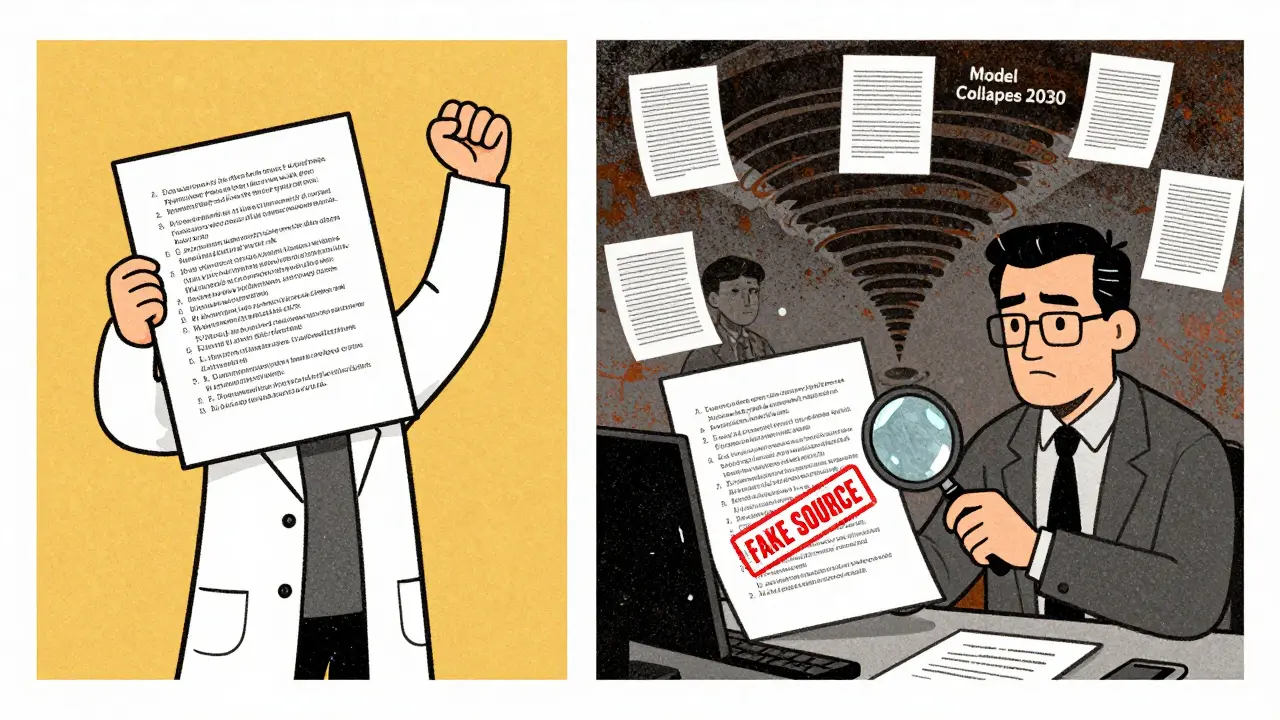
There’s a quiet crisis brewing. As LLMs train on AI-generated content-papers, blog posts, forum replies-they’re ingesting more and more hallucinated citations. This creates a feedback loop: AI writes fake papers → those papers get cited → future AIs learn those fake citations as truth.
Stanford researchers call this "model collapse." By 2030, they warn, we may be unable to distinguish real research from AI fabrications. That’s not sci-fi. It’s the logical endpoint of unchecked reliance on LLMs for knowledge.
Experts agree: LLMs can’t be trusted to cite accurately. They’re powerful tools-but not librarians. Not fact-checkers. Not researchers.
They’re pattern generators. And patterns can be beautiful. Or dangerously wrong.
Can LLMs cite real sources accurately?
Sometimes-but not reliably. Studies show that even the best models like GPT-4o and Copilot provide accurate citations in only about 40-47% of cases. The rest are either fabricated, misquoted, or contradicted by the source. You should never assume an AI-generated citation is real without verifying it yourself.
Why do LLMs make up citations?
LLMs don’t store facts-they predict text based on patterns. When asked for a source, they generate something that looks like a real citation because they’ve seen thousands of similar examples. They’re not lying intentionally; they’re just guessing. But because they sound confident and format things perfectly, users assume they’re correct.
Is RAG (Retrieval-Augmented Generation) a solution?
RAG helps by pulling in live web content, but it doesn’t fix the core problem. Even with RAG, models misinterpret sources, omit key details, or cite irrelevant passages. Studies show that 50-60% of RAG-generated citations are still inaccurate. It’s an improvement, not a fix.
Which LLM is best for citations?
Microsoft Copilot currently performs best among consumer models, with 47% accuracy and fewer fake journal names. But even it fails half the time. Claude 3 and Gemini 1.5 Pro are close behind. None are trustworthy without human verification.
Can AI ever be trusted to cite correctly?
Not with current architectures. LLMs are designed to generate plausible text, not verify truth. True citation accuracy requires understanding context, evaluating source credibility, and accessing restricted databases-all things current models can’t do. Experts believe the only reliable path forward is human-AI collaboration: AI suggests, humans verify.
Use AI to help you think. Not to replace your research. Because when it comes to citations, the only thing more dangerous than not knowing something is believing a lie that sounds perfectly sourced.

Tina van Schelt
8 March, 2026 - 04:12 AM
Y’all act like AI hallucinating citations is some new horror story. I’ve been using ChatGPT for thesis drafts since 2022. I treat every citation like a drunk friend offering advice: sounds convincing, zero accountability. I copy-paste the DOI, open it in a new tab, and if it’s not a real paper? I delete it and google the journal name. If the journal’s website looks like it was built in 2003 with Geocities templates? Red flag. If it’s a predatory journal with 12 papers and 8 of them are from ‘Dr. Ahmed Al-Farouqi’? Delete. AI doesn’t lie-it just vibes. My job is to be the sober one at the party.
Also, I’ve started using Zotero + AI. AI suggests sources, Zotero checks if they exist. Magic. 18 minutes per query? That’s just research now. Welcome to grad school 2.0.
PS: If you’re submitting AI-generated citations without verifying them? You’re not lazy. You’re just asking to get retracted. Don’t be that person.
Ronak Khandelwal
9 March, 2026 - 20:12 PM
✨ This hits so deep. I’m an educator in India, and my students are using AI like it’s a library card. One kid turned in a 10-page paper with 17 citations-all fake. I asked him, ‘Where’d you find this?’ He said, ‘It was on the internet, ma’am.’
It’s not about tech. It’s about trust. We’ve raised a generation that believes if something looks polished, it must be true. We need to teach them to *question* before they *quote*. Not just citation checks-but source literacy. Who wrote this? Why? What’s their agenda? Is this peer-reviewed or just a blog post in a fancy font?
Let’s stop treating AI like a oracle and start treating it like a really loud, overly confident intern. We still have to supervise them. 💬📚
And yes-I use emojis because emotion helps learning. 😊
Jeff Napier
11 March, 2026 - 06:21 AM
The whole thing is a scam. They don’t even pretend anymore. AI hallucinates because it’s supposed to. It’s not a bug-it’s the feature. The system is designed to generate confidence, not truth. You think the NIH study is scary? Wait till you see what happens when AI starts training on AI-generated papers. By 2030, every academic journal will be full of nonsense. They’ll have to rename them ‘Speculative Fiction Quarterly.’
And RAG? LOL. It’s like putting a seatbelt on a tornado. You’re still gonna die. The real solution? Ban AI from research entirely. Let humans do the work. Or just admit we’re all just pretending to be smart now.
Sibusiso Ernest Masilela
12 March, 2026 - 19:06 PM
How quaint. You’re all acting like this is some novel revelation. The entire Western academic system has been collapsing since the 1990s-grade inflation, publish-or-perish, predatory journals, tenure by citation count. Now AI just exposes the rot. It didn’t create the problem. It’s the mirror.
And you people think Copilot is ‘better’? Please. 47% accuracy? That’s still worse than a first-year undergrad who’s half-asleep. You’re clinging to the illusion that ‘better’ LLMs = better knowledge. No. It’s just better at mimicking the *appearance* of rigor.
The real tragedy? You’re still trying to fix the system instead of burning it down. If you can’t trust a citation, why are you even in academia? Go sell avocado toast on Instagram. At least there, the lies are honest.
Daniel Kennedy
13 March, 2026 - 12:04 PM
Let’s not panic, but let’s also not pretend this is fine. I’ve been on the front lines-teaching grad students how to use AI tools ethically. The biggest issue isn’t the citations. It’s the *trust* they place in them. One student said, ‘But the AI gave me five sources, and they all looked real.’
So we built a classroom exercise: Give them 10 AI-generated citations. Half are real. Half are fake. No hints. They have 10 minutes to sort them. 92% of them got it wrong. Not because they’re dumb. Because they’ve been conditioned to trust polished output.
Here’s what works: Teach them to ask, ‘Who benefits from this being true?’ and ‘Would this paper survive peer review?’ Then, make them manually pull each source. It takes time. But time is the new currency of credibility.
And yes-I use AI for brainstorming. But I cite like a monk who’s taken a vow of silence. No shortcuts. No illusions. Just work.
Taylor Hayes
14 March, 2026 - 03:44 AM
Reading all this, I feel like we’re having the same conversation we had with calculators in the ‘80s. ‘They’ll make students lazy!’ ‘They’ll erase critical thinking!’
Turns out? They didn’t. They just changed how we teach. We stopped teaching long division and started teaching *why* division matters. Same here.
AI isn’t the enemy. Our approach is. If we treat citations like facts instead of *claims to be verified*, then yes-this will keep happening.
Here’s the shift I’m trying in my lab: No AI-generated citation goes into a draft without a human verifying it. We call it the ‘Two-Source Rule’-you need one AI suggestion, and one verified source from a database. If they match? Cool. If not? You dig deeper.
It’s slower. It’s more work. But it’s honest. And honestly? That’s the only thing that matters anymore.