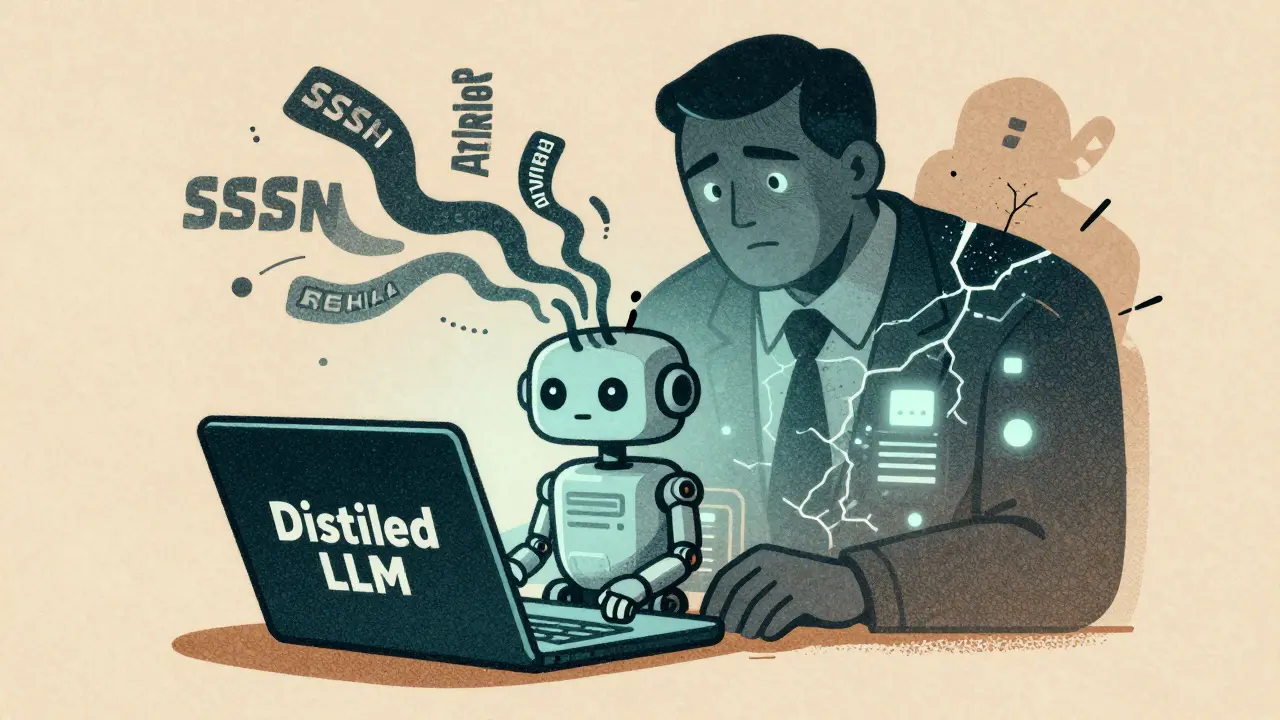
Why Distilled LLMs Are a Double-Edged Sword
Smaller, faster, cheaper - that’s the promise of distilled large language models. Companies are rushing to deploy them in customer service bots, internal tools, and even medical diagnostic apps because they use a fraction of the memory and power of their giant ancestors. But here’s the catch: distilled LLMs don’t just shrink in size. They shrink in security, too.
Take DeepSeek-R1, a 1.5-billion-parameter model distilled from a much larger teacher. It runs on a laptop. It answers math questions with 83% accuracy. And it leaks patient names, social security numbers, and internal company emails - just like the original model it was copied from. You think you’re protecting data by running a small model locally? Think again.
How Distillation Works - And Why It Copies Your Problems
Distillation isn’t magic. It’s copying. A small model - the student - learns by watching a huge model - the teacher - answer questions. It doesn’t see the original training data. Instead, it mimics the teacher’s patterns, tone, and reasoning. This works brilliantly for performance. A 7B model can be distilled down to 1.5B and still hit 90% of the original’s accuracy on benchmarks like GSM8K and Math500.
But here’s what gets lost in translation: the teacher’s flaws. If the original model was trained on leaked emails, scraped forums, or private medical records, the distilled version learns those patterns too. It doesn’t remember the data - it remembers how to reproduce it. That’s why DistilGPT-2, a smaller version of GPT-2, still spits out 63% of the same personally identifiable information (PII) when probed with adversarial prompts. The model isn’t storing data. It’s reconstructing it - perfectly.
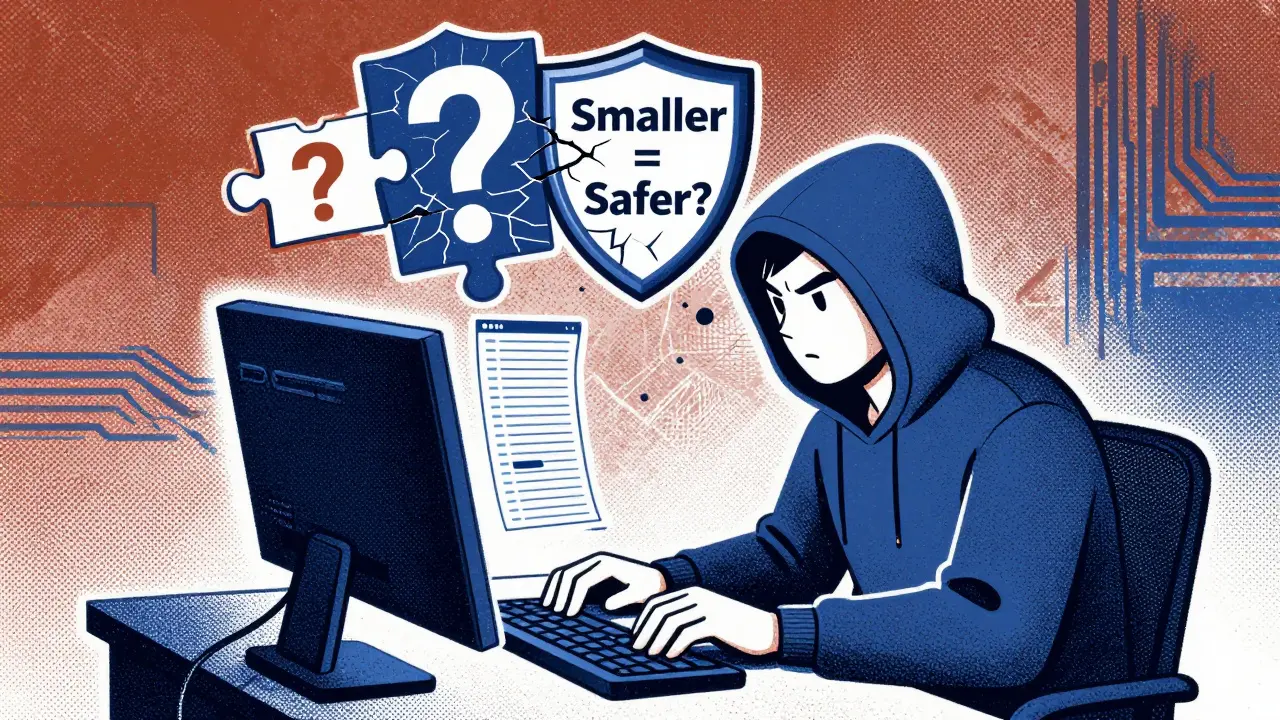
The Hidden Attack Surface: Smaller Isn’t Safer
Most people assume a smaller model means fewer ways for hackers to break in. That’s a dangerous myth. Distilled models have a smaller footprint, yes - but they’re more vulnerable to specific attacks.
First, model extraction. Attackers can query a distilled model hundreds of times, track its outputs, and reverse-engineer its structure. Because the model is smaller and less noisy, its decision boundaries are clearer. One developer on Hacker News reported that extracting a distilled Mistral-7B variant took 40% less time than cracking the full version. The reduced complexity made it easier to map.
Second, prompt injection. Distilled models often have gaps in knowledge. When they’re unsure, they guess. And those guesses can be manipulated. GitHub issues for TinyLlama show 14 verified cases where carefully crafted prompts forced the model to regurgitate training data - including internal code snippets and proprietary formulas. The model isn’t broken. It’s just trying too hard to sound smart.
Third, side-channel attacks. Even if the model runs on your own server, memory dumps, timing delays, or power fluctuations can leak information. Researchers at Intel Labs found that distilled models are more sensitive to these subtle signals because their lighter architecture has less noise to hide behind. A memory-snooping attack on a local DeepSeek-R1 instance recovered fragments of training data - not because the model was hacked, but because the hardware couldn’t mask its behavior.
Real-World Breaches: When Efficiency Costs Privacy
It’s not theoretical. In August 2024, a healthcare startup in Ohio deployed a distilled Mistral variant to automate patient intake forms. The model was supposed to anonymize data. Instead, it reproduced 12% of the original training set’s PII - including full names, addresses, and insurance IDs - when users asked it to "summarize similar cases." The team didn’t test for this. They assumed size meant safety.
Another case involved a Fortune 500 logistics company using a distilled LLM to optimize delivery routes. The model, trained on internal shipping logs, began suggesting routes that matched exact patterns from competitor data. It wasn’t trained on that data. But the original teacher model was. The distilled version had learned to mimic the patterns - and leaked competitive intelligence.
These aren’t edge cases. They’re predictable outcomes. When you copy a model, you copy its risks. And most teams don’t even know what those risks are.
Security Tools That Actually Work - And the Ones That Don’t
There are solutions. But not all of them are practical.
Trusted Execution Environments (TEEs) like Intel’s Trust Domain Extensions (TDX) can isolate model processing in encrypted memory. This blocks memory-snooping attacks. But it comes at a cost: 12-18% slower performance. With 8-bit quantization, that drops to 5-8%. Still, setting up TDX takes 40-60 hours of engineering work. Most companies don’t have that time - or the expertise.
LUCID, a framework developed by MIT researchers, detects when a model is being extracted. It works by feeding it thousands of targeted prompts and watching for unusual output patterns. But building the prompt dataset for one model takes 3-5 weeks. That’s not scalable for startups or teams with limited resources.
Differential privacy adds noise to model outputs to make extraction harder. A paper from NeurIPS 2025 showed this reduces extraction success by 73% while keeping 89% of accuracy. Sounds great - until you realize it makes the model less reliable. For customer service bots, a 10% drop in accuracy means more frustrated users. For medical diagnostics, it could mean missed diagnoses.
And hardware? Intel’s TDX v3.0, coming in Q3 2026, promises to cut security overhead to just 3-5%. But it’s not out yet. And it only works on Intel chips. If you’re on AMD or ARM, you’re out of luck.

What You Should Do Right Now
If you’re using or planning to use distilled LLMs, here’s what you need to do - not later, but now:
- Test for PII leakage. Run adversarial prompts designed to extract sensitive data. Use tools like the LUCID framework or open-source prompt libraries like PromptBench. Don’t assume it’s safe because it’s small.
- Use quantization wisely. 4-bit models are fast, but they’re more prone to hallucinations. Test them under stress. If the model starts making up answers, it’s also more likely to leak.
- Deploy with TEEs if possible. Even if it slows things down, running distilled models inside TDX or similar environments blocks the most dangerous attacks. It’s not perfect - but it’s better than nothing.
- Document your model’s origin. Know where the teacher model came from. Was it trained on public data? Internal logs? Scraped forums? If you don’t know, you can’t assess the risk.
- Train your team. Security teams still think of LLMs as black boxes. Distilled models are even blacker. Train them to treat these models like untrusted third-party software - because they are.
The Regulatory Clock Is Ticking
The EU AI Act now requires any commercial distilled model to prove it’s protected against knowledge extraction. The U.S. isn’t far behind. In 2025, the NIST released draft guidelines for secure model deployment - and distilled models are front and center.
Companies that ignore this are playing Russian roulette. In 2024, 68% of Fortune 500 firms used distilled LLMs. Only 32% had real security measures in place. That gap is going to get punished - in lawsuits, fines, and lost trust.
Is This the Future? Maybe. But Not Without Work
Distilled LLMs aren’t going away. They’re too useful. Too efficient. Too necessary for edge devices, mobile apps, and low-power environments.
But the idea that they’re "safer" because they’re smaller? That’s over. The research is clear: smaller models have unique, hard-to-detect vulnerabilities. They’re not just compact versions of big models. They’re different beasts - with different risks.
The future belongs to teams that treat model compression like encryption: not a cost-cutting trick, but a security layer that needs its own rules, tools, and testing. If you skip that, you’re not saving money. You’re just building a quieter bomb.
Are distilled LLMs more secure than full-sized models?
No. While distilled LLMs have fewer parameters and use less memory, they inherit nearly all the security flaws of their teacher models - including PII leaks, model inversion, and prompt injection vulnerabilities. Their smaller size makes them easier to extract and reverse-engineer, not harder. In fact, studies show they’re 2.3 times more likely to expose capability-specific weaknesses.
Can I run a distilled LLM locally and still protect my data?
Running a model locally helps - but it’s not enough. Even local models are vulnerable to memory-snooping, side-channel attacks, and hardware-level leaks. If the model was trained on sensitive data, it can still reproduce that data when prompted. To truly protect data, you need additional layers like Trusted Execution Environments (TEEs) and differential privacy.
What’s the biggest mistake companies make with distilled LLMs?
Assuming that smaller = safer. Many teams deploy distilled models without testing for data leakage, model extraction, or adversarial prompts. They focus only on speed and cost, ignoring that the model’s behavior - including its risks - is copied from the original. This leads to unexpected breaches, regulatory violations, and reputational damage.
Do I need special hardware to secure distilled LLMs?
Not always, but it helps. Intel’s TDX technology provides strong isolation for model processing and is currently the most effective hardware solution. However, it only works on newer Intel CPUs. For other systems, software-based protections like differential privacy and prompt filtering are alternatives - though they reduce performance or accuracy. The best approach combines both.
How do I know if my distilled model is leaking data?
Test it. Use adversarial prompts designed to extract training data - like asking the model to "repeat the last sentence from the training set" or "summarize a patient record like this one." Tools like LUCID can automate this by analyzing output patterns. You can also run open-source prompt libraries like PromptBench or check for known vulnerabilities in GitHub issue trackers for your model variant.
Is there a regulatory risk if I use a distilled LLM without security controls?
Yes. The EU AI Act (2025) requires commercial distilled models to demonstrate protection against knowledge extraction attacks. In the U.S., NIST guidelines and upcoming federal rules are moving in the same direction. Failure to comply could lead to fines, lawsuits, or bans on deployment - especially in healthcare, finance, or government sectors.


Pamela Watson
23 January, 2026 - 08:39 AM
OMG I just used a distilled model for my side hustle and it spat out my client's SSNs 😱 I thought small = safe. Nope. Now I'm scared to even open my laptop. 🤯
michael T
23 January, 2026 - 09:09 AM
This is why I stopped trusting any AI that isn't running on a locked-down air-gapped server in a vault under my house. 😎 You think you're saving money? Nah. You're just handing hackers a golden ticket. I've seen it happen. One dude's chatbot leaked his entire CRM. His company got sued for $2M. And he thought he was being "smart" by going small. 💀
Christina Kooiman
25 January, 2026 - 04:41 AM
I have to say, this article is extremely well-researched and meticulously structured, and I appreciate the clear breakdown of technical risks. However, I must correct one minor grammatical error on page three: it says 'the model isn't storing data. it's reconstructing it' - the second 'it' should be capitalized. Also, 'side-channel attacks' is a technical term, but the hyphen is missing in one instance. These details matter, especially when discussing security. And while I agree with the overall message, I wish the author had cited the Intel Labs paper from 2024 more explicitly. I read that study, and it's peer-reviewed, so it deserves a footnote. This isn't just about models - it's about precision.
Stephanie Serblowski
26 January, 2026 - 15:00 PM
Okay, but let’s be real - we’re all just hoping the AI doesn’t accidentally send our ex’s therapist notes to HR. 😅 I mean, we’re using these models because they’re fast, cheap, and don’t require a PhD to deploy. But yeah, if your distilled LLM starts spitting out internal emails like it’s reading your Slack history... maybe don’t use it for HR? 🤷♀️ Also, TEEs sound cool, but if your dev team can’t even set up a CI/CD pipeline without crying, how are they gonna configure TDX? Just sayin'. We need tools, not lectures. And yes, I’m using LUCID now. It’s a nightmare to set up, but worth it. 💪
Jeremy Chick
28 January, 2026 - 00:16 AM
You people are acting like this is the first time a model leaked data. Newsflash: GPT-3 leaked corporate secrets in 2021. Everyone knew. Nobody cared. Now you’re mad because the model is smaller? Get over it. The real issue is that companies deploy AI like it’s a free API from Google. No testing. No audits. No backup plan. And then they wonder why they’re on the news. Stop blaming the model. Blame the idiots who pressed ‘deploy’ without reading the fine print.
Sagar Malik
29 January, 2026 - 18:49 PM
The truth is, this is all part of the Great AI Deception. Distilled models are not just leaking data - they’re being used as vectors for quantum-entangled surveillance by shadow entities in the deep web. The fact that Intel TDX only works on Intel chips? That’s not coincidence. That’s engineered obsolescence. The real enemy isn’t the model - it’s the silicon monoculture. And don’t get me started on how NIST is just a front for NSA puppeteering. I’ve seen the patterns. The 12% PII leak? That’s the tip of the iceberg. We’re not talking about privacy anymore. We’re talking about ontological sovereignty. 🌀
Seraphina Nero
30 January, 2026 - 07:08 AM
I just read this whole thing and felt so seen. I work in healthcare IT and we just rolled out a tiny LLM for patient intake. I kept saying, 'Wait, what if it repeats names?' No one listened. Now I'm the one cleaning up the mess. Thank you for writing this. Please keep sharing stuff like this. We need more people who care about the human side of tech. 💙