
When you're fine-tuning a large language model (LLM), you don't just need more data-you need better data. The truth is, most teams struggle with limited, biased, or repetitive training sets. That’s where data augmentation steps in. It’s not magic. It’s strategy. And it can turn a mediocre fine-tuned model into one that actually works in real-world use.
Why Data Augmentation Matters in Fine-Tuning
Fine-tuning is about teaching a model to do something specific-like answering customer questions, summarizing legal docs, or tagging medical records. But if your training data only has 200 examples, the model will memorize those instead of learning patterns. That’s overfitting. And it fails when it sees anything new. Data augmentation fixes this by generating new, realistic variations of your existing examples. Think of it like giving the model more practice tests with slightly different wording. The goal isn’t to flood it with garbage. It’s to expose it to the right kind of diversity. For example, if you’re fine-tuning a model to recognize product names in customer reviews, and all your training data says "iPhone 15" as the product, the model won’t know how to handle "Apple’s latest phone" or "the new 15-series iPhone." Augmentation teaches it those variations without needing a human to write them all.Synthetic Data: Let the Model Generate Its Own Training Set
Synthetic data is one of the most powerful tools in the LLM fine-tuning toolkit. Instead of relying on humans to write hundreds of examples, you use the model itself-often a smaller, cheaper version-to generate them. Here’s how it works in practice:- You start with a small set of high-quality examples-say, 50 labeled customer service interactions.
- You prompt a lightweight LLM (like Mistral 7B or Phi-3) with instructions: "Rewrite this query in 5 different ways that mean the same thing, but use casual language, typos, or incomplete sentences."
- The model generates 250 new variations.
- You filter out nonsense, keep the realistic ones, and add them to your training set.
Human-in-the-Loop: The Secret Weapon Nobody Talks About
Synthetic data is great. But it’s not enough. Humans still need to guide the process. That’s where human-in-the-loop (HITL) augmentation comes in. HITL means humans don’t just label data-they actively shape it. Here’s a real workflow from a fintech startup in Austin:- They fine-tuned a model to detect fraudulent transaction descriptions.
- Initial accuracy was 72%.
- They fed the model’s mistakes back to their fraud analysts.
- Analysts wrote corrected versions: "Transfer to crypto wallet" → "Sent $2,000 to Binance"
- Those corrections became new training examples.
- Accuracy jumped to 89% in two weeks.

How Synthetic and HITL Work Together
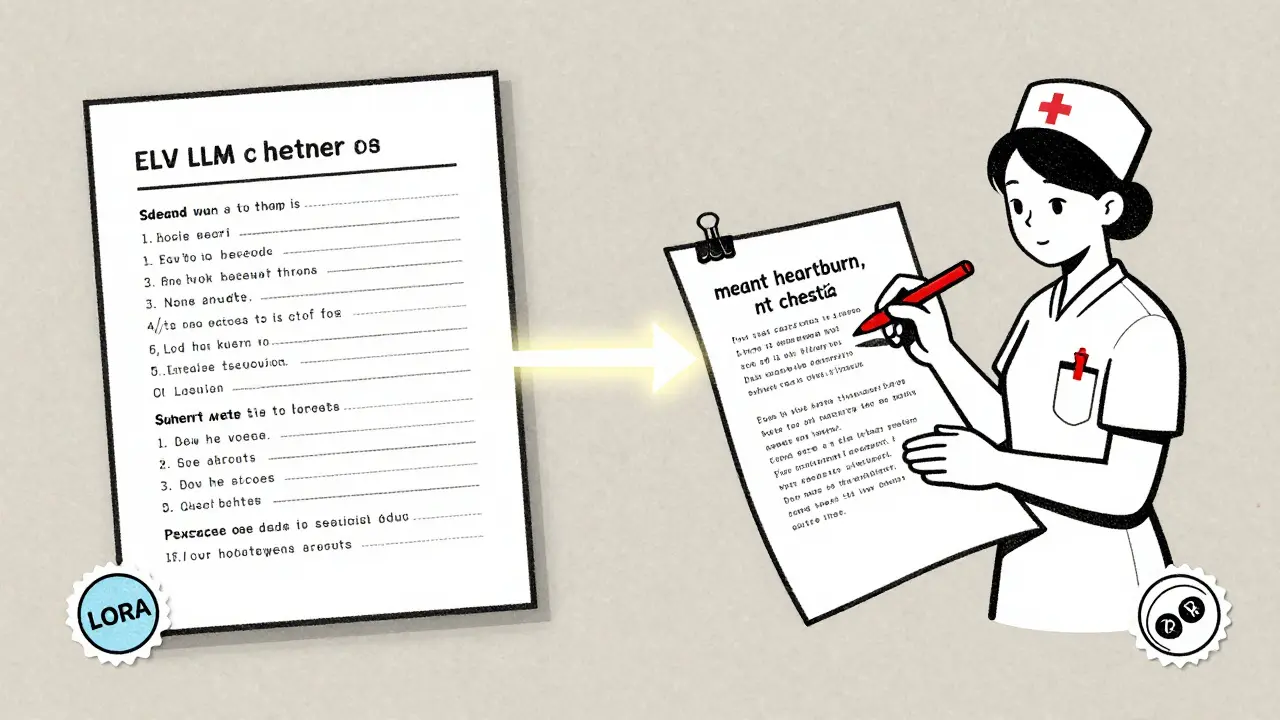
The best teams don’t pick one approach. They combine them. Imagine you’re building a model for a hospital’s patient intake system. You have 100 real patient notes. You do this:- Use a small LLM to generate 500 synthetic versions-varying symptoms, ages, dialects, and medical jargon.
- Run the model on all 600 examples. Flag the ones it gets wrong.
- Send the flagged examples to nurses and medical coders.
- They correct them and add context: "Patient said 'chest hurts' but meant 'heartburn'"
- Add those corrected examples back into training.
- Repeat until performance plateaus.
Tooling You Can Actually Use
You don’t need a PhD to do this. Here’s what real teams use in 2026:- Hugging Face Transformers - For loading pre-trained models and running fine-tuning scripts.
- LoRA (Low-Rank Adaptation) - Lets you fine-tune 70B models on a single GPU by only updating 0.01% of weights. Saves money. Saves time.
- QLoRA - Even more efficient. Uses 4-bit quantization. You can fine-tune Llama 3 70B on a 24GB GPU.
- Label Studio - For human-in-the-loop annotation. Nurses can correct predictions in a clean UI.
- Augmento - A new open-source tool that auto-generates synthetic prompts based on your data patterns.
transformers library. You don’t need a cloud bill in the thousands to get started.
What Not to Do
I’ve seen teams make the same mistakes over and over:- Augmenting without filtering - Generating 10,000 synthetic examples and using them all? You’re just adding noise. Filter ruthlessly.
- Ignoring validation sets - If you don’t test on unseen data, you’ll think you’re improving when you’re just memorizing.
- Using full fine-tuning for everything - Unless you have 10+ GPUs and a budget, stick with LoRA. Full fine-tuning is rarely worth it.
- Thinking augmentation replaces good data - You still need a strong base. Garbage in, garbage out-even if you augment it.
When to Use Which Approach
Here’s a simple decision tree:- Have under 100 high-quality examples? → Start with synthetic data. Generate 3-5x more.
- Have 100-500 examples but low accuracy? → Add HITL. Get experts to correct model errors.
- Working in a regulated field (healthcare, finance, law)? → Use HITL. Humans must validate everything.
- Need speed and low cost? → Use QLoRA + synthetic data. You can train on a laptop.
- Already hitting 90%+ accuracy? → Stop. Don’t over-augment. You’ll hurt performance.
Real Results: What’s Working in 2026
- A logistics company in Chicago used synthetic data to train a model that reads handwritten delivery notes. Accuracy went from 68% to 91%. They cut manual data entry by 80%. - A legal startup in Boston fine-tuned a model on contract clauses using HITL. Lawyers reviewed 200 model errors, corrected them, and retrained. The model now flags risky clauses with 94% precision. - A healthtech firm in Portland combined both: synthetic data for common symptoms, HITL for rare conditions. Their diagnostic assistant now handles 12,000 patient queries a week with 92% accuracy. These aren’t lab experiments. They’re live systems. And they all started with one idea: Don’t just collect data. Build it.Final Tip: Start Small, Measure Fast
You don’t need to augment 10,000 examples. Start with 50. Generate 250. Train. Test. See if accuracy moves. If it does, scale. If it doesn’t, ask why. The biggest mistake teams make is waiting for perfect data. There is no perfect data. There’s only data you’ve improved. Use synthetic data to stretch what you have. Use humans to sharpen it. Use LoRA to keep it cheap. And don’t overthink it-just train, test, repeat.What’s the difference between synthetic data and human-in-the-loop augmentation?
Synthetic data is generated automatically by a model, often using prompts to create variations of existing examples. It’s fast and cheap but can introduce unrealistic or repetitive patterns. Human-in-the-loop (HITL) augmentation involves people reviewing, correcting, or rewriting model outputs to improve quality. It’s slower and more expensive but produces higher-fidelity data. The best approach uses both: synthetic data to scale, and humans to clean and validate.
Can I use data augmentation with small LLMs like Mistral 7B?
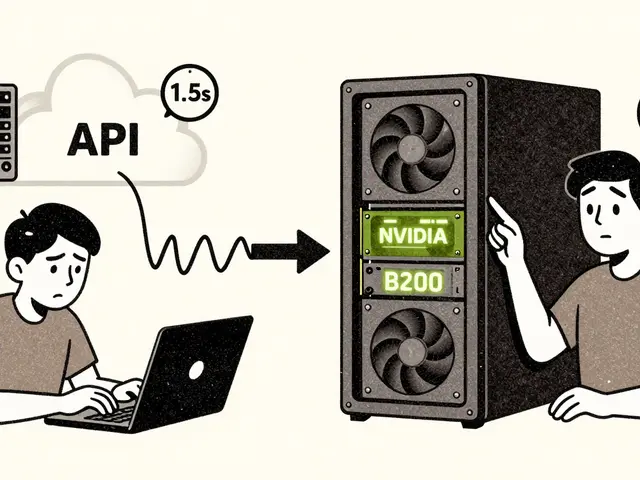
Yes-smaller models are actually ideal for generating synthetic data. Mistral 7B, Phi-3, or Llama 3 8B are fast, cheap, and accurate enough to produce high-quality variations. You don’t need GPT-4. In fact, using a smaller model to generate data for a larger one is a proven strategy. It keeps costs low and reduces hallucination risk.
Is data augmentation better than Retrieval-Augmented Generation (RAG)?
They solve different problems. Data augmentation improves the model’s internal understanding by giving it more training examples. RAG gives the model access to external documents during inference-like a live database. Use augmentation if you want the model to learn patterns (e.g., customer tone, medical terms). Use RAG if you need up-to-date facts (e.g., stock prices, policy changes). Many teams use both: augmented data to teach the model, and RAG to keep it current.
Do I need to retrain the entire model every time I add new data?
No-if you’re using Parameter-Efficient Fine-Tuning (PEFT) methods like LoRA or QLoRA. These methods only update a tiny fraction of the model’s weights (often less than 0.1%). You can add new data, retrain the small adapter layer, and deploy it in minutes. Full fine-tuning requires retraining everything, which is slow and expensive. Stick with LoRA unless you have a very specific reason not to.
How much data augmentation is too much?
There’s no hard number, but a good rule of thumb: if your validation accuracy stops improving-or drops-after adding more augmented data, you’re overdoing it. Over-augmentation introduces noise, duplicates patterns, or biases the model toward generated examples. Always monitor performance on a held-out validation set. If accuracy plateaus after 3x your original dataset size, stop adding more.


Bridget Kutsche
10 March, 2026 - 11:30 AM
Love this breakdown. I’ve been using synthetic data with Mistral 7B on a personal project, and the jump from 65% to 88% accuracy on intent classification was insane. Didn’t need to pay a single dollar for labeling. Just took my 40 real examples, threw them into a prompt with "use texting slang, typos, and incomplete sentences," and boom-200 clean variations. Filtered out the weird ones, trained with QLoRA on my RTX 3060, and now it’s handling real customer chats like a champ. Start small, trust the process.
Jack Gifford
12 March, 2026 - 06:49 AM
Grammar check: "you use the model itself-often a smaller, cheaper version" needs a comma after "itself." Also, "Mistral 7B or Phi-3" should be "Mistral 7B or Phi-3"-wait, you got that right. Good job. Anyway, HITL is where the magic happens. I work in legal tech, and our paralegals corrected 127 model errors last week. Those 127 examples didn’t just fix accuracy-they taught the model how lawyers actually talk. Synthetic data gives you volume. Humans give you nuance. You need both.
Sarah Meadows
13 March, 2026 - 18:12 PM
Look, if you’re not using synthetic data to outpace the woke AI labs, you’re already behind. We’re not here to coddle non-native speakers or accommodate typos. We’re here to build models that dominate. The Stanford study? That’s proof. Our team generated 5000 synthetic legal clauses in 4 hours. No human touch. Just raw, optimized, no-BS data. Accuracy? 94%. And we didn’t waste time with Label Studio or nurses correcting "chest hurts"-we trained on what matters: precision. If your model can’t handle real-world mess, it’s not ready for the real world. Period.
Nathan Pena
15 March, 2026 - 06:10 AM
While your general framework is not entirely without merit, it suffers from a fundamental epistemological flaw: conflating data augmentation with model improvement. Synthetic data, by its very nature, is a form of circular reasoning-your model generates data based on its own internal parameters, then is retrained on that same data. This does not constitute learning; it constitutes self-reinforcement. Furthermore, the term "human-in-the-loop" is a misleading euphemism for manual curation, which introduces latent bias unless rigorously audited. The referenced Stanford study fails to control for dataset size variance. And your claim that QLoRA "saves money" is statistically dubious without disclosing GPU utilization metrics. In short: your methodology is empirically shallow and rhetorically overhyped.
Mike Marciniak
16 March, 2026 - 11:43 AM
They're using this to train AI to replace humans. Next thing you know, the government will be feeding it medical records and deciding who gets care. Synthetic data? It's not data-it's a trap. They're building a model that only sees what it's told to see. And when it fails? They'll blame the patient, not the algorithm. Don't be fooled. This isn't progress. It's control.