
Choosing the right hardware for running large language models (LLMs) isn’t just about raw power-it’s about latency, cost per token, and whether your system can actually keep up when users expect answers in under a second. If you’re deploying LLMs in production, you’re not just picking a GPU-you’re betting on your application’s responsiveness, scalability, and long-term viability. Let’s cut through the noise and look at what actually matters: NVIDIA’s A100, H100, and CPU offloading.
Why This Choice Matters Right Now
In 2026, LLM inference isn’t a luxury. It’s the backbone of customer service bots, real-time content generators, code assistants, and internal knowledge engines. If your model takes 3 seconds to reply, users leave. If it costs $0.02 per query, your margins vanish. The hardware you pick today will dictate your performance for the next 2-3 years.
The market has shifted dramatically since 2023. Back then, A100s were the gold standard. Today? H100s are winning. And CPU offloading? It’s still around-but only for testing, not production.
The A100: Still Useful, But Falling Behind
The NVIDIA A100, launched in 2020, was built for general-purpose AI workloads. It has 80GB of HBM2e memory, 2.0 TB/s bandwidth, and third-generation Tensor Cores. For its time, it was a beast. Today, it’s the old workhorse.
When running Llama 3.1 70B with vLLM, the A100 hits about 1,148 tokens per second. That sounds fast-until you compare it to the H100’s 3,311 tokens per second. That’s nearly 3x faster. And the gap isn’t just in raw speed. The A100’s memory bandwidth is the bottleneck. As models grow beyond 70B parameters, the A100 starts stuttering. It can’t feed data to its cores fast enough.
Here’s the kicker: A100s are still widely available in cloud environments, and their hourly rates are lower. On AWS, you might pay $0.75/hour for an A100 versus $1.20/hour for an H100. But if the H100 processes 2.8x more tokens in that same hour, you’re actually paying less per token. A 2025 benchmark from Hyperstack.cloud found H100s delivered 18% lower cost per token than A100s on the same workload. That’s not a fluke-it’s architecture.
The H100: The New Standard for Production LLMs
The H100, built on NVIDIA’s Hopper architecture and released in late 2022, wasn’t just an upgrade. It was a redesign for transformers.
Its 80GB HBM3 memory runs at 3.35 TB/s bandwidth-67.5% faster than the A100. It has 14,592 CUDA cores (110% more). But the real game-changer is the Transformer Engine. This feature dynamically switches between FP8, FP16, and INT8 precision during inference. Most models don’t need full 16-bit precision. FP8 cuts memory use by half and doubles throughput. NVIDIA’s own data shows up to 6x faster training and 4x better inference performance over A100 when using FP8.
Real-world results back this up. A 30B model on H100 with FP8 runs 3.3x faster than on A100. For smaller models like Mistral 7B, the H100 delivers 247 tokens per second at $1.20/hour. The A100? Just 112 tokens per second at $0.75/hour. The H100 wins on cost per token, even with a higher hourly rate.
Enterprise users report higher concurrency too. One financial services team on the NVIDIA Developer Forum noted they handle 37 concurrent chat requests on H100 before latency hits 2 seconds. On A100? It’s 22. That’s not a small difference-it’s the difference between a usable chatbot and a frustrating one.
The H100 NVL variant, with two GPUs and 188GB of HBM3 memory, is now the go-to for models over 100B parameters. No other consumer-grade GPU comes close.
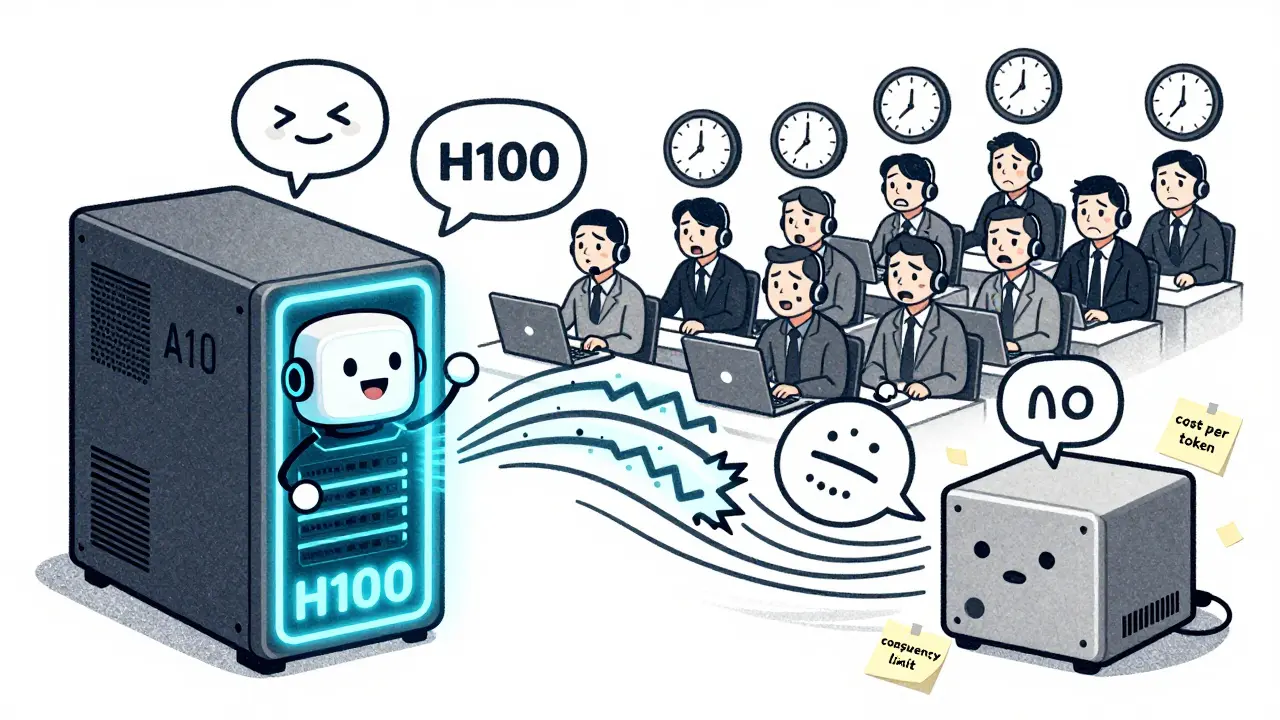
CPU Offloading: The Compromise No One Wants to Admit
CPU offloading sounds appealing. Run a 70B model on a server with 128GB RAM and a few cheap GPUs? Yes, it’s possible. Tools like vLLM’s PagedAttention and Hugging Face’s accelerate let you swap weights between GPU memory and CPU RAM.
But here’s the truth: it’s slow. And painfully so.
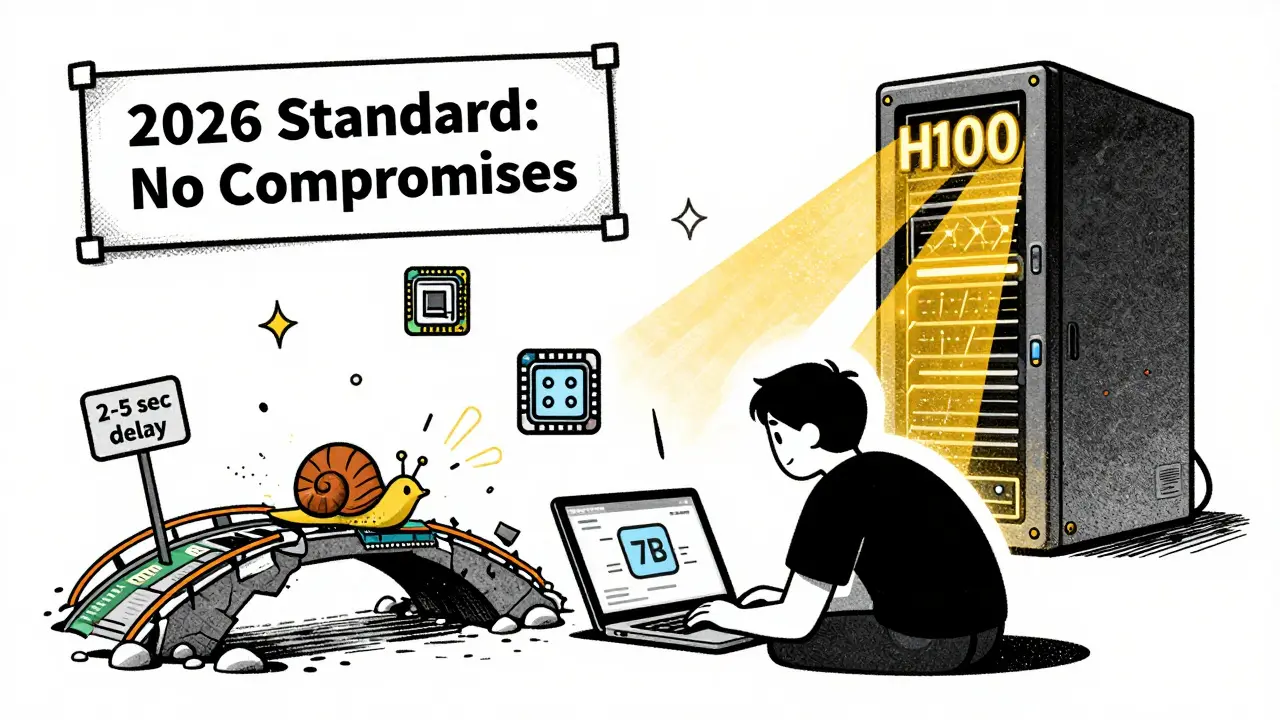
MLPerf benchmarks from late 2024 show CPU offloading adds 3-10x latency. A model that takes 200ms to respond on an H100 takes 2-5 seconds with offloading. That’s not a delay-it’s a dead end for real-time apps.
Users on Hugging Face forums reported 8-15 second response times for 7B models on high-end server CPUs. Even with AMD EPYC 9654 chips, throughput drops to 1-5 tokens per second. That’s slower than a human typing.
It’s useful for development, prototyping, or running tiny models on laptops. But if you’re deploying a public-facing service? Don’t even consider it. The engineering effort to stabilize it is high, and the user experience is terrible.
Software and Implementation Realities
It’s not just about the hardware. The software stack matters.
H100s need tuning. To get full FP8 benefits, you need to recompile your inference pipeline. NVIDIA says it takes 2-4 weeks of engineering work to fully optimize complex systems. That’s not trivial. But once done, the gains are massive.
A100s? They’re the easy option. Over 85% of inference frameworks-vLLM, TensorRT-LLM, DeepSpeed-work out of the box. You can get up and running in a day. But you’re leaving performance on the table.
CPU offloading? It’s a mess. Documentation is patchy. GitHub contributors report 5-7 days just to stabilize a 70B model. And even then, crashes are common under load.
Market Trends: Who’s Winning in 2026?
Gartner’s May 2025 report shows H100s now power 62% of new enterprise LLM deployments. A100s are down to 28%. CPU offloading? Just 10%-and most of that is in research labs, not production.
Why? Price. Cloud providers slashed H100 instance rates by 40% since January 2025. That made the cost per token drop below A100 levels for most workloads. AMD’s MI300X tried to compete, but it’s still 1.7x slower than H100 at 85% of the cost. Not enough.
Google’s TPU v5p is a wildcard. It can outperform H100 on some models, but only with Google’s own frameworks. If you’re locked into PyTorch or Hugging Face, it’s not an option.
For now, H100 is the only chip that balances speed, cost, and scalability for production LLMs. IDC predicts it’ll hold 75%+ of the market through 2027.
When Should You Choose What?
- Choose H100 if you’re running models over 13B parameters, need low latency, handle concurrent users, or care about long-term scalability. This is your default for production.
- Stick with A100 only if you’re on a tight budget, running small models (<13B), or have legacy systems that can’t be reconfigured. It’s a stopgap, not a strategy.
- Avoid CPU offloading for anything public-facing. It’s fine for learning, experimenting, or running 3B models on your workstation-but not for real users.
If you’re building a new system today, H100 is the only choice that makes sense. The performance gap is too wide. The cost per token is too favorable. And the software ecosystem is finally catching up.
Don’t optimize for yesterday’s hardware. The future of LLM inference isn’t about bigger RAM or cheaper CPUs. It’s about bandwidth, precision, and architecture-and the H100 delivers all three.
Is the H100 worth the extra cost over the A100 for LLM inference?
Yes, for most production use cases. Even though H100 instances cost more per hour, they process 2.5-3x more tokens. Benchmarks show the cost per token is often 15-20% lower on H100. For models over 13B parameters, the performance gap is too large to ignore. The H100’s Transformer Engine and HBM3 memory make it the only viable option for real-time applications.
Can I use CPU offloading to run a 70B model on a $2,000 server?
Technically, yes-but don’t. You can run models like Llama 3 70B on a server with 128GB RAM and a single consumer GPU, but latency will be 2-5 seconds per token. That’s unusable for chatbots, search assistants, or any user-facing tool. CPU offloading is great for experimentation or running tiny models on laptops, but it’s not a production solution.
Do I need to rewrite my code to use the H100’s Transformer Engine?
You don’t have to, but you’ll miss out on major gains. Most frameworks like vLLM and TensorRT-LLM support FP8 automatically. But to unlock the full 3-4x speedup, you need to enable FP8 precision in your inference pipeline and recompile with NVIDIA’s tools. That takes 1-4 weeks of engineering work, depending on complexity. The payoff? Faster responses and lower costs.
What’s the minimum GPU memory needed for LLM inference?
For models under 7B parameters, 24GB is enough. For 13B-30B models, 40GB is the sweet spot. For 70B+ models, you need at least 80GB-and even then, you’ll hit limits with high concurrency. That’s why the H100 NVL (188GB) is becoming the standard for enterprise deployments. CPU offloading can stretch this further, but with terrible latency.
Is AMD’s MI300X a viable alternative to the H100?
Not really. The MI300X is cheaper and offers decent performance, but it’s still 1.7x slower than the H100 on transformer workloads. Framework support is weaker, and most inference engines are optimized for NVIDIA’s architecture. Unless you’re locked into AMD’s ecosystem, the H100 remains the clear choice for performance and ecosystem maturity.
Will H100 be obsolete by 2027?
No. Analysts at IDC and McKinsey predict H100-class GPUs will dominate the market through 2027. The next architectural leap-likely based on next-gen Tensor Cores or specialized AI accelerators-is still 2-3 years away. If you deploy H100 today, it’ll remain relevant for at least 3-5 years. A100s, on the other hand, are already nearing obsolescence for large models.



Amanda Ablan
19 February, 2026 - 04:09 AM
I've been running Llama 3.1 on an A100 for our customer support bot, and honestly? It's been fine. But after reading this, I'm convinced we need to upgrade. The cost-per-token math is too clear to ignore. We're paying more in cloud hours than we should just because we were slow to adapt. Time to push for the H100 budget.
Meredith Howard
20 February, 2026 - 03:07 AM
The data here is compelling but I wonder if the software overhead is being undercounted. Switching from A100 to H100 isn't just plug and play. There's retraining pipelines to update tensor cores alignment fp8 quantization schedules and dependency hell with CUDA versions. It's not a simple swap. The 2-4 week engineering window is real and often underestimated in cost projections.
Yashwanth Gouravajjula
22 February, 2026 - 03:03 AM
In India we use A100s because H100s are hard to get. But the math still works. Even with slower speed we serve more users per server because labor is cheap. Hardware matters but context matters more.
Kevin Hagerty
22 February, 2026 - 17:15 PM
Wow so we're supposed to believe that H100 is the only choice now? Bro I ran a 70b model on a 3090 with offloading and it worked fine. People just want to sell you the latest hype. You're not building a rocket you're running a chatbot. Chill out.
Janiss McCamish
23 February, 2026 - 22:10 PM
CPU offloading is for hobbyists. If you're putting this in production and still using it you're asking for trouble. We tried it for a week. Users complained. We switched to H100. Problem solved. No drama.
Richard H
24 February, 2026 - 10:31 AM
The H100 is the only real option. Everything else is just American companies trying to sell you outdated gear. If you're not using H100 you're leaving money on the table and your users are suffering. This isn't even a debate anymore. Get with the program.
Kendall Storey
24 February, 2026 - 11:09 AM
H100 is the new black. Seriously. Once you go FP8 you never go back. The throughput jump is insane. We went from 120 tokens/sec on A100 to 310 on H100. Our latency dropped from 1.8s to 0.4s. Users noticed. Our NPS went up 32 points. It's not just hardware it's user experience. And yeah the setup is a pain but it's worth it.
ravi kumar
25 February, 2026 - 13:00 PM
I'm using A100 for small models. It's stable. Easy to monitor. Our team is small. We don't need 3k tokens/sec. Sometimes simple wins. Not every project needs H100 hype.
Megan Blakeman
25 February, 2026 - 23:09 PM
I just want to say thank you for this post. It's so clear and kind of calming? Like someone finally explained what's really going on without the tech bro noise. I'm going to share this with my team. We were stuck on A100 because we thought it was 'good enough'... but it's not. H100 it is. 😊