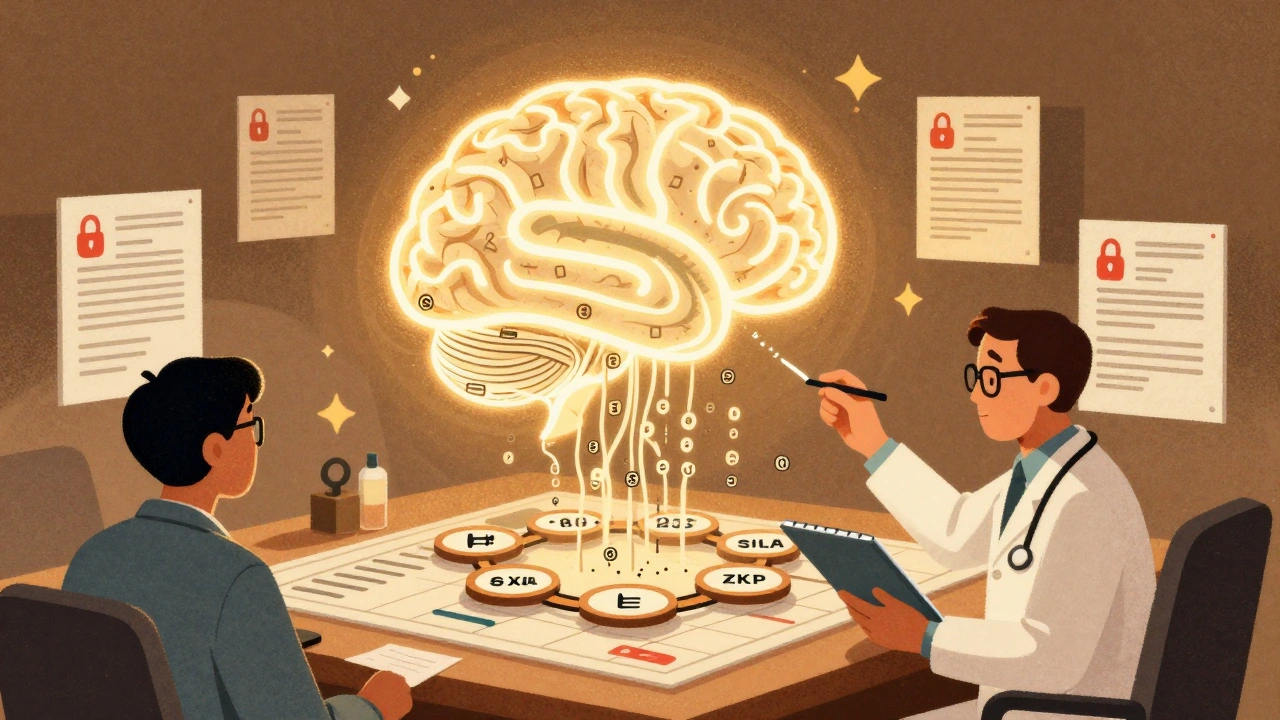
Imagine an AI that creates medical diagnoses, financial reports, or legal documents - but you can prove every step it took, who approved it, and that no one changed it after the fact. That’s not science fiction. It’s happening now, and it’s built on the convergence of generative AI, blockchain, and cryptography.
For years, we’ve worried about AI making things up - hallucinating facts, fabricating images, or pushing biased outputs with no trail. At the same time, blockchain promised transparency but struggled with speed, cost, and privacy. Cryptography kept data safe but couldn’t explain how decisions were made. Now, these three are merging to fix each other’s weaknesses. The result? Systems that don’t just work - they prove they’re trustworthy.
Why This Blend Matters More Than Any Single Tech
Generative AI alone is powerful but opaque. A model might flag a fraudulent insurance claim, but can you prove it didn’t just guess? Blockchain alone is tamper-proof but slow and public. Cryptography alone encrypts data but doesn’t track how it’s used. Together, they form a new kind of digital foundation.
Here’s how it works in practice: A generative AI analyzes patient records to suggest a treatment plan. That plan isn’t just saved - it’s signed with a cryptographic key, timestamped, and written onto a blockchain. Every input, every parameter, every version of the model used is recorded. If someone tries to alter the output later, the blockchain rejects it. If a regulator asks for proof, they can verify the entire chain without seeing the raw patient data - thanks to zero-knowledge proofs.
This isn’t theoretical. In Q3 2024, MedChain AI launched a system in U.S. hospitals that cut medical record fraud by 89%. How? Every diagnostic suggestion from their AI was anchored to a blockchain. Even the prompts doctors typed were logged. No more fake records. No more disputed diagnoses. Just verifiable, encrypted truth.
The Technical Engine: How AI, Blockchain, and Crypto Work Together
This isn’t just glueing three tools together. It’s a deep integration with specific cryptographic methods and AI architectures.
One key technique is homomorphic encryption. It lets AI models run calculations on encrypted data - like checking a patient’s risk score - without ever decrypting their medical history. The data stays hidden, but the AI still works. This is critical for HIPAA compliance and patient privacy.
Another is federated learning. Instead of gathering all patient data in one cloud server (a huge privacy risk), AI models are trained across thousands of hospital systems. Each hospital keeps its data local. Only model updates - tiny mathematical adjustments - are shared and recorded on a blockchain. This prevents data breaches while improving model accuracy.
Then there’s the use of Generative Adversarial Networks (GANs) for key recovery. Lost encryption keys used to mean lost access - forever. Now, GANs can generate plausible key fragments based on usage patterns and historical signatures. In one GitHub project, developers cut key recovery time from 72 hours to under two hours. That’s not magic. It’s AI learning how keys behave.
And blockchain isn’t just a ledger. AI agents now scan smart contracts for vulnerabilities - like reentrancy attacks or logic loops - 65% faster than human auditors. AWS’s Prove AI system, launched in December 2024, does exactly this: it watches for suspicious code changes in real time and flags them before they’re deployed.

Where It’s Working - And Where It’s Failing
The biggest wins are in regulated industries. Finance, healthcare, and supply chains need proof, not promises.
In finance, banks use this combo to verify AI-generated credit decisions. A loan application is reviewed by an AI, the reasoning is encrypted and hashed, then stored on a private blockchain. Regulators can audit the decision without seeing personal data. DigitalDefynd found these systems have 92% higher auditability than traditional AI.
Supply chains use it to track provenance. A shipment of pharmaceuticals? Each step - from manufacturer to warehouse to pharmacy - is logged by AI sensors, encrypted, and added to the chain. If a drug is counterfeit, you trace it back to the exact batch and timestamp.
But it’s not perfect. The VeriTrust startup lost $2.3 million in early 2024 when their AI model was tricked by an adversarial attack - a carefully crafted input that fooled the system into approving fraudulent transactions. The cryptographic checks were there, but the AI didn’t recognize the manipulation. That’s a lesson: crypto protects data, but it doesn’t fix bad AI.
Another problem? Computational load. Adding AI and blockchain together increases processing needs by 15-20%. In low-bandwidth areas - like rural clinics or shipping containers - this causes delays. Tribe AI’s field tests showed delivery tracking systems lagged by 3-5 seconds per update, which added up over long routes.
Real-World Implementation: What It Takes to Build This
If you’re thinking of building this, here’s what you’re signing up for.
First, you need the right infrastructure. AWS’s Prove AI uses Key Management Service (KMS) to generate cryptographic key pairs. These keys sign every AI-generated output before it hits the blockchain. You can’t skip this. Without proper key management, the whole system is vulnerable.
Second, you need to design for data lineage. Every prompt, every training dataset, every model version must be tracked. The AI doesn’t just make decisions - it creates a trail. That trail is your audit log.
Third, use permissioned blockchains for sensitive data. Public chains like Ethereum are great for transparency, but not for medical records. Hyperledger Fabric, a private blockchain framework, lets you control who sees what. Version 2.3.1, released in November 2024, includes built-in tools for integrating AI models directly into smart contracts.
And yes, you’ll need training. AWS’s certification program requires 120-150 hours of focused learning. Stack Overflow surveys show 78% of developers struggle with key management. That’s not a bug - it’s the biggest hurdle. If keys are lost or stolen, the whole system collapses.
One fix gaining traction is zero-knowledge proofs (ZKPs). These let you prove an AI model is working correctly - without revealing the model itself. The zkAI-Verifier repository on GitHub shows how ZKPs can confirm a model’s integrity while keeping its weights and training data secret. That’s huge for intellectual property protection.
What’s Coming Next - And What to Watch For
The market is exploding. The global AI-blockchain integration space hit $1.7 billion in Q3 2024 and is projected to hit $8.9 billion by 2027. Forty-three percent of Fortune 500 companies are testing this now.
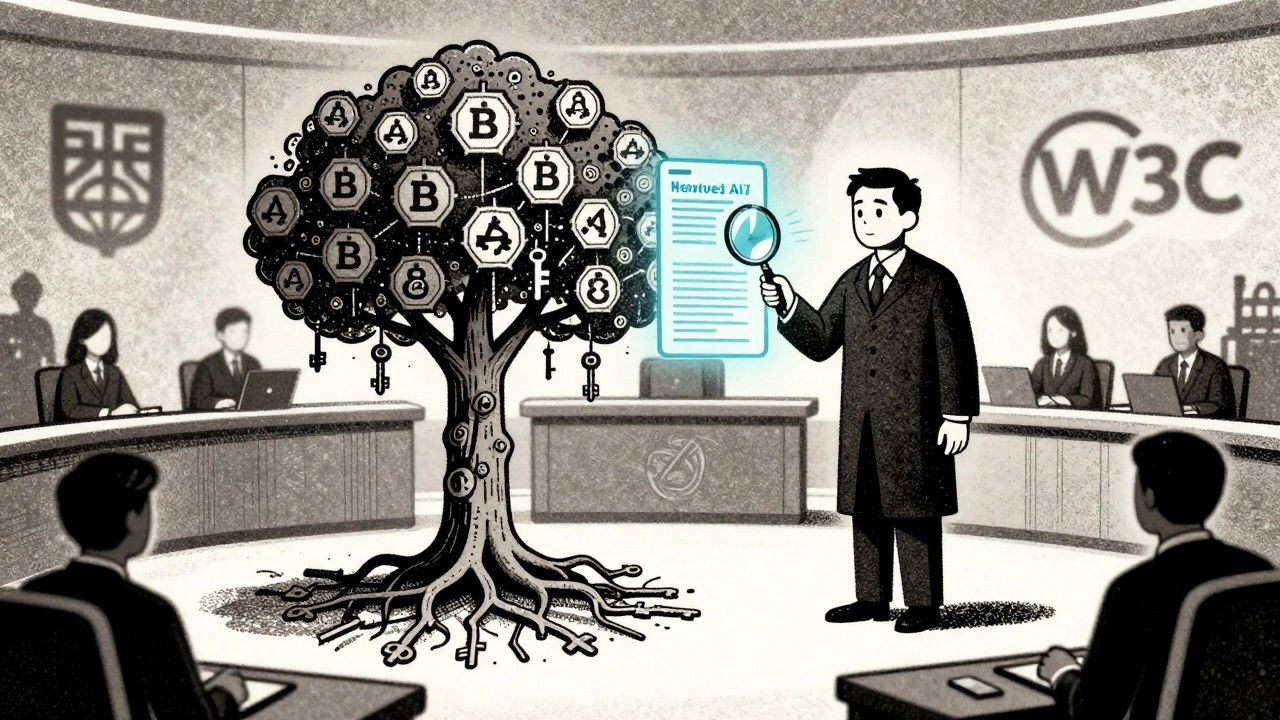
Upcoming standards will shape how this evolves. The W3C’s Verifiable AI Working Group plans to release its first official standard - Blockchain-based AI Content Authentication 1.0 - in Q2 2025. That means browsers and apps will soon have built-in tools to verify if an image, video, or text was AI-generated and whether it’s been tampered with.
The Ethereum Foundation just allocated $4.2 million to research AI-enhanced consensus mechanisms. That’s a signal: they’re betting this isn’t a niche experiment. It’s the future of trust.
But there are risks. Security researcher Elena Rodriguez warned at DEF CON 32 that combining AI and blockchain creates new attack surfaces. In February 2024, a side-channel vulnerability in a GAN-based key system exposed 12,000 crypto wallets. The flaw wasn’t in the blockchain - it was in how the AI generated key fragments. That’s the lesson: complexity breeds vulnerability.
Regulation is catching up too. The EU’s AI Act, effective since February 2025, requires verifiable provenance for all AI-generated content used in commercial settings. Companies that don’t adopt blockchain-backed verification will face fines and legal exposure.
Who Should Care - And Who Should Wait
If you work in finance, healthcare, legal tech, or supply chain - this is your new baseline. You’re not choosing whether to adopt it. You’re choosing when.
For developers, this is the next frontier. Learning how to integrate AI models with smart contracts, manage cryptographic keys, and use ZKPs will be as essential as knowing Python or React.
But if you’re a small business with no compliance needs, or a hobbyist building AI art tools - hold off. The overhead isn’t worth it yet. The tech is still expensive, complex, and requires deep expertise.
This isn’t about replacing AI. It’s about making AI accountable. It’s not about replacing blockchain. It’s about making blockchain useful for real-time, intelligent systems. And it’s not about cryptography being secret. It’s about making secrecy work with transparency.
The future isn’t AI or blockchain. It’s AI on blockchain - secured by cryptography - and verified by everyone.
Can generative AI be trusted without blockchain?
Not reliably. Generative AI can produce convincing but false outputs - known as hallucinations - with no way to trace how or why. Without blockchain, there’s no permanent, tamper-proof record of the model’s inputs, decisions, or versions. This makes it impossible to audit, verify, or hold anyone accountable. In regulated fields like healthcare or finance, this lack of traceability is a legal and ethical risk.
Does blockchain make AI more secure?
Not directly - but it adds critical layers of accountability. Blockchain doesn’t stop AI from being hacked or fooled. But it records every interaction with the AI: which model version was used, who triggered it, and what output was generated. If a malicious actor tampers with the result, the blockchain detects the change. This turns AI from a black box into a verifiable process.
How does cryptography protect privacy in this setup?
Cryptography keeps sensitive data hidden while still allowing AI to use it. Homomorphic encryption lets AI analyze encrypted medical records without ever seeing the real data. Zero-knowledge proofs let you prove an AI decision was valid - say, a patient qualifies for treatment - without revealing their name, diagnosis, or history. Federated learning keeps training data on local devices, so it never leaves the hospital or clinic. Together, these methods ensure privacy without sacrificing performance.
Is this technology only for big companies?
Right now, yes - but that’s changing. The infrastructure, expertise, and cost (cloud computing, cryptographic key management, AI training) are still high. Most implementations are in Fortune 500 firms, hospitals, and banks. However, tools like AWS’s Prove AI and open-source frameworks like Hyperledger Fabric are making it easier. By 2026, we’ll likely see affordable SaaS platforms that let small businesses plug into this system without building it from scratch.
What happens if the AI model is biased?
Blockchain doesn’t fix bias - it records it. If an AI denies loans to a certain demographic, the blockchain will show exactly which training data, model version, and prompt caused that decision. That transparency is the first step to fixing bias. Without it, bias stays hidden. With it, regulators, auditors, and affected users can demand corrections. The goal isn’t perfect AI - it’s accountable AI.
Can this system be hacked?
No system is unhackable. But this combination makes attacks much harder. Hacking the AI alone won’t work - the output is signed and stored on a distributed ledger. Hacking the blockchain won’t work - it’s decentralized and cryptographically secured. The biggest risks are in key management and adversarial inputs. If someone steals a cryptographic key or tricks the AI with a crafted input, they can cause damage. That’s why ongoing monitoring, zero-knowledge proofs, and AI-driven vulnerability detection are essential.
How soon will this become mainstream?
In regulated industries - finance, healthcare, government - it’s already happening. By 2027, most new AI systems in these sectors will include blockchain-backed verification. For consumer apps like social media or content generators, expect widespread adoption by 2028, especially after the W3C’s official standard launches in mid-2025. Within five years, seeing a "verified by AI-Blockchain" badge on digital content will be as normal as seeing a padlock icon on a website.


Jane San Miguel
9 December, 2025 - 21:34 PM
This is the most sophisticated convergence of trust architectures since the advent of public-key infrastructure. The integration of homomorphic encryption with federated learning represents a paradigm shift-not merely an incremental improvement. Zero-knowledge proofs, when layered atop GAN-augmented key recovery systems, create an epistemological foundation where verifiability and confidentiality are no longer orthogonal concerns. This isn’t just innovation; it’s the redefinition of digital accountability. The MedChain case study alone should be mandatory reading for every compliance officer in healthcare.
Kasey Drymalla
11 December, 2025 - 15:56 PM
AI on blockchain is just the government’s way to track everything you do and lock you out if you disagree with the algorithm. They’re not building trust-they’re building a prison with a fancy label. That ‘verified’ badge? That’s your digital handcuff. And don’t get me started on AWS. They’re just another Big Tech puppet.
Dave Sumner Smith
12 December, 2025 - 22:16 PM
You think this is secure? Please. GAN-based key recovery? That’s just AI learning how to guess your password based on your coffee habits and Spotify playlist. The system doesn’t prevent hacks-it just makes them look legit. That $2.3M loss by VeriTrust? That wasn’t a glitch. That was the system working exactly as designed-to make you feel safe while they harvest your data. And don’t even mention the EU AI Act. That’s just a tax on innovation for people who don’t understand how freedom works.
Cait Sporleder
13 December, 2025 - 12:38 PM
It is, in my estimation, nothing short of a revolutionary epistemic realignment that generative AI, blockchain, and cryptography have coalesced into a tripartite architecture of verifiable integrity. The elegance lies not merely in their synergy, but in their ontological complementarity: AI provides the cognitive engine, blockchain the immutable chronicle, and cryptography the sacred veil that preserves dignity amidst transparency. Homomorphic encryption, in particular, is a triumph of mathematical poetry-allowing computation upon encrypted data without sacrilege of privacy. And yet, one cannot help but wonder whether the computational burden, particularly in resource-constrained environments, may inadvertently exacerbate digital inequities. The promise is luminous, but the infrastructure must be democratized, lest this be merely the latest opiate of the technocratic elite.
Paul Timms
14 December, 2025 - 05:02 AM
Great breakdown. The key takeaway: trust isn’t built by tech alone-it’s built by transparency you can verify. The real win is making bias visible so it can be fixed.
Jeroen Post
14 December, 2025 - 15:08 PM
You’re all missing the point. This isn’t about trust. It’s about control. The blockchain doesn’t record truth-it records power. Who owns the keys? Who decides which AI gets audited? Who gets to say what’s ‘verified’? The system is designed to make you believe you’re free while the architects sit in their server farms deciding what you’re allowed to see. This isn’t progress. It’s the final stage of algorithmic feudalism. And the W3C standard? That’s just the crown being polished.