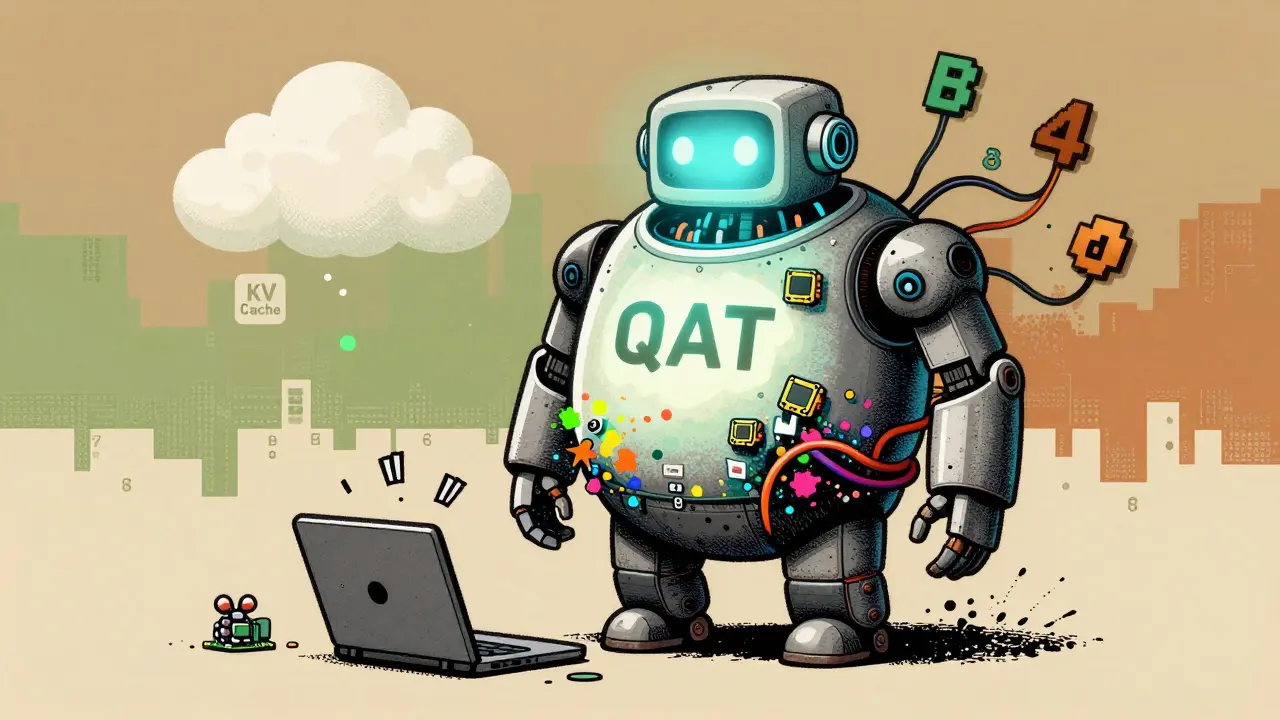
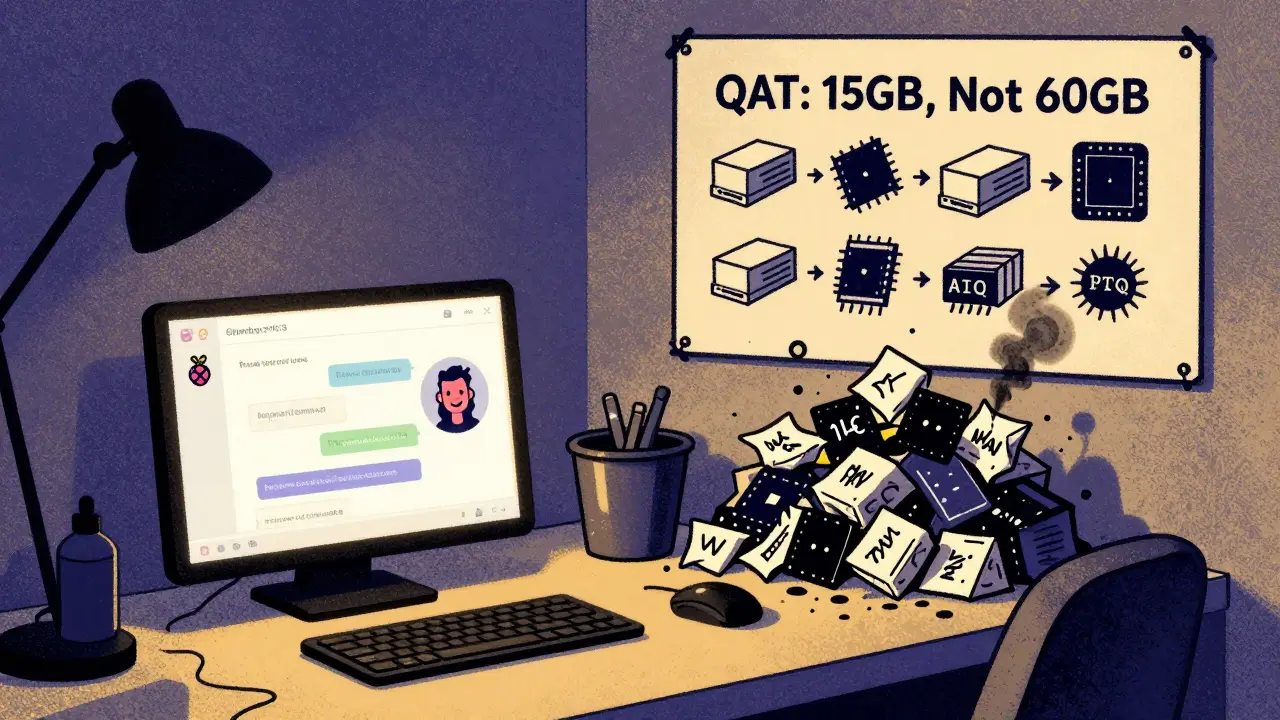
Large language models are getting bigger, but your hardware isn’t. A 30-billion-parameter model like LLaMA-30B needs 60GB of memory just to load. That’s fine in a data center with racks of A100s-but what if you want to run it on a laptop, a phone, or even a Raspberry Pi? The answer isn’t buying better hardware. It’s quantization-aware training.
Why Standard Quantization Fails on Large LLMs
A few years ago, reducing a model’s precision from 32-bit floating point to 8-bit or 4-bit was straightforward. You trained the model normally, then converted the weights. That’s called post-training quantization (PTQ). It worked fine for smaller models-say, under 3 billion parameters. But when models hit 7B, 13B, and beyond, PTQ started breaking. Accuracy dropped hard. On benchmarks like Hellaswag, models lost 20-30% of their performance. On text generation tasks, the output became repetitive, confused, or outright nonsensical. The problem? LLMs don’t just store weights-they rely on dynamic internal states like the Key-Value (KV) cache during inference. PTQ ignored these, and that’s where things fell apart. You can’t just quantize weights and hope for the best. The model needs to learn how to work with low-precision numbers while it’s still learning. That’s where quantization-aware training (QAT) comes in.How Quantization-Aware Training Works
QAT simulates the effects of quantization during training. Instead of training in full precision and then compressing, you train with fake low-bit numbers built into the process. Think of it like practicing a sport with heavier weights-you’re not actually competing with them, but your muscles adapt so you’re stronger when you go back to normal gear. Modern QAT for LLMs doesn’t just quantize weights. It also quantizes:- Activations (outputs of layers) to 8-bit or even 6-bit
- The KV cache to 4-bit-a game-changer for long-context generation
- Embedding layers with grouped quantization (group size of 32)
Why QAT Beats Post-Training Quantization
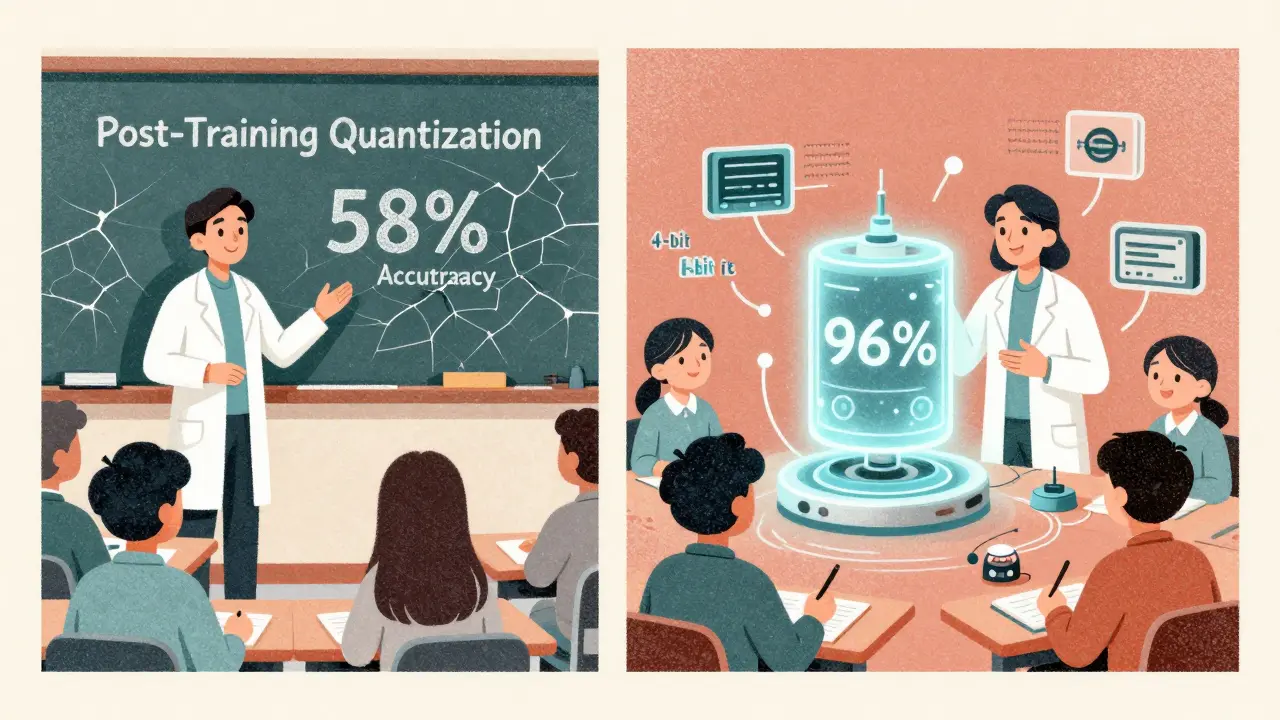
Let’s compare QAT to PTQ on real numbers:| Metric | Post-Training Quantization (PTQ) | Quantization-Aware Training (QAT) |
|---|---|---|
| Hellaswag Accuracy | 58% | 96% of original |
| WikiText Perplexity | 6766 | 30 (68% recovery) |
| MMLU Score | 52% | 63.2% |
| 8K Context Throughput | Baseline | +37% |
| Memory Footprint | 15GB | 15GB |
What You Need to Know Before Starting
QAT isn’t plug-and-play. It’s complex. Here’s what you’re signing up for:- Hardware cost: Training a QAT model on Llama3-8B takes 24-48 hours on 4x A100 GPUs. That’s expensive if you’re doing this on the cloud.
- Learning curve: You need to understand PyTorch internals, quantization numerics, and how LLM layers interact. Most tutorials skip the hard parts.
- Layer sensitivity: Not all layers behave the same. The first 3 and last 2 layers in LLaMA models are especially sensitive. Skip quantizing them, and your perplexity drops from 6766 to 30. Get it wrong, and your model becomes useless.
- Data dependency: Early QAT needed the original training data. Now, most implementations use data-free distillation-where the model generates its own training examples from its own outputs. That’s clever, but it still fails on niche domains like legal or medical text.
from torchao.quantization import quantize
model = quantize(model, int4_weight_only())Real-World Use Cases
Companies aren’t just experimenting-they’re deploying.- Mobile AI: Qualcomm reports 89% of companies using on-device LLMs now rely on QAT. That’s Siri, Google Assistant, and your phone’s AI keyboard running 7B models locally.
- Edge computing: Factories, warehouses, and remote sensors are using QAT-quantized LLMs for real-time document analysis, voice commands, and error detection-all without internet access.
- Cloud providers: AWS, Google Cloud, and Azure now offer built-in QAT pipelines. You can upload a model, select 4-bit quantization, and get a deployable version in minutes.
The Catch: It’s Still Hard
Despite the progress, QAT has a reputation for being finicky. GitHub issues are full of complaints:- Training crashes with NaN values (65% of issues)
- Accuracy drops after a few epochs (58% of complaints)
- KV cache quantization causes silent failures (42% of reports)
What’s Next?
The field is moving fast. In January 2025, Meta announced plans to bake QAT directly into Llama training pipelines. That means future models might come pre-quantized. No fine-tuning needed. Google’s TensorFlow 2.15 now auto-assigns bit-widths per layer-some weights at 4-bit, others at 6-bit-based on sensitivity. That’s a huge step toward automation. But the biggest shift? Adoption. In Q1 2024, only 12% of enterprises using models over 7B parameters used QAT. By Q4 2024, that jumped to 37%. Gartner predicts the quantization tools market will hit $1.2 billion by 2026. For now, if you’re working with LLMs over 3 billion parameters and care about performance, QAT isn’t optional. It’s the only way to make them practical.Frequently Asked Questions
Is quantization-aware training better than post-training quantization for LLMs?
Yes, for models over 7 billion parameters. QAT preserves up to 96% of original accuracy on benchmarks like Hellaswag, while post-training quantization often drops accuracy by 20-30%. QAT also handles the Key-Value cache during training, which PTQ ignores-making it far more stable for long conversations.
Can I run a 30B LLM on my laptop with QAT?
Yes, if you use 4-bit quantization. A 30B model like LLaMA-30B drops from 60GB to about 15GB with QAT. On a laptop with 16GB of VRAM, you can run it with some optimizations. On a desktop with a 24GB GPU, performance is smooth. Even Raspberry Pi 5 users have successfully run 7B models with QAT.
What’s the biggest challenge in implementing QAT?
The biggest challenge is layer sensitivity. Not all layers respond the same to quantization. The first 3 and last 2 layers in transformer models are critical-quantizing them causes massive accuracy loss. Manual tuning or automated sensitivity detection (now in PyTorch 2.5) is required. Training also takes 24-48 hours on multiple A100s, which can be costly.
Do I need the original training data for QAT?
No, modern QAT uses data-free distillation. The model generates its own training examples from its own outputs, eliminating the need for the original dataset. This makes QAT practical for proprietary or sensitive models. However, it still struggles with highly specialized domains like medical or legal text where the model’s own generations lack sufficient accuracy.
Which tools should I use for QAT in 2026?
For PyTorch users, torchao is the most reliable, with strong support for int4 weights and int8 activations. Hugging Face’s llm-qat-toolkit offers a user-friendly interface and community support. TensorFlow users should use Model Optimization Toolkit. Avoid experimental or poorly documented libraries-many have bugs that cause silent accuracy drops.
Is QAT worth it for small models under 3B parameters?
Not usually. Post-training quantization already works well for models under 3B parameters, with accuracy loss under 5%. The extra time and complexity of QAT isn’t justified. Save QAT for models above 7B, where the memory savings and accuracy retention make a real difference.


poonam upadhyay
27 January, 2026 - 03:29 AM
Okay so I tried QAT on my 30B model… and let me tell you, it was like trying to teach a cat to drive a Tesla. First 3 layers? Nope. Last 2? Absolutely not. I quantized them anyway because I was tired and hungry and thought ‘eh, it’ll be fine.’ Spoiler: it wasn’t. My model started writing poetry about toaster ovens and calling them ‘sentient bread machines.’ I cried. Then I retrained. Now it’s stable. But man-torchao saved my sanity. Also, if you’re on a laptop with 16GB VRAM, just use 5-bit. 4-bit is a gamble with a side of existential dread.
Shivam Mogha
27 January, 2026 - 14:02 PM
QAT works. Just don’t touch the first and last layers.
mani kandan
29 January, 2026 - 11:38 AM
Interesting read-really well structured. I’ve been experimenting with QAT on a 7B model for edge deployment in our rural IoT sensors, and the results have been surprisingly robust. The KV cache quantization alone made our response latency drop by nearly 40%, which is huge when you’re dealing with spotty connectivity. That said, I agree with the point about layer sensitivity-it’s not just a footnote, it’s the core of the whole process. I ended up using torchao’s auto-sensitivity detector after three failed attempts. Took 18 hours on two A100s, but now it runs on a Jetson Orin with zero crashes. The future’s definitely quantized.
Rahul Borole
30 January, 2026 - 05:39 AM
As a practitioner deploying LLMs in enterprise environments, I can confidently state that quantization-aware training is no longer an optional optimization-it is a mandatory prerequisite for operational scalability. The performance delta between PTQ and QAT on models exceeding 7B parameters is not merely statistical; it is functionally decisive. Our team transitioned from PTQ to QAT in Q3 2024, and the reduction in inference failures, coupled with a 37% increase in context throughput, directly enabled our deployment of on-device AI assistants across 12,000 field units. While the training overhead remains non-trivial, the ROI is unequivocal. We now enforce QAT as standard in our model lifecycle governance framework. Tools like torchao and Hugging Face’s llm-qat-toolkit have matured to the point where they are production-ready. For organizations seeking to avoid model degradation under resource constraints, QAT is not merely advisable-it is non-negotiable.
Sheetal Srivastava
31 January, 2026 - 16:34 PM
Frankly, if you're still debating whether to use QAT over PTQ, you're operating at a 2021 cognitive layer. The fact that you're even considering post-training quantization on a 7B+ model suggests a fundamental misunderstanding of transformer dynamics-particularly the non-linear interaction between activation sparsity and KV cache entropy. Modern QAT isn't just 'better'-it's the only statistically coherent approach that preserves semantic integrity under low-bit constraints. And please, stop using group size 64 for embeddings; that's just lazy. Group size 32 is the bare minimum for non-catastrophic degradation. Also, if you're not using cosine decay with gradient clipping at 1.0, your training is just noise with a GPU. The fact that people still think this is 'plug-and-play' is why AI deployment is still a dumpster fire. Use torchao. Read the ACL 2024 EfficientQAT paper. And for the love of all that is holy-don't quantize the first three layers unless you want your model to start believing it's a Shakespearean sonnet generator.