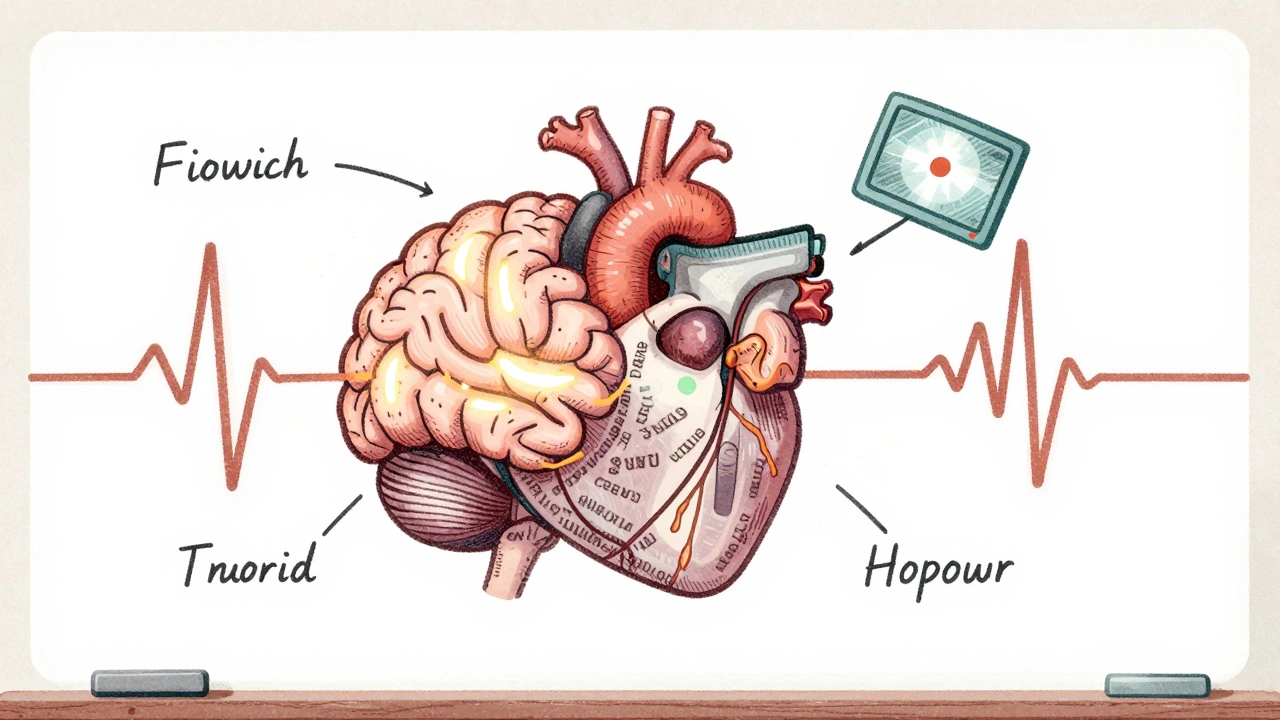
Imagine telling an AI to show you a diagram of how the heart pumps blood, and it doesn’t just describe it in words-it draws it, labels it, and explains it out loud in real time. That’s not science fiction anymore. Since 2023, when GPT-4 first connected text and images, multimodal generative AI has gone from a lab curiosity to something businesses, doctors, and creators are using every day. Today, these models don’t just read text or see pictures-they understand multimodal AI as a whole: speech, video, sensor data, and more-all at once.
How Multimodal AI Actually Works
Early AI models were like specialists. One model read text. Another analyzed images. A third handled audio. They couldn’t talk to each other. Multimodal AI changed that. It’s built to process multiple types of input simultaneously and connect them like a human would.
The system works in three stages. First, each type of data-text, image, sound, video-goes through its own neural network. Then, the fusion module looks for connections: Does the voice saying "the machine is overheating" match the thermal image showing a red hotspot? Is the person in the video frowning while saying "I’m fine"? Finally, the output module generates something new: a summary, a drawing, a spoken explanation, or even a video clip.
There are three main ways to fuse these inputs. Early fusion combines raw data right away, letting the model learn relationships from scratch. Late fusion keeps each modality separate until the end, which is easier to manage but misses subtle links. Hybrid fusion uses both, and it’s becoming the industry standard because it balances accuracy with flexibility.
Models Leading the Pack in 2025
By late 2025, several models have pushed the boundaries of what multimodal AI can do. OpenAI’s GPT-4o, released in December 2025, can process live video at 30 frames per second with just 230ms delay. That’s faster than a human blink. You can film yourself explaining a math problem, and it’ll respond with a step-by-step whiteboard explanation-spoken and drawn in real time.
Meta’s Llama 4, launched in November 2025, focuses on speech and reasoning. It doesn’t just transcribe what you say-it understands tone, pauses, and context. Ask it to summarize a meeting recording, and it’ll tell you who disagreed, what was left unresolved, and even suggest follow-up questions.
Alibaba’s QVQ-72B Preview and Google’s Gemini 2.0 also made big leaps. Gemini now syncs audio and video with near-perfect timing, making it ideal for captioning live events or translating speeches while matching lip movements. Meanwhile, Meta’s Segment Anything Model (SAM) lets users point at an object in a video and instantly isolate it-cutting video editing time by 47% in medical and filmmaking workflows.
And then there’s ARMOR, the Carnegie Mellon and Apple system that uses distributed depth sensors to help robots navigate. It cuts collisions by over 60% and processes data 26 times faster than older systems. This isn’t just about smarter chatbots-it’s about machines that can see, hear, and move safely in the real world.
Why It’s Better Than Text-Only AI
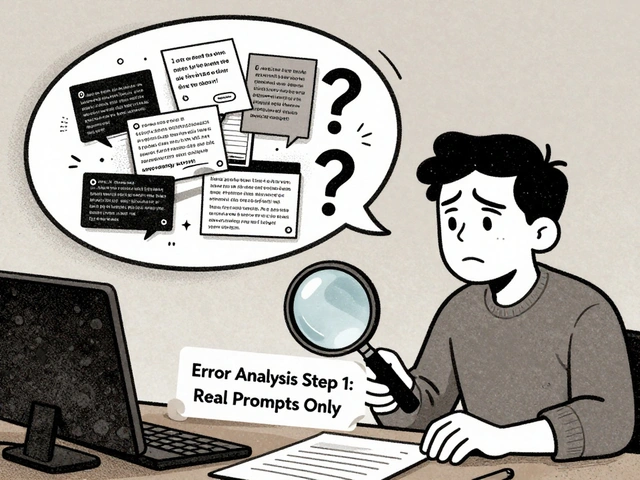
Text-only models like GPT-3.5 or older versions of Claude had a big blind spot: they couldn’t verify what they were saying. If you asked for a diagram of a cell, they’d describe it in words-but couldn’t draw it. If you said "the patient is in pain" and showed an MRI, they couldn’t cross-check the two.
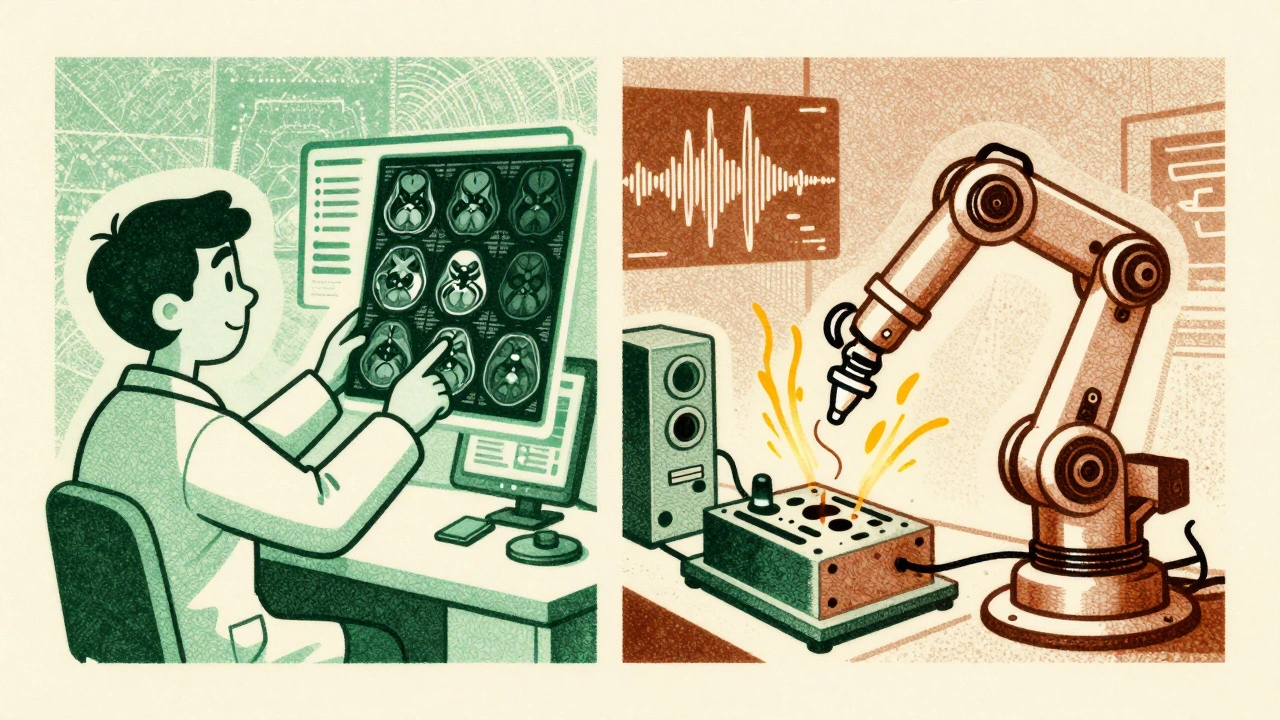
Multimodal AI fixes that. It spots contradictions. In a study by Shaip, these models caught mismatches between spoken descriptions and visual evidence with 92.4% accuracy. In healthcare, combining patient history with X-rays and lab results boosted diagnostic accuracy to 94.2%, up from 82.7% with images alone. In manufacturing, adding audio sensors to visual inspections cut false alarms by over 50%.
It also understands context better. A customer service bot that hears frustration in a voice call and sees a frustrated face in a video can respond with empathy-not just scripted replies. DHS IT Solutions found this reduced misinterpretations by 68% in real-world support scenarios.
The Downsides: Cost, Complexity, and Hallucinations
But multimodal AI isn’t magic. It’s expensive. Inference costs are 3.7 times higher than text-only models. Training requires weeks of curated data-8 to 12 weeks versus 2 to 4 for text-only systems. And it’s not always consistent.
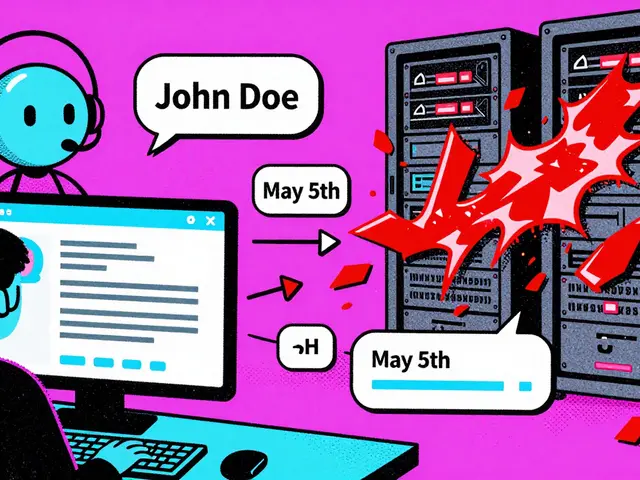
One major problem? Modality hallucinations. A model might generate a perfectly detailed image of a car, then describe it as a boat. Or it might say a person is smiling in a video while the audio clearly shows them yelling. Stanford’s Dr. Marcus Chen found these inconsistencies happen in over 22% of complex reasoning tasks. In medicine or aviation, that’s dangerous.
Enterprise users report mixed results. UnitedHealthcare cut radiology report times from 48 hours to under 5 hours with a multimodal assistant-and kept 98.3% accuracy. But an IBM Watson client abandoned their system after six months because false defect detections in manufacturing hit 18.7%. That’s too high for production lines.
And then there’s the data problem. Getting video, audio, and sensor data aligned is hard. Seventy-eight percent of developers say syncing temporal data across modalities is their biggest headache. One modality often dominates the model’s attention, drowning out quieter but important signals.
Who’s Using It-and Where
Adoption is booming. Media and entertainment lead with 68% of enterprises using multimodal AI-for automated video editing, voice dubbing, and AI-generated content. Healthcare follows at 57%, using it for diagnostics, patient monitoring, and training simulations.
Marketing teams use it to generate personalized ads: a customer uploads a photo of their living room, and the AI suggests furniture that matches the style, writes a description, and even creates a short video walkthrough. Manufacturing uses it for quality control, combining camera feeds with microphone recordings to detect tiny cracks or unusual vibrations.
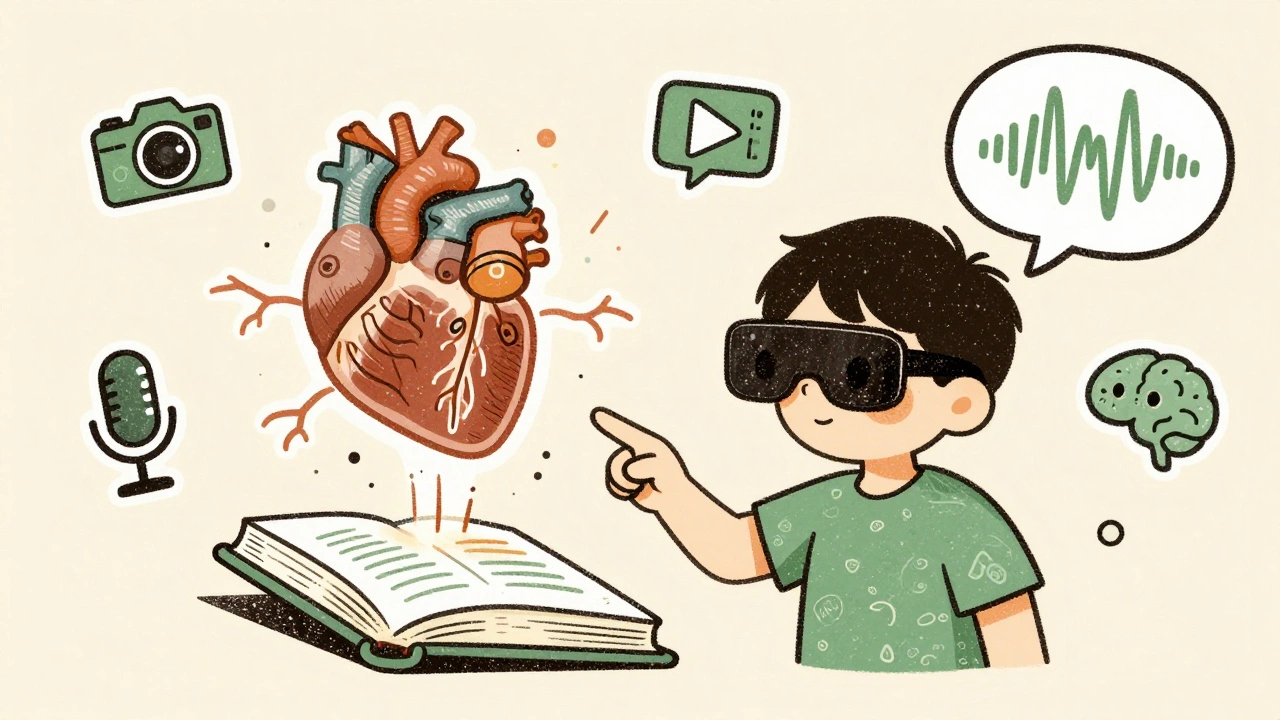
On the consumer side, apps like Kyutai’s Moshi can respond to voice and facial expressions in under 120 milliseconds-close to natural conversation speed. Reddit users are already using GPT-4o Vision to turn textbook descriptions into labeled anatomical diagrams, saving hours of study time.
Getting Started: Tools and Challenges
If you’re a developer or business looking to try this, you’ve got two paths: open-source or commercial APIs.
Open-source options like LLaVA (Large Language and Vision Assistant) are free and highly active. The LLaVA GitHub repo has over 28,000 stars and nearly 5,000 contributors. It’s great for learning, but documentation is spotty. You’ll need strong Python skills, familiarity with PyTorch, and patience.
Commercial APIs from OpenAI, Anthropic, and Google are easier to plug in-often ready in 40 to 60 hours. But they cost more. Enterprise implementations run between $250,000 and $1.2 million, depending on customization.
Most teams spend 8 to 12 weeks training staff. You need to understand transformers, fusion techniques, and how to evaluate outputs across modalities. Standardized metrics? Still missing. That’s why many companies use a mix of automated tests and human reviewers.
What’s Next: Edge AI, AR, and Autonomy
The next wave is happening off the cloud. Qualcomm’s Snapdragon X Elite chips, launching in early 2026, will run multimodal models directly on laptops and phones. That means real-time translation during a face-to-face conversation, with lip-sync and tone matching-no internet needed.
By 2027, expect seamless integration with AR glasses. Imagine pointing your glasses at a machine and seeing a floating overlay: its name, maintenance history, and a voice explaining how to fix it. Emotional recognition is coming too-models that detect stress, confusion, or excitement from voice, face, and posture.
The biggest shift? Agentic systems. These aren’t just assistants-they’re task runners. You say, "Plan a birthday party for my 8-year-old," and it finds a venue (based on photos of past events), generates invites with custom illustrations, picks a playlist based on the child’s favorite songs, and even writes a short story for the guestbook-all in under 10 minutes.
The Big Picture
Multimodal generative AI isn’t just another upgrade. It’s the first AI that can truly engage with the world the way humans do. It sees, hears, speaks, and reasons across formats. That’s why Gartner predicts 95% of new enterprise apps will include it by 2027.
But it’s not without risk. Deepfakes are expected to triple by 2026. Privacy concerns grow as systems collect more sensor data. And energy use? Training a single multimodal model now consumes over three times the power of a text-only one.
Still, the potential is undeniable. From doctors catching diseases earlier to artists creating immersive stories, from robots working safely beside humans to students learning anatomy through interactive diagrams-this isn’t just changing tools. It’s changing how we think, create, and connect with technology.
The future isn’t just visual. It’s not just verbal. It’s everything at once-and AI is finally catching up.
What is multimodal generative AI?
Multimodal generative AI is artificial intelligence that can understand and generate content across multiple types of data-like text, images, audio, and video-at the same time. Unlike older AI that only processed one type (like text), these models connect information between formats to reason, create, and respond more like a human does.
How is multimodal AI different from regular AI?
Regular AI, like early versions of ChatGPT, only works with text. It can’t see images, hear sounds, or interpret video. Multimodal AI can do all of that. It can look at a photo and describe what’s happening, listen to a voice and match it to facial expressions, or generate a diagram based on a spoken description. This lets it understand context better and avoid mistakes that text-only models often make.
What are the best multimodal AI models in 2025?
As of late 2025, the top models include OpenAI’s GPT-4o (with real-time video processing), Meta’s Llama 4 (focused on speech and reasoning), Google’s Gemini 2.0 (strong in audio-visual sync), and Alibaba’s QVQ-72B Preview. Open-source options like LLaVA are also widely used by developers for experimentation and customization.
Can multimodal AI make mistakes?
Yes. One major issue is "modality hallucination," where the AI generates conflicting outputs-for example, describing a person as happy in text while the video shows them angry. These inconsistencies happen in over 22% of complex tasks, according to Stanford researchers. In high-stakes fields like healthcare or aviation, that’s a serious risk.
Is multimodal AI expensive to use?
It’s significantly more expensive than text-only AI. Inference costs are 3.7 times higher, and training requires 8-12 weeks of specialized data curation. Enterprise implementations typically cost between $250,000 and $1.2 million. Smaller businesses often start with APIs from OpenAI or Anthropic to test the technology before investing in custom systems.
What industries are using multimodal AI the most?
Media and entertainment lead with 68% adoption, using it for video editing, dubbing, and AI-generated content. Healthcare follows closely at 57%, using it for diagnostics by combining medical images with patient records. Manufacturing uses it for quality control by analyzing visual and audio data together. Marketing teams use it to create personalized ads based on customer photos and preferences.
What’s the future of multimodal AI?
The next big steps are edge deployment-running models on phones and laptops without the cloud-integration with AR/VR for immersive experiences, and agentic systems that can complete multi-step tasks autonomously. By 2027, you’ll be able to point at an object and get real-time explanations, and by 2030, multimodal AI could reshape 78% of knowledge work, according to MIT researchers.
Stephanie Serblowski
15 December, 2025 - 18:47 PM
Okay but GPT-4o processing video at 30fps with 230ms delay? That’s faster than my coffee maker brews. 🤯 I just tried to explain a diagram to my cat and she stared at me like I was the AI hallucinating. This tech is wild, but honestly? I’m already using it to turn my textbook nightmares into labeled heart diagrams. Saved me 8 hours last week. #MultimodalMagic
Renea Maxima
16 December, 2025 - 07:52 AM
So we’re just gonna ignore that this is the exact same tech that’s going to make deepfakes indistinguishable from reality? The moment you give AI the ability to ‘understand’ emotion from voice and face, you’re handing over the keys to the human soul. We’re not building tools-we’re building mirrors that lie better than politicians. 🌑
Jeremy Chick
16 December, 2025 - 22:02 PM
Y’all acting like this is new. I’ve been using LLaVA since 2024 to auto-generate memes from my dog’s face. It knows when he’s guilty. It knows when he’s lying about eating the couch. This ain’t AI revolution-it’s just AI finally catching up to how dumb humans are. Also, ARMOR? That’s just robots learning not to walk into walls. Took ‘em long enough.
Sagar Malik
18 December, 2025 - 19:25 PM
Let me tell u somethin… this whole multimodal thing? It’s a psyop. Big Tech wants you to believe they’re ‘understanding’ reality-but they’re just correlating noise. They don’t know what ‘pain’ is. They don’t know what ‘smiling’ means. They just map pixel patterns to word clusters. And now they’re gonna run on Snapdragon chips? Bro, the NSA already has this model trained on your smart fridge data. You think your AR glasses are helping you? Nah. They’re feeding your paranoia back to the algorithm. 🤖👁️
Seraphina Nero
20 December, 2025 - 13:31 PM
My grandma just asked me if she could use this to see what her late husband’s voice sounded like in a video. I showed her how GPT-4o can sync audio with old photos. She cried. This isn’t just tech-it’s healing. We need to make sure it’s used for people like her, not just for ads and robots.
Megan Ellaby
22 December, 2025 - 10:34 AM
okay so i tried the qvq-72b preview last night to make a diagram of a cell for my bio class and it literally drew a mitochondria with a little face and called it ‘energy buddy’ 😂 i was not ready for this level of personality. also it corrected my spelling of ‘lysosome’ without me asking. i love it. also can we talk about how it made a 15-second video of the cell ‘dancing’ to my playlist? i’m not even mad. i’m impressed.
Rahul U.
22 December, 2025 - 20:31 PM
As someone working in rural India with limited bandwidth, I find the edge AI future exciting. If models can run on smartphones without cloud dependency, we can finally bring diagnostic tools to villages. But the cost barrier remains. Open-source like LLaVA is a lifeline. We need more community-driven fine-tuning, not just corporate APIs. Let’s not let this tech become a luxury only for the wealthy. 🙏
E Jones
23 December, 2025 - 14:37 PM
Imagine this: you’re not just being watched by cameras and microphones-you’re being *understood*. Every sigh, every pause, every micro-expression is being logged, analyzed, and weaponized into an ad, a loan denial, a job rejection. And now they’re training AI to detect your emotional state? That’s not innovation-that’s emotional surveillance on steroids. You think your therapist is confidential? Try telling that to a multimodal AI trained on 200 million therapy transcripts scraped from Reddit. They’re not just reading your face-they’re mapping your trauma. And the worst part? They’ll sell the blueprint to the highest bidder. You’re not using AI. AI is using you. And it’s learning to love your pain. 🤖💔
Barbara & Greg
24 December, 2025 - 19:06 PM
It is deeply concerning that society so readily embraces technologies that erode the boundaries between perception and fabrication. The notion that an algorithm can ‘understand’ human emotion, when it lacks consciousness, is not merely misguided-it is ontologically fraudulent. To entrust diagnostic authority, educational tools, or emotional interpretation to systems that hallucinate with 22% frequency is not progress-it is the abandonment of epistemic responsibility. One must ask: when the machine speaks, who is truly listening? And more importantly-why do we permit it to speak at all?