
Companies are pouring money into generative AI-but too many have no idea where it’s going. A marketing team spent $12,000 last month on AI tools to write product descriptions. A sales team used another $8,500 to generate custom pitches. The IT department didn’t even know about it until the credit card bill arrived. That’s not innovation. That’s financial chaos.
Why AI Spending Gets Out of Control
Generative AI tools are easy to sign up for. No IT approval needed. No procurement forms. Just enter a credit card, and you’re off. A single employee can burn through $5,000 in a week using ChatGPT Enterprise, Claude 3, or Midjourney Pro. And because usage is invisible to finance teams, there’s no oversight. No one tracks which department is using what, how much, or whether it’s actually moving the needle.
According to a 2025 Gartner survey, 68% of companies using generative AI have no formal spending policies in place. That’s not a gap-it’s a liability. Without controls, AI becomes a black hole for cash. You might get great output, but if you’re spending $200,000 a month and seeing zero ROI, you’re not innovating-you’re gambling.
Build a Real AI Budget, Not a Wish List
Stop thinking of AI as a free tool. Treat it like software licenses, cloud hosting, or marketing spend. Start with a generative AI spend budget that’s tied to business outcomes.
- Assign a budget per department based on use cases-not guesswork.
- Cap monthly spend per user (e.g., $150 per employee using AI tools).
- Require managers to justify spending with metrics: time saved, revenue generated, errors reduced.
At a mid-sized SaaS company in Portland, finance set a $25,000 monthly AI budget across all teams. They split it: $10,000 for marketing content, $8,000 for customer support automation, $5,000 for internal documentation, and $2,000 for R&D experiments. Any team wanting more had to submit a proposal with expected ROI. Within three months, spending dropped 32%-but output quality went up because teams were forced to prioritize.
Chargebacks Are Not Optional
If your finance team doesn’t know who’s spending what, you can’t fix it. That’s where chargebacks come in.
Chargebacks mean every department pays for the AI tools they use. Not the company. Not IT. Them. This isn’t punishment-it’s accountability.
Here’s how it works:
- Use a centralized AI spend platform like Ramp, Divvy, or a custom Slack + API tracker.
- Link each API call or tool usage to a user or team.
- At month-end, generate a report showing who used what and how much it cost.
- Invoice that cost back to the department’s budget.
At a regional bank in Seattle, chargebacks cut AI waste by 41% in two quarters. The HR team stopped using AI to write job postings after they saw their $3,200 monthly bill. They switched to a template system-and saved $28,000 a year. The legal team, which used AI to summarize contracts, saw their usage drop 60% after realizing they were paying $1,800/month for something they could automate manually for $200.
Chargebacks don’t kill innovation. They make it intentional.

Set Guardrails Before You Hit Go
Spending controls mean nothing if people are using AI to generate fake financial reports, leak customer data, or violate compliance rules. You need technical and policy guardrails.
Start with these three:
- Block sensitive data input: Tools like Microsoft Copilot and Google Gemini can be configured to prevent copying and pasting PII, financial figures, or internal strategy docs. Turn this on everywhere.
- Require approval for high-risk use cases: If someone wants to use AI to draft investor memos, legal contracts, or customer communications, they need a manager’s sign-off. Use a simple form in Notion or Airtable.
- Monitor output quality: Set up automated checks. For example, if AI-generated sales emails contain more than two vague claims (like “best-in-class” or “revolutionary”), flag them for review.
One manufacturing firm in Ohio used AI to generate safety manuals. But the tool hallucinated a procedure that didn’t exist. A worker followed it-and nearly got hurt. After that, they added a human review step for all AI-generated operational content. No exceptions.
Track What Actually Matters: ROI, Not Usage
Don’t measure AI by how many prompts you run. Measure it by what it changes.
Ask these questions:
- Did AI reduce time spent on X task? By how many hours per week?
- Did it improve customer satisfaction scores? Track NPS before and after AI use.
- Did it increase conversion rates? Compare sales funnel metrics with and without AI-generated content.
- Did it reduce errors? Count how many revisions or corrections were needed.
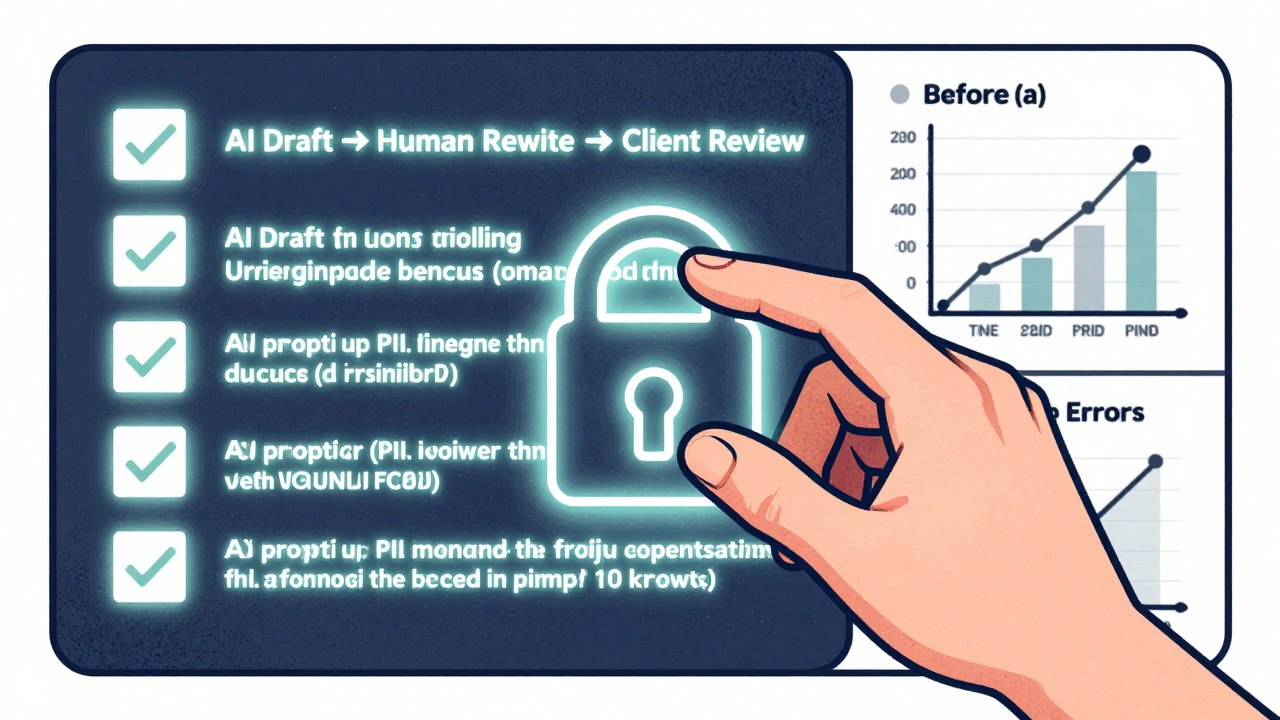
At a digital agency in Austin, they tracked AI usage across 120 projects. They found that teams using AI for initial drafts saved 15 hours per project-but only if they had a clear editing workflow. Teams without editing standards spent more time fixing bad output than they saved. The fix? They created a simple checklist: “AI draft → Human rewrite → Client review.” That simple rule cut revision time by 70% and boosted client retention.
What Happens When You Don’t Control AI Spend?
Three things: waste, risk, and resentment.
Waste: Teams buy tools they don’t need. Someone signs up for Perplexity Pro because they heard it’s good for research-then never uses it again. But the subscription auto-renews. That’s $1,200 a year down the drain.
Risk: AI generates false financial forecasts. It writes compliance documents with made-up regulations. It leaks confidential data through public prompts. One company lost $4.2 million in 2024 because an AI tool pulled internal pricing data into a public-facing report.
Resentment: Finance sees departments spending wildly. IT gets blamed for “not securing AI.” Leadership thinks innovation is out of control. Morale drops because people feel like they’re being punished for using tools that were supposed to help them.
Control doesn’t mean restriction. It means clarity.
Start Small. Fix One Thing.
You don’t need a full AI finance department to get started.
Here’s your first step: Pick one team that’s using AI heavily-marketing, customer support, or HR. Ask them:
- What are you using AI for?
- How much are you spending?
- What’s the result?
Then set a $500 monthly cap. Require them to report monthly on time saved or revenue impacted. If it works, scale it. If it doesn’t, adjust or stop.
That’s how you build real control-not by rolling out a 50-page policy, but by proving value, one team at a time.
Final Thought: AI Is a Tool, Not a Magic Wand
Generative AI isn’t going away. But without finance controls, it will drain your budget, create legal risks, and erode trust. The companies winning with AI aren’t the ones spending the most. They’re the ones spending the smartest.
Set budgets. Assign costs. Lock down guardrails. Measure outcomes. Do those four things, and you won’t just save money-you’ll unlock real, sustainable value.




Buddy Faith
9 December, 2025 - 04:24 AM
lol so now we're treating AI like it's a credit card scammer we gotta put on a leash? next they'll make us fill out a form to use a toaster
Scott Perlman
10 December, 2025 - 03:00 AM
this is actually smart. stop letting people run wild with money. just set a small cap and see what works. no need to overcomplicate it.
mark nine
10 December, 2025 - 21:00 PM
i've seen this play out at my company. marketing went nuts with midjourney, then suddenly we got a $14k bill. nobody knew who signed up. now we use a shared account with usage logs. way less chaos.
Eva Monhaut
12 December, 2025 - 13:23 PM
The real win here isn't the budget cuts-it's the clarity. When teams know their spending is tied to outcomes, they start thinking like owners, not free-tool hoarders. That shift in mindset? Priceless. And it doesn't require a committee. Just one manager asking, 'What did this actually do?'
Xavier Lévesque
12 December, 2025 - 19:13 PM
Funny how the same people who scream about 'corporate bureaucracy' are the first to want free AI magic. You don't get innovation without accountability. This isn't about stifling creativity-it's about not letting one person's whim bankrupt the whole damn company.
Sandi Johnson
13 December, 2025 - 21:15 PM
so let me get this straight… we’re gonna charge back AI spend like it’s a coffee machine in the breakroom? next they’ll invoice us for breathing too hard near a chatbot
Tony Smith
14 December, 2025 - 06:16 AM
The notion that AI should be exempt from financial governance is not only naive-it is profoundly irresponsible. To permit untracked expenditure on generative systems is to abdicate fiduciary duty. One must establish governance frameworks with the same rigor applied to any capital-intensive asset.
Thabo mangena
15 December, 2025 - 17:05 PM
In my country, we say: 'A horse without reins will run into the thorn bush.' This is exactly that. AI is powerful, yes-but power without discipline leads to ruin. Your suggestions are not just wise, they are necessary. Thank you for speaking truth with clarity.
Karl Fisher
17 December, 2025 - 12:17 PM
Oh wow. A 50-page policy? How dare they suggest we actually think about what we're doing. I mean, sure, maybe we should stop letting interns generate investor decks with AI that hallucinated a 300% revenue spike… but come on, where's the fun in that? This is the future, people! Let the chaos reign. I'm starting a startup called 'AI or Bust'-we'll just use ChatGPT to write our SEC filings. It's fine. Probably.