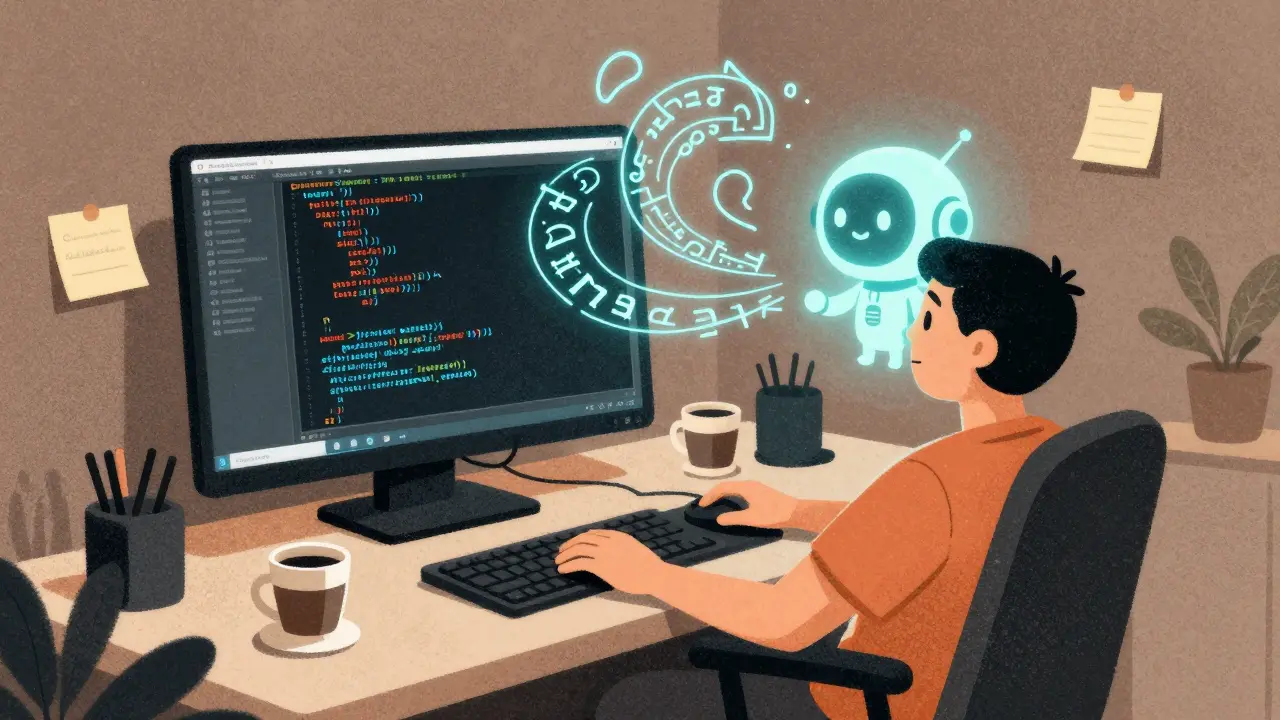
When you hear "vibe coding," you might picture a developer lounging in a beanbag, muttering to their screen while code magically appears. It’s not that simple-and it’s not magic either. But for 74% of developers who’ve tried it, vibe coding has changed how they work. Not always for the better. Not always faster. But undeniably differently.
What Is Vibe Coding, Really?
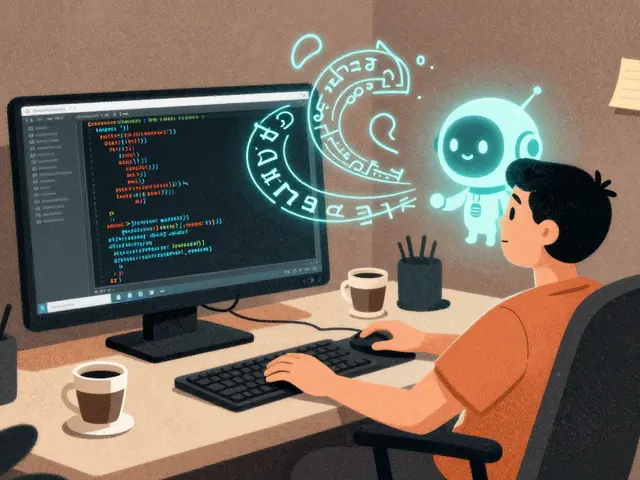
Vibe coding isn’t a new programming language. It’s not a framework. It’s not even a tool. It’s a way of working-where you talk to an AI the way you’d talk to a junior teammate, and it writes code for you. You say, "Make a login form with email validation," and it spits out working JavaScript or Python. You don’t type much. You don’t even think as hard. You just describe what you want, and the AI tries to deliver.
This approach exploded after 2023, thanks to tools like GitHub Copilot, Amazon CodeWhisperer, and Google Gemini for Developers. They’re not just autocomplete. They’re full-code generators. And they’re everywhere. According to Stanford’s 2025 study of over 100,000 developers, 600+ companies now use these tools regularly. But here’s the twist: not everyone gets the same results.
Why 74% Say It Boosts Productivity
Why do so many developers feel more productive? It’s not because they’re writing less code. It’s because they’re writing the right kind of code faster.
Think about the boring stuff: setting up a REST endpoint, writing unit tests, building CRUD forms, scaffolding a database migration. These tasks eat hours. With vibe coding, you can generate all of it in under a minute. Y Combinator found that 25% of its Winter 2025 startup cohort used AI to build most of their internal tools-things that used to take weeks, now took days.
Senior developers report saving 3-4 hours a day. That’s not hype. That’s data. On Reddit, a developer with 12 years of experience wrote: "Copilot handles my boilerplate. I focus on the hard parts. That’s the win." G2 Crowd reviews echo this: 78% of users say AI helps them build standard components faster. Stack Overflow’s 2025 survey shows 82% of positive feedback centers on test scaffolding and API templates.
For junior devs, it’s a lifeline. If you’re still learning how to structure a class or debug a loop, having an AI that can show you examples in real time is like having a mentor who never sleeps. And that’s why adoption is highest among new developers-78% of juniors use AI for most of their code, compared to 47% of seniors.
The Dark Side: Why It Slows You Down
But here’s the catch. The same 74% who feel more productive? A third of them are wrong.
A 2025 randomized trial by METR followed 16 experienced developers through 246 real coding tasks. They thought they’d finish 24% faster with AI. They actually took 19% longer. That’s a 43-point gap between expectation and reality.
Why? Because AI code isn’t clean. It’s not always correct. It’s not even always logical.
AI doesn’t understand your system. It doesn’t know your business rules. It just predicts what code looks like based on patterns in its training data. So it writes code that compiles-but breaks in production. It generates "syntactically correct but logically flawed" code, as one developer put it. And that’s the real cost.
IBM’s case studies show that debugging AI-generated code takes 2.7x longer than writing it from scratch. Why? Because you’re not just fixing a bug-you’re reverse-engineering someone else’s (machine’s) thought process. And that’s exhausting.
Juniors feel this worst. One Reddit user, new to coding, wrote: "I thought I was getting faster. But my PRs have 40% more rework requests since I started using Copilot." The AI gave him code that looked right. But it didn’t fit the architecture. He spent more time fixing it than he would’ve spent writing it himself.
Who Actually Benefits? Experience Matters
Not everyone gains from vibe coding. And it’s not about how much you code-it’s about how much you know.
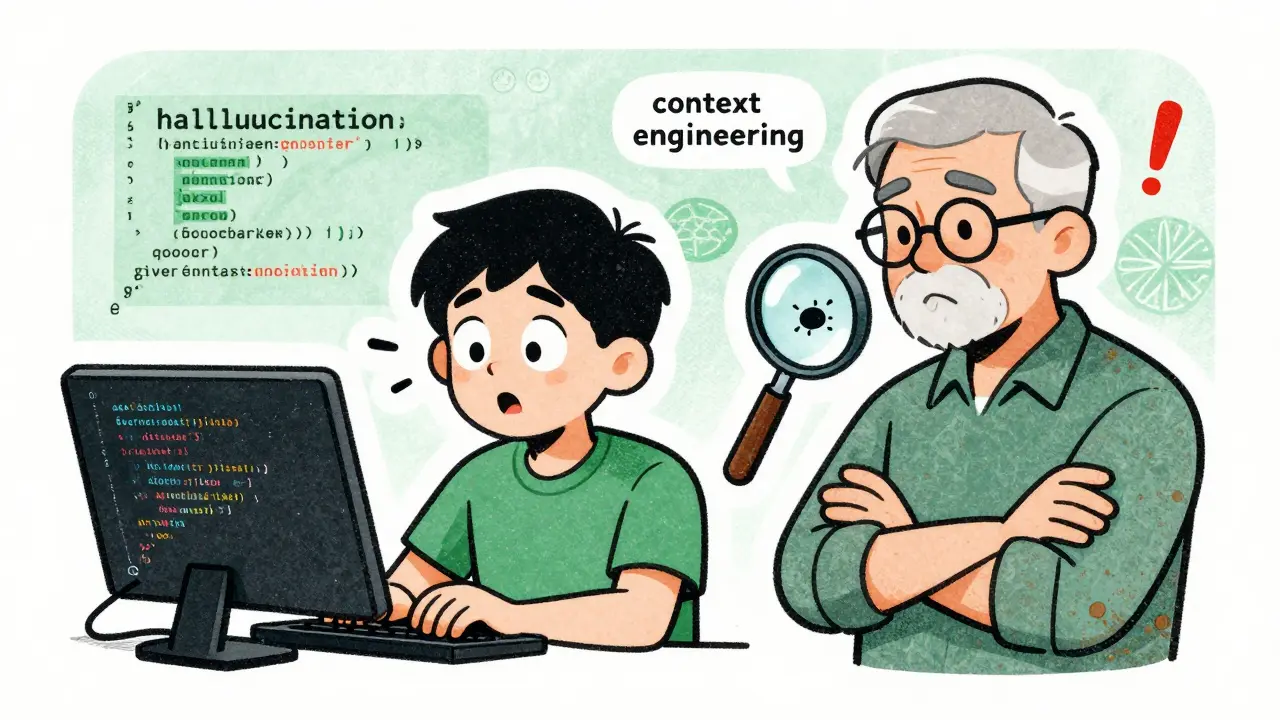
Senior developers (10+ years) ship 32% AI-generated code. Juniors ship 13%. That’s not because seniors are lazy. It’s because they know when to use AI and when to write it themselves. They understand context. They know how to prompt effectively. They can spot a hallucination before it becomes a bug.
Stanford’s research found that developers who master "context engineering"-giving the AI just the right snippet of code, not the whole project-see 35% productivity gains. Those who dump entire codebases into prompts? Only 12%.
And here’s the scary part: the Association for Computing Machinery found that junior developers who rely too heavily on AI are showing signs of "skill atrophy." They’re not learning how to solve problems-they’re learning how to ask for answers. That’s not sustainable.
The Real Productivity Inflection Point
Most people give up on vibe coding after a month. They think it’s broken. But the truth? You need time to learn how to use it.
Fastly’s 2025 survey found a "productivity inflection point" at 18 months. After that, developers who stuck with it started seeing real gains. Not because the AI got better. Because they did.
They learned how to write better prompts. They learned to review AI output like a code review, not a gift. They learned to trust their instincts over the AI’s confidence.
IBM’s internal training program, which includes a 32-hour "Context Engineering" certification, shows developers who complete it ship 28% more AI-generated code-with 40% fewer defects. That’s the key: training isn’t optional. It’s mandatory.
Tools That Work (and Which Ones Don’t)
Not all AI coding tools are created equal.
GitHub Copilot leads with 45% market share among professionals. It’s great for JavaScript, Python, and TypeScript. But if you’re working in COBOL or legacy Java? It’s useless. Training data is sparse. Accuracy drops to 8-12% gains.
Amazon CodeWhisperer (22%) and Google Gemini for Developers (18%) are strong contenders. But the real standout? IBM’s Bob platform. Its "Literate Coding" mode doesn’t just generate code-it shows you why it generated it. It annotates changes, explains logic, and flags risky patterns. That’s the future: not just code generation, but code understanding.
And the tools are evolving. GitHub’s August 2025 update now requires human verification before AI generates complex algorithms. That’s a step in the right direction.
The Hidden Cost: Technical Debt
Here’s what no one talks about enough: the debt.
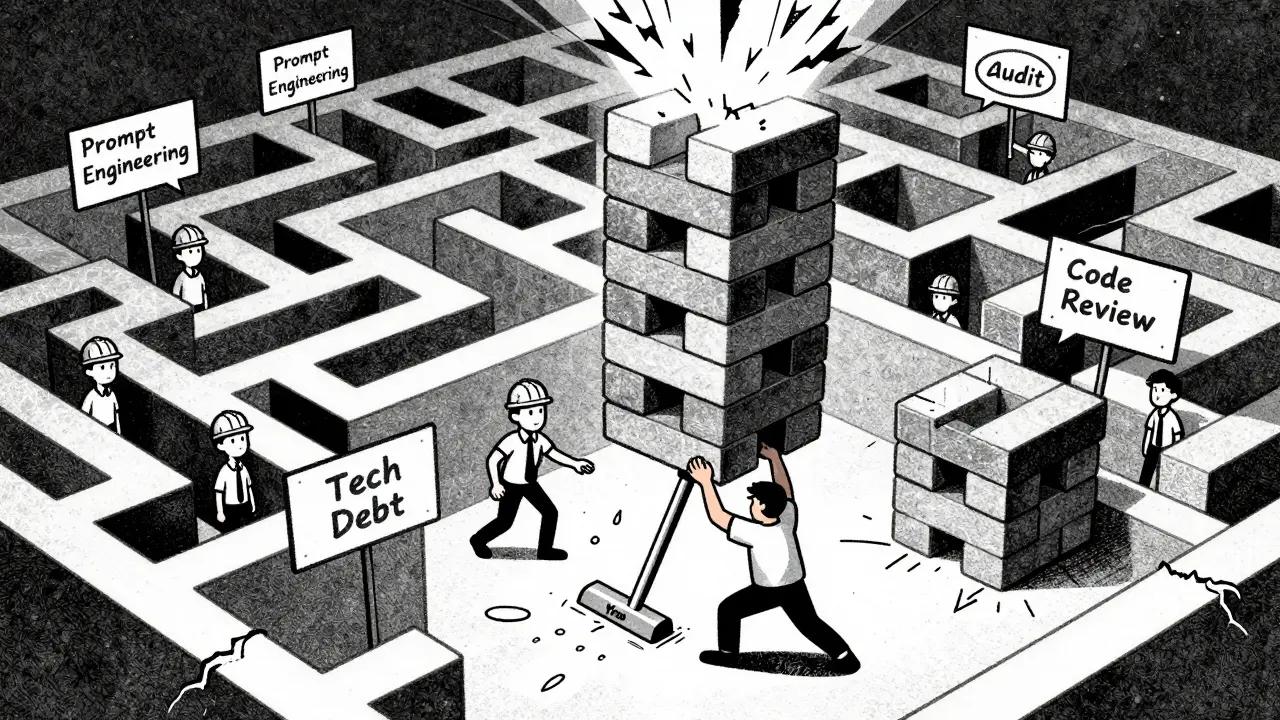
AI-generated code piles up. It’s fast. It’s easy. It’s everywhere. And by the time your team realizes they’ve got 30% of their codebase written by an AI that doesn’t understand your domain? It’s too late.
43% of CTOs surveyed by TechRepublic worry about maintainability beyond three years. Why? Because AI doesn’t document. It doesn’t explain. It doesn’t care about architecture. It just writes.
And now you’ve got a codebase full of "it works on my machine" logic. No comments. No tests. No consistency. Just magic that broke when the server updated.
Companies that succeed with vibe coding? They’ve built new processes: mandatory AI code audits, stricter PR reviews, and team-wide training on prompt engineering. 67% of adopting firms now have formal protocols, according to Decimal Solutions.
What You Should Do Right Now
If you’re thinking about trying vibe coding, here’s the truth:
- Don’t use it for complex systems. Stick to boilerplate, tests, and simple scripts.
- Don’t trust it blindly. Review every line like it’s your own code.
- Don’t let juniors use it as a crutch. Teach them how to think first.
- Do invest in training. Learn context engineering. Learn how to prompt well.
- Do set up code review rules. Make AI-generated code visible and auditable.
Vibe coding isn’t replacing developers. It’s amplifying them. But only if they’re skilled enough to steer it.
It’s not about working less. It’s about working smarter. And that’s something no AI can do for you.
Is vibe coding the same as no-code tools?
No. No-code tools let you build apps with drag-and-drop interfaces-no programming needed. Vibe coding is for people who still write code, but use AI to generate it. You’re still a developer. You’re just not typing every line.
Can AI replace junior developers?
No. AI can generate code, but it can’t replace judgment, context, or problem-solving. Junior developers who rely on AI without learning fundamentals end up slower and less capable. The best junior devs use AI as a tutor-not a replacement.
Why do senior developers use AI less than juniors?
Seniors know what AI gets wrong. They’ve seen too many bugs caused by hallucinations. They use AI for repetitive tasks, not core logic. Juniors use it for everything because they’re still learning-and they don’t yet know what they don’t know.
Does vibe coding work for legacy systems?
Not well. AI struggles with outdated codebases, unclear documentation, and non-standard patterns. Success rates for brownfield projects are only 42%, compared to 87% for greenfield apps. Modernizing legacy systems still requires deep human expertise.
Is vibe coding safe for production code?
Only if you audit it. AI code can pass tests but break in production. Companies using it in production require mandatory reviews, automated checks for common AI errors, and documentation of AI-generated sections. Without controls, it’s a ticking time bomb.
What’s the biggest mistake new users make?
Asking for too much at once. Instead of "Make a full e-commerce site," try "Generate a function that validates a credit card number using Luhn’s algorithm." Specific prompts = better results. Vague prompts = garbage in, garbage out.
Will vibe coding make me a better programmer?
Only if you use it to learn, not to avoid thinking. If you read the AI’s output, understand why it chose that approach, and compare it to your own ideas-you’ll grow. If you just copy-paste, you’ll stagnate.
Final Thought: The Tool Doesn’t Make You Faster. You Do.
Vibe coding doesn’t make you more productive. You do. The AI just gives you more time to focus on what matters: solving hard problems, designing clean systems, and writing code that lasts.
It’s not a shortcut. It’s a lever. And like any lever, it only works if you know how to use it.

Tom Mikota
12 January, 2026 - 23:22 PM
So let me get this straight-you’re telling me I can just say, "Make a login form," and suddenly I’m not responsible for the fact that it sends user passwords to a Russian server? Cool. Cool cool cool. I’ll just slap this into prod and call it a day. 🙃
Mark Tipton
14 January, 2026 - 03:35 AM
It is imperative to note, with empirical rigor, that the statistical anomaly cited-74% productivity uplift-is not only methodologically suspect but potentially indicative of a systemic cognitive bias among developers who conflate velocity with efficacy. The METR study, while peer-reviewed, fails to account for latent technical debt accumulation, which, per IBM’s longitudinal data, exhibits exponential growth post-18 months. This is not productivity-it is deferred catastrophe.
Furthermore, the notion that AI-generated code can be "reviewed like a code review" is a dangerous fallacy. AI does not reason. It interpolates. It hallucinates. It is a probabilistic parrot with a GitHub account. To treat its output as anything other than unverified, untrustworthy, and potentially malicious is to invite systemic failure at scale.
The ACM’s findings on skill atrophy are not merely concerning-they are prophetic. We are not automating development. We are automating obsolescence.
Adithya M
14 January, 2026 - 17:57 PM
Bro, you’re overcomplicating this. If you’re a junior and you’re using Copilot to learn how to structure a class or write a test, that’s not cheating-that’s how you level up. I used to spend 3 hours debugging a simple API endpoint. Now I get it in 10 minutes, read the code, understand why it works, and then rewrite it myself. AI is my tutor, not my crutch. Stop being scared of tools that make you better.
And yes, you HAVE to review it. But so what? You’d review your own code anyway. Now you’re just reviewing faster. That’s not lazy-that’s smart.
Jessica McGirt
15 January, 2026 - 18:18 PM
I appreciate how balanced this post is-it doesn’t sell AI as a magic wand, nor does it demonize it. The distinction between "vibe coding" and "no-code" is especially important. Many people conflate the two, and that’s where the real confusion begins.
As someone who mentors new developers, I’ve seen the same pattern: they start with AI, get excited, then get burned when the code breaks in production. But the ones who stick with it? They become the best engineers-because they learned how to ask better questions, not just get better answers.
Training is non-negotiable. If your team is using AI without a prompt engineering guide, you’re not being innovative-you’re being negligent.
Donald Sullivan
16 January, 2026 - 22:25 PM
Yeah right, "vibe coding"-sounds like a TikTok trend. I’ve seen juniors paste entire error logs into Copilot and then cry when it gives them a solution that uses jQuery in a React app. It’s not productivity. It’s chaos with a UI.
And don’t get me started on the technical debt. I cleaned up a codebase last year where 60% of the services were AI-generated. No comments. No tests. No documentation. Just "it works on my machine" spaghetti. Took me three weeks. And I had to explain to the CTO why we couldn’t hire anyone else because no one could read it.
AI is a tool. But if you’re using it like a hammer on a watch, you’re not gonna fix it-you’re gonna break it.
Tina van Schelt
17 January, 2026 - 07:12 AM
AI didn’t make me lazy-it made me *curious*. I used to dread writing boilerplate. Now I say, "Hey, generate me a Redux slice with async thunks and error handling," and boom-there it is. Then I stare at it. I dissect it. I tweak it. I ask, "Why did it choose this over that?" And suddenly, I’m learning more in 20 minutes than I did in two weeks of tutorials.
It’s like having a genius roommate who’s also a bit of a know-it-all. You don’t just take their word-you challenge them. And that’s where the magic happens.
Also, I love that IBM’s Bob explains the "why." That’s the future. Not just code. Context. Clarity. Humanity.
Ronak Khandelwal
18 January, 2026 - 14:32 PM
✨ Vibe coding is like a meditation for developers-when you stop forcing every keystroke and let the machine flow with you, something beautiful happens. ✨
But here’s the truth-I used to think AI would replace me. Now I know it’s here to reveal who I really am as a coder. Am I someone who hides behind automation? Or someone who uses it to rise higher?
My juniors? I don’t let them use it until they’ve written three full features by hand. Then we sit together. We compare. We laugh. We learn. That’s the real win.
AI doesn’t think. But it can help us think better. And that’s enough. 🙏
Jeff Napier
20 January, 2026 - 00:33 AM
74%? That’s a lie. The real number is 12%. The rest are just repeating what they read on Hacker News.
Let me tell you what’s really happening: Big Tech is pushing this to replace junior devs with AI and pay engineers less. They don’t want you to learn. They want you to be a prompt monkey.
And the fact that you’re all buying this? Classic. You’re being played. The tools aren’t here to help you. They’re here to make you obsolete. Wake up.
Also, why is everyone ignoring the fact that GitHub Copilot trains on open-source code that might be GPL? You’re probably violating licenses right now. And no one’s talking about it. 🤫