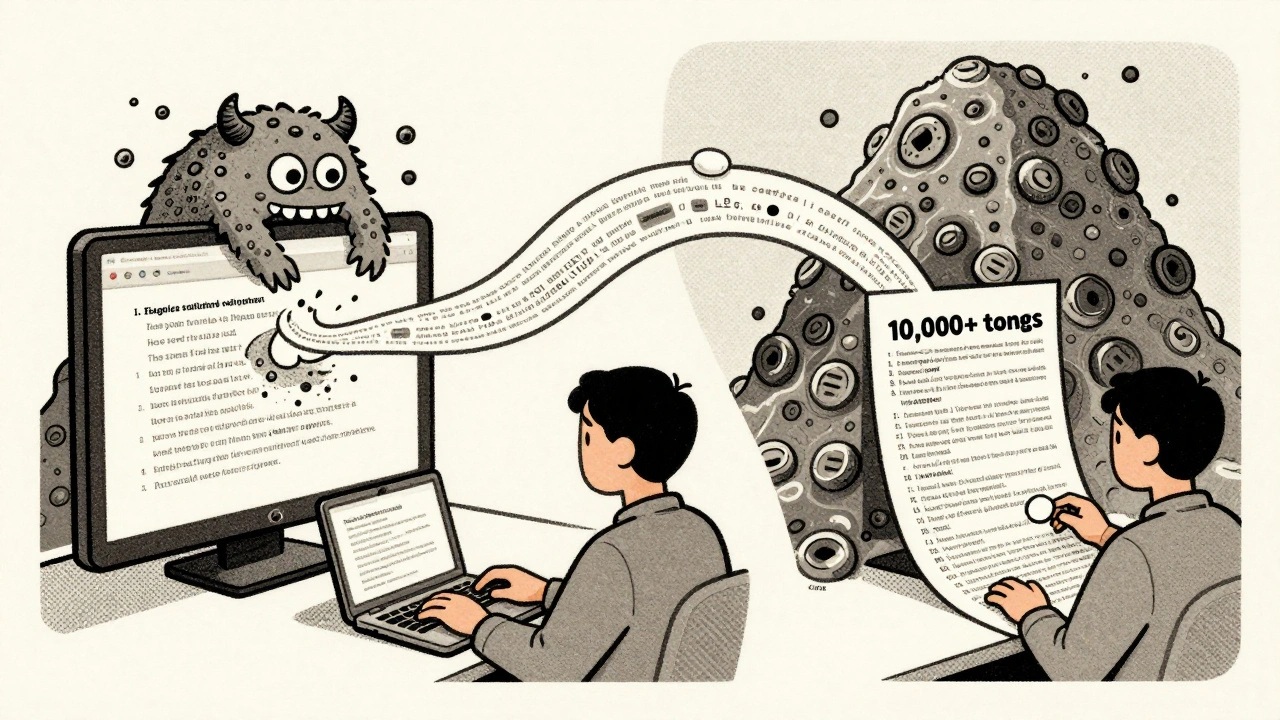
When you run a large language model (LLM) in production, your bill doesn’t just depend on how many users you have-it depends on how they use it. Two customers might sign up for the same plan, but one could cost you ten times more than the other just because they ask longer, more complex questions. This isn’t a bug. It’s the new reality of AI billing.
Why LLM Billing Is Nothing Like Traditional Software
Traditional software pricing is predictable. You pay for a license, a seat, or a fixed amount of storage. A CRM user creates 50 contacts this month? Next month, maybe 55. Easy to forecast. LLMs don’t work like that. A user might type one sentence today and generate 2,000 words tomorrow. That’s not a spike-it’s normal behavior. This unpredictability turns billing into a real-time data problem. Every time someone sends a prompt to an LLM, the system counts the tokens-words, parts of words, punctuation-that go in and come out. Input tokens cost less than output tokens. Some models, like GPT-4 Turbo, cost more per token than smaller ones like Llama 3. And if you’re processing images or audio alongside text? Those add separate charges. If your billing system can’t track these granular events in real time, you’re flying blind. A single customer’s burst of activity during a product launch could generate $10,000 in compute costs before you even notice. And if you bill monthly? You’re either eating the cost or surprising your customer with a shockingly high invoice.How Usage Patterns Drive Cost Variability
Not all usage is created equal. Here’s what actually moves the needle on your LLM bill:- Input vs. Output Tokens: Input tokens (what the user types) are cheaper. Output tokens (what the model generates) are more expensive. A chatbot that gives long, detailed answers costs more than one that replies with “Yes” or “No.”
- Model Choice: Using GPT-4 costs 3-5x more per token than GPT-3.5. If your app lets users pick their model, you need to track which one they use-every time.
- Request Frequency: A user making 100 short requests in 10 minutes creates more overhead than one user making one long request. Each request has a fixed processing cost, even if the token count is low.
- Session Length: Long conversations with memory retention (like a customer service bot) keep the model in context longer. That means more tokens per interaction over time.
- Peak Times: Usage spikes during business hours, product launches, or holidays can overwhelm your system. If your billing engine can’t scale with usage, you’ll undercharge or overcharge.
Three Pricing Models-and Which One Fits Your Use Case
There are three main ways companies charge for LLM access. Each has trade-offs:Tiered Pricing
You pay $0.05 per 1,000 tokens for the first 10,000 tokens. Then $0.04 for the next 40,000. It’s designed to reward heavy users. Pros: Encourages growth. Customers see lower prices as they use more. Cons: Revenue becomes unpredictable. If a customer jumps from 9,500 to 10,500 tokens in one day, your billing system has to split the cost across tiers. Many legacy systems can’t handle that. According to Metronome’s 2023 survey, 63% of AI companies struggled with tiered billing accuracy.Volume Pricing
You pay $0.05 per compute minute for the first 1,000 minutes. Then $0.04 for every minute after that. It’s simpler than tiered pricing but still rewards scale. Pros: Easy to understand. Predictable for high-volume users. Cons: You lose money if usage spikes unexpectedly. Anthropic reported a 12% revenue shortfall in Q2 2024 because a few enterprise clients hit premium tiers faster than expected.Hybrid Pricing
This is what most enterprise customers demand now: a monthly subscription fee (e.g., $5,000 for 5 million tokens) + overage charges (e.g., $0.03 per 1,000 tokens beyond that). Pros: Gives customers budget certainty. Protects your revenue during spikes. Microsoft’s Azure AI saw customer churn drop from 22% to 8% when they switched from pure consumption to hybrid. Cons: Requires advanced billing infrastructure. Only 31% of platforms fully support it, according to IDC’s October 2024 report. You need real-time usage tracking, automated alerts, and precise token counting.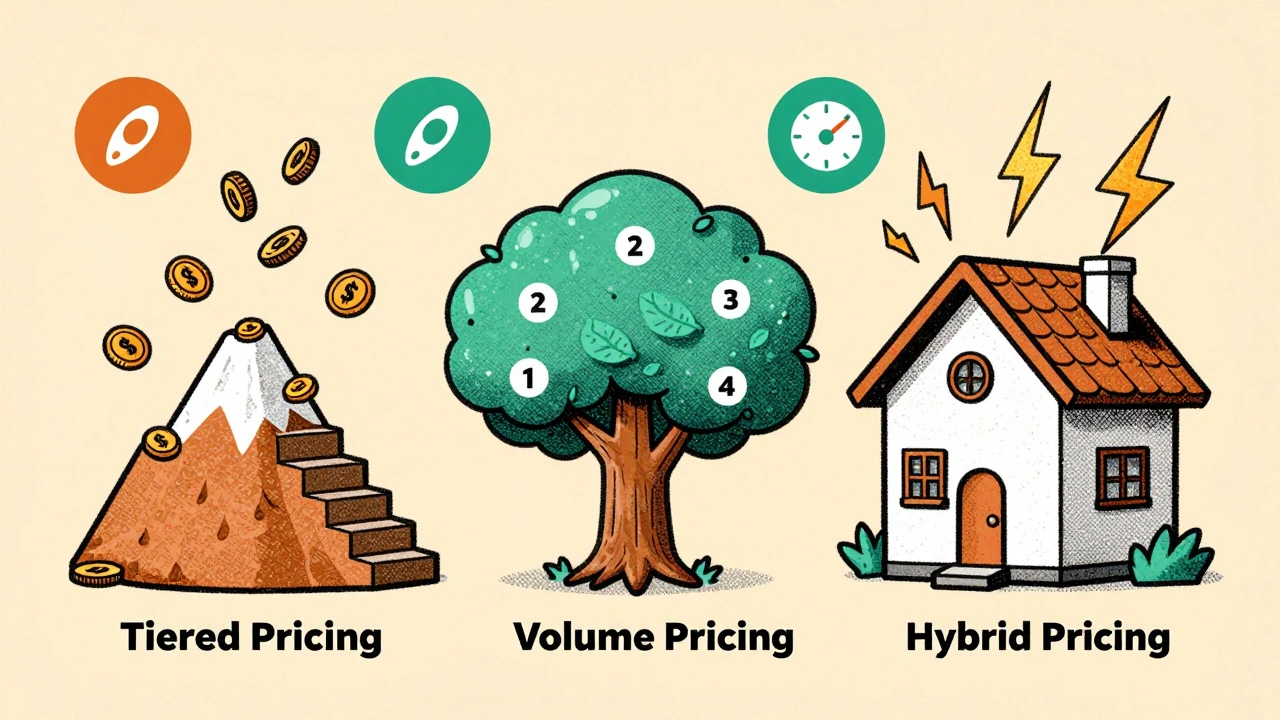
What Happens When Billing Fails
Bad billing doesn’t just cost money-it kills trust. On Reddit, a user named DataEngineerPro said switching from flat-rate to token-based billing reduced customer complaints by 28%. Why? Transparency. Customers knew exactly what they were paying for. But when billing is opaque, chaos follows. One healthcare AI provider had a single customer generate 2.1 million tokens in a week. Their billing system only updated once a month. When the invoice arrived, the customer refused to pay. The company lost $12,000-and the client. G2 reviews show a clear pattern: the top-rated LLM billing platforms (like Metronome) have real-time dashboards. The lowest-rated ones (like older versions of Recurly) can’t even tell input from output tokens. That’s a 15% revenue leak. And it’s not just technical. Finance teams are drowning. Under ASC 606 revenue rules, you can’t recognize income until you’ve delivered the service. But if you bill monthly and usage is unpredictable, you’re guessing how much revenue to book. 42% of public AI companies had to restate their earnings in 2023 because of this.How to Build a Reliable LLM Billing System
If you’re building or choosing a billing system for LLMs, here’s what actually works:- Track tokens in real time. Use a metering system that counts input and output tokens separately, per model, per request. Don’t rely on batch processing.
- Set usage alerts. Notify users at 50%, 75%, and 90% of their plan limit. This prevents surprise bills and gives them time to adjust.
- Offer sandbox environments. Let customers test their prompts before going live. This reduces accidental overuse.
- Use hybrid pricing for enterprise. Subscription + overage is the only model that balances predictability and flexibility.
- Document everything. Kinde’s billing docs got a 4.6/5 rating on GitHub because they showed exact API examples. Most custom systems don’t even try.

The Future: Real-Time, Predictive, and AI-Managed Billing
The next wave of LLM billing isn’t just about tracking usage-it’s about predicting it. In late 2024, Stripe launched “Usage Forecast,” which uses machine learning to predict a customer’s monthly spend based on historical patterns. It’s not perfect-but it cuts surprise bills by nearly half. Meanwhile, Metronome’s “Outcome-Based Billing” module lets vendors tie part of their revenue to performance. For example: $0.01 per token, but only if the model’s response meets a quality score. This aligns cost with value. And here’s the twist: AI is starting to audit its own bills. A Stanford Health Care pilot used an LLM to review 1,000 invoices. It caught errors at 92% accuracy-better than human reviewers. By 2026, Gartner predicts 65% of AI vendors will use outcome-based pricing. The market for AI billing infrastructure will hit $4.2 billion. But only a handful of platforms will survive. The ones that can handle real-time data, complex pricing, and regulatory compliance-like the EU’s AI Act, which requires clear pricing disclosure-will win.Final Thought: It’s Not About Saving Money. It’s About Trust.
LLM billing isn’t a backend problem. It’s a customer experience problem. If your users don’t understand their bill, they’ll stop using your product. If your system can’t scale with usage, you’ll lose money. If your finance team can’t account for it, you’ll face legal risk. The companies that get this right aren’t the ones with the cheapest models. They’re the ones who give customers control, clarity, and confidence. That’s the real competitive edge now-and it’s built into the billing system.Why do input and output tokens cost different amounts?
Input tokens are what the user sends to the model-like a question or prompt. Output tokens are what the model generates in response. Generating text takes more computational power than reading it. That’s why output tokens cost more. For example, GPT-4 Turbo charges $0.03 per 1,000 input tokens and $0.06 per 1,000 output tokens. This reflects the actual compute load.
Can I use a traditional SaaS billing tool for LLMs?
Most traditional tools like Zuora Classic or older Recurly versions can’t handle the granular, real-time nature of LLM usage. They were built for fixed subscriptions, not per-token billing. You’ll get billing inaccuracies, revenue leakage, and customer complaints. Only modern platforms like Metronome, Stripe’s AI billing, or custom-built systems with real-time metering can do it reliably.
What’s the biggest mistake companies make with LLM billing?
Waiting until the end of the month to bill. Usage spikes happen fast. If you don’t monitor usage in real time, send alerts, or cap usage, you’ll either lose money or surprise customers with massive bills. The most successful companies notify users at 50%, 75%, and 90% of their limit-and give them options to upgrade or pause.
Is hybrid pricing better than pure consumption?
For enterprise customers, yes. Hybrid pricing gives them budget certainty with a monthly base fee, while protecting your revenue with overage charges. Pure consumption works for self-serve users who expect to pay for what they use. But enterprise buyers want predictability. Microsoft found that switching to hybrid reduced churn from 22% to 8%.
How do I know if my billing system is accurate?
Run a test: Compare your billing system’s token count against the API provider’s logs (like OpenAI or Anthropic). If they don’t match within 1-2%, your system is leaking revenue. Also check if it separates input/output tokens and tracks model type per request. If it doesn’t, you’re likely undercharging.





kelvin kind
10 December, 2025 - 12:21 PM
Real talk-this post nails it. I’ve seen companies blow their budget on LLMs because they thought it was like SaaS. Nope. It’s more like electricity: you pay for what you use, and someone’s baby bot is running 24/7 generating Shakespearean rants.
Ian Cassidy
10 December, 2025 - 14:00 PM
Token-based billing is the new unit economics battleground. Input/output differential? Totally valid-decoding is compute-heavy, encoding is lightweight. But most platforms still lump them together for simplicity. That’s where the revenue leakage happens. Real-time metering isn’t optional anymore-it’s table stakes.
Ananya Sharma
11 December, 2025 - 02:26 AM
Oh please. You’re all acting like this is some revolutionary insight. I’ve been screaming this since 2022. The real problem isn’t billing-it’s that companies refuse to cap usage or educate users. You think your ‘customer’ knows what a token is? LOL. They think it’s magic. And now you’re surprised when someone pastes a 500-page PDF and you get billed $12k? That’s not a billing failure-that’s a product design failure. Stop blaming the system and start designing for idiots, because that’s who’s using your app.
And hybrid pricing? Cute. But if you’re not enforcing usage alerts at 50%, you’re just begging to be gamed. I’ve seen users deliberately hit 90% then pause for 24 hours to reset the counter. It’s not a feature-it’s a loophole.
Also, ‘outcome-based billing’? That’s just a fancy way of saying ‘we’re gonna charge you more if your AI works better.’ Who’s auditing the quality score? The same AI that’s generating the output? That’s not ethics-that’s a feedback loop with a credit card.
And don’t even get me started on Gartner predictions. They predicted flying cars by 2020. Now they’re saying 65% of vendors will use outcome-based pricing? Yeah, right. The real 65% will be using flat-rate billing because they’re too lazy to build anything better.
Also, ‘AI auditing its own bills’? That’s like a thief installing a camera in his own house to prove he didn’t steal anything. The system’s rigged. You can’t trust the model to audit itself. That’s like asking a cat to count the tuna cans it ate.
And don’t quote me Metronome’s stats like they’re gospel. They’re a vendor. They have a vested interest in making you think their platform is the only one that works. I’ve used three different billing systems. Two of them were fine. One was a dumpster fire. Stop worshiping the hype.
Bottom line: stop treating LLMs like they’re special snowflakes. They’re just expensive, unpredictable, and overhyped APIs. Fix your UX. Cap usage. Educate users. Stop overcomplicating billing. Done.
Adrienne Temple
11 December, 2025 - 21:14 PM
Y’all are overthinking this 😅 I just tell my users: ‘You’re paying for the words the AI writes back, not the ones you type.’ Simple. I set alerts at 50%, 75%, and 90%-and I add a little 🚨 emoji so they notice. One client thought she was paying $5/month and got a $200 bill. Now she uses the sandbox first. No drama. No tears. Just clarity.
Hybrid pricing? YES. My team loves it. They can budget. I don’t get midnight panic emails. Win-win. Also, documenting your API examples? Life saver. Even my non-tech users read it. Who knew?
Zach Beggs
12 December, 2025 - 14:08 PM
Big +1 to the real-time tracking point. We tried batch processing for a month. Ended up with $8k in unaccounted charges. Switched to Stripe’s AI billing-solved 90% of our issues. The token-by-token breakdown is insane but necessary. Also, sandbox environments are underrated. Let people break things before they break your wallet.
Kenny Stockman
14 December, 2025 - 13:16 PM
Love this breakdown. Seriously. I used to think LLMs were just ‘expensive Google search.’ Nope. It’s like running a call center where every agent is a genius who talks forever-and you pay per word they say. Wild. The hybrid model makes total sense for enterprise. My boss finally stopped yelling about bills after we switched. Also, real-time alerts? Best feature ever. I wish my phone had those for my data plan 😅
Sandy Dog
14 December, 2025 - 23:25 PM
OMG I JUST HAD THE WORST DAY 😭😭😭 My LLM bill went from $1,200 to $18,000 in ONE WEEK because someone pasted a whole medical transcript?? I thought I was being clever letting users upload files!! Now my CFO is crying in the breakroom and I’m Googling ‘how to explain AI tokens to a therapist’ 😭 I feel so bad for my team and my users and my bank account and my dignity 😭 I just wanted to help people!! Why is AI so mean?? 💔
Also, I just cried reading the part about ‘AI auditing its own bills’-like, is that even possible?? What if the AI lies?? 😭 I’m so scared now. Who’s gonna audit the auditor?? 🤖💔
Can we all just go back to flat rates?? I miss the days when I didn’t need a PhD to understand my invoice 😭😭😭