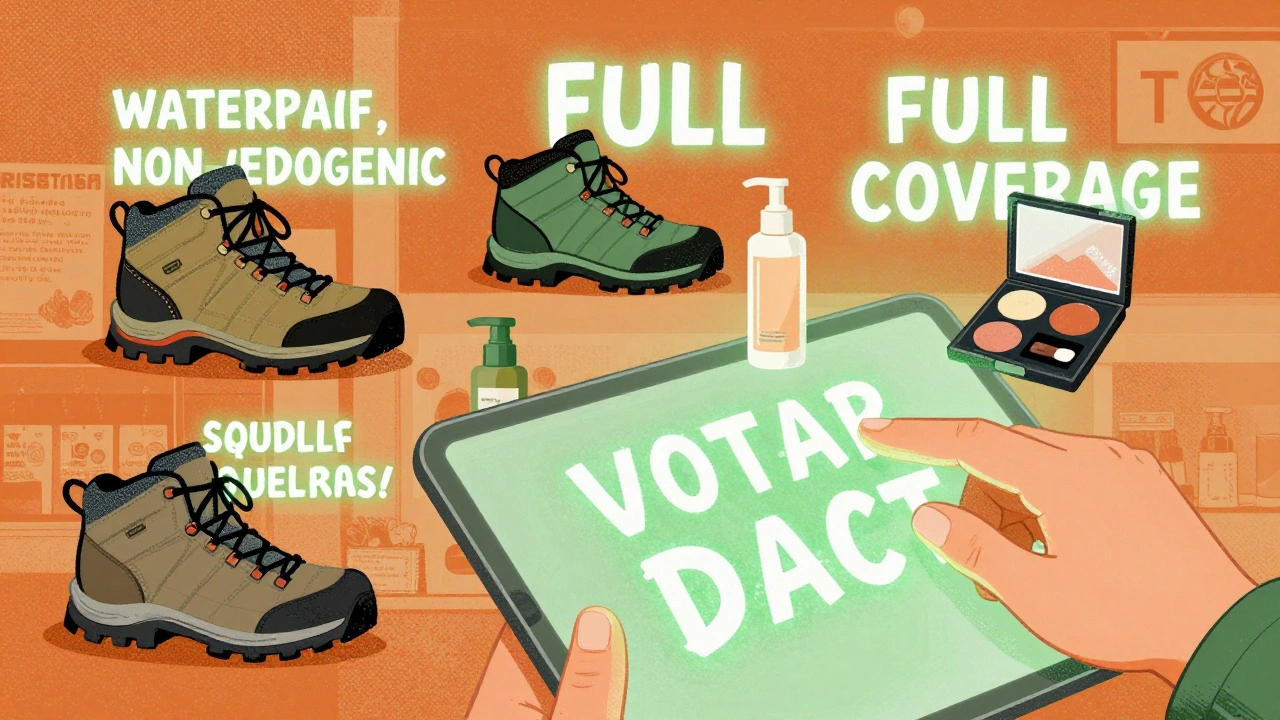
By 2025, if you’re still writing product descriptions by hand or manually arranging online displays, you’re falling behind. Retailers using generative AI for product copy, merchandising, and visual assets are seeing 31% higher sales conversions, cutting content production time by 65%, and boosting organic traffic by up to 22%. This isn’t science fiction-it’s happening right now in stores and websites you shop from every day.
How AI Writes Product Copy That Sells
Generative AI doesn’t just rephrase existing text. It learns from millions of successful product listings, customer reviews, and search queries to write copy that actually converts. Tools like Shopify’s Magic and Adobe’s Sensei analyze what words drive clicks and purchases for specific products-like ‘waterproof’ for hiking boots or ‘non-comedogenic’ for skincare-and weave them into descriptions that feel human but are optimized for search and sales.
These systems can generate 5,000 to 7,500 product descriptions in an hour with 92-95% accuracy. That’s the same quality as a skilled copywriter, but at 15-20 times the speed. Sephora’s AI-generated skin tone recommendations, for example, increased purchase confidence by 31% because the copy spoke directly to individual concerns: ‘For oily skin prone to breakouts, this foundation offers full coverage without clogging pores.’
But here’s the catch: AI doesn’t work well with bad data. If your product database is missing key attributes-like fabric composition, size fit notes, or ingredient lists-the output will be generic or wrong. Successful retailers spend 3-4 months cleaning their product data before turning on AI tools. One mid-sized beauty brand saw their AI-generated copy conversion rate jump from 1.8% to 3.4% after fixing missing ingredient tags and size charts.
Personalized Merchandising That Feels Like a Personal Shopper
Merchandising used to mean placing bestsellers at eye level or bundling complementary items. Now, AI does it in real time-for every shopper.
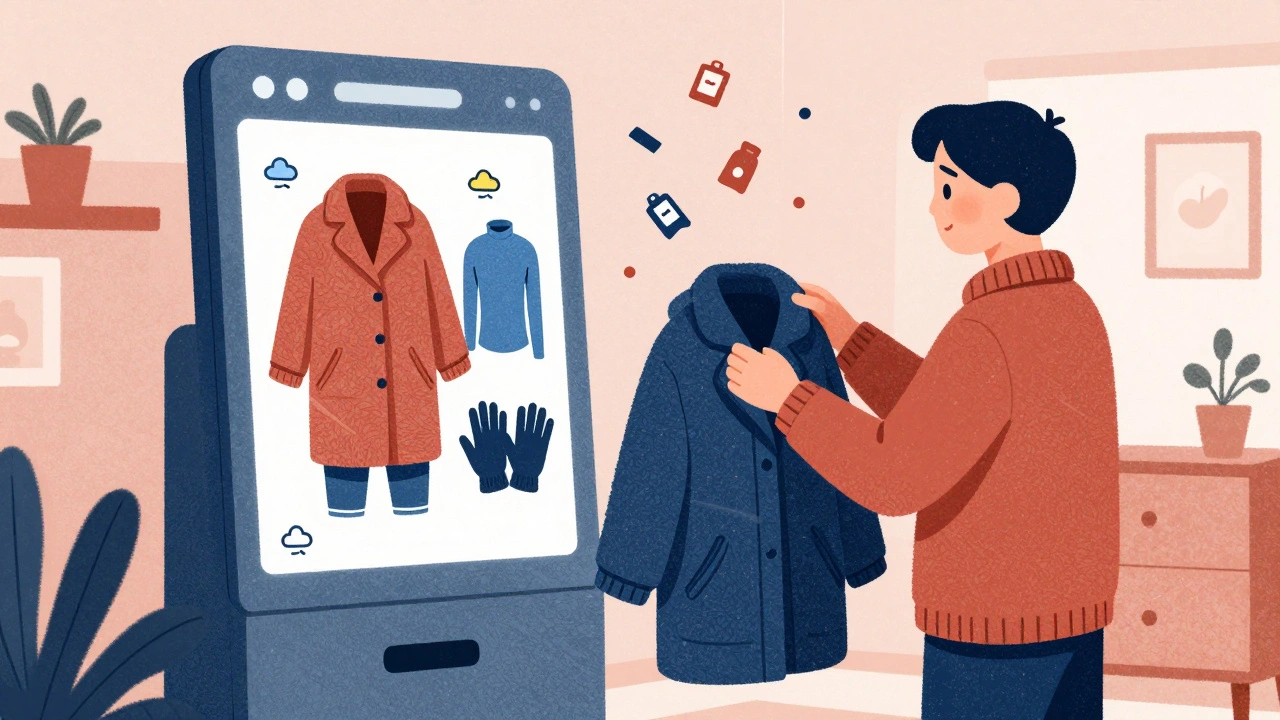
Imagine a customer browsing winter coats on your site. Instead of showing them the same top 10 items everyone sees, AI looks at their past purchases, weather in their zip code, and even what they clicked but didn’t buy. It then surfaces a personalized bundle: a wool coat, a moisture-wicking base layer, and insulated gloves-all with a message like, ‘Based on your last purchase, you might love this combo for snow hikes.’
Home Depot’s in-store kiosks now use AI to recommend tools based on what customers are holding. A shopper picking up a drill gets suggestions for drill bits, safety glasses, and a carrying case-all pulled from real-time inventory. Result? In-store conversion rose 17%, and average order value increased by 23%.
Shopify’s Sidekick 2.0, launched in August 2025, takes this further by analyzing live inventory levels and seasonal trends to auto-generate product bundles. If a retailer has excess stock of a discontinued colorway, the AI can bundle it with a bestseller and promote it as a ‘limited-time match.’ That’s not just automation-it’s dynamic inventory management.
Visual Assets: Virtual Try-Ons That Work (Mostly)
Nothing kills online fashion sales faster than a try-on tool that looks nothing like the real thing. Early AI-generated models made clothes look like plastic, misjudged fabric drape, and got colors wrong by up to 20%. Today? It’s better-but still imperfect.
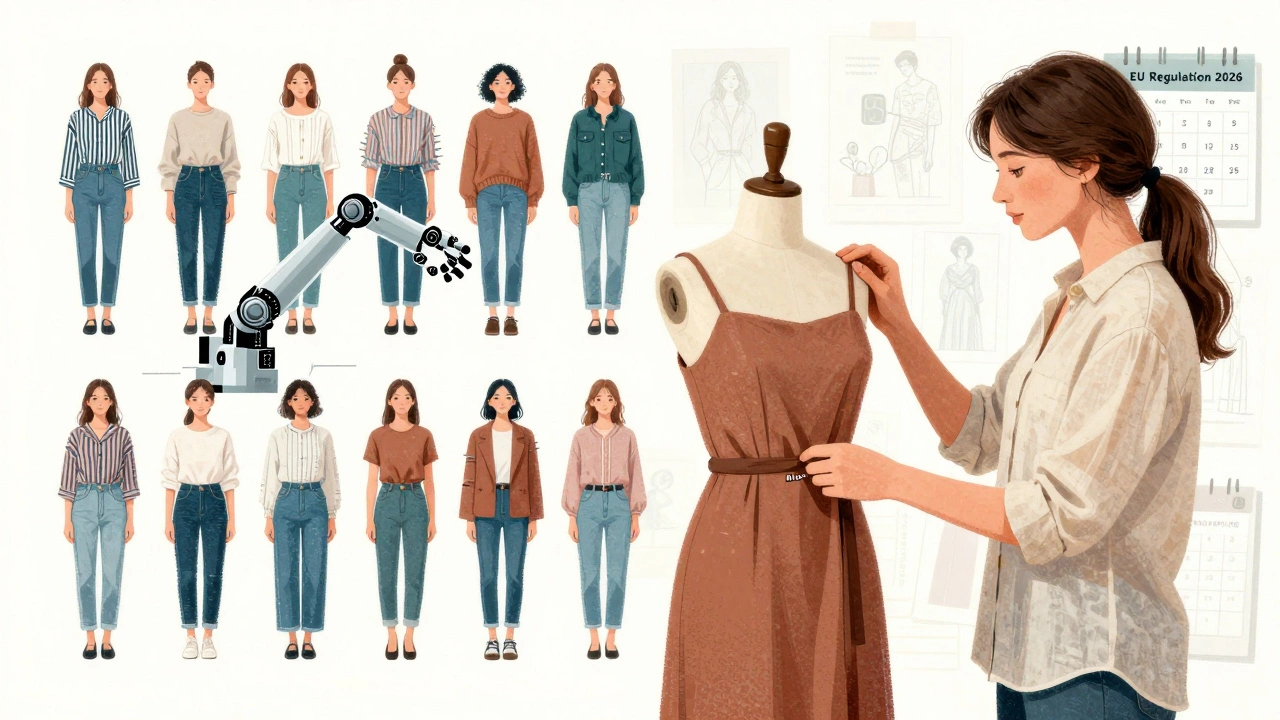
Modern systems like Vue.ai and AWS’s new retail-specific foundation models now generate virtual try-ons at 200-300 images per minute. They simulate how a sweater will hang on different body types, how a dress wrinkles when sitting, or how a pair of jeans fades after washing. For standard apparel like t-shirts or jeans, accuracy has improved to 88-90%. But for textured fabrics-lace, knits, velvet-accuracy drops to 70-75%. That’s why 18-22% of users still order a physical sample before buying.
Color accuracy remains a challenge. Cosmetics brands report only 82% accuracy in matching skin tone shades in AI-generated visuals. One makeup retailer fixed this by feeding their AI 50,000 real customer selfies with verified shade matches. Their return rate for foundation dropped by 29% in six months.
And there’s regulation coming. The EU’s AI Act requires retailers to label AI-generated visual assets by Q1 2026. That means if you’re using virtual try-ons, you’ll soon need a small ‘AI-generated image’ watermark. Brands that already disclose this-like ASOS and Zara-are ahead of the curve.
AI vs. Humans: The Right Balance
Some retailers tried going all-in on AI. They turned off human editors. Within months, customer satisfaction dropped 12%. Why? AI doesn’t understand tone, irony, or cultural nuance.
A luxury handbag brand used AI to write 10,000 product descriptions. The copy was technically accurate-but bland. Words like ‘elegant,’ ‘timeless,’ and ‘crafted’ were overused. Customers said it felt like a robot wrote it. After bringing back human editors to review and refine AI output, brand perception improved by 34%.
The winning model? Human-in-the-loop. AI handles the volume: generating 80% of product copy, merchandising bundles, and visual variations. Humans focus on quality control, brand voice, and edge cases. Estée Lauder cut content production from 14 days to 48 hours this way-and kept brand consistency at 94%.
For SMBs, this means you don’t need a team of data scientists. Shopify’s Magic tools let small merchants generate SEO-optimized descriptions with one click. But you still need to check: Does it sound like you? Does it match your brand’s personality? If your store is quirky and fun, your AI shouldn’t write like a corporate brochure.
What You Need to Get Started
You don’t need a billion-dollar budget. But you do need three things:
- Clean product data-missing attributes, inconsistent naming, or outdated specs will ruin AI output. Start by auditing your PIM system.
- A customer data platform (CDP)-you need at least 12-18 months of purchase history, browsing behavior, and demographic data to train the AI properly.
- A human editor-even if you’re using Shopify’s tools, someone should review the output weekly.
Most retailers take 3-6 months to fully integrate AI tools. Shopify merchants who follow their structured setup guide see 83% higher ROI than those who customize too early. Don’t rush the integration. Get the data right first.
What’s Next? The Future Is Automated-but Not Autonomous
By 2027, McKinsey predicts 95% of retail product content will have AI involvement. Visual assets for standard clothing will be fully automated in 60% of cases. But the real winners won’t be the ones using the most AI-they’ll be the ones using AI smartly.
Think of it this way: AI is your fastest, most tireless intern. It can write 10,000 descriptions, test 500 merchandising layouts, and render 10,000 virtual try-ons in a day. But it can’t feel why a customer loves a certain color, or understand the emotional weight of a family heirloom piece.
The future belongs to retailers who use AI to handle scale, and humans to handle meaning.



Kayla Ellsworth
15 December, 2025 - 23:45 PM
So let me get this straight - we’re outsourcing the soul of retail to a bot that can’t tell the difference between ‘elegant’ and ‘desperate’? Next they’ll be generating funeral eulogies with a 92% accuracy rating. At this point, I’m just waiting for AI to write my birthday card and forget I hate chocolate.
Soham Dhruv
17 December, 2025 - 21:09 PM
real talk tho i tried ai product descriptions for my small shop and it was wild at first like everything sounded like a walmart ad then i just had my cousin read it and tweak the tone and boom now people actually say my listings feel like me not a robot who read too many marketing blogs lol
Bob Buthune
19 December, 2025 - 10:16 AM
Have you ever stood in front of a mirror and wondered if your reflection is real? Now imagine that mirror is your entire online store, and the reflection is being generated by a machine that’s never held a sweater in its hands, never felt the weight of a leather bag, never smelled the difference between real sandalwood and the chemical knockoff they use in bulk. The AI doesn’t care about the grandmother who hand-stitched the lining. It doesn’t know that the color ‘midnight moss’ means something to someone who grew up in the Pacific Northwest. It just spits out words. And we’re calling this progress? We’re not automating retail - we’re erasing the human heartbeat behind every purchase. And one day, when the algorithm decides your product isn’t profitable enough, it won’t even pause to say goodbye.
Jane San Miguel
20 December, 2025 - 08:02 AM
The entire premise of this article is fundamentally flawed. Generative AI does not ‘learn’ from customer behavior - it statistically interpolates patterns from datasets that are often biased, incomplete, and ethically dubious. Furthermore, the claim that ‘92-95% accuracy’ equates to ‘high-quality copy’ is a dangerous conflation of technical metrics with aesthetic or emotional resonance. The fact that Estée Lauder retained human editors suggests even they recognize the epistemological bankruptcy of treating language as a variable to be optimized. This isn’t innovation - it’s linguistic colonialism, where corporate efficiency overrides cultural nuance, and the consumer is reduced to a data point in a predictive model.
Kasey Drymalla
21 December, 2025 - 02:49 AM
ai is just the start theyll replace cashiers next then managers then the whole company then the whole country then the whole world and youll be begging for a human to tell you what to buy because the robot ran out of socks and now your life is a glitch