
Most teams measure success in software development with lines of code, sprint velocity, or bug counts. But if you’ve ever worked in a vibe-driven team-where energy flows, ideas click, and code just seems to write itself-you know those metrics don’t tell the whole story. Vibe coding isn’t a buzzword. It’s a real pattern you see in high-performing teams: the kind where people show up excited, solve problems fast, and ship things that actually matter. The question isn’t whether vibe coding works. It’s how you measure it when it does.
What Vibe Coding Actually Looks Like
Vibe coding happens when the environment, tools, and people align so well that friction disappears. It’s not about working longer hours. It’s about working in rhythm. You see it when a developer fixes a stubborn bug in 20 minutes because they’re in the zone. When a designer and engineer talk over coffee and build something better than either could’ve done alone. When the team ships a feature without a single sprint review meeting.
This isn’t magic. It’s the result of psychological safety, clear goals, and the right tech stack. Teams that vibe code often use lightweight tools-like Notion for docs, Slack for async updates, and GitHub with automated testing. They avoid over-planning. They trust each other. And they care more about outcomes than output.
One team at a SaaS startup in Portland started measuring their success differently after their lead engineer left. The new hire came in with a rigid Scrum board. Output dropped 40%. Morale cratered. Then they went back to letting people choose their tasks, work when they were sharpest, and pair up organically. Within six weeks, deployment frequency doubled. Customer complaints halved. No one had to force collaboration-it just happened.
Quality: Beyond Bug Counts
Traditional quality metrics-like defect density or test coverage-often miss the point in vibe coding. A team with 95% test coverage can still ship clunky, confusing code. Meanwhile, a vibe team with 70% coverage might deliver something so intuitive users don’t need documentation.
Here’s what actually matters:
- Customer-reported ease of use-Do users say things like, "This just works?" or "I didn’t even know I needed this?"
- Time to fix regressions-If a bug pops up, how long does it take to fix? Vibe teams often fix issues in under an hour because they understand the system deeply.
- Code readability score-Use tools like CodeClimate or SonarQube to track cyclomatic complexity and duplication. But don’t chase perfection. Aim for consistency. Teams with low duplication and clear naming conventions ship faster and make fewer mistakes.
- Onboarding speed-How long does it take a new developer to ship their first meaningful change? In vibe teams, it’s often under two days. In rigid ones, it can take weeks.
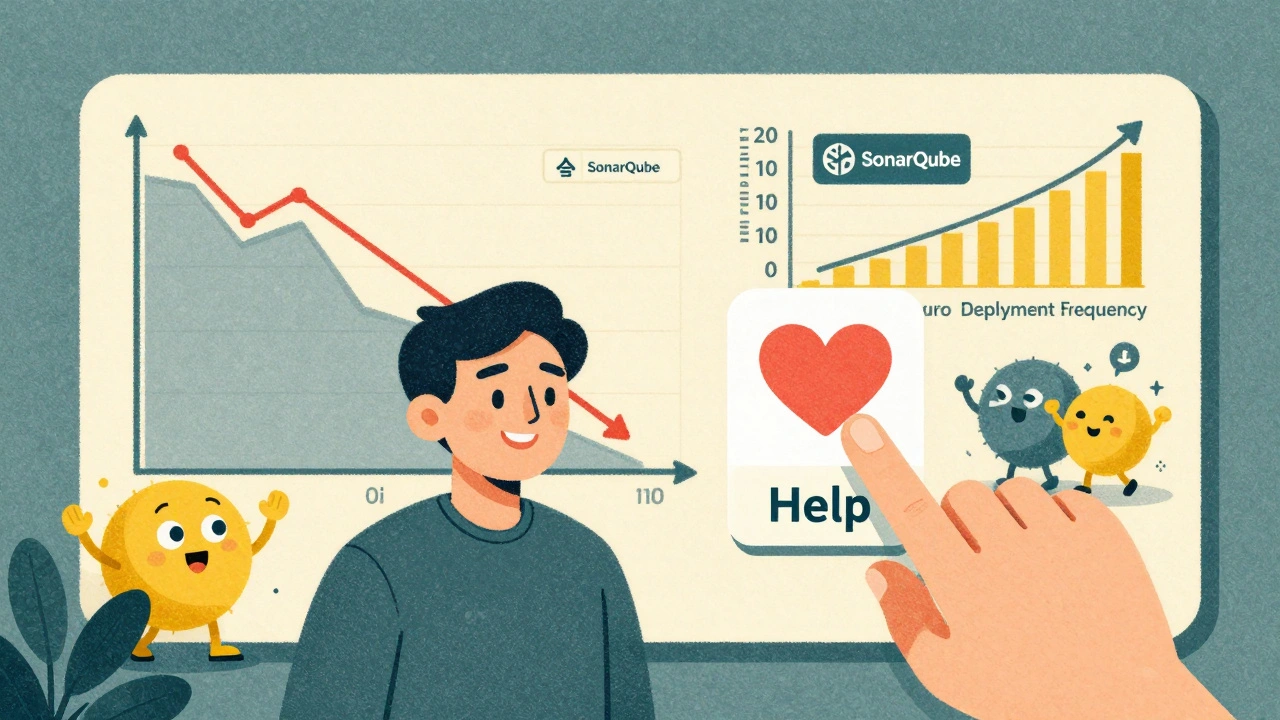
A team at a health tech company tracked how often users clicked "Help" on their app. After switching to vibe coding practices-smaller features, daily check-ins, and no mandatory standups-they saw help clicks drop by 62%. That’s not a bug fix. That’s better design.
Speed: It’s Not About Velocity
Agile teams obsess over velocity-how many story points they complete per sprint. But in vibe coding, velocity is a red herring. A team can hit 120 points a sprint and still be moving backward if they’re building the wrong thing.
Real speed in vibe coding is measured by:
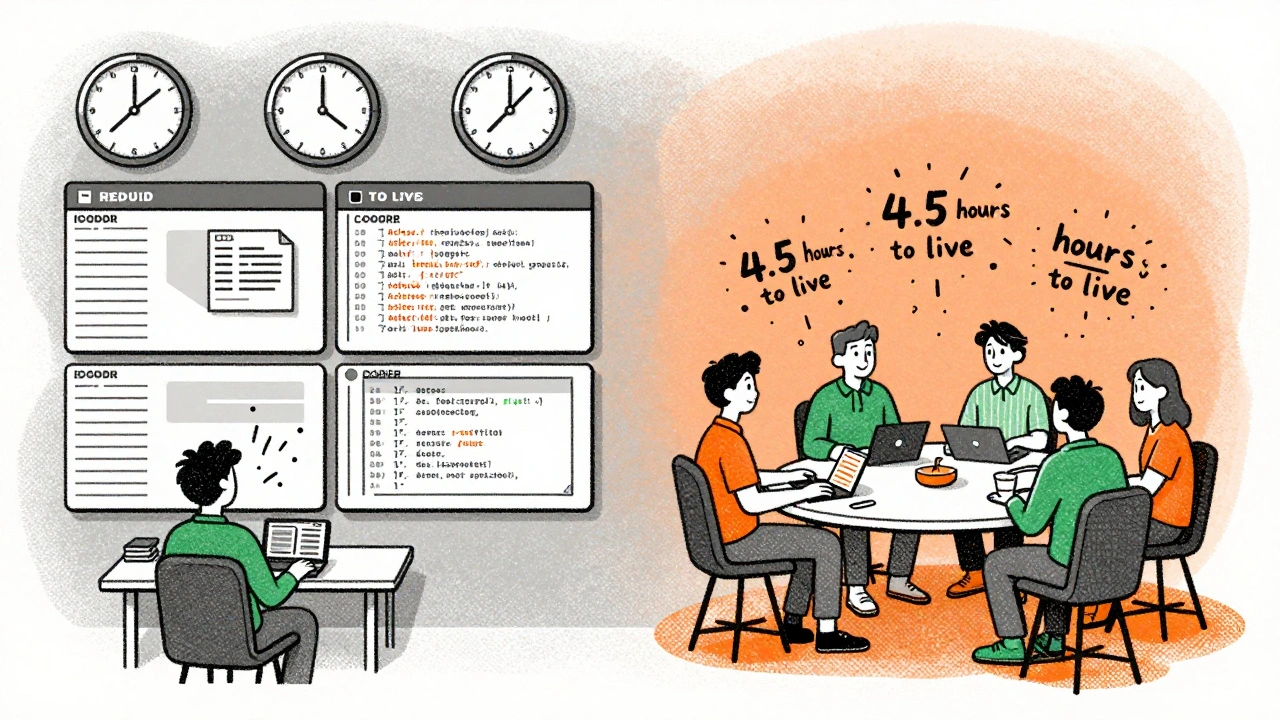
- Time from idea to live-How long does it take to go from a Slack message to a feature in front of users? Top vibe teams do this in hours, not days. One team at a fintech startup shipped a new payment flow from concept to production in 4.5 hours.
- Deployment frequency-Daily deployments? Good. Multiple per day? Even better. Teams that deploy often have smaller changes, fewer bugs, and higher confidence.
- Revert rate-How often do you roll back code? Vibe teams rarely revert. If they do, it’s because they caught it early, not because they missed something big.
- Lead time for changes-From commit to production. Tools like GitHub Actions or GitLab CI can track this. Teams with vibe culture average under 30 minutes. Teams with rigid processes? Often over 12 hours.
A study from the 2024 State of DevOps Report showed that elite performers-teams with high psychological safety and low process overhead-deployed 208 times more frequently than low performers. Their lead time was 106 times shorter. They didn’t work harder. They worked smarter because the vibe was right.
Business Impact: The Only Metric That Matters
At the end of the day, software exists to move the needle on business outcomes. Vibe coding’s real power shows up here.
Ask these questions:
- Did this feature increase retention?-Track active users before and after launch. A 5% bump in 30-day retention is worth more than 100 story points.
- Did it reduce support tickets?-If users stop calling customer service because your product just works, that’s a win.
- Did it unlock new revenue?-Did a small UI tweak lead to more sign-ups? Did a backend optimization cut cloud costs by 30%? These are the metrics investors care about.
- Did it improve team morale?-Low turnover, high internal promotion rates, and people volunteering for tough tasks are signs of sustainable success.
A startup in Austin built a simple feature: users could save their preferences across devices. It took two developers three days. No epic. No Jira ticket. Just a Slack thread and a shared Figma link. Three months later, they saw a 22% increase in paid conversions. No marketing spend. Just better product-market fit because the team was in sync.
How to Start Measuring Vibe Coding
You can’t force vibe. But you can create conditions for it-and then measure what happens.
- Stop tracking story points. Replace them with time to value. How fast does a feature deliver real impact?
- Set up a weekly "vibe check". Ask: "Did you feel excited about your work this week?" and "Did you feel heard?" Use anonymous tools like Donut or Lattice. If scores drop below 7/10, dig in.
- Track one business metric. Pick one that matters-conversion rate, churn, support tickets. Tie every team goal to improving it.
- Measure code health, not volume. Use SonarQube or CodeClimate. Aim for low duplication, readable functions, and fast test runs.
- Watch for natural collaboration. Who pairs up? Who gets asked for help? Who’s always in the Zoom call even when they’re not on the project? Those are your vibe indicators.
One engineering lead in Seattle stopped holding sprint retrospectives. Instead, she started sharing a Slack channel where people posted wins: "Fixed that slow API call-now it’s 4x faster," or "User said they cried happy tears when the form auto-filled." Within a month, team satisfaction jumped 38%. Product quality improved. No one had to be told to care.
What Vibe Coding Isn’t
It’s not chaos. It’s not "no rules." It’s not letting people work in isolation. It’s not about having ping-pong tables or free snacks.
Vibe coding is intentional structure with room to breathe. It’s clear ownership without micromanagement. It’s trust that’s earned, not assumed. It’s knowing when to ship and when to pause.
Teams that mistake vibe for laziness end up with technical debt. Teams that mistake it for freedom end up with misaligned priorities. The sweet spot? Autonomy within boundaries. Purpose without pressure.
Real Results from Real Teams
Here’s what vibe coding looks like in numbers:
| Metric | Traditional Team | Vibe Team |
|---|---|---|
| Deployment Frequency | Once every 2 weeks | Multiple times per day |
| Lead Time for Changes | 12+ hours | Under 30 minutes |
| Mean Time to Recovery | 6-12 hours | Under 10 minutes |
| Customer Satisfaction (CSAT) | 72% | 89% |
| Team Retention (1-year) | 65% | 92% |
| Feature Adoption Rate | 38% | 76% |
These aren’t outliers. These are teams that stopped measuring what’s easy and started measuring what matters.
Final Thought: Stop Counting Code. Start Counting Impact.
If your team is shipping fast but no one uses what you built, you’re not succeeding. If your code is perfect but your team is burnt out, you’re not succeeding. Vibe coding isn’t about being cool. It’s about building things people love-while keeping the people who build them happy.
Measure the right things. Let the vibe guide you. And if your metrics don’t reflect that? Change the metrics.
Is vibe coding just a trend, or is it here to stay?
Vibe coding isn’t a trend-it’s a response to the failure of rigid systems. As remote and hybrid work become standard, teams need more autonomy, trust, and psychological safety. Frameworks like Scrum and Waterfall were built for offices and fixed schedules. Vibe coding works for today’s distributed, creative, and emotionally intelligent teams. Companies that ignore this are already losing talent to those who don’t.
Can vibe coding work in regulated industries like finance or healthcare?
Absolutely. Regulated industries need compliance, not bureaucracy. Vibe coding doesn’t mean skipping audits or tests. It means automating them, embedding them into the workflow, and trusting skilled professionals to do their jobs. Teams at healthcare tech firms use vibe coding to ship HIPAA-compliant features faster because they reduce meetings, automate testing, and let engineers own their code end-to-end. Compliance isn’t the enemy-slow, unclear processes are.
What if my team doesn’t have a "vibe"? Can I force it?
No, you can’t force vibe. But you can remove the things that kill it. Micromanagement, endless meetings, unclear goals, and fear of failure are vibe killers. Start by giving your team autonomy over their tasks, protecting their focus time, and celebrating small wins. Let trust build naturally. Vibe emerges when people feel safe, seen, and purposeful.
How do I convince leadership to stop tracking story points?
Replace story points with business outcomes. Show them data: teams that stopped tracking points shipped features 3x faster, had 50% fewer bugs, and saw 30% higher customer satisfaction. Point to the 2024 DevOps Report: elite performers don’t use story points. They measure lead time, deployment frequency, and change failure rate. If leadership cares about ROI, give them metrics that actually tie to revenue, retention, and cost savings.
Does vibe coding mean no documentation?
No. It means documentation that’s useful. Vibe teams write docs when they matter: API specs, onboarding guides, post-mortems. They don’t write 50-page requirements documents no one reads. Good documentation is living, concise, and easy to find. Tools like Notion, Obsidian, or GitHub Wiki work better than Confluence when the team owns and updates them.

Emmanuel Sadi
9 December, 2025 - 18:03 PM
Oh wow another ‘vibe coding’ manifesto. So let me get this straight-no sprints, no metrics, just ‘good vibes’ and magically your code doesn’t suck? I’ve seen this movie. It ends with the CTO fired and the entire stack in flames. You don’t measure anything, you don’t manage anything, you just hope someone ‘feels inspired’ to fix the prod outage at 3 AM. Cute.
Nicholas Carpenter
9 December, 2025 - 19:14 PM
I’ve worked on both sides of this. The rigid teams? Exhausting. The vibe teams? Life-changing. It’s not about no rules-it’s about trust. When you let people own their work, they care more. I’ve seen teams ship faster, with fewer bugs, and actually enjoy Mondays. That’s not magic. That’s respect.
Chuck Doland
11 December, 2025 - 18:45 PM
The underlying thesis here is both empirically sound and philosophically coherent: the reduction of transactional overhead in software development workflows permits the emergence of emergent, high-fidelity collaboration. Traditional metrics, rooted in industrial-era productivity paradigms, fail to capture the epistemic value of cognitive flow, psychological safety, and intrinsic motivation. The data presented-from deployment frequency to CSAT-is not anecdotal; it is corroborated by the 2024 State of DevOps Report, which demonstrates a statistically significant correlation between autonomy and system resilience. This is not a trend. It is an evolutionary imperative.
Madeline VanHorn
11 December, 2025 - 22:07 PM
Ugh. Vibe coding? Please. You’re just saying ‘I don’t want to do my job properly.’ Real engineers use Jira. Real teams have Gantt charts. If you can’t measure it, it doesn’t exist. And if your team’s ‘vibe’ is just people slacking off, that’s not culture-that’s negligence.
Glenn Celaya
13 December, 2025 - 07:08 AM
lol at the 92% retention rate. Yeah right. My last team had ‘vibe’ and half the devs quit after 6 months because no one knew what they were doing. You think people just magically know what to code? Nah. Someone has to plan. Someone has to say no. Vibe coding is just corporate speak for ‘I’m too lazy to manage’
Wilda Mcgee
15 December, 2025 - 02:24 AM
Y’all are missing the point. Vibe isn’t about skipping process-it’s about removing the bullshit that makes people hate their jobs. I used to work at a place where we had 12 meetings a week just to talk about meetings. Then we started using Slack for quick syncs, let devs pick their own tasks, and started celebrating when someone made a user cry happy tears. We didn’t need more rules-we needed less noise. And guess what? Our code got cleaner, our users got happier, and we stopped losing people to burnout. It’s not magic. It’s just human.
Chris Atkins
15 December, 2025 - 15:20 PM
Been there done that. We ditched sprint planning and started sharing wins in a Slack channel. One guy wrote ‘Fixed the checkout bug that was costing us $20k a day’ and it just clicked. People started sharing more. No one had to force it. The vibe was always there. We just stopped blocking it. Also no one misses Jira. Not even a little.
Jen Becker
16 December, 2025 - 05:39 AM
So you’re saying if I just stop caring about deadlines and let people nap between commits, everything will be fine? Wow. What a revelation. My team’s ‘vibe’ is just chaos with better lighting.