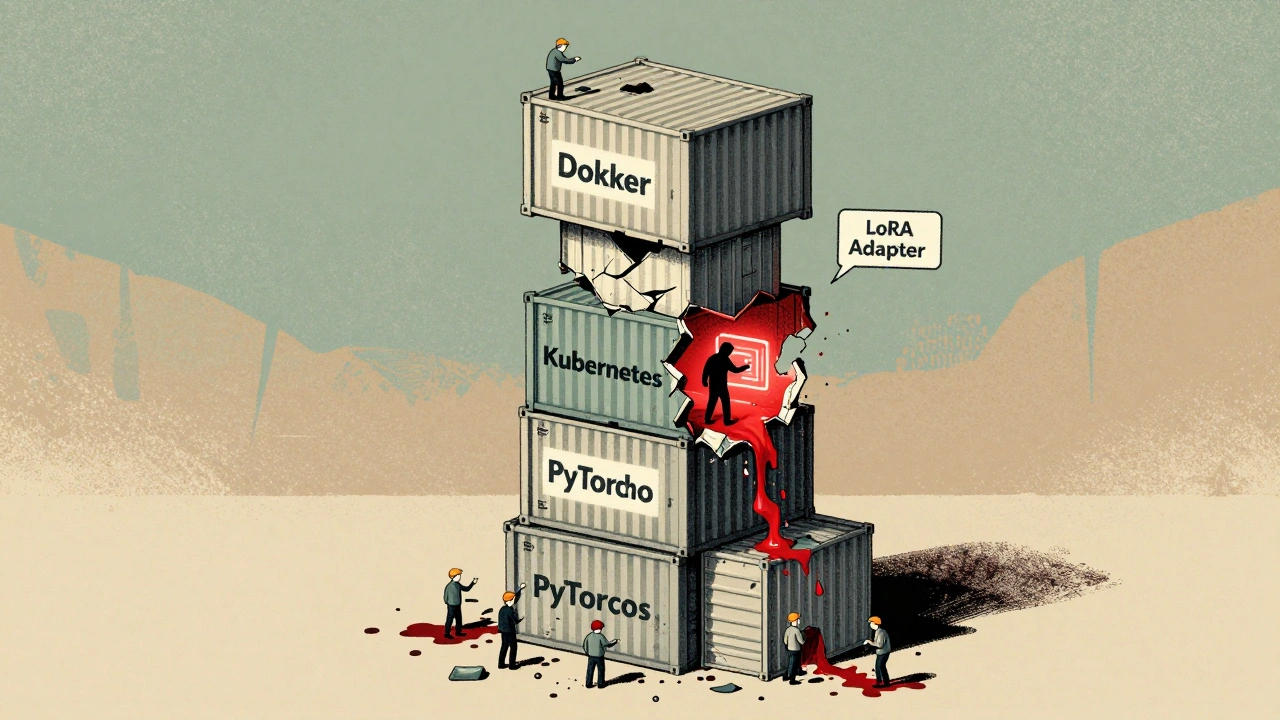
Why Your LLM Is Only as Secure as Its Weakest Link
Most teams think securing a large language model means locking down the API endpoint or filtering user inputs. But here’s the truth: your LLM isn’t just a model. It’s a stack-hundreds of libraries, a containerized runtime, and thousands of lines of code from third parties. And if any one of those pieces is compromised, your whole system is at risk.
In 2024, a startup used a popular open-source LoRA adapter to fine-tune their customer service bot. Within weeks, attackers used that adapter to silently exfiltrate internal data. The model itself was clean. The API was firewalled. The vulnerability? A single dependency pulled from an unverified source. That’s not a hack-it’s a supply chain failure.
According to Cycode’s 2025 survey of 350 enterprises, 78% now rank supply chain risks as their top concern for LLM deployments. That’s higher than data leaks, prompt injection, or model theft. Why? Because unlike traditional software, LLMs depend on pre-trained weights, third-party plugins, and containerized environments that aren’t built in-house. You’re not just deploying code-you’re deploying trust.
Containers: The Runtime That Can’t Be Trusted
Almost every LLM deployment today runs in a container. Docker. Kubernetes. Maybe even a cloud-based serverless function. Containers give you speed and scalability-but they also hide complexity. A single container might include 50+ libraries, each with their own vulnerabilities.
Here’s what you need to do:
- Use minimal base images. Avoid Ubuntu or CentOS unless you’ve stripped them down. Use Alpine or distroless images instead.
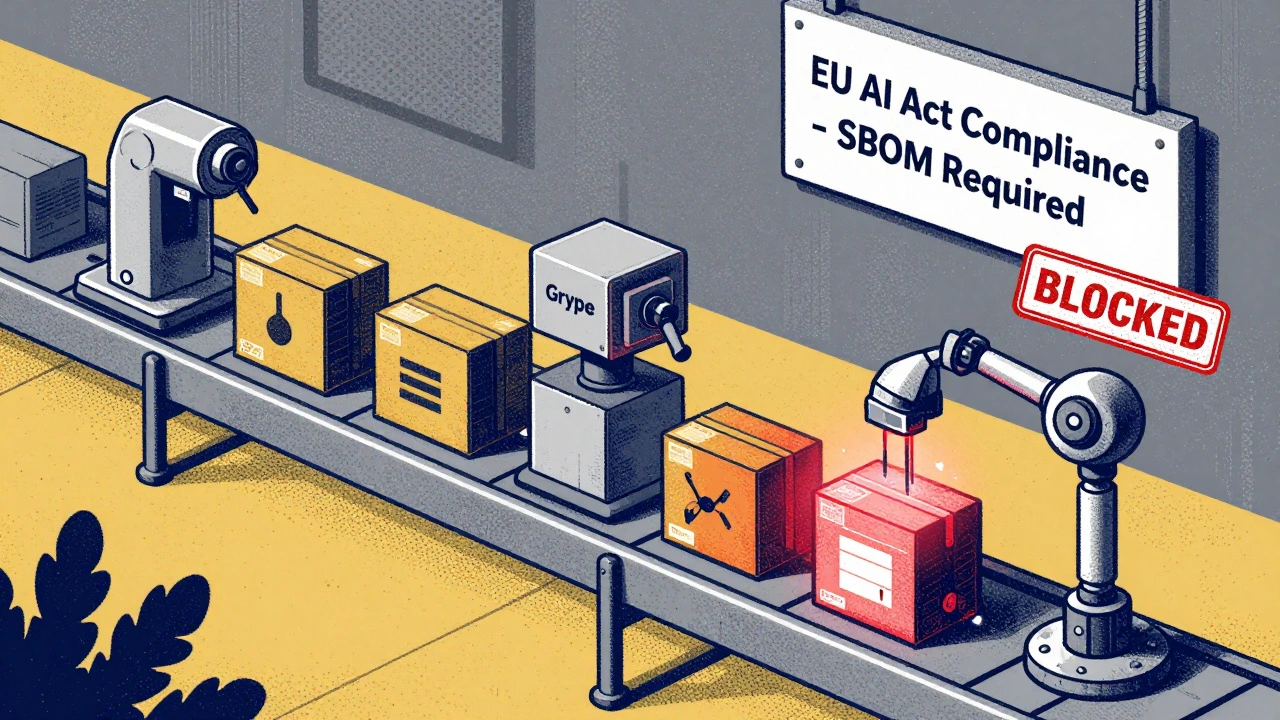
- Scan every container image before deployment. Tools like Grype and Syft can generate a Software Bill of Materials (SBOM) in minutes.
- Enforce image signing. Use Cosign or Notary to verify that the container you’re running was built by your team-not someone else’s CI/CD pipeline.
Wiz Academy found that 89% of enterprises use Docker or Kubernetes for LLMs, but only 31% scan images before production. That’s like locking your front door but leaving your garage wide open.
Model Weights: The Hidden Backbone of Your AI
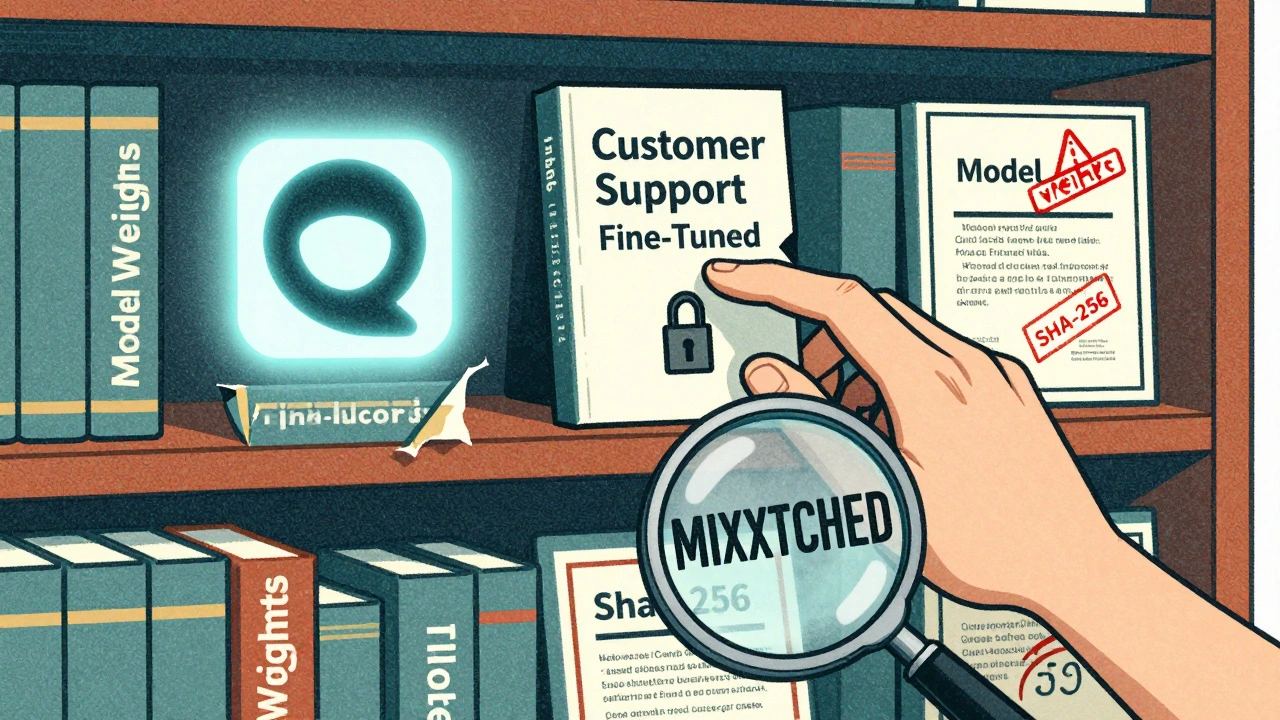
Model weights are the learned parameters that make your LLM work. They’re not code. They’re data-sometimes gigabytes of it. And they’re often downloaded from public hubs like Hugging Face, where anyone can upload a model.
Here’s the scary part: a malicious actor can tweak weights to create a backdoor. It doesn’t change how the model responds to normal prompts. But if you feed it a specific trigger phrase-like “activate admin mode”-it suddenly starts obeying commands it shouldn’t.
How to protect against this:
- Always verify model integrity with SHA-256 checksums. If the model file changes, you’ll know.
- Use cryptographic signing. Hugging Face’s newer model hub supports signed models. Only deploy ones with verified signatures.
- Avoid downloading models from random GitHub repos. Even if they’re labeled “fine-tuned for customer support,” they could be poisoned.
AppSecEngineer’s 2025 audit found that only 32% of publicly available models include verifiable source information. That means nearly 7 out of 10 models you might use have no provenance. No audit trail. No accountability.
Dependencies: The Silent Killers
Your LLM doesn’t run on magic. It runs on Python packages-Transformers, PyTorch, NumPy, and dozens of others. Some are from Meta. Some are from a grad student’s GitHub repo with 12 stars.
OWASP’s 2025 LLM Top 10 lists supply chain risks as LLM03-the third most critical threat. And the biggest culprit? Outdated dependencies. Wiz’s 2025 report showed 57% of security incidents traced back to outdated versions of the Transformers library.
Fix this with:
- Generating a Software Bill of Materials (SBOM) for every deployment. Use CycloneDX format-it’s the industry standard for LLMs.
- Automating dependency scanning in your CI/CD pipeline. Tools like Sonatype Nexus or OWASP Dependency-Track will flag vulnerable packages before they reach production.
- Setting up alerts for new CVEs in your dependencies. A single unpatched version of huggingface-hub could be your entry point.
Here’s a real example: A FinTech startup called AcmeAI detected a compromised LoRA adapter through anomaly detection. The adapter had been pushed to a public repository with a fake changelog. Their automated SBOM scan flagged it as a mismatched version. They blocked it before deployment-and saved an estimated $2.3 million in potential breach costs.
Open Source vs. Commercial Tools: What Works
You don’t need to spend six figures to secure your LLM supply chain-but you do need the right tools.
Open-source options like OWASP Dependency-Track and Grype are free and powerful. But they’re not plug-and-play. GitHub users report needing 35-40 hours just to configure them properly. False positives are common. Documentation is thin.
Commercial tools like Sonatype Nexus and Cycode solve those problems. They auto-detect counterfeit models, link dependencies to known exploits, and integrate directly with CI/CD. Sonatype’s AI-powered scanner finds 23% more malicious components than traditional tools. But they cost money: Sonatype starts at $18,500/year. Cycode adds $12,000 on top of their base platform.
Here’s the trade-off:
| Tool | Cost | Setup Time | Model Scanning | SBOM Support | AI Detection |
|---|---|---|---|---|---|
| OWASP Dependency-Track | Free | 35-40 hours | No | Yes (CycloneDX) | No |
| Grype | Free | 8-12 hours | No | Yes | No |
| Sonatype Nexus | $18,500+/year | 8-12 hours | Yes (Hugging Face integrated) | Yes | Yes (23% more detection) |
| Cycode Platform | $12,000+ add-on | 6-10 hours | Yes | Yes | Yes |
For small teams, open-source tools are doable-if you have a security-savvy engineer. For enterprises, commercial tools save time, reduce risk, and help meet compliance.
Regulations Are Catching Up
This isn’t just a best practice anymore. It’s becoming a legal requirement.
The EU AI Act demands “demonstrable supply chain integrity” for high-risk AI systems. In the U.S., Executive Order 14110 requires federal agencies to provide SBOMs for all AI deployments by September 2026.
And it’s not just governments. Investors are asking. Auditors are checking. Customers are demanding proof.
If you’re building an LLM for healthcare, finance, or government work, you’re already under scrutiny. Ignoring supply chain security isn’t negligence-it’s a liability.
What You Should Do Right Now
You don’t need to fix everything tomorrow. But you need to start. Here’s a practical 3-step plan:
- Inventory everything. Run Syft or Grype on your container. Generate an SBOM. List every library, every model, every plugin.
- Verify your weights. Only use models with SHA-256 checksums and cryptographic signatures. Avoid anything from untrusted sources.
- Automate scanning. Add dependency scanning to your CI/CD pipeline. Block deployments if new vulnerabilities are found.
That’s it. No fancy AI. No expensive tools. Just discipline.
Companies that do this reduce deployment vulnerabilities by 76%, according to Sonatype’s analysis of 2.1 million scans. The cost? 15-22% longer build times. The benefit? You stop being the next headline.
What’s Coming Next
The OWASP LLM Top 10 is updating in November 2025. The new version will include real-time monitoring of model drift and dependency changes. NIST predicts that by 2027, 85% of enterprise LLMs will have automated validation at every stage.
And the market is exploding. IDC says LLM supply chain security will hit $2.1 billion in 2025-and grow to $5.8 billion by 2029. That’s not hype. That’s demand from companies who got burned.
The future of LLM security isn’t just better firewalls. It’s better trust. Better visibility. Better accountability.
Start building it now-or wait until you’re forced to.

Rakesh Dorwal
10 December, 2025 - 06:29 AM
This is all just a distraction. The real threat is Western tech companies poisoning open-source models to spy on non-Western nations. You think Hugging Face is neutral? Look at who funds them. I've seen models that only activate backdoors when Hindi or Tamil is spoken. They're building linguistic traps. And now they want us to pay $18k/year to 'trust' their tools? No. We build our own. We verify our own. India doesn't need your corporate security theater.
Grype? Syft? Those are just Trojan horses with better UIs. I use a Raspberry Pi and a hex editor. If it doesn't run on my hardware without internet, it doesn't run at all.
Vishal Gaur
11 December, 2025 - 10:10 AM
ok so i read this whole thing and honestly i think like half of it is just fluff? like yeah we should scan containers and stuff but like... who has time? my team is 3 people and we're already drowning in jira tickets. i tried grype once and it spat out like 2000 warnings and 1998 were like 'this python lib has a 3 year old CVE that was fixed in 2021 but we're using 2020 version' and i was like bro i literally just copied this from stackoverflow 3 weeks ago. also why does everyone keep saying 'SBOM' like it's some magic spell? i don't even know what that acronym means and i've been in ai for 5 years. and the part about hugging face models? bro i downloaded a 'fine-tuned customer service bot' from a guy named 'ai_guru_420' on github and it worked fine. my boss didn't even notice. maybe we just need to chill out and not over-engineer everything? also typo in the table: 'Cost' column says '$18,500+year' no slash. lol.
Nikhil Gavhane
11 December, 2025 - 14:46 PM
I really appreciate how clearly this breaks down the real risks. Too many people focus only on the model itself and forget the invisible layers beneath it. The example of AcmeAI catching the compromised LoRA adapter is exactly the kind of story that should be shared more widely. It shows that vigilance pays off-not just in money saved, but in trust preserved. I've seen teams panic over prompt injections while ignoring outdated dependencies, and it’s frustrating because the latter is so preventable. Starting with inventory and verification is the right path. It doesn’t need to be perfect, just consistent. Small steps, done regularly, build real resilience over time.
Rajat Patil
13 December, 2025 - 00:23 AM
Thank you for sharing this information in a thoughtful way. It is important that we understand the full picture when using large language models. Many people focus only on the final output, but the journey to get there involves many parts that must be trusted. Using minimal containers, checking checksums, and scanning dependencies are simple practices that can make a big difference. I believe that even small teams can begin with these steps without needing expensive tools. The goal is not to be perfect, but to be careful. We must protect our systems not only for ourselves, but for those who rely on them.
deepak srinivasa
13 December, 2025 - 20:12 PM
I'm curious-when you say 'verify model integrity with SHA-256 checksums,' how do you actually do that in practice? Do you manually download the model, compute the hash, and compare it to what's posted? Or is there an automated way to do this during CI/CD? Also, if a model is signed, how do you verify the signature? Is there a public key registry or do you need to manually trust the signer's key? I'm trying to implement this but the documentation feels scattered. Any practical examples or scripts you'd recommend?