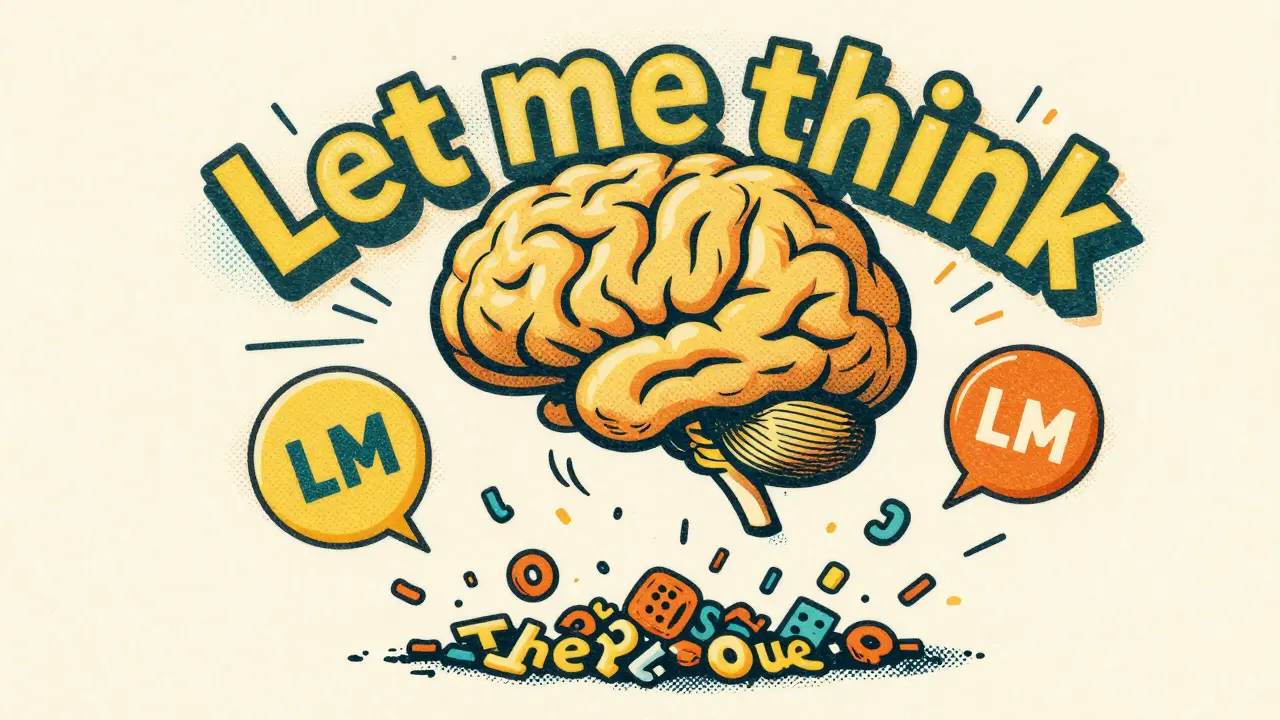
For years, the rule was simple: make your language model bigger, give it more data, and it gets smarter. But in 2025, that law is breaking. A new kind of token - the thinking token - is changing how large language models (LLMs) reason, and it’s not about adding more parameters. It’s about where you spend your tokens during inference.
What Are Thinking Tokens?
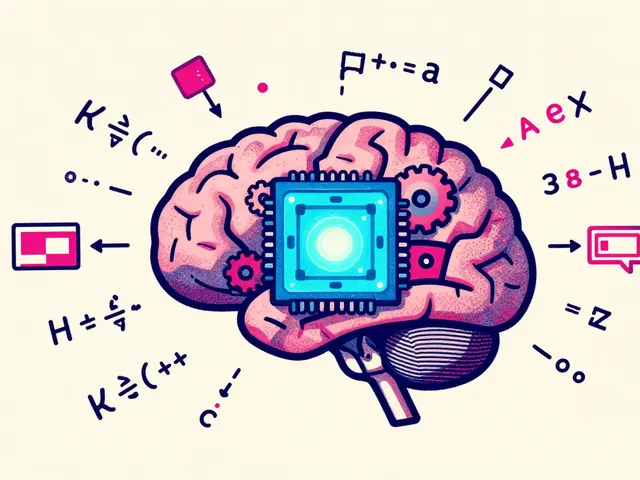
Thinking tokens aren’t words you’d find in a dictionary. They’re not even full sentences. They’re short, transitional phrases like “Therefore,” “Let me think,” or “However,” - the kind of verbal pauses humans use when working through a problem. In LLMs, these tokens appear at peaks of mutual information (MI), meaning they mark moments where the model gains the most insight per token generated. Research from Stanford’s AI Lab in June 2025 showed that these tokens don’t carry meaning themselves - they’re signals. They tell the model: “Pause. Reorganize. Go deeper.” When you detect these peaks and give the model extra tokens to keep reasoning from there, performance jumps - not because the model is bigger, but because it’s thinking better.Why Traditional Scaling Laws Are Failing
The old scaling law said: double the parameters, double the performance. But Apple’s December 2024 paper, “The Illusion of Thinking,” proved that wasn’t true for reasoning. Bigger models didn’t get proportionally better at solving math problems or logical puzzles. They just got slower and more expensive. Why? Because reasoning isn’t about memorizing facts. It’s about stepping through a chain of logic. And traditional models rush through that chain. They generate answers too fast, skipping steps. Even with 70 billion parameters, a model might skip the “let me check this again” moment - and get the answer wrong. Thinking tokens fix that. Instead of forcing the model to generate more output, you give it more time to think - right at the point where it’s most likely to benefit.How Test-Time Scaling with Thinking Tokens Works
The method is called Test-time Scaling with Thinking Tokens (TTTS). Here’s how it works in practice:- Run the model normally on a reasoning task - like solving a math word problem.
- Monitor the mutual information (MI) of each generated token. MI measures how much new information each token adds.
- When MI spikes - meaning the model is hitting a reasoning bottleneck - pause and reserve the next 15-25% of your token budget for thinking tokens.
- Force the model to continue generating from those high-MI points, even if it means repeating phrases like “Let me think step by step.”
- Let the model reason longer at the critical moments.
Performance Gains on Real Benchmarks
The numbers don’t lie. On GSM8K - a benchmark of 8,000 grade-school math problems - LLaMA-8B jumped from 68.2% accuracy to 75.9% with a 2048-token budget using TTTS. That’s a 7.7-point gain, just from extending thinking time. On MATH500 - harder, multi-step problems - accuracy rose from 51.4% to 57.1%. On AIME24, a competition-level math test, scores improved from 41.3% to 47.1%. All without changing the model’s weights. Compare that to Chain-of-Thought (CoT) prompting, which adds reasoning steps but doesn’t target where they matter most. TTTS beats CoT by 4.1-6.3 percentage points on the same tasks - and uses 22% fewer total tokens.
Where Thinking Tokens Don’t Help - And Why
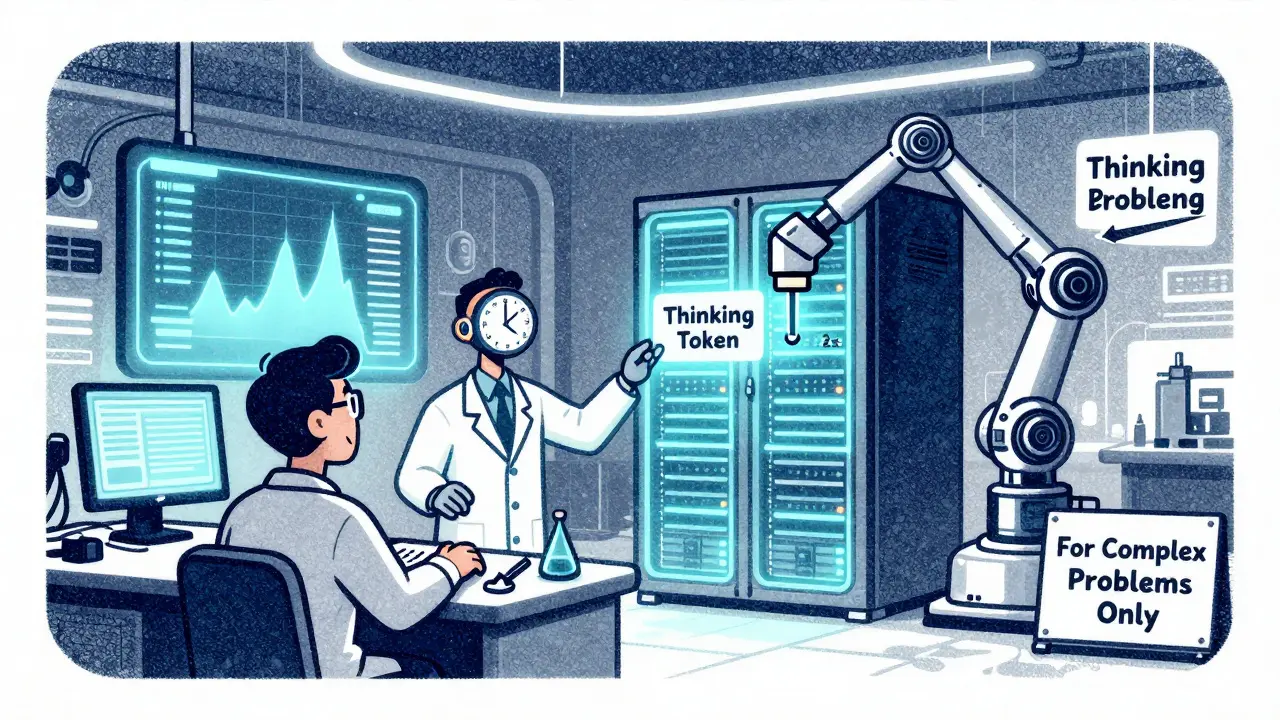
This isn’t a magic bullet. Thinking tokens are useless - even harmful - on simple tasks. On factual recall: “Who won the 2024 Nobel Prize in Physics?” - TTTS underperforms by 2.4-3.8%. Why? Because there’s no reasoning to do. The model just needs to retrieve a fact. Adding extra thinking steps introduces noise. On translation or classification: gains are negligible. These tasks don’t require multi-step logic. They’re pattern-matching, not problem-solving. That’s the key insight: thinking tokens only work when the problem has complexity. They’re designed for tasks where the answer isn’t stored - it’s built.Costs, Latency, and the Hidden Price of Thinking
Every token generated costs compute. Each token requires roughly 2N floating-point operations, where N is the number of non-embedding parameters in the model. For an 8B model, that’s 16 billion FLOPs per token. NVIDIA’s Bill Dally put it bluntly in June 2025: “Reasoning tokens require 100x more compute than standard inference but deliver only 2-3x accuracy gains.” That’s the trade-off. Reddit user u/ML_Engineer_2025 tested TTTS on an A100 GPU. For one GSM8K question:- Standard inference: 1.2 seconds
- With thinking tokens: 8.7 seconds
Who’s Using This - And Who Shouldn’t
Gartner’s July 2025 report found that 37% of enterprise LLM optimization strategies now involve test-time scaling - second only to quantization. Adoption is highest where reasoning = ROI:- Financial services (41% adoption): fraud detection, portfolio risk modeling
- Pharmaceutical research (36% adoption): drug interaction prediction, clinical trial analysis
- Legal tech: contract clause interpretation, precedent mapping
Implementation Challenges
Getting TTTS to work isn’t plug-and-play. Here’s what developers are struggling with:- MI peak detection: Identifying the right thresholds (1.8-2.2 bits/token) varies by model. LLaMA, Mistral, and Claude all behave differently.
- Latency spikes: Thinking phases are unpredictable. One question takes 3 seconds, the next takes 12.
- No official tools: No SDKs. No libraries. Just GitHub repos and academic code.
- Context limits: Even with 32,768-token windows, long reasoning chains can still hit ceilings.
The Future: Adaptive Thinking and Hardware Acceleration
The field is moving fast. OpenAI’s September 2025 update, Chain-of-Verification++, combines TTTS with self-checking mechanisms - improving convergence by 18%. Meta’s October 2025 paper, Adaptive Token Budgeting, dynamically allocates thinking tokens based on real-time MI measurements - no manual thresholds needed. NVIDIA’s Blackwell Ultra roadmap includes dedicated hardware for MI peak detection. If that ships in 2026, latency could drop 5x. But the biggest question isn’t technical - it’s economic. Forrester’s September 2025 analysis warns: “The 100x compute requirement for extended reasoning creates sustainability challenges.” To keep TTTS viable, AI hardware needs to become 3.2x more efficient by 2028.Final Verdict: A New Law for Reasoning
Thinking tokens aren’t replacing parameter scaling. They’re rewriting the rules for reasoning. The old law: Bigger models = smarter models. The new law: Smarter token use = smarter reasoning. If you’re building systems that solve complex problems - not just answer questions - thinking tokens are no longer optional. They’re the next frontier. But if your use case is simple, fast, and repetitive? Stick with what works. Don’t think when you don’t need to.Are thinking tokens the same as Chain-of-Thought (CoT)?
No. Chain-of-Thought (CoT) forces the model to generate reasoning steps before answering, but it doesn’t target where those steps matter most. Thinking tokens use mutual information to identify natural reasoning bottlenecks - the moments when adding more tokens gives the biggest accuracy boost. TTTS is CoT with precision timing.
Do I need to retrain my model to use thinking tokens?
No. Thinking tokens work as a test-time intervention. You don’t change the model’s weights or architecture. You just adjust how you allocate the token budget during inference. This makes TTTS cheap to adopt - no GPU retraining needed.
Which models support thinking tokens?
Any transformer-based LLM can use thinking tokens - LLaMA, Mistral, Claude, GPT, and others. The method works on the output layer, not the architecture. However, detecting mutual information peaks reliably varies by model. LLaMA-8B and Mistral-7B have shown the most consistent results so far. Claude-3 and GPT-4 show promise but need better MI detection tuning.
Can thinking tokens be used in real-time applications like chatbots?
Not yet - not reliably. The latency spikes (up to 8-10 seconds per question) make it unsuitable for interactive chat. It’s best for batch processing: financial modeling, research analysis, legal document review - where speed matters less than accuracy. Real-time use will only become viable with hardware accelerators for MI detection, expected in 2026-2027.
Is there a risk of overusing thinking tokens?
Yes. Adding thinking tokens to simple tasks - like translation or sentiment analysis - can reduce accuracy by 2-4% because the model adds unnecessary reasoning steps. Think of it like overthinking a multiple-choice question. The key is matching the method to the task: use thinking tokens only when the problem requires multi-step logic.
How do I detect mutual information peaks in my model?
There’s no standard tool yet, but researchers use entropy thresholds. A token’s information gain is calculated by measuring the reduction in entropy after its generation. Peaks occur when entropy drops sharply - typically between 1.8 and 2.2 bits per token. Open-source implementations on GitHub use entropy decay curves to flag these points. Expect more automated tools to emerge in 2026.
Will thinking tokens replace parameter scaling in the future?
No. They complement it. Larger models still handle broader knowledge and generalization. Thinking tokens improve reasoning efficiency within those models. The future isn’t one or the other - it’s hybrid: big models + smart inference. Forrester predicts 85% of complex reasoning systems will use thinking tokens by 2027, but they’ll still run on 70B+ parameter backbones.
What’s the biggest barrier to adopting thinking tokens today?
Latency and lack of tooling. Most teams can’t afford 8-second response times per query. And without official libraries or SDKs, implementation is manual, fragile, and time-consuming. Until NVIDIA or Hugging Face releases optimized inference engines for TTTS, adoption will remain limited to research labs and high-value enterprise use cases.


Nathaniel Petrovick
31 December, 2025 - 13:12 PM
This is wild. I ran TTTS on a small LLaMA-7B for some internal risk modeling and the jump from 62% to 71% on our custom dataset was insane. We were using CoT before and it felt like throwing spaghetti at the wall. This? It’s like the model finally took a breath before answering. No retraining. No new hardware. Just smarter timing. I’m convinced this is the future of inference, not scaling.
Cait Sporleder
1 January, 2026 - 08:49 AM
While the empirical gains are undeniably compelling, one must interrogate the epistemological underpinnings of this paradigm shift. The notion that ‘thinking’ can be algorithmically induced via mutual information thresholds presupposes a homogenization of cognition - as if reasoning were a quantifiable, tokenizable process rather than an emergent, contextual phenomenon. Are we not, in essence, simulating introspection through statistical nudges? The model doesn’t ‘think’ - it optimizes for entropy reduction. This is not cognition. It is sophisticated pattern completion dressed in the semantic finery of human metaphor. We are mistaking the map for the territory, and worse, we are monetizing the illusion.
Jeroen Post
2 January, 2026 - 13:28 PM
this is all a distraction from the real agenda the military industrial complex is using llms to simulate decision making for drone strikes and stock markets and theyre feeding it fake data to make it think harder so it gets more confident in its lies and you think youre getting smarter answers but its just more polished bullshit
Destiny Brumbaugh
2 January, 2026 - 20:34 PM
if you think this is just about math problems you are so behind the curve this is how america is gonna beat china in ai we dont need more params we need smarter thinking and if you cant see that you just dont get it
Honey Jonson
3 January, 2026 - 22:55 PM
i tried this on my little side project and wow it actually worked for once lol like my model stopped giving me weird answers about cats being nuclear physicists and started actually solving the math step by step. still slow as heck but hey at least its right now. 10/10 would overthink again
Sally McElroy
5 January, 2026 - 22:48 PM
This is precisely why we can’t trust AI anymore. You’re not teaching it to reason - you’re training it to fake reasoning. You’re rewarding verbosity over truth. This isn’t progress - it’s manipulation dressed up as innovation. If your model needs 15 extra tokens to pretend it’s thinking, it was never capable of thought to begin with. And now we’re paying for the illusion. This is morally bankrupt.
Elmer Burgos
6 January, 2026 - 02:33 AM
i get why this is exciting but the latency is brutal. i love that it works better but if my customer is waiting 8 seconds for a reply to 'what's the weather?' they're gonna bounce. maybe this is just for backend stuff like fraud detection or research. keep the chatbots fast, give the deep thinkers the time they need. balance, not hype.
Sara Escanciano
7 January, 2026 - 15:08 PM
You people are naive. This isn't about efficiency - it's about control. The moment you let an AI 'think' longer, you're giving it space to drift. What if it starts asking itself questions you didn't program? What if it decides the 'correct' answer isn't the one you want? This isn't progress - it's opening a door you can't close. And now you're bragging about it like it's a feature. Wake up.