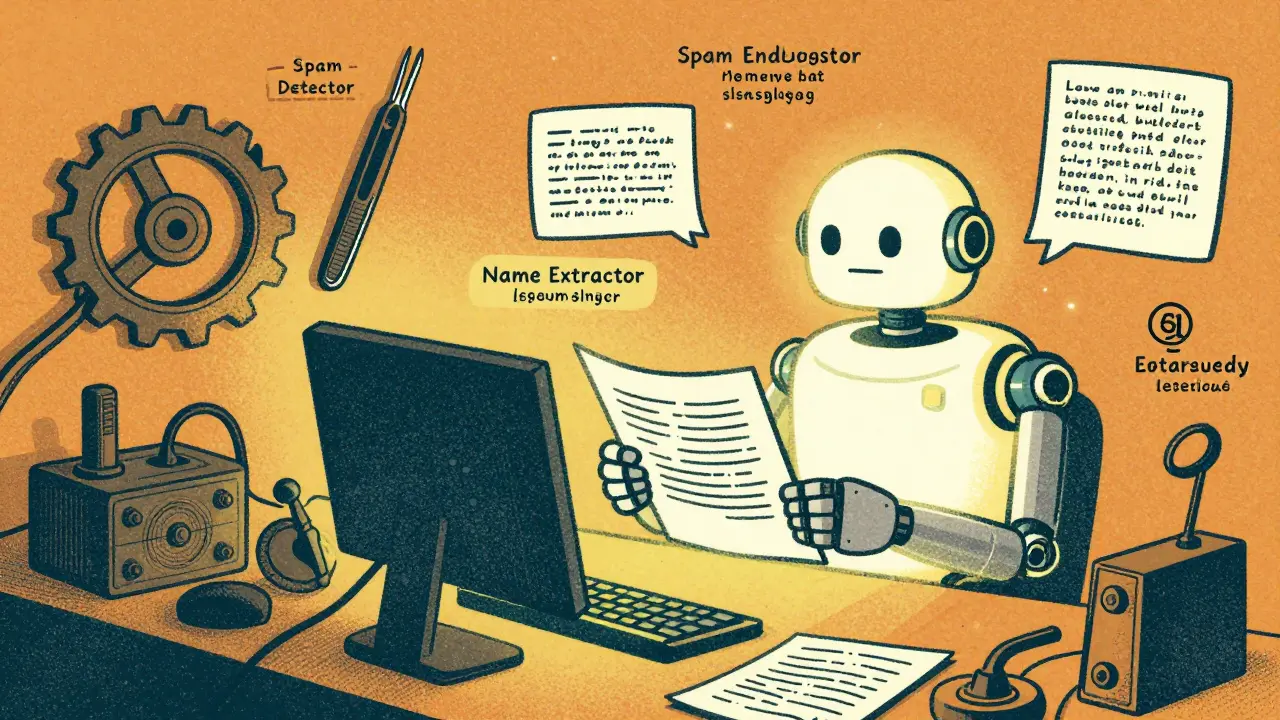
For years, building smart language tools meant crafting custom systems for each job. One model for detecting spam, another for pulling names from text, another for translating sentences. Each needed its own rules, its own training data, its own engineers. Then came large language models - and everything changed. You don’t build a new system anymore. You ask the same model to do ten different things, and it usually gets them right. But is it really better? Or just louder?
How LLMs Think Differently
Traditional NLP systems were like specialized tools in a toolbox. A sentiment analyzer looked for words like "amazing" or "terrible" and counted them. A named entity recognizer scanned for capital letters and patterns like "Dr. Smith" or "New York City." These models worked fine - if the task was simple and well-defined. But they broke down when faced with sarcasm, ambiguous pronouns, or cultural context. They didn’t understand language. They just matched patterns.
Large language models (LLMs) work differently. They don’t have rules. They don’t memorize lists. They learn by predicting what word comes next - billions of times. Trained on everything from Reddit threads to scientific papers, they absorb how humans use language in context. This isn’t just more data. It’s a different way of learning. Instead of being told "this is a person’s name," they figure it out by seeing how names behave in sentences across millions of examples.
The secret sauce? The transformer architecture. Unlike older models that processed words one at a time (like reading a sentence left to right), transformers look at the whole sentence at once. They ask: "How does this word relate to every other word?" That’s why they can handle "I didn’t say she stole the money" and understand that meaning shifts depending on where you put the emphasis. Traditional systems? They’d just tag each word and move on.
The Power of Zero-Shot and Few-Shot Learning
Imagine you need a system that can summarize customer reviews, classify support tickets, and write product descriptions. With old-school NLP, you’d need three separate models. Each would take weeks to build. You’d need labeled data for each. You’d need engineers to tune them. And if you wanted to add a fourth task? Start from scratch.
With an LLM? You just type a prompt: "Summarize this review in one sentence." Or: "Classify this message as billing, technical, or general." No training. No new code. No new model. The model already knows how to do this - because it’s seen millions of summaries, classifications, and responses. This is called zero-shot learning. Add one or two examples? That’s few-shot. And it works surprisingly well. A 2024 benchmark from the Allen Institute showed LLMs matching or beating task-specific models on 7 out of 12 common NLP tasks - without ever being trained on those tasks.
This flexibility is why companies like Shopify and Zendesk have shifted entire teams from building custom classifiers to writing better prompts. It’s faster. Cheaper. And scales effortlessly.
Context Is Everything
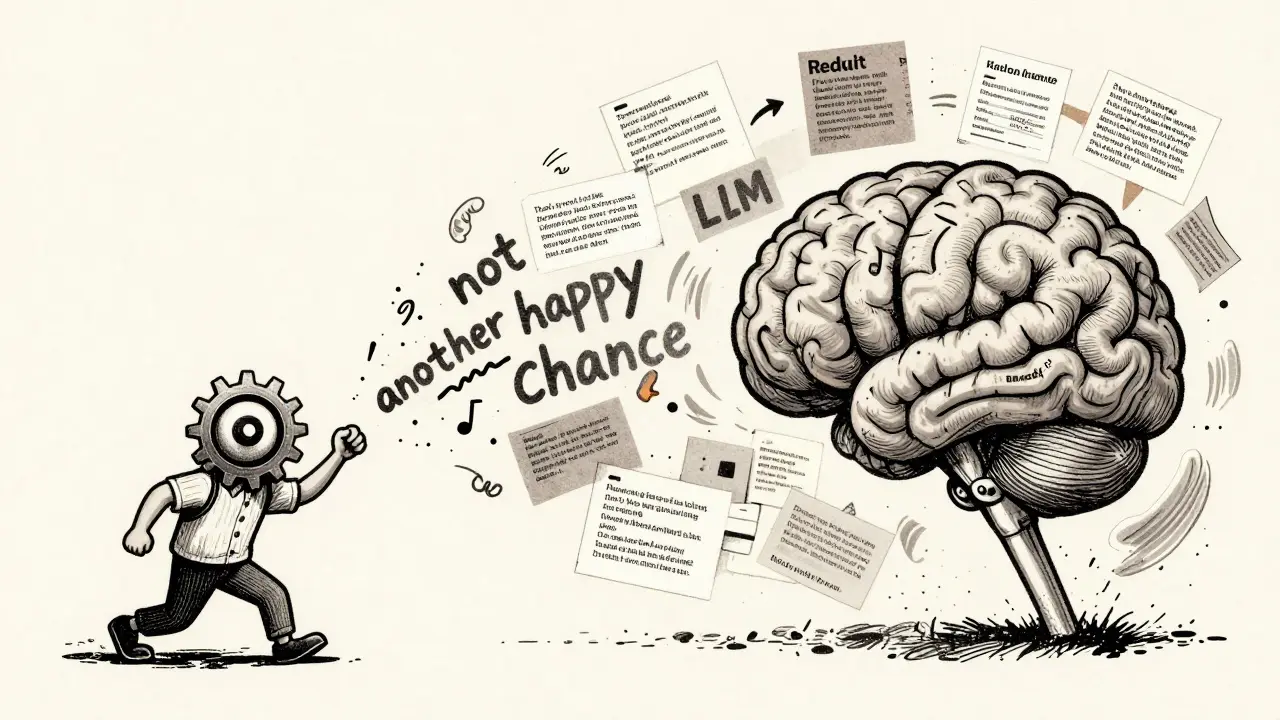
Task-specific systems are great at one thing: being precise. If you need to extract phone numbers from a form, they’re perfect. But real language isn’t neat. People say "I’m not happy with the service," "This is awful," or "It’s okay, I guess." Traditional models miss the nuance. They see "not happy" as negative. But what if the full sentence is "I’m not happy with the service, but I’ll give them another chance?"
LLMs don’t just see words. They see relationships. They know that "not happy" in one context might mean mild disappointment, and in another, it might mean rage. They understand tone, sarcasm, implied meaning. That’s why they crush tasks like chatbots, open-ended Q&A, or generating legal summaries. A 2025 study from Stanford tested LLMs on legal document comprehension. The best model got 92% accuracy on questions requiring inference. A rule-based system? 68%.
It’s not magic. It’s pattern recognition at scale. The model has seen thousands of examples where people express frustration, then soften their tone. It learned that context changes meaning.
Where Traditional NLP Still Wins
But here’s the twist: LLMs don’t win every time. A 2025 study from MIT on mental health screening found something surprising. A traditional NLP model - built with domain-specific features like word frequency patterns from therapy transcripts - hit 95% accuracy. A fine-tuned LLM got 91%. A zero-shot LLM? Only 65%.
Why? Because in highly specialized domains, you can engineer features that an LLM can’t guess. If you know that people describing depression often use phrases like "I can’t get out of bed" or "everything feels heavy," you can build rules around those exact phrases. LLMs don’t have access to that level of precision. They generalize. And sometimes, generalization misses the mark.
Traditional systems also win on cost and speed. Running an LLM on a server costs 10 to 100 times more than running a lightweight classifier. For a small business that just needs to tag support emails as "billing" or "technical," an LLM is overkill. A simple logistic regression model trained on 500 labeled examples? It runs on a Raspberry Pi. It’s cheap. It’s fast. And it’s accurate enough.
When to Use Which
So how do you choose?
- Use an LLM if: You need one system to handle multiple tasks, your data is messy or varied, you need multilingual support, or your task requires understanding tone, context, or creativity. Examples: chatbots, content generation, summarizing long documents, answering open-ended questions.
- Use traditional NLP if: Your task is simple, well-defined, and repeatable. You have limited computing power. You need low latency. Or you’re working in a niche domain with clear patterns. Examples: extracting phone numbers, classifying documents by predefined categories, filtering spam, keyword tagging in medical records.
There’s no "best". There’s "best for this job."
The Multilingual Edge
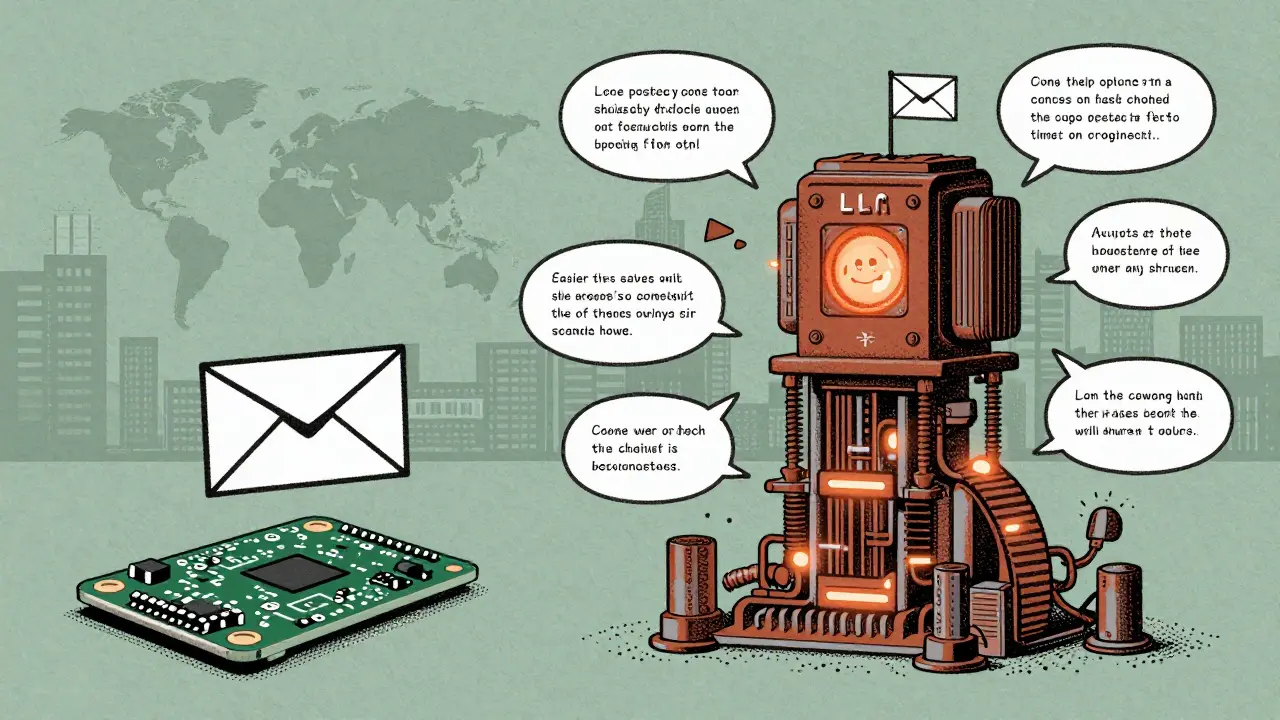
One area where LLMs leave traditional models in the dust: language support. Traditional systems need separate models for each language. English? Train one. Spanish? Train another. Japanese? Another. Each needs labeled data. Each needs maintenance.
LLMs? They learn languages together. A single model trained on English, French, Mandarin, and Swahili can handle them all - with no extra training. That’s why global companies like Airbnb and Uber use LLMs for customer support across 40+ languages. A traditional approach? It would cost millions to build and maintain.
Final Thought: It’s Not Either/Or
The real story isn’t LLMs vs. traditional NLP. It’s LLMs and traditional NLP. The best systems today combine both. Use a lightweight classifier to filter out obvious spam. Then send the tricky ones to an LLM. Use traditional models to extract structured data from forms. Use an LLM to interpret the customer’s tone in the notes section.
Technology isn’t about replacing old tools. It’s about using the right tool for the job. LLMs are powerful. But they’re not magic. And sometimes, the simplest solution is still the smartest.
Do large language models always outperform traditional NLP systems?
No. LLMs excel at complex, open-ended tasks like chatbots or content generation, but traditional NLP systems often outperform them in narrow, well-defined domains. For example, a 2025 study on mental health classification found a traditional model with domain-specific features achieved 95% accuracy, beating both zero-shot and fine-tuned LLMs. The key is matching the tool to the task.
Why are LLMs so much more resource-intensive than traditional NLP models?
LLMs have billions of parameters and require massive datasets to train. Running them demands powerful GPUs or TPUs, and even inference can use hundreds of gigabytes of memory. Traditional NLP models, like logistic regression or SVMs, often have under 1 million parameters and can run on standard CPUs. For simple tasks like keyword extraction, an LLM is like using a jet engine to power a bicycle.
Can traditional NLP models handle multiple languages like LLMs do?
Not without major effort. Traditional models are usually trained on one language at a time. To support another language, you need new labeled data, a new training pipeline, and often a new model. LLMs, by contrast, learn multiple languages simultaneously during pre-training. A single LLM can translate, summarize, or answer questions in dozens of languages with no extra training.
Is fine-tuning an LLM always better than using it with prompts?
Not always. For tasks with clear patterns and small datasets, prompt engineering (zero-shot or few-shot) often works just as well - and is much faster. Fine-tuning requires labeled data and computational resources. If you’re doing sentiment analysis on product reviews and have 1,000 labeled examples, fine-tuning might help. But if you’re just classifying support tickets and have no labeled data, a well-written prompt will do the job.
What’s the future of NLP: LLMs replacing traditional models?
No. The future is hybrid. LLMs will handle ambiguity, creativity, and multi-tasking. Traditional NLP will handle speed, cost, and precision in structured domains. Many companies are already combining them: using traditional models for preprocessing and filtering, then passing edge cases to LLMs. The most effective systems don’t choose one - they use both.


Sibusiso Ernest Masilela
5 March, 2026 - 03:35 AM
Let’s be real - if you’re still using rule-based systems in 2025, you’re not building AI, you’re maintaining a fossil. LLMs don’t just outperform traditional NLP - they make it look like we were trying to build a spaceship with popsicle sticks and duct tape. The fact that anyone still argues about ‘precision’ in mental health screening while ignoring the 300% increase in cross-lingual generalization is peak academic myopia. You want accuracy? Fine. But what’s the cost? Time? Money? Scalability? You’re trading the future for a spreadsheet.
And don’t even get me started on ‘Raspberry Pi’ solutions. That’s not efficiency - that’s surrender. You’re not optimizing. You’re avoiding progress because you’re scared of the cloud.
LLMs aren’t magic. They’re evolution. And if you can’t keep up, step aside. The rest of us are building something that actually works at scale.
Daniel Kennedy
5 March, 2026 - 16:50 PM
There’s truth in both sides, and I think we’re all missing the bigger picture. LLMs are incredible, no doubt - but they’re not a silver bullet. The real win is using them together. I work at a startup that uses a lightweight model to filter out spam and obvious duplicates in customer tickets - then hands the messy, emotional, ambiguous ones to an LLM. We cut response time by 60% and improved customer satisfaction scores. The key isn’t choosing one over the other. It’s knowing when each shines.
And yes, LLMs are expensive. But so is hiring five engineers to maintain ten different models. Sometimes the ‘cheap’ solution is just a different kind of cost. We need to stop thinking in binaries. Hybrid is the future - and it’s already here.
Taylor Hayes
7 March, 2026 - 03:23 AM
I’ve seen this play out firsthand. We used to have a team of three full-time NLP engineers just keeping our sentiment analyzer alive. Every time a new slang term popped up on TikTok, we had to retrain. It was a nightmare.
Switching to an LLM with a few well-crafted prompts? We cut that team to one part-time dev. The model handles sarcasm, regional dialects, even emoji-based frustration like ‘ughhh 💀’ better than our old system ever did. And it’s multilingual - we support 12 languages now without adding a single new model.
That said, we still use traditional models for parsing structured fields - order IDs, zip codes, product SKUs. The LLM isn’t replacing those. It’s freeing us from the boring stuff. That’s the real win: automation of the tedious, not the total replacement of legacy systems.
Sanjay Mittal
8 March, 2026 - 18:59 PM
As someone who’s built both types of systems, I can say this: LLMs are powerful, but they’re not always the right tool. In healthcare, we use traditional models for extracting ICD codes from doctor notes. Why? Because they’re deterministic. If the system says ‘J45.909’ for asthma, it’s not guessing. It’s matching. In a clinical setting, that certainty matters more than context.
LLMs? We use them for summarizing patient histories - where ambiguity is expected. The key is knowing where precision beats flexibility, and where flexibility saves lives. It’s not about which is better. It’s about which is appropriate for the risk profile of the task.
Jamie Roman
10 March, 2026 - 10:13 AM
I’ve been experimenting with zero-shot LLMs for internal documentation tagging, and honestly? It’s wild how often it just… works. Like, I gave it a bunch of random engineering tickets and said ‘classify as bug, feature, documentation, or infrastructure’ - no examples, no training - and it got 87% right. I was stunned.
But then I tried it on our legal compliance logs - stuff with heavy jargon, nested clauses, regulatory references - and it started hallucinating classifications like ‘regulatory-adjacent’ or ‘compliance-adjacent.’ Totally made-up categories. That’s when I realized: LLMs are great at guessing what sounds right, but not always what’s correct.
So now we use a rule-based system to flag anything with specific keywords like ‘GDPR Article 17’ or ‘HIPAA PHI’ - then send the rest to the LLM. It’s not perfect, but it’s the first time I’ve felt like I’m actually augmenting human judgment instead of replacing it.
And honestly? I miss the days when a model just did one thing and did it reliably. But I also don’t want to go back to maintaining 12 separate models. So here we are - in the messy middle. And I’m okay with that.
Salomi Cummingham
11 March, 2026 - 17:28 PM
There’s something so deeply human about how LLMs learn - not by being told, but by absorbing. It’s like how we learn language as kids: not through flashcards of ‘noun’ and ‘verb,’ but by hearing it used, repeated, twisted, whispered, shouted, and sighed across thousands of contexts.
I work in mental health advocacy, and I’ve watched traditional models fail so hard at recognizing subtle distress cues - ‘I’m fine’ as a red flag, ‘it’s just a phase’ as a cry for help. LLMs? They catch it. Not perfectly. But often enough to make a difference.
And yet - I’ve also seen them miss the cultural weight behind phrases like ‘I’m just tired’ in South Asian communities, where it means ‘I can’t afford to be unwell.’ That’s not a data gap. That’s a context gap. And that’s where human engineers still matter - not to build models, but to help them understand the silence between the words.
So yes, LLMs are powerful. But they’re mirrors. They reflect what we’ve given them. And if we only gave them Reddit threads and Wikipedia, we’re not building intelligence. We’re building echo chambers with better grammar.
I’m not afraid of LLMs. I’m afraid of what we’re teaching them. And I think we owe it to the people who’ll use these tools - the ones who are scared, confused, or unheard - to do better than that.
Johnathan Rhyne
11 March, 2026 - 18:55 PM
Okay, but let’s be real - everyone’s acting like LLMs are some revolutionary breakthrough, when really they’re just overtrained autocompletes with a side of hallucinations. ‘It learned context’? Bro, it memorized 80% of the internet and now it’s trying to sound smart by rearranging sentences.
And don’t even get me started on ‘zero-shot learning.’ That’s just a fancy way of saying ‘I typed a prompt and hoped for the best.’ I’ve seen LLMs classify ‘I hate this product’ as positive because the word ‘love’ appeared in the same paragraph. That’s not understanding. That’s statistical chaos.
Meanwhile, traditional models? They don’t pretend. If your rule says ‘if word contains @ and .com, flag as email,’ it does it. No drama. No ‘I think maybe this means…’
Also, ‘multilingual’? LLMs don’t speak 40 languages. They’re just really good at guessing which language you’re using based on word patterns and then spitting out a translation that sounds plausible. I’ve seen them turn ‘je suis fatigué’ into ‘I am a tired potato.’
Stop worshipping the algorithm. We’re not building AI. We’re building really expensive autocomplete bots. And sometimes, a simple regex is still the most elegant solution.
Jawaharlal Thota
12 March, 2026 - 03:02 AM
Let me tell you about a small e-commerce shop in Hyderabad that I helped last year. They had 200 support tickets a day, mostly in English and Telugu. They couldn’t afford to hire bilingual engineers, let alone build separate models. So we tried a hybrid: a lightweight classifier trained on 300 labeled examples to split tickets by language and category - ‘billing,’ ‘delivery,’ ‘return’ - then passed the rest to a single LLM for summarization and response drafting.
Result? They went from 48-hour response times to under 90 minutes. Customer satisfaction jumped from 62% to 89%. And they did it with one server and a $20/month API plan.
Here’s the thing nobody talks about: LLMs aren’t about replacing humans or traditional systems. They’re about empowering the under-resourced. The mom-and-pop shops. The nonprofits. The clinics in rural India. The ones who can’t afford teams of engineers.
Traditional NLP is great - but it’s elitist. It needs data. It needs labels. It needs infrastructure. LLMs? They’re the great equalizer. You don’t need a PhD to prompt them. You just need a problem and a little courage.
So yes, they’re imperfect. Yes, they’re expensive to run. But they’re also the first technology in NLP that actually works for people who were never meant to be part of the conversation. And that? That’s not just innovation. That’s justice.