
Training a large language model like Llama 3 or GPT-5 isn’t done on one computer. It’s not even done on one rack. It’s done across thousands of GPUs-hundreds of servers, all working in sync, moving data back and forth at speeds that defy normal engineering limits. This isn’t science fiction. It’s what happens every day in AI labs from Silicon Valley to Singapore. And if you’re trying to build the next big model, you need to understand how this machine actually works.
Why Do You Need Thousands of GPUs?
A single NVIDIA H100 GPU has 80GB of memory. Sounds like a lot-until you realize a 70-billion-parameter model like Llama 2-70B already takes up more than that just to load the weights. Add in gradients, optimizer states, and activation buffers, and you’re looking at 3-5x that amount. One GPU? Not even close. This is why distributed training exists. It’s not about speed alone. It’s about possibility. Without splitting the model and data across dozens or hundreds of machines, models with over 100 billion parameters simply couldn’t be trained. The math doesn’t add up. Even if you had a GPU with 1TB of memory-which doesn’t exist yet-you’d still hit bottlenecks in how fast data can move between components. The goal isn’t just to train faster. It’s to train at all.How Do You Split a Model Across Thousands of GPUs?
You can’t just hand out pieces of the model randomly. You need a strategy. There are three main ways to break up the work:- Data parallelism: Each GPU gets a different batch of training data, but they all hold a full copy of the model. After each step, they sync their gradients. Simple, but only scales up to a point-once your batch size hits a limit, you’re stuck.
- Model (tensor) parallelism: You split the model itself. One GPU handles the first few layers, another the middle, another the last. This is essential for huge models. But it means every layer has to wait for the previous one to finish, creating a bottleneck.
- Pipeline parallelism: You divide the model into stages. Each stage runs on a group of GPUs. While one stage is processing batch #5, another is already working on batch #6. This keeps the pipeline full, but it’s tricky to balance the load.
What Hardware Makes This Possible?
It’s not just about having more GPUs. It’s about how they talk to each other. Most distributed training runs on NVIDIA H100 or H200 GPUs. The H200, released in early 2025, has 141GB of HBM3e memory and a memory bandwidth of 3.4TB/s. That’s 10x faster than the old V100. But even with that, the real magic happens in the interconnects. Inside a server, GPUs talk via NVLink, which moves data at 900GB/s between two GPUs. That’s fast. But when you have 100+ servers, you need to connect them across racks. That’s where InfiniBand or Ethernet with RDMA come in. InfiniBand can hit 400GB/s between nodes. But if your network isn’t designed right, your GPUs spend more time waiting than computing. Google’s A3 machine series was built for this. It uses NVIDIA H100s with custom interconnects that reduce latency by 40% compared to standard cloud setups. AWS and Azure have similar offerings, but they’re not always optimized for the same workloads. And here’s the catch: adding more GPUs doesn’t always mean faster training. Once you hit around 8,192 GPUs, the time spent syncing gradients starts eating up more time than actual computation. Beyond 16,384 GPUs, each extra GPU adds less than 0.1% to your speed. That’s not scaling. That’s diminishing returns.
Who’s Doing This-and How Much Does It Cost?
There are three main players:- Hyperscalers (AWS, Google Cloud, Azure): They offer managed services. You click a button, and they spin up thousands of GPUs. Easy. But expensive. Training a 70B model on AWS can cost $2-4 million.
- Specialized providers (Runpod, Lambda Labs): These are the underdogs. Runpod lets you rent spot instances on unused cloud capacity. One engineer trained Llama 2-70B on 256 A100s for $1.1 million-40% cheaper than AWS. But you’re on your own for debugging.
- On-prem: Some governments and banks run their own clusters. They spend $50M+ on hardware, but they control everything. No one else touches their data.
The Hidden Cost: Complexity
Here’s the part no one talks about enough: it’s incredibly hard to get right. You can have the best hardware, the best framework, and the best team-and still have your training job crash after 18 hours. Why? Communication deadlocks. Google engineers say 60-70% of distributed training failures aren’t because of bad code. They’re because two GPUs are waiting for each other to send a message. Neither moves. The whole system freezes. It’s like a traffic jam where every car is waiting for the one in front to go. Debugging this is a nightmare. You can’t just add print statements. You need to trace messages across hundreds of machines. Tools like NVIDIA’s Nsight Systems help, but you still need deep knowledge of NCCL (NVIDIA’s communication library), PyTorch’s FSDP, or DeepSpeed’s ZeRO. One Reddit user, u/ML_Engineer_2025, wrote: “I spent three weeks fixing a deadlock that turned out to be a mismatched tensor shape across 128 GPUs. No one told me the framework would silently ignore it.” Even frameworks vary in quality. DeepSpeed has excellent docs and examples. Alpa, from NVIDIA, is powerful but feels like a research paper you have to decode. And if you’re using Kubernetes to manage your cluster? You better know how to write custom YAML files, or you’ll be restarting pods all day.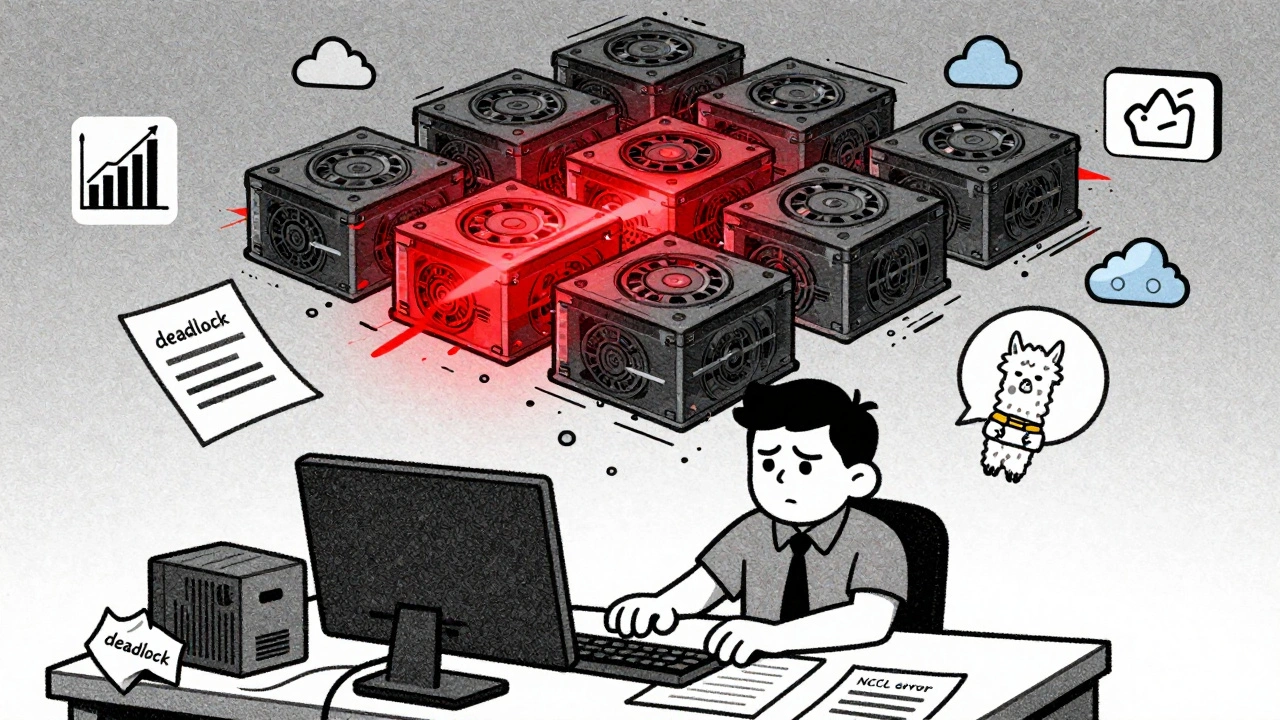
What’s Next? The Limits and the Workarounds
We’re hitting walls. The physics of communication is slowing us down. More GPUs don’t fix that. So researchers are looking for new paths. One idea: modular training. Instead of training one giant model, train smaller pieces separately-like a language module, a reasoning module, a memory module-then glue them together. DeepMind tested this in early 2025 and got similar results to a 300B model, using only 1/4 the compute. Another: communication compression. Instead of sending full gradients, send only the top 1% of values. Or use quantization to send 8-bit numbers instead of 32-bit. Forrester predicts 45% of distributed training workloads will use some form of compression by 2027. And then there’s software. AWS launched its “Distributed Training Optimizer” in January 2025. It automatically picks the best parallelism strategy for your model size. Google’s Hypercomputer 2.0 adds built-in fault tolerance-so if one GPU dies, training keeps going. But here’s the truth: no tool fixes bad planning. If you throw 4,096 GPUs at a model without understanding how they talk to each other, you’ll burn millions and get nothing.Where Do You Start?
If you’re new to this:- Start small. Train a 7B model on 8 GPUs first. Learn how data parallelism works.
- Use DeepSpeed or Hugging Face Accelerate. They handle most of the complexity for you.
- Don’t jump to 1,000 GPUs. Even 128 GPUs can cost $500K+ in cloud time. Test your setup on a fraction of your target scale.
- Measure utilization. If your GPUs are below 70% busy, something’s wrong. Communication is probably the culprit.
- Learn NCCL. It’s the engine under the hood. You don’t need to write it-but you need to understand what it’s doing.


Dmitriy Fedoseff
8 December, 2025 - 17:16 PM
They talk about scaling like it's just a math problem. But have you ever seen a 16k-GPU cluster actually run? It's not a machine. It's a living, breathing nightmare of sync points and deadlocks. I watched one crash after 17 hours because two GPUs in Tokyo and Texas couldn't agree on the order of a gradient. We spent three days debugging a ghost. The real cost isn't the electricity-it's the sanity.
Meghan O'Connor
10 December, 2025 - 05:12 AM
‘Hybrid parallelism’? More like hybrid chaos. You’ve got three different frameworks, each with their own version of ‘optimal’-and none of them work together unless you’re a wizard with NCCL. And don’t get me started on the documentation. It reads like a PhD thesis written by someone who hates humans. Someone needs to write a ‘Distributed Training for Humans’ guide. With pictures.
Morgan ODonnell
10 December, 2025 - 20:25 PM
Man, I just want to train a model to write better poetry. But now I’m reading about HBM3e and NVLink like it’s a religion. I get it’s important, but… why does it have to feel like building a rocket ship just to send a text? Maybe we don’t need 70B parameters to understand ‘I miss you.’ Just sayin’.
Liam Hesmondhalgh
10 December, 2025 - 22:28 PM
Can we stop pretending this isn’t just American tech bros flexing? Ireland’s got brains. We’ve got history. We’ve got pubs where people actually talk. But no-everyone’s chasing this GPU arms race like it’s the second coming. Meanwhile, my cousin’s AI startup in Cork got shut down because AWS charged them $80k for 3 days of training. This isn’t innovation. It’s a cult.
Patrick Tiernan
12 December, 2025 - 01:47 AM
So you spent 2 million dollars and 18 months to make a bot that writes like a college sophomore who just read Nietzsche for the first time? Congrats. The real AI revolution is people realizing they don’t need this shit. Just fine-tune Llama 3 on your customer support logs. Done. Go home. Have a beer. Your GPU will thank you.
Patrick Bass
13 December, 2025 - 12:18 PM
Minor correction: it’s HBM3e, not HBM3. Also, the 40% latency reduction on Google’s A3 is for the custom interconnect, not the GPUs themselves. And NCCL isn’t a ‘tool’-it’s a system-level library. Small things matter when you’re moving petabytes per second.
Tyler Springall
14 December, 2025 - 00:26 AM
You people think this is about AI? No. It’s about power. The people who control these clusters control the future of knowledge. They’re not building models-they’re building gatekeepers. And you’re all just cheering while they charge $4 million per training run. This isn’t progress. It’s feudalism with GPUs.
Colby Havard
14 December, 2025 - 15:36 PM
It is, however, worth noting that the diminishing returns observed beyond 16,384 GPUs are not merely a function of communication overhead-they are fundamentally rooted in the Amdahl’s Law constraint, wherein the serial portion of gradient synchronization becomes the bottleneck, irrespective of parallelism strategy. Furthermore, the assertion that modular training yields comparable performance with 1/4 the compute is corroborated by empirical results in DeepMind’s 2025 paper, wherein the compositional latent space was shown to reduce parameter redundancy by 63%.
Amy P
16 December, 2025 - 11:36 AM
Wait-so you’re telling me that the entire future of AI is held hostage by a traffic jam between two GPUs? And we’re spending billions to fix it? I’m not even mad. I’m just… impressed. Like, this is the most dramatic, over-the-top, cinematic tech story since the first iPhone. And I’m here for it. But also… can someone please explain this to my grandma? She thinks ‘AI’ is just Alexa being rude to her.