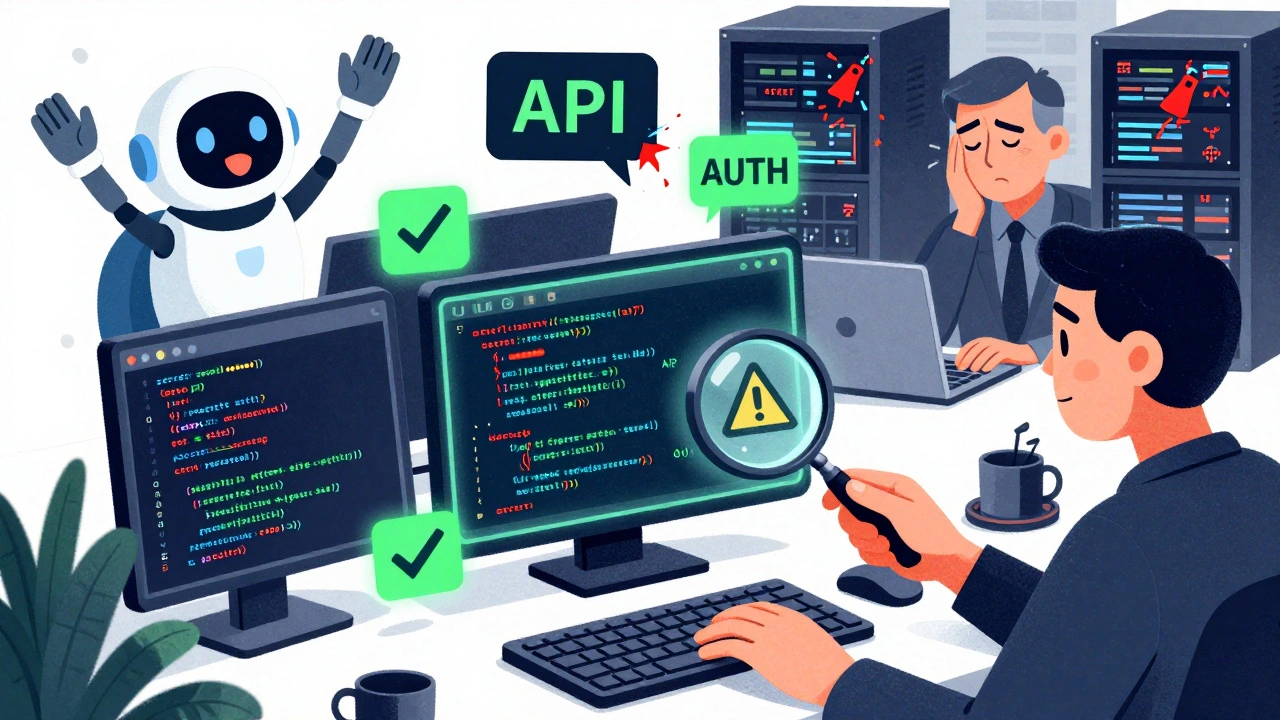
By late 2025, vibe coding isn’t just a buzzword-it’s a quiet revolution happening in developer workflows. You’ve probably heard about it: type a prompt, get working code, skip the boilerplate. Sounds like magic. But here’s the real story: 72% of developers surveyed in the 2025 Stack Overflow report aren’t using it at all. Meanwhile, 74% of those who do say they’re more productive. So what’s going on? Why do some teams thrive with vibe coding while others refuse to touch it? The answer isn’t in the tools-it’s in the questions you ask.
Why Sentiment Surveys Are the Only Real Measure of Adoption
Numbers don’t lie, but they also don’t tell the whole truth. You’ll see headlines like “Vibe Coding Adoption Soars 217%” and assume everyone’s jumping on board. But Crunchbase’s growth stats don’t tell you who’s actually using it-or why they’re scared to. The real adoption story lives in sentiment surveys. These aren’t just polls. They’re diagnostic tools that reveal the hidden friction between promise and reality. Take the data from Second Talent’s 2026 report: 63% of developers have spent more time debugging AI-generated code than writing it themselves. That’s not productivity. That’s debt. And yet, 51% faster task completion? That’s the hook. The gap between perceived gain and actual cost is exactly why surveys must dig deeper than yes/no answers. You need to know: When does vibe coding save time? When does it cost more?What to Ask: The 7 Questions That Reveal Real Adoption
Don’t ask “Do you use vibe coding?” That’s like asking “Do you use a hammer?” and expecting to understand carpentry. You need context. Here’s what actually matters:- What kind of code are you generating? Are you building UI components, API endpoints, or full-stack apps? Frontend devs use v0 by Vercel for buttons and forms. Backend devs lean on GitHub Copilot for route handlers. The tool matters less than the task.
- Do you review every line of AI-generated code? 87% of users say they use AI for code completion, but only 38% consistently audit output. Those who skip review are the ones leaking API keys into public repos. Escape Tech found over 2,000 exposed secrets in vibe-coded apps-mostly from unreviewed Supabase integrations.
- Have you ever deployed vibe-coded code to production without understanding it? 40% of junior developers admit yes. That’s not innovation. That’s risk. This question exposes the real danger: confidence without competence.
- How often do you need to rewrite or refactor AI-generated code? If you’re doing it more than once per feature, the tool isn’t saving time-it’s adding layers of complexity. The “vibe” fades fast when you’re fixing broken auth flows generated by an LLM.
- Do you trust the AI to handle edge cases? 58% of users report struggling with edge cases. An AI might generate a login form in 30 seconds, but it won’t handle password reset loops, rate limiting, or session hijacking. Human judgment is still the firewall.
- Would you use this for a mission-critical app? Only 9% of builders say yes. Compare that to 65% using visual tools like Bubble for production apps. The confidence gap isn’t about skill-it’s about accountability. You can point to a visual builder’s drag-and-drop logic. You can’t point to a prompt.
- What’s your security process for vibe-coded code? If you don’t have one, you’re already compromised. GitHub’s December 2025 update added scanning for Copilot output. Lovable rolled out mandatory secret scanning in November. If your team hasn’t updated their CI/CD pipeline to scan vibe-generated code, you’re operating on luck.
The Hidden Cost: Debugging Time vs. Speed
The biggest myth about vibe coding is that it cuts development time. It doesn’t. It shifts it. You trade typing time for review time. You trade upfront effort for technical debt. A developer might build a basic CRUD app in 10 minutes using Bolt.new. Great. But when that app starts crashing under 500 concurrent users because the AI didn’t handle database connection pooling? Now you’re spending 12 hours fixing it. That’s not efficiency. That’s a hidden tax. And it’s why senior engineers are skeptical. They’ve seen this before. Remember when developers started copy-pasting Stack Overflow snippets? Same pattern. Same risks. Same eventual reckoning.
Who’s Actually Using Vibe Coding-and Why
The users aren’t the ones you think. It’s not the senior architects. It’s not the enterprise teams. It’s:- Non-developers building personal tools-think a habit tracker or a custom dashboard for their side hustle. They don’t care about scalability. They care about “it works.”
- Junior developers trying to keep up. They’re using vibe coding to produce output fast, even if they don’t fully understand it. It’s a crutch, but it’s also a learning tool.
- Freelancers who need to deliver fast. They’re not worried about long-term maintainability. They’re worried about getting paid.
The Platforms: Lovable, Bolt.new, GitHub Copilot-What’s Really Different?
Not all vibe coding tools are equal. GitHub Copilot is a code assistant. It’s embedded in your IDE. It suggests lines. It doesn’t generate full apps. Lovable, on the other hand, is a full app generator. You say “build me a SaaS dashboard,” and it outputs React, Node, PostgreSQL, auth, Stripe-everything. That’s powerful. But it’s also dangerous. Lovable hosts over 4,000 apps. That’s 85% of the public vibe-coded ecosystem. And Escape Tech found that 92% of those apps had at least one critical vulnerability. Why? Because Lovable uses Supabase by default, and Supabase’s anonymous JWT tokens are easy to expose. The AI doesn’t know security best practices. It knows patterns. And patterns can be broken. Bolt.new is simpler. It’s great for small scripts, quick UIs, and prototypes. But it doesn’t scale. Create.xyz? Limited to 449 apps. The market is lopsided. And that skews sentiment. If 85% of the sample is from one platform with known flaws, your survey data is poisoned.
Where Vibe Coding Fits-And Where It Doesn’t
Here’s the truth: vibe coding isn’t replacing developers. It’s replacing junior coding tasks. It’s great for:- Generating boilerplate code (login flows, API clients, config files)
- Writing unit tests from function descriptions
- Creating documentation from code comments
- Building prototypes for client demos
- System architecture design
- Security-critical logic (auth, payments, data encryption)
- Legacy system integration
- Performance optimization
- Any code that must survive 3+ years of maintenance
The Future: Hybrid Development Is the Only Real Path Forward
The next generation of vibe coding won’t be about replacing code. It’ll be about augmenting judgment. Platforms that survive will integrate:- Automated security scanning built into the generator
- Code quality scores with explanations (not just “this looks good”)
- Human-in-the-loop prompts (“Do you want to add rate limiting here?”)
- Version-controlled generation logs (so you can trace what the AI changed)
By 2026, vibe coding won’t be a choice between AI and humans. It’ll be a choice between teams that use it wisely-and teams that let it run wild. The surveys that matter won’t ask if you use it. They’ll ask: How do you control it?
Is vibe coding just another name for AI code generation?
No. AI code generation is a feature. Vibe coding is a workflow. It’s not just about getting code from an AI-it’s about how you interact with it over time. Vibe coding includes iterative feedback, multi-agent collaboration, and reflection loops. It’s a system. AI code generation is a single output. Think of it like the difference between using a calculator and running a financial modeling team.
Why do so many developers say they don’t use vibe coding if it’s so productive?
Because productivity isn’t just about speed. It’s about sustainability. Many developers have tried vibe coding, got burned by buggy or insecure code, and walked away. The 74% who report productivity gains are likely the ones who use it for small, low-risk tasks. The 72% who don’t use it are the ones who’ve seen what happens when you trust AI with production systems. The data isn’t contradictory-it’s segmented.
Can vibe coding replace junior developers?
Not really. It replaces repetitive tasks, not learning. Junior devs who rely on vibe coding without understanding the output end up with gaps in their knowledge. The best junior developers use it as a tutor-not a crutch. They generate code, then study it, then rewrite it themselves. That’s how they grow. The ones who just copy-paste? They plateau fast.
Are vibe coding platforms secure?
Most aren’t-not by default. Escape Tech found over 2,000 vulnerabilities in publicly deployed vibe-coded apps. The biggest risks? Exposed API keys, anonymous JWT tokens, and hardcoded secrets. Platforms like Lovable have started fixing this, but if your team isn’t scanning generated code with tools like Trivy or Snyk, you’re leaving the door open. Security isn’t built into vibe coding-it has to be added.
Should my team adopt vibe coding?
Only if you treat it like a tool, not a replacement. Start small: use it for test generation or boilerplate. Train your team to review every line. Add automated security scans to your pipeline. Don’t let non-developers deploy vibe-coded apps to production. If you can do that, it’s a force multiplier. If you can’t, it’s a liability.
What’s the biggest mistake teams make with vibe coding?
Assuming the AI knows what it’s doing. It doesn’t. It predicts patterns based on training data. It doesn’t understand business logic, security standards, or system constraints. The biggest mistake is handing it control. The right approach is to give it tasks, then verify, test, and validate everything it produces. The AI is the assistant. You’re the architect.


Rakesh Dorwal
10 December, 2025 - 13:41 PM
Let me tell you something the tech bros won’t admit-vibe coding is just the latest CIA psyop to make devs lazy so they stop asking questions. You think GitHub Copilot is helping you? Nah. It’s training you to be a code monkey who can’t debug without AI crutches. And don’t get me started on Lovable-they’re all backed by shadowy VC firms who want you to deploy apps with exposed API keys so they can harvest data later. Wake up, people. This isn’t innovation. It’s digital colonization.
Vishal Gaur
10 December, 2025 - 16:47 PM
ok so i read this whole thing and like... honestly? i think vibe coding is kinda cool but also kinda scary? like i used it to make a todo app in 5 mins and it worked but then i realized i had no idea how the auth worked and i just copied the code from the prompt and now my server is getting hacked every other day lol. also i typed 'build me a website' and it gave me a website with a navbar that says 'hello world' and a footer that says 'made by ai' which is kinda funny but also sad? idk man. maybe i should learn to code properly but i'm lazy and also my cat keeps walking on my keyboard so i just let the ai do it. also typo: 'vibe' not 'vibe' lol
Nikhil Gavhane
12 December, 2025 - 03:48 AM
I’ve been using vibe coding for small scripts and UI components for about six months now, and it’s been a game-changer-when used responsibly. I never deploy anything without reviewing every line, writing tests first, and running Snyk scans. The real value isn’t in speed-it’s in reducing repetitive work so I can focus on architecture and edge cases. I’ve seen juniors struggle because they treat it like a magic wand, but if you treat it like a smart assistant, it becomes one of the most powerful tools in your kit. The key is discipline, not fear.
Rajat Patil
13 December, 2025 - 12:57 PM
I understand that many people are worried about this new way of writing code. It is true that some people use it without understanding what is happening. But I also believe that many young developers are learning faster because of it. If we give them guidance and set clear rules, like checking code before deploying and using security tools, then this can help more people enter the field. We should not reject new tools just because they are different. We should teach how to use them well.
deepak srinivasa
15 December, 2025 - 11:56 AM
What exactly counts as 'vibe coding' versus just using AI code suggestions? Is it the workflow, the tool, or the mindset? And if 85% of public vibe-coded apps come from one platform, doesn't that mean survey data is skewed? Like, if everyone's using Lovable and it has known security flaws, then the negative sentiment might just reflect Lovable's flaws, not vibe coding as a whole. Are there any studies comparing vibe coding across different tools with controlled variables? I'm curious how much of the problem is the tool versus the usage pattern.