You probably have a developer on your team who started using GitHub Copilot or Amazon CodeWhisperer last Tuesday. They didn't ask permission. They just wanted to finish their sprint faster. Now, three months later, that tool is generating 40% of the new code in your critical payment processing module, and nobody from your security team has actually checked what it's doing with your proprietary algorithms.
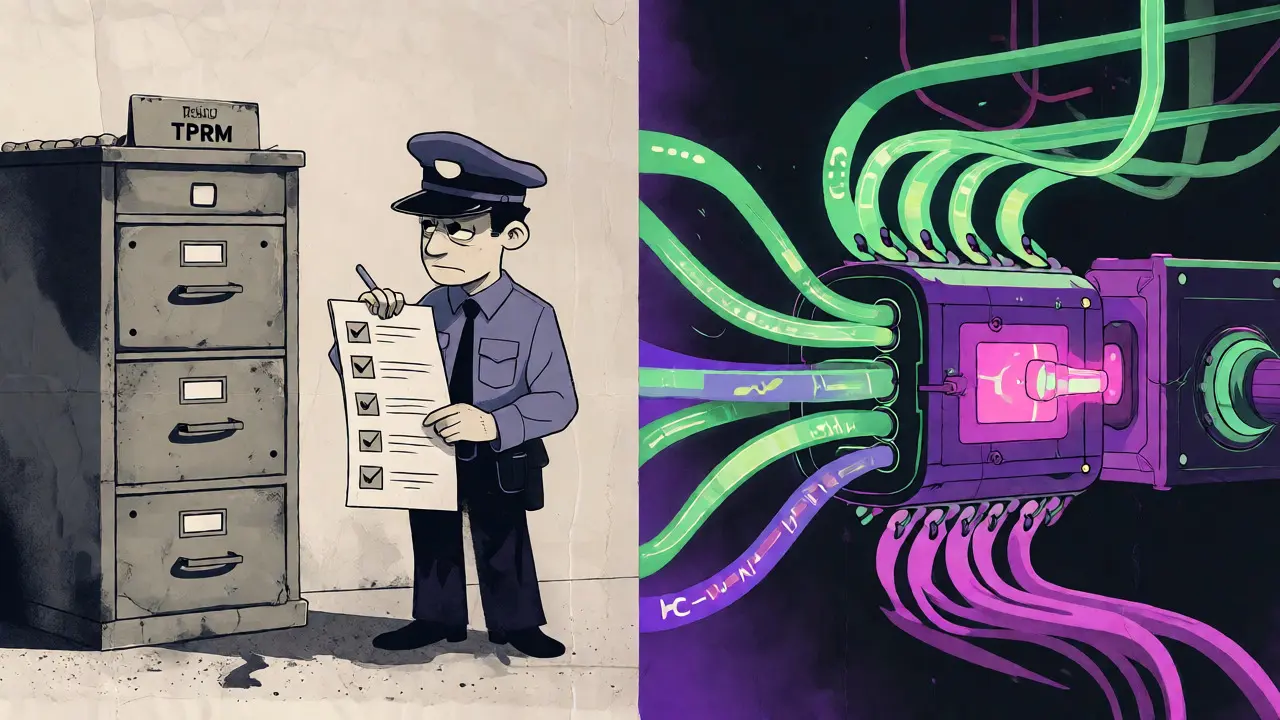
This isn't hypothetical. It's the new reality of software development in 2026. While adoption of AI coding assistants has skyrocketed-with 58% of Fortune 500 companies now using them-the formal governance structures haven't caught up. Traditional third-party risk management (TPRM) frameworks were built for SaaS tools that store data, not for probabilistic engines that generate logic. If you treat an AI coding platform like a standard cloud storage provider, you're missing the most dangerous part of the equation: the output itself becomes a potential vulnerability vector.
Why Standard Vendor Assessments Fail Here
Most TPRM questionnaires ask if a vendor is SOC 2 compliant and where their data centers are located. For an AI coding platform, those answers are necessary but wildly insufficient. The core risk isn't just about where your prompt goes; it's about what comes back out. Unlike traditional software, which executes deterministic logic, Large Language Models (LLMs) used in these platforms are probabilistic. They don't "know" your company's specific security architecture unless explicitly trained on it, and even then, they hallucinate.
The Financial Services Information Sharing and Analysis Center (FSISAC) identified this gap clearly in their Q4 2023 guide. They categorize AI coding platforms as a unique risk class because the tool doesn't just process data-it creates assets. When a developer accepts a suggestion, they are integrating third-party generated code into your intellectual property portfolio. If that code contains a subtle SQL injection flaw or hardcodes a credential pattern that conflicts with your internal secrets manager, the breach happens inside your application layer, long after the vendor assessment was signed off.
Consider the concept of "shadow AI." Gartner noted that nearly half of enterprises struggled with this in 2024. Developers bypass procurement because the friction is too high. By the time security catches wind, the code is already in production. You need a framework that assesses the tool's behavior in real-time, not just its static policy documents.
The Five Domains of AI-Specific Risk
To properly evaluate these vendors, you need to move beyond generic checklists. The FSISAC framework provides a robust structure, weighting five critical domains based on your organization's risk appetite. Here is how you should prioritize them when evaluating platforms like Google Vertex AI or newer entrants:
- Confidential Data Usage (25-35% weight): This is the big one. Does the vendor use your code snippets to train their global model? If yes, are you comfortable with your proprietary algorithms potentially influencing suggestions given to competitors? Only 27% of vendors offer true data isolation, meaning they guarantee your prompts never leave your tenant or feed into the broader training corpus.
- Business Integration (20-30% weight): How does the tool fit into your CI/CD pipeline? Can it integrate with your existing Static Application Security Testing (SAST) tools? If the AI generates code that bypasses your linting rules, integration is broken.
- Organizational Use Case (15-25% weight): Is this for non-critical UI components or core banking transactions? The risk profile changes drastically depending on whether a bug causes a visual glitch or a financial loss.
- Business Continuity (15-25% weight): What happens if the API goes down? Do developers have a fallback? Since these tools rely on massive cloud compute resources, latency issues can stall development velocity.
- Reputational Risk (10-20% weight): If the AI suggests code that inadvertently infringes on open-source licenses or introduces bias, who takes the hit? Your brand does, not the vendor.
Notice that technical specs like "uptime" aren't even in the top two. In 2026, availability is assumed. Trust and transparency are the scarce commodities.

Evaluating Technical Controls: What Actually Matters
When you dig into the technical documentation, look for specific capabilities rather than marketing fluff. Many vendors claim "enterprise-grade security," but few implement the controls that matter for code generation.
First, check for code sandboxing. According to a SANS Institute survey, only 32% of vendors fully support isolating generated code before execution. Without this, a maliciously crafted prompt could theoretically trigger unexpected behavior in the local environment during testing. Second, look at output validation mechanisms. Does the platform run its own internal security scan on every suggestion before showing it to the developer? Currently, only about 55% of platforms do this effectively.
Data filtering is another critical control. You want a system that prevents sensitive information-like API keys or customer PII-from being ingested into the context window. NCC Group penetration testing found that data filtering systems were only 41% effective across major platforms. This means more than half of the time, sensitive strings might slip through to the cloud backend. Ask the vendor specifically: "Do you redact secrets locally before sending the prompt to the server?" If the answer is no, walk away.
| Platform | Data Provenance Transparency | Security False Positive Rate | Compliance Alignment | Primary Risk Concern |
|---|---|---|---|---|
| GitHub Copilot | Low (2.1/5) | 18.7% (Industry Avg) | SOC 2 Type II | Training on public repos may leak IP patterns |
| Amazon CodeWhisperer | High | 23.4% | FINRA / AWS GovCloud | Higher noise in security scanning |
| Google Vertex AI | Medium | N/A (Integrated) | ISO 27001 / HIPAA | Vendor lock-in to Google Cloud ecosystem |
The Shadow AI Problem and Governance Gaps
Here is the uncomfortable truth: your security team is likely involved in less than a third of AI tool selections. The SANS Institute reported that while 87% of development teams adopt these tools quickly, only 32% of security/compliance teams participate in the selection process. This creates a governance vacuum.
Developers care about speed. They want autocomplete that works. They don't care about NIST AI Risk Management Framework compliance. This disconnect leads to incidents. In a recent Reddit thread discussing horror stories, one engineer shared how Copilot suggested hardcoding database credentials directly into a production API endpoint. Another noted that CodeWhisperer generated code that completely bypassed their internal security libraries, rendering their custom encryption useless.
To fix this, you need automated guardrails. You cannot rely on manual code reviews to catch every AI-induced flaw. Integrate AI-specific linters into your pull request workflows. These tools can flag suspicious patterns, such as hardcoded secrets or known vulnerable library versions, immediately upon generation. Furthermore, mandate that any AI-generated code must pass the same rigorous SAST/DAST scans as human-written code. No exceptions.
Regulatory Pressures and Future Proofing
If you operate in finance, healthcare, or EU markets, the regulatory landscape has tightened significantly since 2024. The EU AI Act, now fully enforced, classifies many AI coding assistants as "high-risk" systems. This requires conformity assessments that prove the tool's reliability and transparency. Similarly, SEC guidance mandates disclosure of material risks from AI-generated code in financial reporting.
Don't get caught flat-footed by audits. Ensure your vendor contracts include right-to-audit clauses that allow you to inspect how your data is handled. Look for vendors participating in emerging standards like the AI Coding Platform Security Alliance (AICPSA), launched in early 2025. Membership here signals a commitment to standardized security testing frameworks, which simplifies your due diligence.
Also, consider the sustainability of the vendor. PitchBook analysis showed that 62% of AI coding vendors were still operating at a loss in late 2024. While funding rounds keep them alive, a sudden pivot or acquisition could change their data handling policies overnight. Contractually lock in data retention and usage terms to protect yourself against future business model shifts.
Practical Steps for Implementation
So, how do you actually run this assessment without slowing down engineering? Follow this streamlined workflow:
- Risk Categorization (Days 1-5): Use a lightweight questionnaire to determine if the tool will touch sensitive data or critical infrastructure. Classify it as Low, Medium, or High risk.
- Targeted Questionnaire (Weeks 1-2): Skip the 100-question generic forms. Focus on the 15-25 questions that matter for AI: training data opt-out, secret redaction, and audit trail capabilities.
- Technical Validation (Weeks 2-4): Run a pilot with a small team. Monitor for false positives in security scans and measure actual productivity gains versus overhead. Check if the tool integrates with your Identity and Access Management (IAM) system.
- Continuous Monitoring: Set up alerts for anomalous usage patterns. If a developer starts pasting entire proprietary modules into the chat window, flag it.
Remember, the goal isn't to stop innovation. It's to ensure that the speed gained by AI doesn't come at the cost of systemic fragility. The firms that master this balance will ship faster and sleep better.
What is the biggest security risk with AI coding platforms?
The primary risk is unintended data exposure. Developers often paste sensitive code snippets containing API keys or proprietary algorithms into the AI interface. If the vendor uses this data for training, your IP could be leaked to other users or stored indefinitely. Additionally, AI-generated code may introduce vulnerabilities that human reviewers miss, such as insecure defaults or outdated library dependencies.
Do I need a separate risk assessment for each AI coding tool?
Yes, especially if the tools differ in architecture. A cloud-based LLM like GitHub Copilot has different data flow risks compared to a locally hosted model or a hybrid solution like Amazon CodeWhisperer. Each vendor has unique data retention policies, training practices, and integration capabilities. However, you can create a baseline assessment template and only customize the sections relevant to specific data handling differences.
How does the EU AI Act affect my choice of AI coding assistant?
The EU AI Act classifies certain AI systems as high-risk, requiring strict conformity assessments. While general coding assistants may fall under lower categories, if they are integrated into critical infrastructure or safety components, they face higher scrutiny. Vendors must provide transparency about their training data and performance metrics. Choosing a vendor that complies with ISO/IEC 42001 (AI Management System standard) helps demonstrate alignment with these regulatory expectations.
Can AI coding platforms accidentally violate open-source licenses?
Yes. If an AI model is trained on open-source code with restrictive licenses (like GPL), it might suggest code snippets that carry those license obligations. If you incorporate this into a proprietary product without attribution or compliance, you risk legal action. Some platforms offer indemnification clauses or filter out code from restrictive licenses during generation, but you must verify this capability during the vendor assessment.
What is 'Shadow AI' in the context of coding?
Shadow AI refers to the unauthorized or informal adoption of AI tools by employees without IT or security approval. In coding, this happens when developers install browser extensions or IDE plugins for AI assistance without going through procurement. This bypasses security controls, leading to potential data leaks and inconsistent code quality. Mitigating shadow AI requires clear policies and providing approved, secure alternatives that meet developer needs.