Stop guessing if your team is ready for AI-assisted development. The numbers don't lie, but they also tell a complicated story. In July 2026, vibe coding is the practice of generating software code through natural language prompts using AI platforms has moved from a trendy experiment to a core part of the developer workflow. But here is the catch: while adoption is skyrocketing, so are security risks and debugging headaches.
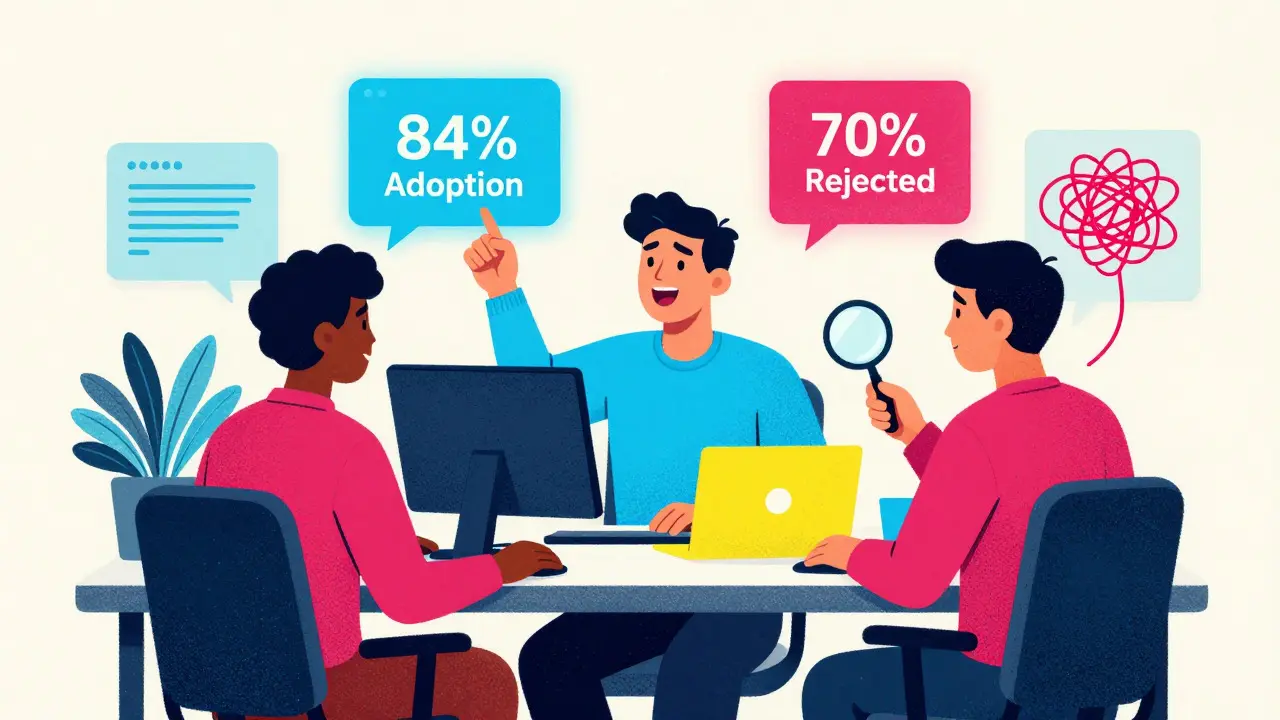
You might have heard that everyone is switching to AI coding tools. The reality is more nuanced. According to Stack Overflow's 2025 Developer Survey, which polled over 90,000 developers, 84% are now using or planning to use these tools. That is a massive jump from just 70% in 2023. However, 'using' doesn't mean 'trusting blindly.' Only 30% of AI-generated code suggestions are actually accepted by developers. The other 70%? They get rejected, rewritten, or discarded because they are wrong, inefficient, or insecure.
The Big Numbers: Who Is Leading the Charge?
To understand where the industry is heading, you need to look at who holds the market share. The landscape is dominated by a few key players, each with a different approach to how AI helps you write code.
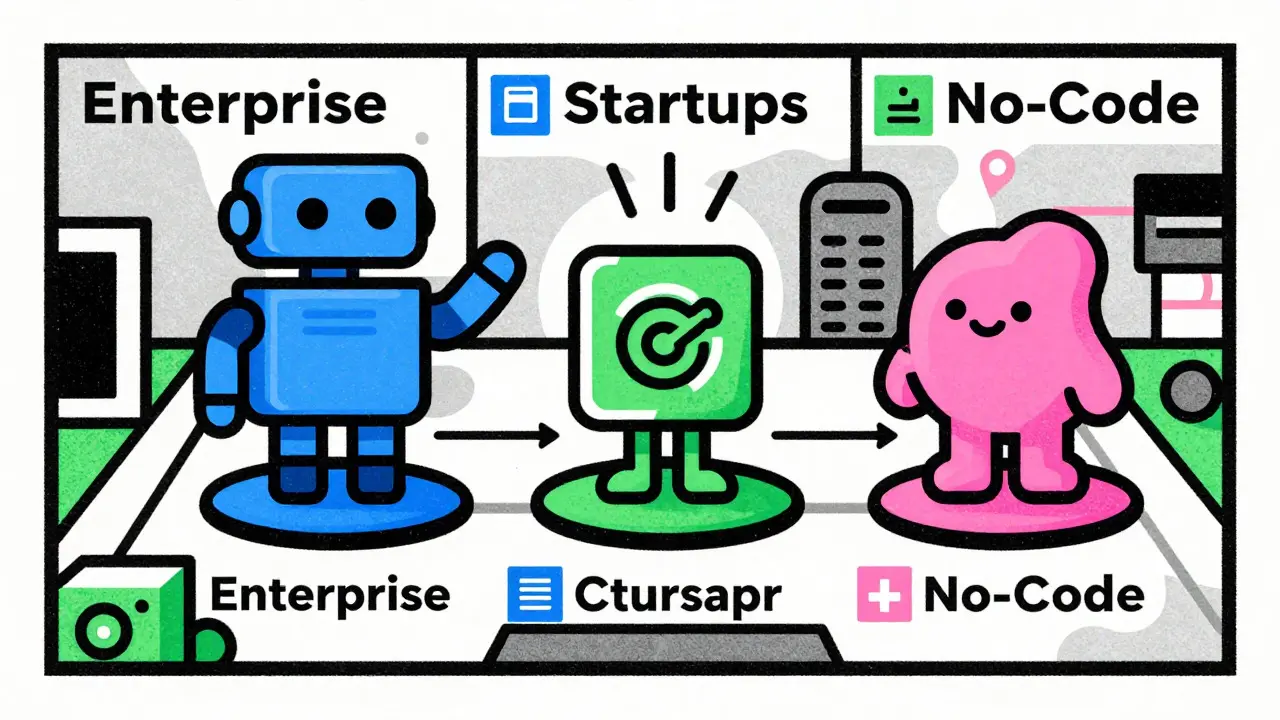
GitHub Copilot, developed by Microsoft and OpenAI, remains the enterprise giant. It holds about 45% of the enterprise market share. Its strength lies in its deep integration with Visual Studio Code and JetBrains IDEs. As of late 2025, it supports over 35 programming languages and offers context-aware generation up to 1,000 tokens. For companies, the price is $19 per user per month, while individuals pay $10. Despite its dominance, it faces scrutiny; 12% of Fortune 500 companies have banned it due to data privacy concerns.
Then there is Cursor, an AI-first code editor founded by former Facebook engineers. It has become the darling of startups, capturing 35% of the market among Y Combinator-backed companies. Why? Because it runs models locally on your machine. This addresses the privacy fears that plague cloud-based solutions. Cursor scaled from $1 million to $100 million in annual recurring revenue in just one year. Its Pro tier costs $20 per month, but it demands serious hardware-at least 16GB of RAM and an i5 processor-to run smoothly.
For those who want to skip the code entirely, Loveable, founded by Andrew Chen in 2023, targets the no-code/low-code segment. It holds 15% market share there. With 2.3 million users and an impressive 8% conversion rate to paid plans (beating the industry average of 2-5%), Loveable proves that non-technical founders are hungry for rapid prototyping. It charges $20 per user per month for business features.
| Platform | Primary Audience | Price (Monthly) | Key Strength | Major Weakness |
|---|---|---|---|---|
| GitHub Copilot | Enterprises | $10 - $19/user | IDE Integration & Scale | Data Privacy Concerns |
| Cursor | Startups & Pros | $20/user | Local Execution (Privacy) | High Hardware Requirements |
| Replit | Educators & Beginners | Freemium | Cloud Collaboration | Security Hesitancy in Regulated Fields |
| Loveable | No-Code/Low-Code | $20/user | Rapid UI Prototyping | Limited Customization |
The Hidden Cost: Security and Quality Risks
Here is where the shiny stats get messy. You can write code faster, but are you writing better code? The answer, unfortunately, is often no.
A Q3 2025 analysis by MktClarity found that 40-45% of AI-generated code contains security vulnerabilities. Think about that. Nearly half of what the AI spits out could leave your application open to attacks. One specific finding from the IEEE's 2025 Security Assessment was alarming: 62% of AI-generated SaaS platforms lacked proper rate limiting on authentication endpoints. That is a basic security feature, yet AI misses it consistently.
John Feminella, a Principal Engineer at Microsoft, called this an "existential threat" in his August 2025 whitepaper. He argues that without systematic auditing, we are building a house of cards. Real-world consequences are already appearing. Security engineer Jane Rodriguez documented a case where AI-generated code bypassed authentication in a fintech app, leading to three weeks of emergency remediation.
Performance benchmarks add another layer of complexity. While tools like Cursor and Copilot reduce coding time by 35-55% for routine tasks, they increase debugging time by 20-30% for complex implementations. You save time typing, but you spend more time fixing the mess the AI made when it got confused.
What Developers Actually Say: The Human Element
Statistics give you the broad view, but developer feedback gives you the ground truth. On Reddit’s r/programming, a thread with over 1,200 comments revealed a common sentiment. User u/CodeWizard42 noted, "Cursor cut my prototyping time by 70%, but I still spend 40% more time debugging the AI-generated sections." This trade-off-speed versus maintenance-is the defining challenge of vibe coding in 2026.
Review sites paint a similar picture. GitHub Copilot holds a 4.6/5 rating on G2 based on nearly 3,000 reviews. Users love its context awareness but criticize its "hallucination rate" of 15-20% for complex logic. Loveable scores 4.3/5 on Trustpilot, praised for helping non-technical founders build MVPs quickly, but criticized for having a steep learning curve when trying to customize beyond basic templates.
Dr. Sarah Chen, an MIT Computer Science Professor, warns that vibe coding creates a "dangerous illusion of competence" among junior developers. If you rely on AI to write every line, you may never learn the foundational concepts needed to debug when things go wrong. This skill gap is becoming a major concern for hiring managers.

Market Growth and Future Predictions
Despite the risks, the money keeps flowing. The vibe coding market is estimated between $2.96 billion and $12 billion in 2025 alone. Startups raised over $300 million in funding during that year. By 2030, forecasts vary wildly. Forrester predicts a $65 billion market, while Roots Analysis sees it reaching $325 billion by 2040. This disparity reflects uncertainty about whether AI coding will remain a niche tool or become the universal standard.
Geographically, North America leads with 55% market share, driven by the US and Canada's large developer base. Europe accounts for 30%, and Asia-Pacific for 15%. Enterprise adoption is accelerating, with tech giants like Amazon, Google, and Meta reporting that 20-50% of their new code is now AI-generated. However, only 9% of companies deploy vibe coding for the majority of their mission-critical production applications. Most stick to using it for internal tools or prototypes.
How to Adopt Vibe Coding Safely
If you are considering integrating these tools into your workflow, start small. Don't let AI write your entire backend overnight. Use it for boilerplate code, documentation, and initial prototyping. Always audit the output. Treat AI-generated code as untrusted input until you verify it yourself.
Invest in training. Your team needs to learn prompt engineering and AI code auditing. These are now essential skills alongside traditional programming. Expect a learning curve of 40-60 hours to master advanced features. And remember, the tool is only as good as the person guiding it. Keep your human expertise sharp, because when the AI hallucinates, you'll be the one cleaning up the mess.
Is vibe coding safe for enterprise use?
It depends on your risk tolerance. While GitHub Copilot integrates well with enterprise security protocols, 12% of Fortune 500 companies have banned it due to data privacy concerns. Additionally, 40-45% of AI-generated code contains security vulnerabilities. Enterprises should use local execution models like Cursor for sensitive data and enforce strict code auditing processes before deployment.
Which AI coding tool is best for startups?
Cursor is currently the top choice for startups, holding 35% market share among Y Combinator companies. Its ability to run models locally addresses data privacy concerns, and it excels at rapid prototyping. However, it requires robust hardware (16GB+ RAM). For non-technical founders, Loveable offers a strong no-code alternative for building UIs quickly.
How much time does AI coding actually save?
For routine tasks, AI tools can reduce coding time by 35-55%. However, this comes with a trade-off: debugging time for complex implementations increases by 20-30%. Overall, developers report saving significant time on prototyping but spending more time reviewing and fixing AI-generated errors.
What are the biggest security risks of AI-generated code?
The primary risks include hidden vulnerabilities and missing security controls. A 2025 IEEE assessment found that 62% of AI-generated SaaS platforms lacked proper rate limiting on authentication endpoints. Additionally, 40-45% of all AI-generated code contains some form of security vulnerability, making manual auditing essential.
Will AI replace junior developers?
Not immediately, but it changes the role. Experts warn that vibe coding creates an "illusion of competence" among juniors who may lack foundational knowledge. Instead of replacing developers, AI shifts the focus toward code auditing, prompt engineering, and system architecture. Junior devs must adapt by mastering these new skills to remain valuable.