Why Big Isn't Always Better in AI
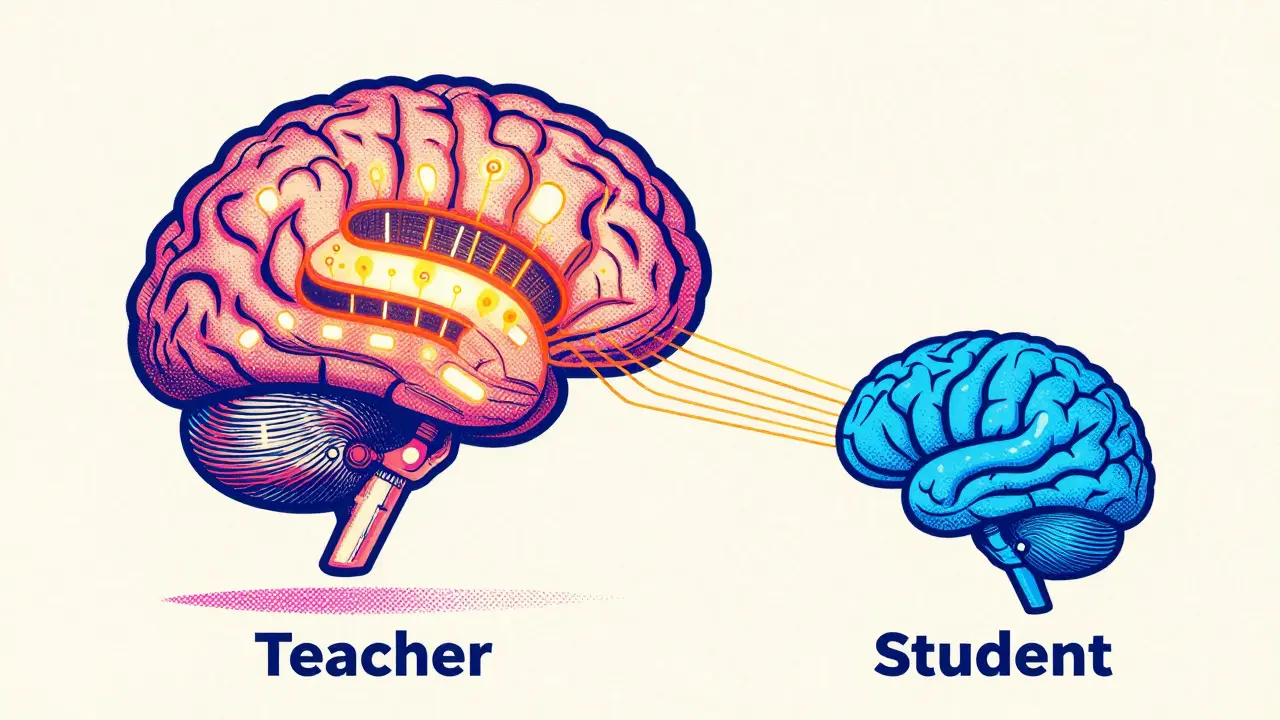
We are living through an era where Generative AI is technology that creates new content like text, images, and code based on patterns learned from vast datasets seems to grow bigger every day. You have likely heard of models with hundreds of billions of parameters dominating the headlines. But there is a catch: these massive models are expensive to run, slow to respond, and often overkill for everyday tasks. This is where Model Distillation is a machine learning technique that transfers knowledge from a large 'teacher' model to a smaller 'student' model while preserving performance capabilities comes into play.
Think of it this way. Imagine you hire a world-class professor to teach a smart undergraduate student. The professor knows everything about quantum physics, but they are expensive to keep on staff. The student, however, learns the core concepts well enough to answer most questions accurately. Once trained, the student is cheaper to employ, faster to consult, and just good enough for 90% of the work. That is exactly what model distillation does for artificial intelligence.
As we move further into 2026, the industry is shifting away from blind scale toward efficiency. Companies no longer want to pay premium prices for a giant brain when a compact one can do the job. This shift is not just about saving money; it is about making AI accessible on devices with limited power, like smartphones or edge servers, without sacrificing too much quality.
Key Takeaways
- Cost Efficiency: Distilled models can reduce inference costs by up to 80% compared to their larger counterparts.
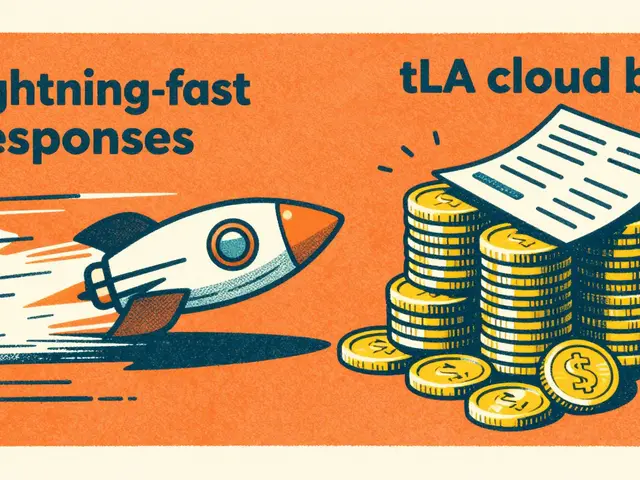
- Speed Boost: Latency can drop significantly, with some benchmarks showing response times improving from 500ms to under 70ms.
- Performance Retention: Well-executed distillation preserves 90-95% of the original model's accuracy on standard benchmarks.
- Data Savings: Techniques like "distilling step-by-step" require up to 87.5% less training data than traditional fine-tuning methods.
- Limitations Exist: Student models cannot exceed the teacher's capabilities and may struggle with complex, multi-step reasoning tasks.
How Knowledge Distillation Actually Works
To understand why this works, we need to look at the mechanics behind the scenes. The process relies on a Teacher-Student Paradigm is a framework where a large pre-trained model guides the training of a smaller model. The "teacher" is typically a massive foundation model like GPT-4 is a large language model developed by OpenAI known for advanced reasoning and generative capabilities, Llama 3 is an open-source large language model series developed by Meta AI, or Google's PaLM 2 is a path-language-model developed by Google Research for multilingual and multimodal tasks.
In traditional machine learning, you train a model using hard labels. If the question is "Is this image a cat?", the label is simply "Yes" (1) or "No" (0). This is binary and rigid. In distillation, the teacher model provides "soft targets." Instead of just saying "Cat," the teacher outputs a probability distribution. It might say: "90% chance it's a cat, 5% it's a dog, 3% it's a fox, 2% it's a raccoon."
This soft information is gold. It tells the student model not just what the right answer is, but how similar other wrong answers are to the right one. The student model then uses a mathematical measure called KL Divergence is a statistical method used to measure the difference between two probability distributions to minimize the gap between its own predictions and the teacher's soft probabilities. By mimicking the teacher's uncertainty and confidence levels, the student learns the nuances of decision-making rather than just memorizing correct answers.
Advanced approaches, such as the "distilling step-by-step" method developed by Google and Snorkel AI in 2023, take this further. Here, the teacher doesn't just give the final answer; it generates a rationale or chain of thought. The student then learns to replicate this reasoning process. This allows the student to achieve high performance with drastically less data-up to 87.5% less than traditional fine-tuning requires.

The Business Case: Why Enterprises Are Switching
If you are running a business, the technical details matter less than the bottom line. The primary driver for adopting distilled models is cost reduction. According to AWS's April 2024 documentation, distilled models can reduce inference costs by approximately 65%. Let's put that in perspective. If your customer support chatbot runs on a large model costing $0.002 per 1,000 tokens, switching to a distilled version could drop that to around $0.0007 per 1,000 tokens. For a company processing millions of queries daily, those fractions of cents add up to massive savings.
Speed is the second major factor. In real-time applications like voice assistants or live translation, latency kills user experience. Benchmarks from AWS Bedrock show that while a teacher model might take 500 milliseconds to generate a response, a distilled student model can cut that down to 70 milliseconds. That is nearly a sevenfold improvement in speed. Users don't notice the difference in accuracy between a 94% accurate model and a 91% accurate model, but they definitely notice if the app hangs for half a second versus responding instantly.
Furthermore, distillation enables deployment in environments where big models simply cannot fit. Edge computing devices, IoT sensors, and even modern smartphones have memory constraints. A 70-billion parameter model will choke a smartphone's RAM. A distilled 7-billion parameter model, however, can run locally, ensuring user privacy and offline functionality. This is why IDC projects that distilled models will power 65% of enterprise AI deployments by 2026.
| Feature | Model Distillation | Traditional Fine-Tuning | Quantization |
|---|---|---|---|
| Data Requirement | Low (Synthetic data from teacher) | High (Needs extensive labeled data) | N/A (Post-training optimization) |
| Accuracy Retention | High (90-95% of teacher) | Variable (Depends on data quality) | Moderate (Can lose nuance) |
| Inference Speed | Fast (Smaller architecture) | Same as base model | Very Fast (Lower precision math) |
| Training Cost | Moderate (Requires teacher access) | High (Compute intensive) | Low |
| Best Use Case | General purpose, edge deployment | Domain-specific specialization | Extreme resource constraints |
Real-World Successes and Pitfalls
It is easy to get excited about the theory, but how does it hold up in practice? We see clear winners and losers in current deployments. Customer service chatbots are perhaps the biggest success story. Enterprise users report that distilled models match teacher models in resolving 87% of queries. Since most customer questions are repetitive and straightforward, the student model handles them efficiently without needing the teacher's deep reasoning powers.
However, the pitfalls become apparent in specialized domains. IBM's January 2024 case study highlighted a failure in legal document analysis. While the teacher model achieved 89% accuracy in interpreting complex legal clauses, the distilled student dropped to 72%. Legal texts require nuanced understanding of context and precedent, areas where the student's reduced capacity shows its limits. Similarly, healthcare developers on Reddit noted struggles with domain-specific terminology, requiring additional fine-tuning after the initial distillation.
There is also the issue of bias propagation. Dr. Emily Bender from the University of Washington warned in her April 2024 report that distillation can amplify biases present in the teacher model. If the teacher has a gender bias in sentiment analysis, the student will learn and potentially exaggerate that bias because it is mimicking the teacher's probability distributions closely. One study found a 12.3% increase in gender bias propagation in distilled sentiment analysis models. This means you cannot treat distillation as a "set and forget" solution; rigorous auditing of the student model is essential.
Implementing Distillation: Tools and Techniques
If you are ready to try this yourself, the landscape has matured significantly since 2023. You no longer need to build everything from scratch. Cloud providers have integrated distillation directly into their platforms.
Amazon Bedrock Model Distillation is a service announced in preview in April 2024 that automates the creation of distilled models is a leading example. It allows you to select a teacher model (up to 70B parameters) and a student architecture (as small as 7B parameters, like Mistral 7B). The platform automates dataset generation, creating up to 15,000 prompt-response pairs automatically. This reduces implementation time from several weeks to just 3-5 days. Developers rate this highly, giving it a 4.2/5 satisfaction score, though some criticize the job completion time.
For those preferring open-source routes, Hugging Face's Transformers library offers tools like DistilBERT, which remains a staple for natural language understanding tasks. Google Vertex AI also added distillation features in late 2023, supporting their suite of foundation models.
When setting up your own pipeline, keep these rules of thumb in mind:
- Parameter Ratio: AWS recommends keeping the student model at no smaller than 1/10th the parameter count of the teacher for optimal results. Going smaller often leads to catastrophic forgetting.
- Temperature Calibration: When generating soft targets, set the temperature between 0.6 and 0.8. Too low, and the probabilities are too sharp (like hard labels); too high, and they are too flat (noisy).
- Data Verification: Even with automated generation, manually verify 15-20% of the synthetic data to catch hallucinations from the teacher model.
The Future: Self-Distillation and Beyond
As we look ahead from our vantage point in August 2026, the technology is evolving rapidly. The next frontier is "self-distillation," where a model improves itself through recursive knowledge transfer. Meta AI reported an 8.7% accuracy gain on reasoning tasks using this method in their May 2024 preprint. This suggests that models may soon be able to optimize themselves without human intervention, constantly refining their internal representations.
Google is also researching "iterative distillation," achieving 96.2% teacher performance after three distillation cycles. This approach addresses the limitation of single-step distillation by progressively refining the student model. However, experts caution against infinite cycles. MIT's 2023 study indicates a hard ceiling at roughly 95% capability retention due to fundamental limits in knowledge compression. Beyond that point, diminishing returns set in, and the risk of knowledge degradation increases.
Regulatory frameworks are catching up too. The EU AI Act requires transparency in synthetic data generation. Providers like AWS are responding with "distillation provenance" features, tracking which teacher model versions were used and the confidence scores associated with generated data. This ensures accountability, which is critical for industries like finance and healthcare.
Ultimately, model distillation is not about replacing large models entirely. It is about creating a tiered ecosystem. Keep the giant brains for research, complex reasoning, and creative breakthroughs. Deploy the distilled students for the heavy lifting in production environments. This balance will define the efficient, scalable AI infrastructure of the future.
What is the main difference between model distillation and quantization?
Quantization reduces the precision of the numbers used in a model (e.g., from 32-bit to 8-bit), which shrinks file size and speeds up computation but can lead to a loss of nuance in reasoning. Model distillation, on the other hand, trains a structurally smaller model to mimic the behavior of a larger one. Distillation generally preserves more reasoning capabilities than quantization but requires a more complex training process involving a teacher model.
Can a distilled model ever be smarter than its teacher?
Generally, no. A student model is limited by the knowledge it receives from the teacher. As noted by experts, the student cannot exceed the teacher's capabilities. However, in very specific narrow tasks, a student might appear "smarter" if it is fine-tuned extensively on that specific domain, but this is due to specialization, not superior general intelligence. The ceiling is defined by the teacher's output quality.
How much data do I need to distill a large language model?
You need significantly less data than traditional fine-tuning. Advanced techniques like "distilling step-by-step" can achieve high performance with up to 87.5% less training data. Platforms like Amazon Bedrock can automate the generation of thousands of prompt-response pairs, meaning you might only need a few hundred carefully curated examples to guide the teacher, rather than millions of labeled instances.
Is model distillation suitable for real-time applications?
Yes, it is ideal for real-time applications. Because distilled models are smaller, they have lower latency. Benchmarks show response times can drop from 500ms to 70ms. This makes them perfect for use cases like live chatbots, voice assistants, and mobile apps where immediate feedback is crucial for user experience.
What are the risks of using distilled models in sensitive industries?
The primary risks are bias amplification and error propagation. If the teacher model contains biases, the student will learn them, potentially amplifying them by up to 12.3% in some sentiment analysis cases. Additionally, if the teacher hallucinates during the generation of training data, the student will learn those errors as facts. Rigorous auditing and manual verification of synthetic data are required for sectors like healthcare and law.