It is 2026. The hype cycle has settled. The question is no longer "Should we try AI?" but "Where does it actually save us money?" In 2025, the enterprise landscape shifted dramatically from experimental pilots to hard-nosed production deployments. Companies stopped chasing shiny new toys and started demanding ROI. According to data from MenloVC, model API spending doubled from $3.5 billion to $8.4 billion in just six months during that period. Why? Because organizations finally figured out how to make Large Language Models (LLMs) work reliably within their existing security and compliance frameworks.
If you are a decision-maker looking at your tech stack today, you need to know which applications deliver real value and which ones are still burning cash. This guide breaks down the top enterprise use cases for LLMs in 2025, focusing on what worked, what failed, and how to implement these systems without creating a security nightmare.
The Shift from General Purpose to Domain Specific
In early 2024, everyone was throwing generic models at every problem. By 2025, that approach died. Enterprises realized that general-purpose models hallucinate too much when dealing with internal policy documents or specialized financial regulations. The winning strategy became Retrieval-Augmented Generation (RAG) and fine-tuned Small Language Models (SLMs).
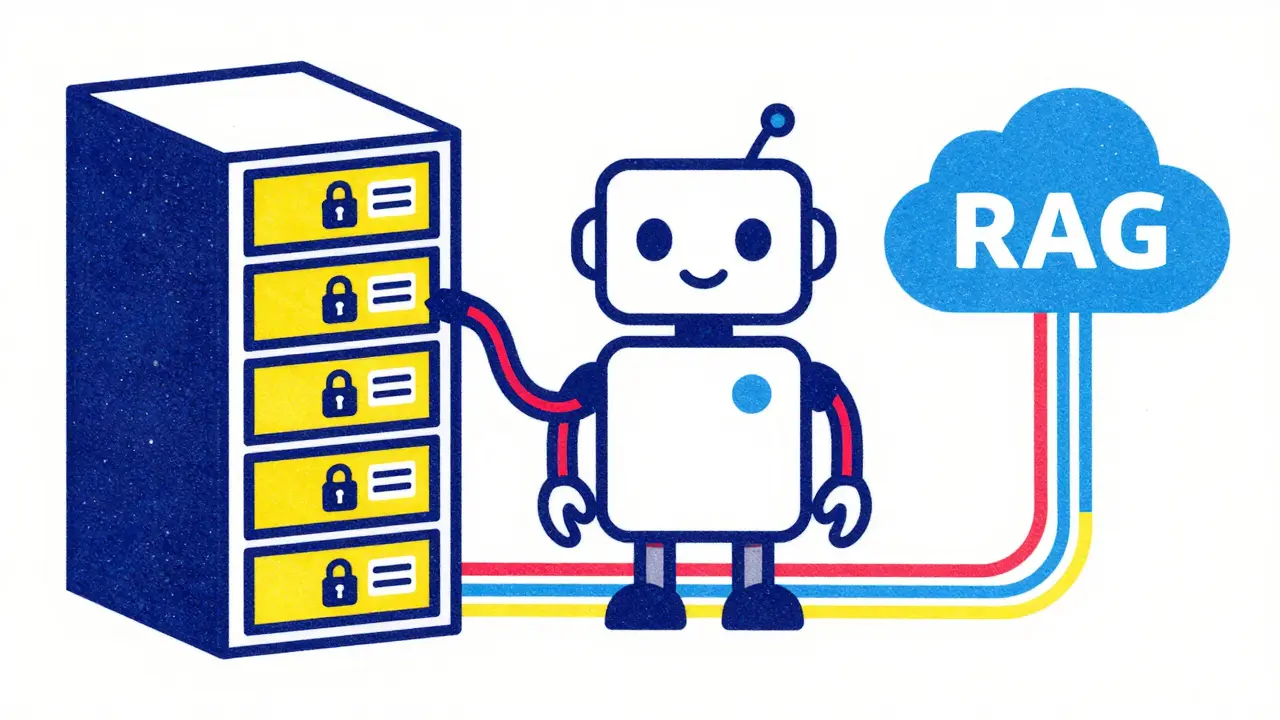
RAG connects an LLM to your private database. Instead of relying on its training data (which might be outdated or irrelevant), the model pulls specific facts from your company’s knowledge base before answering. This simple architectural change boosted accuracy on domain-specific tasks from around 70% to over 90%, according to benchmarks from AI21 Labs. It also solved the biggest fear executives had: data leakage. Your sensitive customer data never leaves your secure environment; only the query and the retrieved context interact with the model.
Simultaneously, SLMs like Mistral 7B and IBM’s Granite series gained massive traction. These smaller models require significantly less computational power-often running on standard enterprise servers rather than expensive GPU clusters. They offer comparable accuracy for narrow tasks while cutting infrastructure costs by up to 75%. For most businesses, this meant they could deploy AI locally, ensuring compliance with strict data sovereignty laws.
Top 5 High-ROI Enterprise Use Cases
Not all AI projects are created equal. Based on adoption rates and reported savings across finance, healthcare, and retail sectors, here are the five use cases that delivered the strongest returns in 2025.
1. Intelligent Customer Service Automation
This remains the king of LLM applications. But the 2025 version is different from the chatbots of the past. Modern implementations use RAG to access live product manuals, return policies, and order histories. The result? Chatbots that don’t just say "I didn't understand that," but actually resolve complex issues.
- Impact: Reduced ticket volume to human agents by 40-60%.
- Accuracy: Achieved 91% resolution accuracy on tier-1 support queries.
- Key Benefit: Faster response times improved customer satisfaction scores by an average of 18 points.
Companies like global retailers reported that their support teams could handle peak holiday seasons without hiring temporary staff. The AI handled the routine password resets and tracking inquiries, freeing humans to deal with angry customers who needed empathy.
2. Automated Code Generation and Maintenance
Code generation was the first breakout use case, accounting for 28% of enterprise implementations. Developers used tools powered by LLMs to write boilerplate code, generate unit tests, and debug errors. Anthropic’s Claude and OpenAI’s Codex variants led this charge.
- Impact: Developers spent 30-40% less time on repetitive coding tasks.
- Quality: Bug detection rates improved as AI reviewed code against best practices before deployment.
- Key Benefit: Accelerated feature release cycles by weeks.
However, the lesson learned in 2025 was that AI should augment, not replace, senior engineers. Teams that used AI as a "pair programmer" saw productivity gains of 3.2x compared to those trying to fully automate development pipelines, which often resulted in messy, unmaintainable codebases.
3. Legal and Compliance Document Review
Law firms and corporate legal departments were early adopters because the stakes are high and the volume of text is enormous. LLMs excel at summarizing contracts, identifying risky clauses, and ensuring compliance with regulations like GDPR or HIPAA.
- Impact: Reduced document review time by 65-80%.
- Accuracy: Identified 95% of non-compliant clauses after fine-tuning on historical case law.
- Key Benefit: Allowed lawyers to focus on strategy rather than reading thousands of pages of dense text.
Security was paramount here. 94% of financial and healthcare enterprises mandated on-premise deployment for these tasks. They couldn’t risk sending client contracts to a public cloud API. Localized SLMs provided the necessary privacy shield.
4. Internal Knowledge Management
Most companies suffer from "tribal knowledge"-information stuck in employees’ heads or scattered across Slack channels, old emails, and PDFs. In 2025, enterprises deployed internal search engines powered by LLMs. Employees could ask natural language questions like "What is our policy on remote work for parents?" and get a cited answer from the official HR handbook.
- Impact: Cut employee onboarding time by half.
- Adoption: 65% of new hires reported faster ramp-up times.
- Key Benefit: Reduced reliance on key individuals for basic information retrieval.
This use case required significant data preparation. Gartner warned that 65% of enterprises saw accuracy degrade if they didn’t clean their data first. Successful projects spent 3-6 months curating their knowledge bases before launching the AI interface.
5. Financial Fraud Detection and Analysis
Banks and fintech companies used LLMs to analyze unstructured data from transaction notes, customer communications, and news feeds. Traditional rule-based systems missed subtle patterns. LLMs could detect anomalies in narrative descriptions of transactions.
- Impact: JPMorgan Chase reported 94.7% detection accuracy with 38% fewer false positives.
- Speed: Real-time analysis prevented losses before they occurred.
- Key Benefit: Reduced manual investigation workload for fraud analysts.
This required deep domain-specific fine-tuning. Generic models struggled with financial jargon. Banks invested heavily in training data to ensure the AI understood the nuances of money laundering schemes versus legitimate complex transactions.
| Use Case | Implementation Time | Data Prep Required | Primary Risk | ROI Driver |
|---|---|---|---|---|
| Customer Service | 4-8 weeks | Medium | Tone inconsistency | Reduced labor costs |
| Code Generation | 2-4 weeks | Low | Security vulnerabilities in code | Developer productivity |
| Legal Review | 8-12 weeks | High | Data privacy breaches | Billable hour reduction |
| Knowledge Search | 6-10 weeks | Very High | Hallucinations | Employee efficiency |
| Fraud Detection | 12-20 weeks | Very High | False negatives | Loss prevention |
Vendor Landscape: Who Won in 2025?
The market consolidated quickly. While there were dozens of players in 2023, by mid-2025, three names dominated enterprise contracts. Anthropic emerged as the leader with 38% market share, praised for its superior reasoning capabilities and robust safety features. OpenAI held 29%, leveraging its brand recognition and extensive ecosystem. Google took 22%, appealing to enterprises already deeply embedded in the Alphabet ecosystem.
Open-source models saw declining adoption in production environments, dropping from 19% to 13%. Meta’s Llama 4 underperformed in real-world settings despite technical improvements, largely due to lack of enterprise-grade support. Most companies chose paid solutions because they needed 24/7 SLAs and clear liability structures. If your AI bot gives bad advice, you want a vendor to hold accountable, not a Discord community.

Critical Implementation Pitfalls to Avoid
Even with the right use case, many projects fail. Here is what went wrong for others, so you can avoid the same mistakes.
- Ignoring Data Governance: Garbage in, garbage out. If your internal documents are outdated or contradictory, the LLM will confidently give you the wrong answer. Spend months cleaning your data before buying any software.
- Underestimating Integration Complexity: Connecting an LLM to Salesforce, ServiceNow, and Microsoft 365 is harder than it looks. 63% of dissatisfied users cited integration issues as their primary pain point. Ensure your IT team has the skills to build these bridges.
- Chasing Novelty Over Reliability: Don’t switch vendors every time a new model launches. Stick with one that meets your security and accuracy needs. Vendor lock-in is a concern, but constant migration destroys productivity.
- Neglecting Human Oversight: AI is a tool, not a replacement for judgment. Always keep a human in the loop for high-stakes decisions, especially in healthcare and finance. "Superagency" teams that combine AI speed with human oversight outperformed fully automated systems.
Future Outlook: What Comes After 2025?
We are currently in 2026. Looking back at 2025, the trend was clear: consolidation and specialization. Expect this to continue. Gartner predicts enterprise LLM spending will reach $22.3 billion by 2027. The growth will come from industry-specific vertical models, not general-purpose chatbots.
Multimodal capabilities-where AI processes text, images, and video simultaneously-are becoming standard. Real-time collaboration features are also emerging, allowing multiple employees to work with an AI assistant simultaneously. However, the core principle remains unchanged: solve a specific business problem with measurable ROI. If you can’t define the metric for success, don’t start the project.
Which LLM vendor is best for enterprise security in 2025?
Anthropic and Google led in enterprise security features in 2025. Anthropic captured 38% of new contracts due to its strong reasoning capabilities and safety protocols. Google offered seamless integration for enterprises already using its cloud services. Both providers offered on-premise deployment options, which were mandatory for 94% of financial and healthcare clients.
Are Small Language Models (SLMs) better than large models for businesses?
For many specific tasks, yes. SLMs like Mistral 7B require 60-75% less computational resources and can run on standard servers. They achieved accuracy within 3-5 percentage points of larger models for domain-specific tasks. They are ideal for cost-conscious enterprises needing local deployment for privacy reasons.
How long does it take to implement an LLM for customer service?
A simple Retrieval-Augmented Generation (RAG) system for customer service can be deployed in 4-8 weeks with existing IT staff. However, more complex implementations involving deep integration with CRM systems may take 12-16 weeks. Data preparation often takes longer than the actual model setup.
What is the biggest risk of using LLMs in enterprise?
The biggest risks are data privacy breaches and hallucinations (incorrect information). To mitigate this, enterprises must use on-premise deployments or trusted vendors with SOC 2 Type II compliance. Additionally, implementing RAG ensures the model relies on verified internal data rather than its general training set.
Is open-source AI viable for enterprise production in 2025?
Adoption of open-source models dropped to 13% of enterprise workloads in 2025. While they offer customization and avoid vendor lock-in, they lack the 24/7 support and reliability guarantees (92% uptime vs 85%) that enterprises require. Most companies preferred paid solutions for critical production environments.