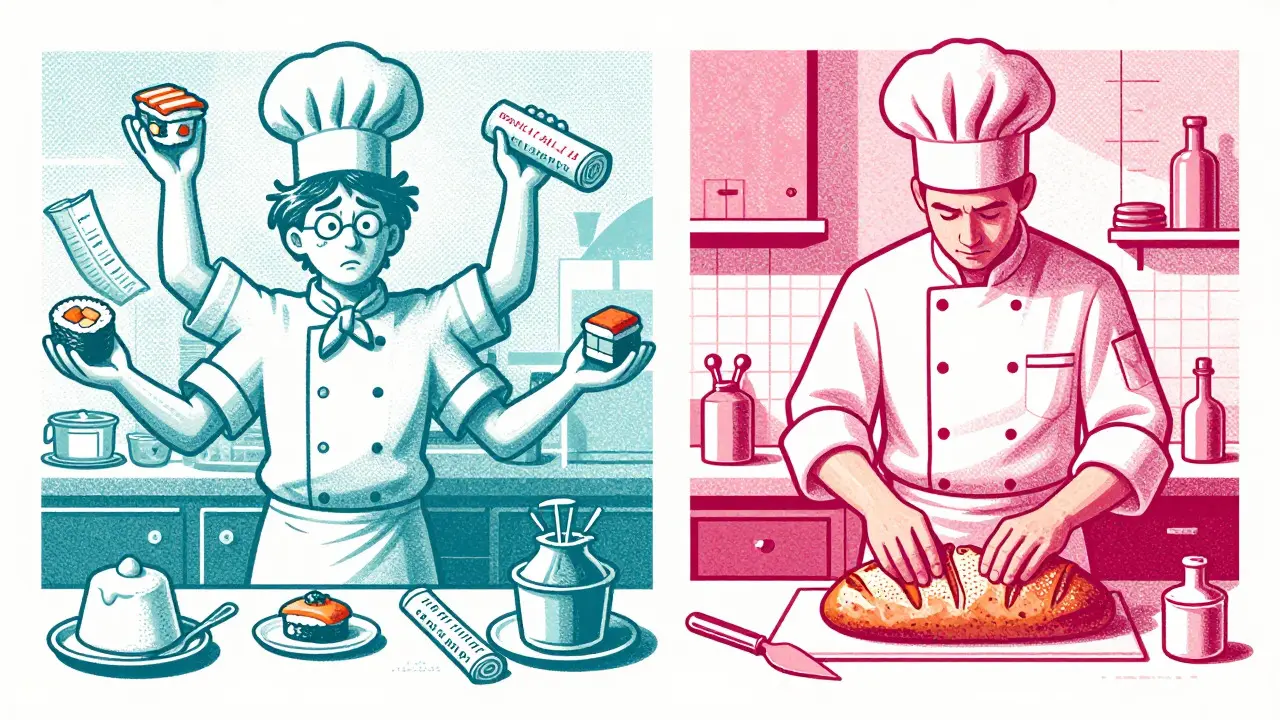
Picture this: you have a brilliant chef who can cook anything from sushi to soufflés. Now imagine you need someone to bake the perfect sourdough bread every single day for your bakery. Do you hire the generalist chef and hope they remember the recipe? Or do you hire a baker who only bakes bread?
In the world of artificial intelligence, we are currently obsessed with the "chef"-the massive, general-purpose Large Language Models (LLMs) like GPT-4 or Claude. They are impressive. They can write code, draft emails, and summarize legal documents. But when you build a niche stack, which is a specialized software architecture built for a specific industry or domain, that generalist often falls short.
This is where fine-tuned models come in. These are AI systems derived from base LLMs but trained further on your specific data. The question isn't whether fine-tuning is cool; it's whether it beats using a general LLM with clever prompting. For many businesses, the answer is a resounding yes-but only if you know when to pull the trigger.
The Accuracy Gap: Why Generalists Fail at Specific Tasks
Let’s talk numbers because they don’t lie. A generic LLM might give you a good enough answer 68% of the time. That sounds okay until you realize that in legal summarization, medical coding, or financial compliance, "good enough" means lawsuits and lost money.
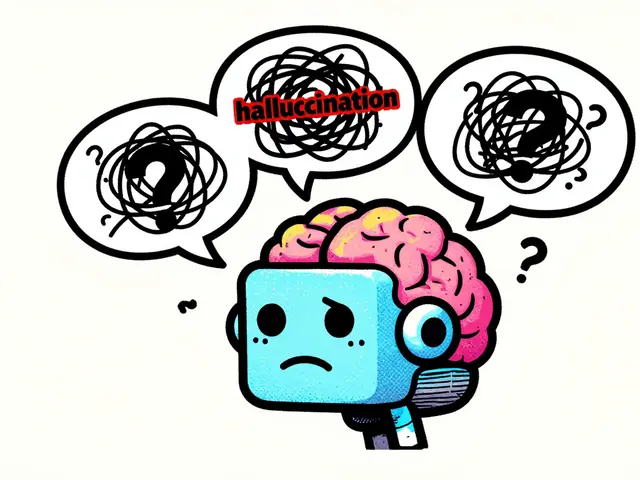
According to analysis by Coders GenAI Technologies in 2025, fine-tuned LLMs achieve up to 92% accuracy in legal summarization tasks compared to just 68% for generic models. Even more critical is the hallucination rate-the tendency of AI to make things up. Generic models hallucinate 32% of the time in these high-stakes scenarios. Fine-tuned models drop that error rate to a manageable 8%.
Why does this happen? General LLMs are trained on the entire internet. They have seen everything, so they predict what is statistically likely based on all human knowledge. A fine-tuned model has been narrowed down. It has studied your proprietary contracts, your specific medical terminology, or your unique customer support logs. It doesn't guess; it recalls patterns from your specific context.
Consider a customer support chatbot. A generic model tries to be helpful and polite, resulting in on-brand responses only 54% of the time. A fine-tuned model, trained on your brand voice guidelines and past successful interactions, hits an 89% success rate. That difference changes how your customers perceive your company.
The Cost of Being Too Narrow: Catastrophic Forgetting
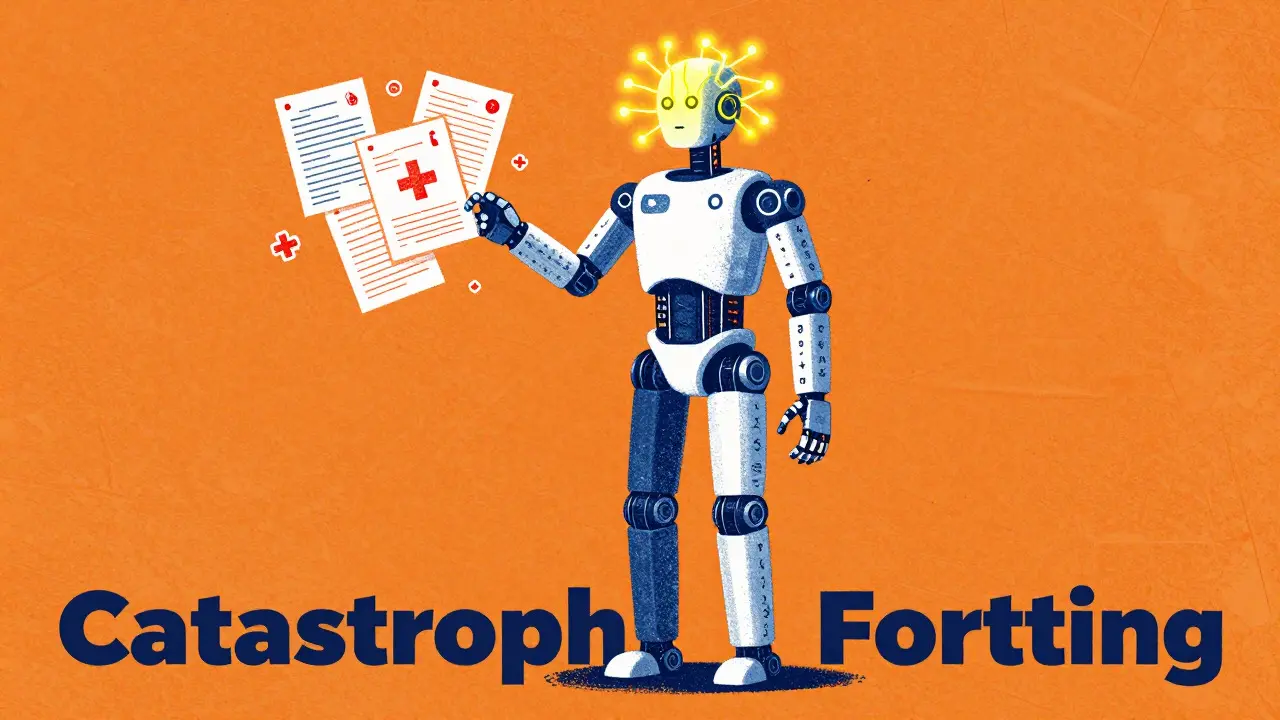
If fine-tuning is so great, why doesn't everyone do it? Because specialization comes with a hidden tax called catastrophic forgetting. This is a phenomenon where a model loses its general reasoning abilities as it learns new, specific information.
Meta AI researchers documented this clearly in late 2024. After fine-tuning a model for a specific domain, they observed a 22% decline in commonsense reasoning performance. Imagine hiring a brilliant mathematician to learn your inventory system, only to find they can no longer add two plus two.
User feedback from Reddit’s r/MachineLearning community highlights this risk. In early 2025, a developer shared how their fine-tuned model "could no longer perform basic arithmetic after medical terminology training." Another user reported that their chatbot became "too rigid," failing to handle novel customer queries that fell outside its training data.
This is why fine-tuned models underperform in broad applications. Toloka AI found that fine-tuned models achieved only 63% effectiveness in general blog writing compared to 87% for base LLMs. If your task requires creativity across diverse topics, a generalist is still king. Fine-tuning makes the model brittle if not managed correctly.
Democratizing Access: QLoRA and Parameter-Efficient Fine-Tuning
A few years ago, fine-tuning a large language model required a supercomputer and a budget that would make most startups cry. You needed massive GPU clusters to update millions of parameters. That barrier is crumbling thanks to techniques like QLoRA (Quantized Low-Rank Adaptation).
Here is the breakdown of the resource savings:
- Full Fine-Tuning (Llama 2 7B): Requires 78.5GB of GPU memory.
- LoRA (Low-Rank Adaptation): Reduces this to 28GB.
- QLoRA: Cuts peak memory requirements down to just 15.5GB.
This shift is huge. It means you can now fine-tune a capable model on a single consumer-grade GPU or a modest cloud instance. Meta’s AI research team noted that this democratization allows organizations with limited computational resources to build specialized tools without renting expensive infrastructure.
The result? Smaller teams can compete with enterprise giants. A startup can take a small open-source model like Gemma3 4B and fine-tune it to match the performance of a much larger 27B model on specific tasks. Codecademy’s benchmarks show this approach achieves 87% accuracy versus 85% for the larger model, while reducing inference costs by 65%. You get better results for less money.
RAG vs. Fine-Tuning: The Hybrid Strategy
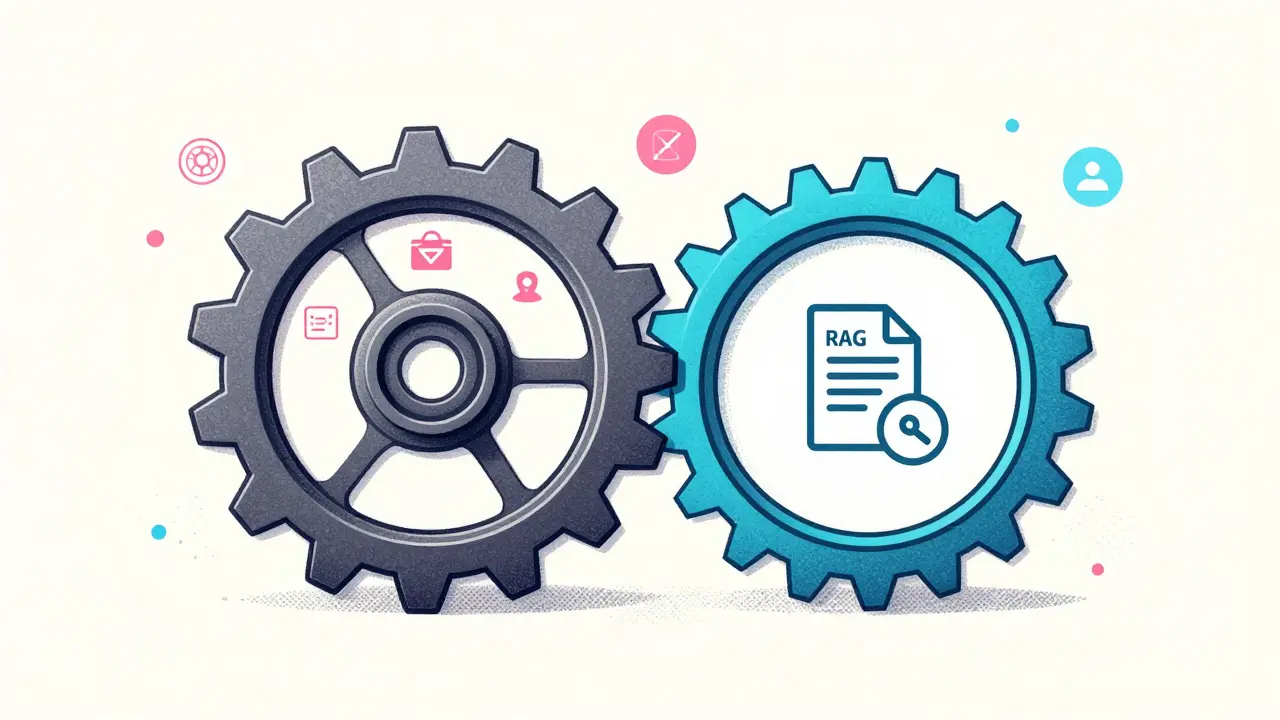
You might have heard about RAG (Retrieval-Augmented Generation). RAG involves feeding the LLM external documents at query time, rather than training the model on them. Many developers treat RAG and fine-tuning as rivals, but experts see them as partners.
Professor Andrew Ng emphasizes that fine-tuning delivers the highest return on investment for applications requiring brand alignment, structured output formats, or regulatory compliance. However, Dr. Emily Zhang of Stanford NLP Lab warns that over-specialization creates brittle systems. Her January 2025 research showed a 35% performance drop in fine-tuned models when faced with novel scenarios outside their training distribution.
This is where the hybrid approach shines. McKinsey surveyed AI leaders in January 2025, and 82% indicated plans to implement "fine-tuned models augmented with RAG" as their primary architecture. Here is how it works:
- Fine-tune the model to understand your domain language, tone, and structure.
- Use RAG to provide real-time, up-to-date facts and documents during inference.
For example, a healthcare app might use a fine-tuned model to ensure HIPAA-compliant language and proper medical coding structures. Simultaneously, it uses RAG to retrieve the latest patient records or recent clinical trials. This combination mitigates catastrophic forgetting while maintaining high accuracy.
When to Fine-Tune: A Decision Checklist
Not every problem needs a fine-tuned solution. Before you spend weeks preparing data, ask yourself these questions:
| Scenario | Recommended Approach | Reasoning |
|---|---|---|
| Need strict brand voice compliance | Fine-Tuning | General LLMs struggle to consistently mimic specific tonal nuances. |
| Handling proprietary, non-public data | Fine-Tuning + RAG | Keeps sensitive data out of public API calls; enhances security. |
| General content creation (blogs, social media) | General LLM | Creativity benefits from broad training; fine-tuning reduces diversity. |
| High-stakes decision making (legal, medical) | Fine-Tuning | Reduces hallucinations and increases domain-specific accuracy significantly. |
| Low volume, occasional queries | Prompt Engineering / RAG | Fine-tuning overhead is too high for low-frequency use cases. |
If you lack high-quality labeled data, hold off. Codecademy’s Q1 2025 report found that 68% of respondents cited "lack of high-quality labeled data" as the primary barrier. You need at least 5,000 to 10,000 well-labeled examples to see meaningful improvements. Garbage in, garbage out applies doubly here.
Implementation Roadmap: From Data to Deployment
Implementing a fine-tuned model is not a weekend hackathon project. For most enterprise applications, expect a timeline of 4 to 12 weeks. Here is what that process looks like in practice:
- Dataset Curation (Weeks 1-6): Collect and label your domain-specific examples. This is the hardest part. Ensure your data covers edge cases and represents the variety of inputs your model will face.
- Base Model Selection: Choose a model that aligns with your compute constraints. If you are resource-constrained, look into smaller models like Microsoft’s Phi-3-mini, which demonstrated that small fine-tuned models can outperform larger generic ones in specialized tasks.
- Fine-Tuning Execution: Use frameworks like Hugging Face Transformers or PyTorch. Implement QLoRA if you are working with limited GPU memory. Validate rigorously using a separate test set comprising 20-30% of your data.
- Integration & Testing: Deploy via API endpoints or containerized services. Monitor for catastrophic forgetting by testing general reasoning capabilities alongside domain-specific tasks.
Technical skills required include proficiency in Python and data preprocessing. Be prepared for challenges like data leakage (reported by 42% of practitioners) and overfitting. Start with a generic model, gather usage data, and then fine-tune. As Dr. Jane Chen of Coders GenAI recommends, this iterative approach reduces development costs by 40% compared to trying to perfect the first version.
The Future of Niche AI Stacks
The market for customized LLMs is exploding, reaching $4.7 billion in late 2024. Healthcare, financial services, and legal tech are leading the charge. But beware of obsolescence. Gartner analysts warn that models fine-tuned on narrow datasets face risks as base models improve rapidly. Forty-one percent of 2023 fine-tuned models already show degraded performance relative to current base models.
The key is agility. Build your niche stack with modularity. Keep your fine-tuned weights separate from your retrieval systems. Update your training data regularly. And always remember: the goal isn't to replace the generalist, but to augment it with the precision of a specialist.
How much data do I need to fine-tune an LLM effectively?
You typically need a minimum of 5,000 to 10,000 high-quality, labeled examples. For complex domains like medicine or law, you may need up to 20,000 examples to cover edge cases and ensure robust performance. Quality matters more than quantity; poorly labeled data will lead to poor model behavior.
What is catastrophic forgetting in fine-tuned models?
Catastrophic forgetting occurs when a model loses its general reasoning abilities after being trained on specific domain data. For example, a model fine-tuned for medical coding might lose the ability to perform basic arithmetic or answer general knowledge questions. This happens because the model's weights are adjusted heavily toward the new domain, overwriting previous general knowledge.
Should I use RAG or fine-tuning for my application?
It depends on your goals. Use RAG for providing up-to-date factual information and accessing proprietary documents without retraining. Use fine-tuning for changing the model's behavior, style, or format (e.g., brand voice, JSON output structures). For best results in niche stacks, combine both: fine-tune for behavior and use RAG for knowledge.
Can I fine-tune a large model on a single GPU?
Yes, if you use parameter-efficient fine-tuning techniques like QLoRA or LoRA. QLoRA can reduce memory requirements for a 7B parameter model from 78.5GB to just 15.5GB, allowing fine-tuning on consumer-grade GPUs with sufficient VRAM. Full fine-tuning usually requires multiple high-end GPUs.
How long does it take to deploy a fine-tuned model?
Expect a timeline of 4 to 12 weeks for most enterprise applications. The majority of this time is spent on dataset curation and labeling (2-6 weeks). The actual training process takes days or hours, but validation, integration, and testing require significant effort to ensure reliability and avoid issues like overfitting.