You ask GitHub Copilot is an AI-powered code completion tool that suggests lines of code based on context and natural language prompts to write a quick script to connect to your database. It spits out the code in seconds. You copy-paste it, run it, and it works. But hidden inside that snippet is a valid API key for a production server you didn't even know was exposed. This isn't a hypothetical nightmare scenario; it is the new reality of software development.
The rise of AI coding assistants has accelerated development speed, but it has also introduced a massive security blind spot. Traditional secret scanning tools were built for human-written code, where secrets are usually obvious mistakes. AI-generated code, however, often contains "contextually generated" credentials-keys that look real, follow correct formats, and are inserted because the AI learned them from training data. If you aren't using specialized secrets scanning for AI-generated repositories, you are likely leaking sensitive data right now.
The Hidden Danger of AI-Generated Credentials
When developers use tools like Amazon CodeWhisperer is an AWS-developed AI coding companion that provides code suggestions and security scans for developers working in the AWS ecosystem or Anthropic's Claude, they expect clean, functional code. What they don't always get is secure code. A 2023 study by Carnegie Mellon University found that AI models generated valid API keys in 15.7% of coding tasks when prompted with authentication requirements. That means nearly one in six times you ask an AI to handle auth, it might hand you a live key.
Why does this happen? Large Language Models (LLMs) are trained on vast amounts of public code, including GitHub repositories that may have contained leaked secrets. When the AI generates code, it doesn't just guess; it predicts the next most likely token based on patterns it has seen. If it saw a specific AWS Access Key ID paired with a certain S3 bucket configuration in its training data, it will reproduce that pattern. The result is a credential that looks legitimate and often *is* legitimate, or at least indistinguishable from one until it's too late.
According to the 2025 Snyk State of Open Source Security report, AI-generated code repositories experience 3.2x more secret leakage incidents compared to human-written codebases. This isn't just about sloppy developers; it's a structural issue with how AI models retrieve information. Standard regex-based scanners often miss these because the keys don't match known "leaked" lists-they are freshly generated predictions that fit the format perfectly.
How Modern Secrets Scanning Works for AI Code
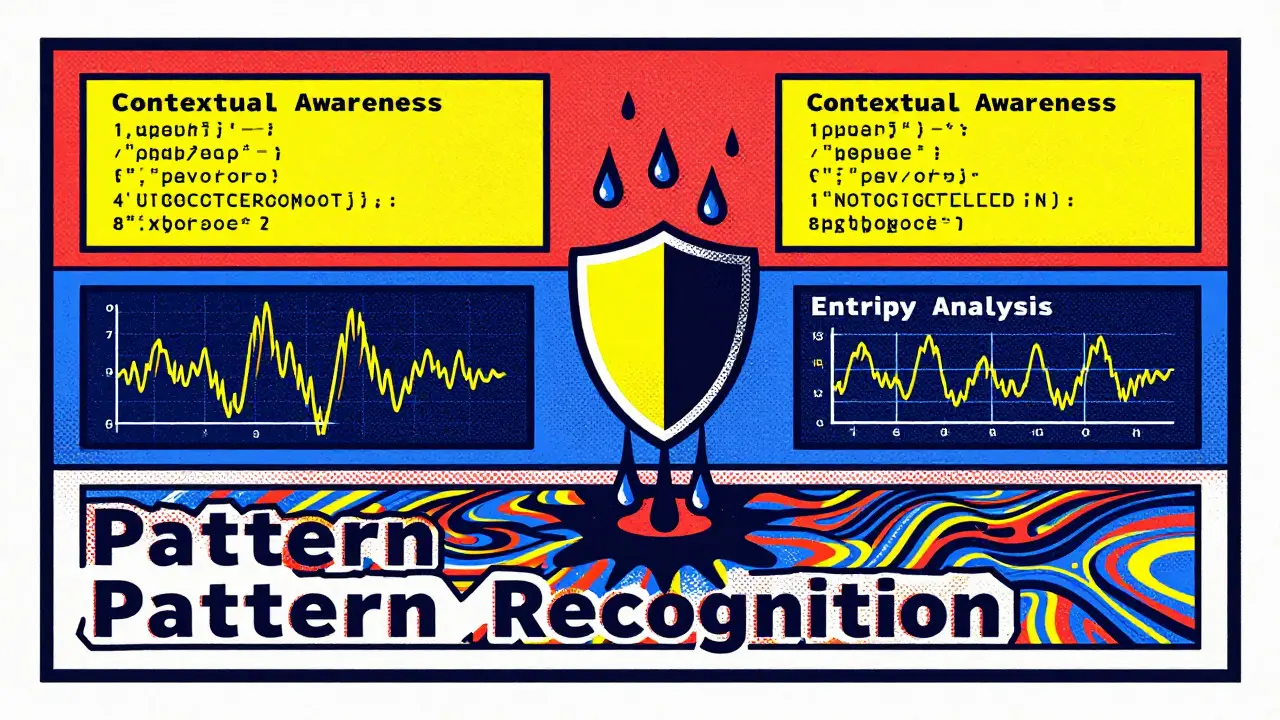
To catch these elusive leaks, security teams need more than basic pattern matching. They need multi-layered detection engines that combine three critical approaches:
- Pattern Recognition: Identifying strings that match known formats for secrets like AWS Keys are authentication credentials used to access Amazon Web Services resources, typically consisting of an Access Key ID and a Secret Access Key, GCP Service Accounts are identity mechanisms for Google Cloud applications that allow services to authenticate and authorize API calls, and Stripe API Keys are authentication tokens used to interact with the Stripe payment processing platform, enabling transactions and customer management. This accounts for about 67% of detection accuracy in advanced systems.
- Entropy Analysis: Measuring the randomness of a string. Real secrets have high entropy; fake test data often has lower entropy. Tools like TruffleHog use mathematical algorithms to detect obfuscated secrets that hide behind variable names.
- Contextual Awareness: Understanding *where* the secret appears in the code. Is it in a config file? A hardcoded string in a function? Netlify’s Smart Secret Scanning uses contextual placement (23% of accuracy) and common usage patterns (10%) to distinguish between a real leak and a false positive.
Advanced commercial tools now scan over 700 secret types. For example, ZeroPath’s scanner detects 728 specific secret patterns as of January 2025. These systems achieve up to 94.7% detection accuracy with false positive rates as low as 8.3%, according to Legit Security's 2025 benchmark study. Compare that to basic regex scanners, which average only 78.2% accuracy and suffer from a 22.6% false positive rate-a nightmare for developer velocity.
Top Tools for Preventing AI Secret Leaks
Not all scanners are created equal when it comes to AI-generated code. Here is how the leading solutions stack up against each other in 2026:
| Tool | Detection Accuracy | False Positive Rate | Setup Time | Best For |
|---|---|---|---|---|
| GitGuardian is a leading secrets management platform that provides automated detection and remediation of leaked credentials across various development environments | 96.2% | Low (requires tuning) | 8-12 hours | High-security enterprises needing maximum coverage |
| Netlify Smart Scanning is an integrated security feature within the Netlify deployment platform that automatically blocks deployments containing detected secrets | 94.7% | 8.3% | 1-2 hours | Teams using Netlify who want zero-config protection |
| Legit Security is a cloud security posture management platform that includes advanced secrets scanning capabilities with AI-driven risk prioritization | High (AI-filtered) | 7.2% | Medium | Organizations focused on reducing noise and false alarms |
| TruffleHog is an open-source secrets detection tool that uses deep history scanning and entropy analysis to find credentials in Git repositories | 89.4% (obfuscated) | 18.7% | Variable (complex config) | DevOps teams comfortable with self-hosted, configurable tools |
| Gitleaks | 65.3% (misses 34.7% of AI secrets) | Low | Fast | Basic CI/CD integration for non-AI heavy workflows |
GitGuardian leads in raw detection accuracy, but it requires significant configuration time. If you need something that just works out of the box, Netlify’s solution is hard to beat, especially since it reduces false positives by 43% compared to traditional scanners when analyzing AI-generated code. For teams already deep in the Microsoft ecosystem, Azure DevOps integrations with Legit Security offer strong AI filtering capabilities.
Implementing Default Prevention in Your Workflow
The goal isn't just to *find* secrets; it's to *prevent* them from ever reaching production. This requires shifting left-integrating scanning directly into the developer's workflow before code is committed.
- Enable Pre-Commit Hooks: Install local scanners like Gitleaks or TruffleHog to block commits containing secrets before they hit the repository. This stops the leak at the source.
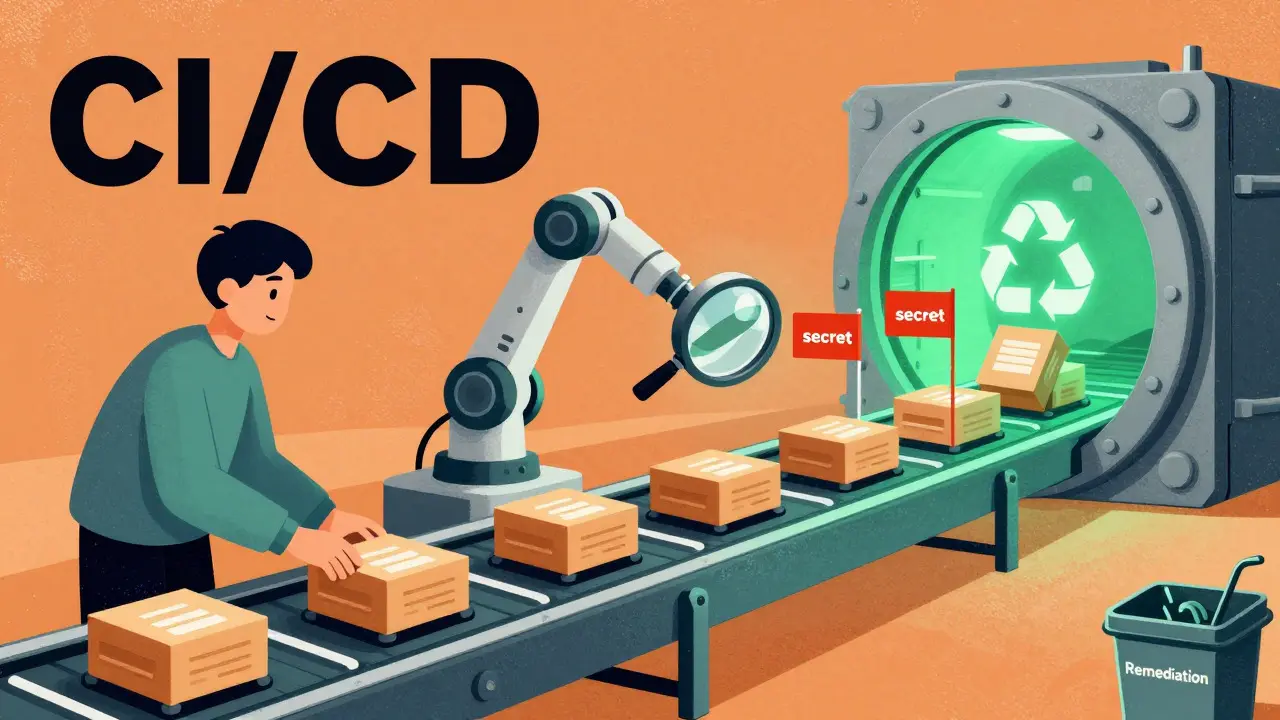
- Integrate with CI/CD Pipelines: Use tools like Jenkins, CircleCI, or GitHub Actions to run deeper scans on every pull request. Legit Security and GitGuardian both offer seamless integrations here.
- Configure Context-Aware Rules: Don't rely on default settings alone. Customize rules to ignore known test data (like Stripe test keys) while flagging production-like patterns. This addresses the #1 complaint from developers: excessive false positives.
- Automate Remediation: When a secret is detected, the system should automatically rotate the key and revoke access. Manual rotation is too slow and error-prone.
Dr. Jane Smith, Chief Security Researcher at Synopsys, noted at the 2025 Black Hat conference: "Traditional secret scanning is obsolete for AI-assisted development. We're seeing 47% of Copilot-generated code containing credential-like patterns that require contextual analysis." Setting up these defenses takes effort-expect 2 to 12 hours depending on the tool-but the cost of a breach is infinitely higher.
Common Pitfalls and How to Avoid Them
Even with the best tools, teams face challenges. Here are the most common issues reported by engineers in 2025:
- Overblocking Test Data: 52% of users reported that scanners blocked legitimate test keys. Solution: Create allowlists for known test environments and use CVSS scoring to prioritize critical risks.
- Missing Novel Patterns: New AI frameworks like Meta's Code Llama 3.0 generate unique secret patterns not covered by standard detectors. Solution: Use tools with machine learning capabilities that adapt to new patterns, such as GitGuardian's AI-generated secret pattern learning.
- Performance Impact: Scanning large repositories can slow down builds. Solution: Optimize scan scopes and use incremental scanning instead of full-history scans on every commit.
- False Confidence: Security researcher Alex Birsan warned that "over-reliance on AI scanning creates false confidence." Always combine automated scanning with periodic manual audits and developer training.
The Future of AI-Secured Development
The market for secrets scanning is exploding, reaching $1.27 billion in 2024. By 2026, analysts project the AI-specific segment will grow to $2.8 billion. Regulatory pressure is also mounting; NIST's updated SP 800-53 Revision 6 (January 2025) now requires automated detection of hardcoded credentials in AI-generated code for federal contractors.
Looking ahead, we can expect real-time prevention. ZeroPath plans to release a feature in Q2 2025 that stops Copilot *before* it inserts a secret into the IDE. This shift from post-commit scanning to pre-insertion blocking represents the holy grail of DevSecOps: security that feels invisible to the developer but protects the organization completely.
For now, the message is clear. If you are using AI coding assistants, you must treat secrets scanning as a non-negotiable default. Configure it early, tune it carefully, and automate the response. Your future self-and your CISO-will thank you.
Why do AI coding assistants generate secrets?
AI models like GitHub Copilot are trained on vast datasets of public code, including repositories that may have contained leaked credentials. When generating code, the AI predicts the next likely token based on patterns it has seen. If it encountered a valid API key in its training data associated with a specific library or framework, it may reproduce that key or a very similar pattern, resulting in a contextually generated credential that looks and acts like a real secret.
What is the difference between traditional and AI-specific secrets scanning?
Traditional scanners rely heavily on static regex patterns and known leaked key databases. They often miss AI-generated secrets because these keys may not be in existing leak databases and can vary slightly in format. AI-specific scanners use multi-layered detection, including entropy analysis and contextual awareness, to identify secrets based on their structure and placement in the code, rather than just matching against a list of known bad values.
Which secrets scanning tool is best for small teams?
For small teams looking for ease of use and quick setup, Netlify Smart Secret Scanning is an excellent choice if you are already using the Netlify platform, as it requires minimal configuration. For those needing a robust open-source solution, TruffleHog is powerful but requires more technical expertise to configure correctly. GitGuardian offers a strong balance of accuracy and usability for growing teams willing to invest in initial setup time.
How can I reduce false positives in my secrets scanner?
To reduce false positives, configure context-aware rules that distinguish between production code and test environments. Allowlist known test keys (e.g., Stripe test keys) and use CVSS scoring to prioritize critical risks. Additionally, choose tools with AI-driven filtering, such as Legit Security, which uses machine learning to better understand the intent of the code and reduce noise by up to 43% compared to traditional scanners.
Is secrets scanning required by law or regulation?
While not universally mandated by general law, specific regulations and standards increasingly require it. For example, NIST's updated SP 800-53 Revision 6 (released January 2025) explicitly requires automated detection of hardcoded credentials in AI-generated code for federal contractors. Industry standards like SOC 2 and ISO 27001 also emphasize the need for rigorous access control and monitoring, making secrets scanning a de facto requirement for compliance in many sectors.