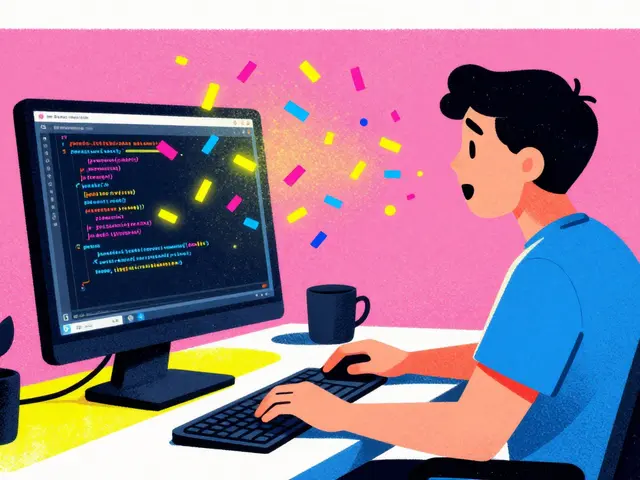
Remember when building a web application meant spending weeks configuring servers, writing boilerplate database schemas, and debugging CSS alignment issues? That era is effectively over. In 2026, we are living through the rise of vibe coding, which is an emerging software development practice that uses artificial intelligence (AI) to generate functional code from natural language prompts. This isn't just about auto-completing lines of JavaScript; it is about describing an entire application's functionality in plain English and watching the AI construct the backend, frontend, and database simultaneously.
If you are a developer looking to speed up your workflow or a non-technical founder wanting to build a product without hiring a team, vibe coding is the tool you need to understand. But before you start prompting, you need to know what actually works, what breaks, and how to structure your projects so the AI doesn't hallucinate its way into a mess. Let’s break down what to expect from AI implementations in full-stack development today.
The Core Mechanics: How Vibe Coding Actually Works
Vibe coding operates on two distinct levels. At the low level, you have the iterative loop where you refine specific code segments. You might ask the AI to fix a bug in a React component, requiring three to five prompt iterations to get it right. At the high level, you manage the lifecycle of building and deploying complete applications. This typically involves creating five to fifteen "vertical slices" per project.
A vertical slice is crucial here. Instead of building all the databases first and then all the UIs, you build one feature end-to-end-from the database schema to the API endpoint to the user interface button. According to data from Wasp.dev, a platform specializing in structured vibe coding workflows, this method allows developers to build complex apps 20 to 50 times faster than traditional methods. The key is that the AI generates approximately 200 to 500 lines of production-ready code per vertical slice, handling authentication, API logic, and UI components in one go.
The foundation of this process is natural language programming. Current large language models interpret these prompts with roughly 85 to 90% accuracy on the first try. However, this accuracy drops significantly if the prompt is vague. You aren't just talking to a chatbot; you are acting as a technical architect who speaks in requirements rather than syntax.
Choosing the Right Stack: Why Framework Matters
Not all codebases are created equal when it comes to AI generation. One of the biggest mistakes beginners make is trying to vibe code using a custom stack of disparate libraries. The AI gets confused by conflicting conventions. Instead, you should use "batteries-included" full-stack frameworks.
| Framework | Language | AI Success Rate | Best For |
|---|---|---|---|
| Wasp | JavaScript (React, Node.js) | High (40% better than custom stacks) | Rapid full-stack app development |
| Laravel | PHP | High | Traditional enterprise-style backends |
| Custom MERN Stack | JavaScript | Medium | Developers needing granular control |
| GitHub Copilot (IDE Integration) | Multi-language | Variable | Augmenting existing codebases |
Survey data from Stack Overflow’s Q3 2025 report shows that frameworks like Wasp (which bundles React, Node.js, and Prisma) see a 40% higher success rate in AI-generated implementations compared to custom configurations. Why? Because the AI knows exactly where things belong. It doesn't have to guess how your router connects to your database. This predictability reduces errors and speeds up deployment.
What to Expect: Speed vs. Complexity
The promise of vibe coding is speed, but the reality is nuanced. For standard CRUD (Create, Read, Update, Delete) applications and business logic, you can expect an 88% first-pass success rate. Building a basic SaaS dashboard or an internal tool used to take days; now it takes hours. Matt Palmer, Head of Developer Relations at Replit, demonstrated in late 2025 how developers could build full-stack applications with client and server components within 30 minutes using conversational interfaces.
However, complexity introduces friction. When you move beyond standard patterns into specialized algorithms or performance-critical systems, success rates drop to 45-50%. The AI struggles with edge cases. GitHub’s internal analysis found that AI implementations correctly anticipate only 62% of potential edge scenarios without explicit prompting. If you don’t tell the AI exactly how to handle a failed payment transaction or a concurrent user conflict, it will likely ignore those possibilities.
This means your role shifts from writer to reviewer. You spend less time typing code and more time reading it. You must architect entire systems, not just functions. As Microsoft’s developer guides emphasize, you iterate on problems, not solutions. You describe the outcome you want, let the AI make the technical choices, and then correct it when it misses the mark.
The Hidden Costs: Technical Debt and Debugging
It sounds too good to be true, so where is the catch? The catch is technical debt. Unstructured vibe coding leads to a 65% higher accumulation of technical debt compared to planned development, according to an analysis of 127 projects by Wasp. If you just prompt away without a plan, you end up with spaghetti code that works but is impossible to maintain.
Debugging AI-generated code is also a unique challenge. While 89% of positive reviews cite rapid prototyping as the main benefit, 67% of negative feedback centers on debugging difficulties. When the AI makes a mistake, it often hallucinates non-existent library functions or creates subtle logical errors that are hard to trace. A Stack Overflow survey reported that 31% of developers encountered AI hallucinations regarding library functions. You need to understand the underlying technology well enough to spot when the AI is lying to you.
Pure vibe coding without technical oversight resulted in 38% higher failure rates in production deployments, according to DZone’s analysis of 50 case studies. This highlights why the "citizen developer" model has limits. While 22% of users are non-technical creators building internal tools, 68% are professional developers using AI to accelerate routine tasks. The hybrid approach-human oversight with AI execution-is currently the most reliable path to production.
Setting Up Your Workflow for Success
To avoid the pitfalls mentioned above, you need a structured workflow. Here is a practical four-phase approach based on industry best practices:
- Foundation Setup (2-4 hours): Configure your UI component libraries and full-stack framework. Don’t skip this. Define your design system early so the AI uses consistent styles.
- AI Assistant Optimization (1-3 hours): Establish project-specific rules. Tell the AI which libraries to prefer, how to name variables, and what architectural patterns to follow. This context window management is critical.
- PRD and Planning (3-6 hours): Develop a Product Requirements Document (PRD). Break your app into vertical slices. Plan the authentication flow, the database schema, and the core features before you write a single prompt.
- Development (15-30 minutes per slice): Execute the prompts for each vertical slice. Iterate quickly. Ship fast to iterate faster.
Microsoft’s Developer Blog outlines a similar recipe: Start with VS Code + GitHub Copilot, write an outcome-focused prompt, let Copilot make technical choices, and iterate on problems. This approach reduced debugging time by 73% in their internal testing. The key is patience, persistence, and planning-the "3 Ps" of successful vibe coding.

Tools and Platforms Dominating 2026
The market for vibe coding tools reached $1.2 billion in Q4 2025, driven by enterprise adoption. Different tools serve different needs:
- GitHub Copilot: With 1.2 million paid subscribers as of January 2026, it remains the dominant IDE-integrated solution. Its recent update, Copilot X, enhances full-stack understanding, reducing context switching by 41%. It is best for developers already working in VS Code who want AI assistance within their existing workflow.
- Emergent.sh: A platform known for its massive 1 million token context window and multi-agent orchestration. It allows specialized AI agents to handle frontend, backend, and database tasks simultaneously. It is ideal for complex applications where maintaining context across many files is challenging.
- Replit: With 4.7 million active monthly users, Replit is the preferred environment for beginners. Its browser-based nature removes setup friction, making it easy to go from idea to deployed app in minutes.
Documentation quality varies. Emergent scores highly for AI-assisted documentation generation, while GitHub Copilot relies more on the user to document their code. Community support is also a factor; Wasp’s Discord community provides average response times of 22 minutes to vibe coding questions, whereas official channels for larger frameworks can take longer.
The Future: Where Is This Heading?
By 2028, Forrester predicts vibe coding will account for 30% of all new application development. We are seeing significant maturation in the space. Recent updates include real-time collaborative vibe coding, announced by Microsoft for Q3 2026, and integrated security scanning for AI-generated code, planned by GitHub for Q2 2026.
Regulatory concerns are also emerging. IP ownership of AI-generated code is a hot topic, with 57% of enterprises implementing specific policies governing vibe coding output. As you adopt these tools, ensure you understand your company’s stance on AI-generated intellectual property.
Long-term viability assessments remain positive but cautious. 73% of technical leads view vibe coding as a permanent addition to the development toolkit. However, 61% express concerns about long-term maintainability without proper architectural oversight. The consensus is clear: vibe coding is not a replacement for developers. It is a powerful augmentation that reshapes how software gets built. The developers who thrive will be those who learn to speak the language of AI while retaining the architectural discipline to guide it.
Is vibe coding suitable for beginners with no coding experience?
Yes, but with caveats. Beginners can build functional applications quickly using platforms like Replit or Wasp. However, you still need a basic understanding of how web applications work (frontend, backend, database) to debug issues and customize the output. Pure no-code solutions require less technical knowledge, but vibe coding offers more flexibility. Expect a learning curve of 25-30 hours to become proficient.
What is a "vertical slice" in vibe coding?
A vertical slice is a development methodology where you build one feature completely from top to bottom-database, API, and UI-before moving to the next feature. This approach helps AI maintain context and ensures that each part of the application works together immediately, reducing integration errors later in the project.
How much faster is vibe coding compared to traditional coding?
For standard CRUD applications and business logic, vibe coding can be 20 to 50 times faster than traditional manual coding. Initial feature implementation time drops from 4-8 hours to 15-30 minutes per vertical slice. However, for complex edge cases or specialized algorithms, the speed advantage narrows to 2-3 times due to the need for manual intervention and debugging.
Which AI tools are best for full-stack vibe coding in 2026?
GitHub Copilot is the leader for IDE-integrated assistance, especially with its Copilot X update. Emergent.sh is strong for complex projects due to its large context window and multi-agent capabilities. Replit is excellent for beginners and rapid prototyping due to its ease of use. Wasp is recommended for structured full-stack development using JavaScript.
Does vibe coding replace software developers?
No. Vibe coding augments developers rather than replacing them. It handles repetitive coding tasks and accelerates prototyping, allowing developers to focus on architecture, problem-solving, and reviewing AI-generated code. The demand for skilled developers who can oversee and direct AI systems is increasing, not decreasing.