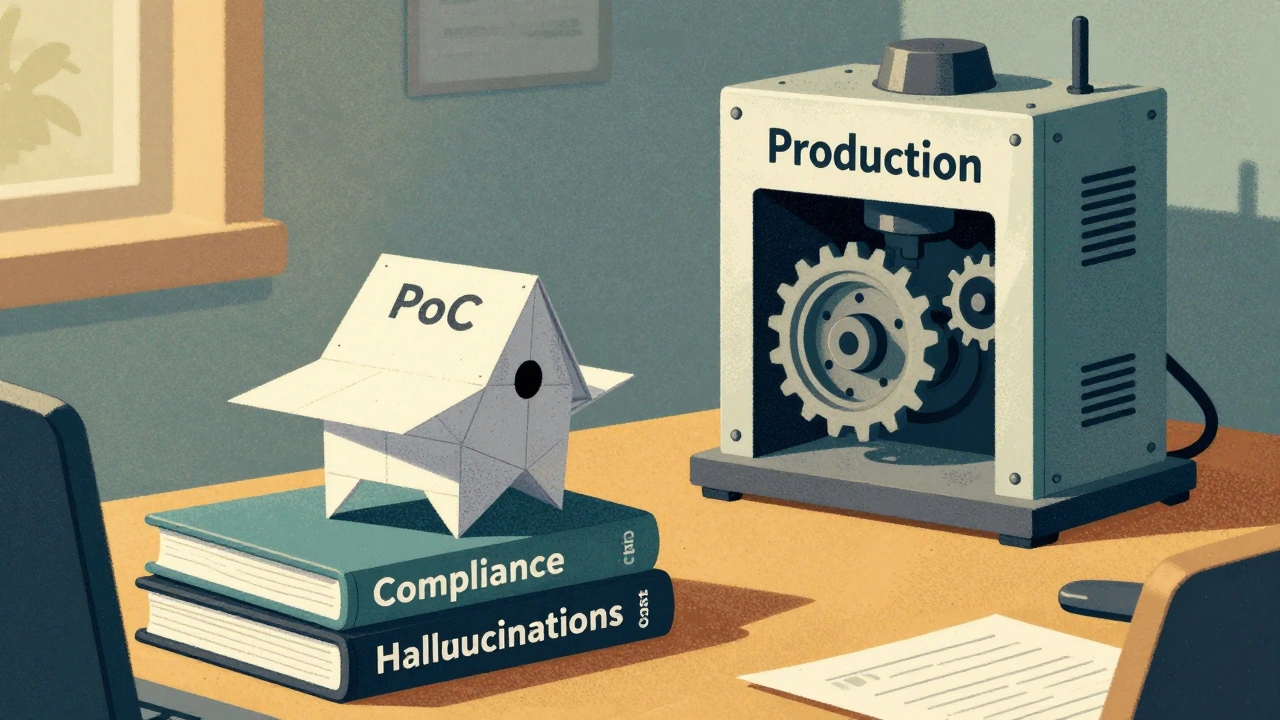
Only 14% of companies that start a generative AI proof of concept ever get it into production. That’s not a typo. It means out of every 10 teams building chatbots, content generators, or automated report writers, just one makes it past the demo stage. The rest hit a wall - unexpected costs, compliance nightmares, hallucinations in live data, or worse, no one uses it because it doesn’t solve a real business problem.
What’s the difference between the 14% and the rest? It’s not better models. It’s not more data. It’s not even smarter engineers. It’s how they treat the proof of concept from day one.
Stop Treating PoCs as Experiments
Too many teams build a PoC like a science fair project: show off a cool demo, get applause, then move on. They test a model on clean, curated data. They run it for 10 minutes. They get 90% accurate responses. Done. They call it a win.
But production isn’t a clean dataset. It’s real users typing weird questions. It’s sensitive customer data flowing through the system. It’s compliance officers breathing down your neck. It’s a 500-request-per-second API that can’t crash for 10 seconds, let alone 10 minutes.
Successful teams treat their PoC as the first version of production. Not a prototype. Not a sandbox. The real thing - just with fewer users and tighter controls. That mindset shift changes everything.
Define Success Before You Write a Single Line of Code
Ask this question before you touch an API: What does success look like in business terms?
Not: “The model generates text.”
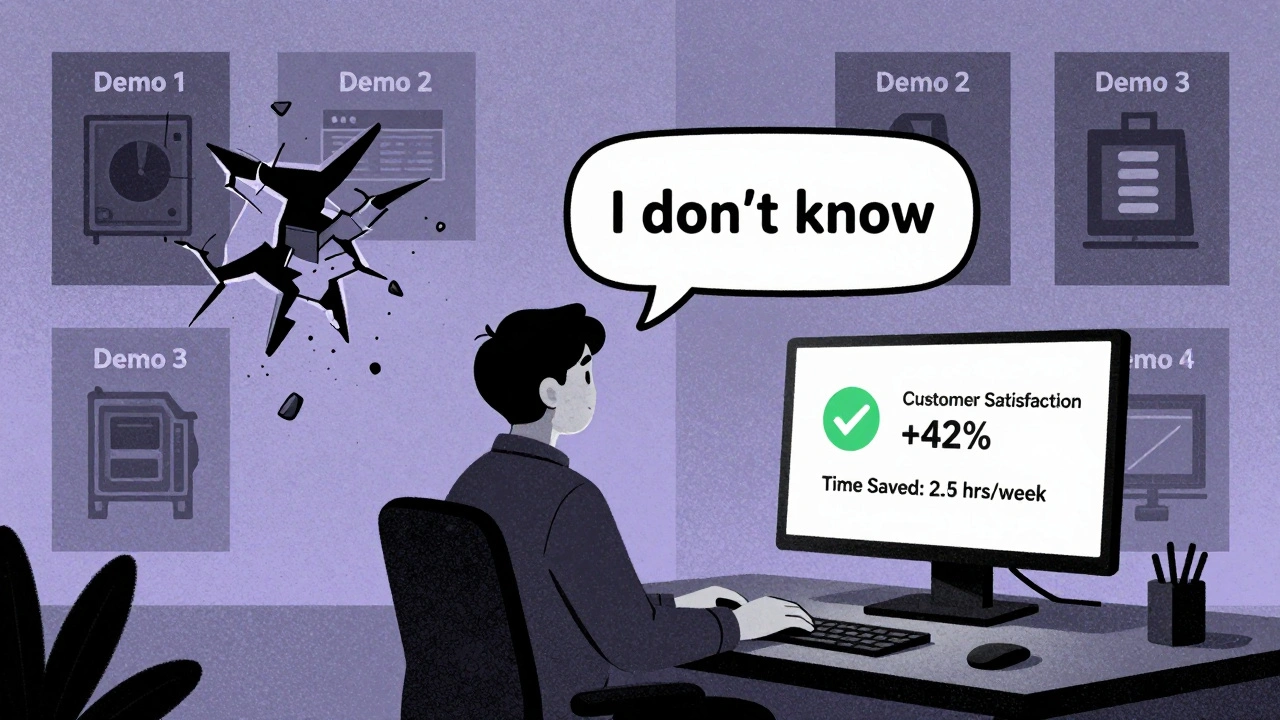
But: “Customer service reps save 2.5 hours per week because the AI drafts 80% of routine responses, and customers rate those replies as helpful in 85% of cases.”
That’s measurable. That’s tied to a business outcome. And 68% of failed projects don’t even have this.
Get stakeholders from marketing, legal, IT, and customer support to sign off on this definition before you start. If they don’t agree on what success means, you’re already behind.
Build Security In, Not On
One company built a generative AI tool to summarize patient records. The PoC worked great. Then legal said: “You can’t store patient data in the cloud without encryption, audit logs, and HIPAA-compliant access controls.” They had to rebuild the whole thing. Took 11 months.
Don’t wait for legal to stop you. Start with security as a requirement, not an afterthought.
Production-grade generative AI needs:
- Data encrypted at rest and in transit
- Role-based access tied to your existing identity system (like Azure AD or Okta)
- Audit trails that log every prompt, response, and user action
- Strict data residency rules - no sending EU patient data to U.S. servers without consent
Platforms like AWS Bedrock and Google Vertex AI have these built in. Open-source models? You’re building it yourself. And that’s where most teams get stuck.

Control the Chaos: Guardrails and Monitoring
Generative AI hallucinates. That’s not a bug - it’s a feature of how LLMs work. But in production, hallucinating that a patient has a condition they don’t have? That’s a lawsuit waiting to happen.
Successful deployments use three layers of control:
- Prompt engineering - Structure inputs so the model knows what to avoid. “Only use information from the patient’s chart. Do not speculate.”
- Retrieval-Augmented Generation (RAG) - Tie the model to trusted sources. If it can’t find the answer in your CRM or knowledge base, it says “I don’t know.”
- Real-time monitoring - Track output quality, not just speed. Look for sudden drops in factual accuracy, spikes in inappropriate language, or patterns of user frustration.
Target: 95% factual accuracy in mission-critical use cases. If you’re below 90%, you’re not ready for production.
And don’t forget to monitor costs. A PoC might use $50 worth of GPU time a week. Production? That could hit $5,000. Set budgets. Track usage. Alert when you’re over 80% of your limit.
Version Control for Prompts? Yes, Really
Most teams treat prompts like sticky notes. They change them on the fly. Then someone says, “Why did the response change last week?” and no one remembers.
Production systems need version control - just like code. Use Git to track:
- Prompt templates
- System instructions
- Fine-tuned model versions
- Test cases and expected outputs
This lets you roll back if something breaks. It lets you audit what changed. And it lets you replicate results across environments.
Only 28% of organizations do this. The rest are flying blind.
Build a Cross-Functional Team - From Day One
Generative AI isn’t an IT project. It’s a business transformation.
The teams that succeed have:
- A business owner (who cares about the outcome)
- A data engineer (who knows how to connect to Salesforce or SAP)
- A security lead (who won’t let you send data to the wrong place)
- A compliance officer (who knows GDPR, CCPA, HIPAA)
- A UX or product person (who understands how users will actually use this)
Not one of these people should be an afterthought. If you bring them in after the PoC, you’re already too late.
Don’t Skip the Training
One bank rolled out an AI assistant for loan officers. It was accurate. It was fast. But no one used it.
Why? The officers didn’t trust it. They didn’t know how to correct it. They thought it was “magic” and were afraid to interfere.
Training isn’t a one-hour webinar. It’s:
- Hands-on workshops where users test the AI with real cases
- Clear guidelines on when to override the AI
- A feedback loop where users can flag bad outputs
Organizations that invest in this see 3x higher adoption rates.
Choose the Right Platform - Or Pay the Price
You can build everything from scratch. But you’ll spend 6 months doing what AWS, Azure, or Google already solved.
Cloud platforms offer:
- Pre-built guardrails and compliance templates
- Monitoring dashboards that track hallucination rates
- Easy integration with CRM and ERP systems
- Cost controls and usage alerts
Platforms focused only on experimentation (like open-source tools without enterprise support) get 3.1/5 ratings. Those with production tools? 4.3/5.
Don’t fall for the illusion of simplicity. The PoC looks easy. Production isn’t.
What Happens After Launch?
Launching is just the start. The real work begins when users start using it.
Set up a feedback loop: every time a user clicks “This answer was wrong,” log it. Feed those examples back into your model. Retrain weekly. Update prompts. Adjust guardrails.
Track business metrics, not just technical ones:
- Did customer satisfaction go up?
- Did response time drop?
- Did staff time free up for higher-value work?
If the answer is no - even if the model is “accurate” - you haven’t succeeded.
By 2025, 70% of enterprise AI systems will automatically detect hallucinations. 85% will cut production costs by 35-50% through smarter optimization. But none of that matters if you didn’t plan for it from the beginning.
The gap between PoC and production isn’t technical. It’s organizational. It’s cultural. It’s about treating AI like a product - not a demo.
Start with business outcomes. Build with security in mind. Involve the right people early. Monitor everything. And never, ever assume your PoC is the end of the journey.
Because in production, there’s no applause. Only users. And they don’t care how cool your model is. They care if it works - every single time.


Indi s
8 December, 2025 - 22:46 PM
Been there. Built a chatbot for customer queries, thought it was golden until real users started asking 'can u help me with my ex?' and the thing started giving relationship advice. Learned the hard way that clean data doesn't exist outside demos. Need to build for chaos from day one.
Rohit Sen
10 December, 2025 - 01:38 AM
14%? That’s low. But honestly, most teams are just playing pretend. They think AI is magic, not engineering. The real 14% are the ones who stopped romanticizing LLMs and started treating them like legacy systems that break at 3 AM.
Vimal Kumar
11 December, 2025 - 00:28 AM
Love this breakdown. Especially the part about cross-functional teams. I’ve seen so many projects die because the legal team got looped in after the demo. If you don’t have compliance in the room from sprint zero, you’re just delaying the inevitable. Also, version control for prompts? Yes. Please. My team still uses Notion for prompts and it’s a nightmare.
Amit Umarani
11 December, 2025 - 20:23 PM
There’s a comma missing after 'production' in the second paragraph. Also, 'hallucinations in live data' should be 'hallucinations with live data.' And '500-request-per-second API' needs hyphens. The rest is solid, but grammar matters when you're talking about enterprise systems.
Noel Dhiraj
12 December, 2025 - 21:40 PM
Stop treating PoCs as experiments - that line hit hard. I used to think AI was about building cool stuff. Turns out it’s about building useful stuff that doesn’t crash when someone types 'how do i fake my taxes' into it. Real talk. We’re all just trying to make something that works before our boss finds out we’re using GPT-4 for everything.
vidhi patel
14 December, 2025 - 14:48 PM
It is imperative to underscore that the term 'hallucinations' is a colloquialism and entirely inappropriate for professional discourse regarding artificial intelligence systems. One must employ precise terminology such as 'factual inconsistencies' or 'non-factual outputs.' Furthermore, the use of emotive language like 'breathing down your neck' is unprofessional and undermines the credibility of the entire argument. This article, despite its useful insights, is marred by linguistic impropriety.
Priti Yadav
15 December, 2025 - 08:07 AM
Who really owns the data in these cloud platforms? AWS Bedrock? Google Vertex? They’re logging everything. Every prompt. Every user. Every patient summary. They’re training their own models on your data under the radar. You think you’re safe because it’s 'encrypted'? Nah. They own the keys. And one day, your 'private' AI will be selling ads based on your customer records. Wake up.
Ajit Kumar
16 December, 2025 - 19:33 PM
It is not merely advisable but absolutely essential to recognize that the transition from proof of concept to production is not a technical challenge but a systemic one rooted in organizational inertia. The notion that 'it's not better models' is correct, yet insufficiently articulated. The real impediment lies in the pervasive cultural delusion that artificial intelligence is a shortcut rather than a discipline requiring rigorous governance, iterative refinement, and unwavering accountability across every functional domain. Teams that fail do so not because they lack resources, but because they lack the intellectual humility to treat AI as a living system - one that demands documentation, oversight, and continuous adaptation, not a one-time demo followed by a press release. The 14% succeed not because they are smarter, but because they refuse to believe the hype. They build with the same discipline they would apply to a nuclear reactor or a cardiac monitor. Anything less is not innovation - it is negligence dressed in buzzwords.