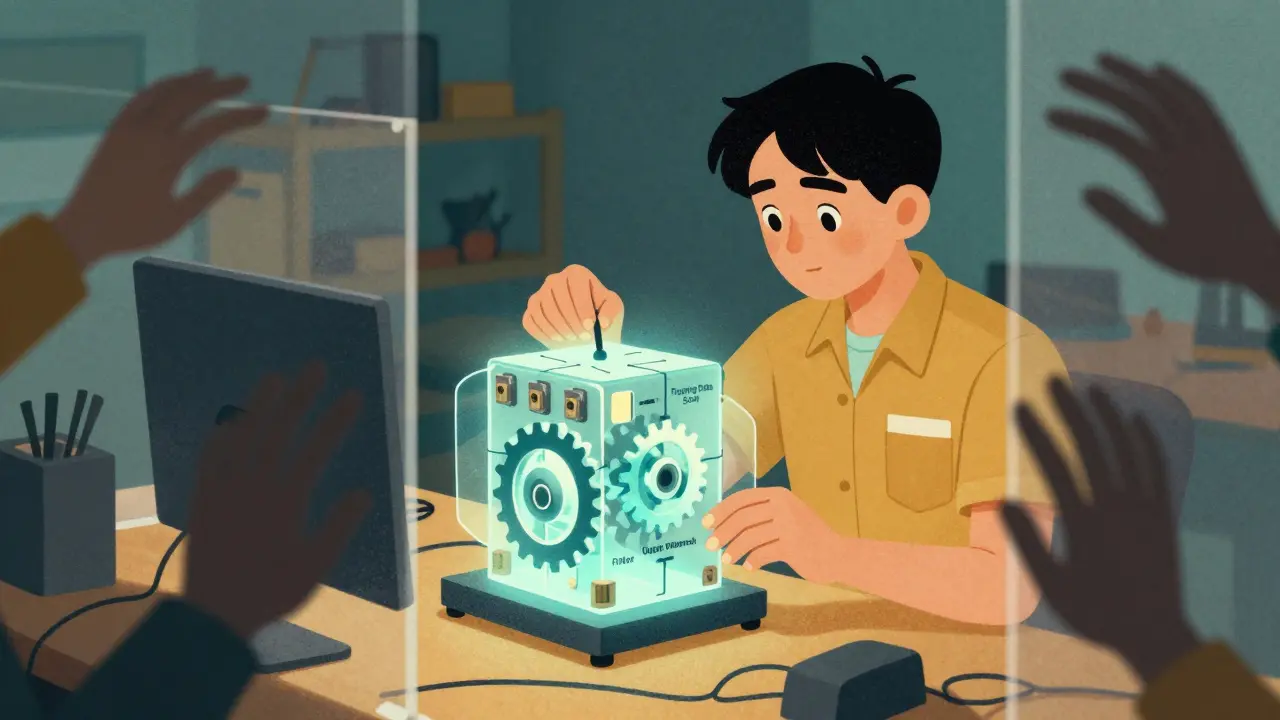
When you build a generative AI model, you’re not just creating code-you’re building a tool that can generate images, text, and videos anyone can use. And that’s the problem. Once it’s out there, bad actors don’t need to hack it. They just type a prompt. A single line. And suddenly, a child’s face is on a naked body. A private photo is turned into something abusive. A voice clone is used to threaten someone. This isn’t science fiction. It’s happening now. And if you’re building AI without safety baked in from day one, you’re not just risky-you’re dangerous.
Why Safety Can’t Be an Afterthought
Most tech companies used to build first, fix later. Release a product. Get users. Then deal with the fallout. That worked for social media apps. It doesn’t work for generative AI. Why? Because AI doesn’t just copy content-it creates it. And once it creates harmful material, you can’t unring that bell. You can’t delete every copy. You can’t recall every user who saw it. The damage is done.
Take child sexual abuse material (CSAM). In 2024, researchers found that even models trained on "clean" datasets could generate CSAM when prompted in certain ways. Not because they were trained on it. But because they learned patterns so well, they could invent it. That’s not a bug. It’s a feature of how these models work. And if you don’t design against it from the start, you’re letting your product become a weapon.
Thorn, a nonprofit focused on child safety, worked with Google, OpenAI, Meta, and Stability AI to create Safety by Design is a framework that embeds protection into the core of AI systems. It’s not a plugin. Not a filter. Not a post-launch review. It’s architecture. Like putting locks on doors before you build the house.
Three Stages of Safety by Design
Safety by Design isn’t one step. It’s three. And each one has to be done right-or the whole system fails.
1. Development: Build Safety Into the Model
This is where most companies fail. They grab public datasets. They scrape the web. They don’t check what’s in there. And guess what? A lot of it is illegal. A lot of it is abusive. Training on that data doesn’t just make your model less accurate-it makes it dangerous.
Safety by Design says: Before you train, scan everything. Use detection tools built for CSAM and CSEM (child sexual exploitation material). Not just once. Continuously. Even if your dataset came from a "trusted" source, assume it’s contaminated until proven otherwise.
Then, build bias into the model. Not bias against people. Bias against abuse. Train the model to recognize harmful patterns-not just in outputs, but in inputs too. If someone types a prompt that even hints at generating abusive content, the model should refuse-not because it’s being censored, but because it’s been taught that this is a line it must not cross.
And don’t skip red teaming. That’s when you hire people to try to break your system. Not for fun. For survival. Ask them: "Can you get this model to generate CSAM?" If they can, you’ve got a problem. If they can’t, you’re ahead of 90% of companies still in development.
2. Deployment: Protect Users in Real Time
Even the safest model can be tricked. That’s why deployment safety matters just as much as development.
Every input gets scanned. Every output gets checked. Not just for CSAM, but for harassment, doxxing, impersonation, and non-consensual imagery. Use automated scanners that look for known patterns, but also for new ones. Machine learning models can detect anomalies in text or images that humans miss.
Watermarking helps. Not because it’s foolproof. But because it creates accountability. If someone uses your model to generate harmful content, you can trace it. You can prove it came from you. And that deters misuse.
Also, don’t just block bad prompts. Redirect them. Show users a message: "This request violates our safety policies. If you’re struggling with something, help is available." That’s not censorship. That’s care.
3. Maintenance: Keep Up With New Threats
Bad actors don’t stop. Neither should you.
Safety by Design isn’t a one-time fix. It’s a living system. New attack vectors emerge every week. A researcher finds a way to bypass filters. A hacker shares a new prompt trick on a dark web forum. Your model has to adapt.
That means continuous monitoring. Automated alerts. Weekly updates. And a team-not a single person, not a contractor, not a compliance officer-that owns safety as their core job.
And here’s the hard truth: If your safety team reports to your legal team, you’re doing it wrong. Safety isn’t a legal issue. It’s a product issue. It’s an engineering issue. It’s a design issue. It has to sit at the table with your lead architect, your data scientist, your UX designer.
What Safety by Design Looks Like in Practice
Let’s say you’re building a text-to-image generator for artists. You want it to be creative. Powerful. Useful.
Here’s what Safety by Design looks like in your workflow:
- You don’t use public datasets. You license only verified, human-curated art collections.
- You train your model with a custom loss function that penalizes outputs matching known CSAM patterns-even if they’re not exact copies.
- You run weekly red team tests with a group of former law enforcement specialists who specialize in online exploitation.
- When a user types "girl, 12, naked," your system doesn’t just block it. It responds: "I can’t generate that. But if you’re feeling overwhelmed, you can talk to someone at Childhelp.org."
- Every image is watermarked with invisible metadata that links back to your system and timestamp.
- Every month, your team reviews new attack patterns from NIST’s AI Safety Benchmark and updates your filters accordingly.
This isn’t theoretical. This is what companies using Safety by Design actually do. And yes, it slows things down. But it stops disasters before they happen.

Why This Matters Beyond Child Safety
Safety by Design started with child protection. But its principles apply everywhere.
Think about deepfake scams. A CEO gets voice-cloned. A bank transfers $2 million. That’s not a fraud issue. It’s a model design issue. If your AI can’t detect voice manipulation attempts, you’re enabling fraud.
Think about misinformation. A model generates fake news about an election. People riot. Lives are lost. That’s not a content moderation problem. That’s a training data problem. A prompt filtering problem. A system design problem.
IBM found that companies using secure-by-design practices in AI saw a 72% improvement in governance and compliance. Why? Because they didn’t wait for audits. They built safety into every layer.
That’s the real win. Safety by Design doesn’t just protect people. It protects your company. Your license to operate. Your reputation. Your bottom line.
The Cost of Ignoring It
Some say: "We’ll handle safety later."
Here’s what "later" looks like:
- A lawsuit from a parent whose child was targeted by your model.
- A congressional hearing where your CEO is asked, "Why didn’t you do anything?"
- A public backlash that erodes trust in your brand for years.
- A regulatory ban that shuts you down.
Thorn estimates the cost of a single CSAM incident-legal fees, lost revenue, brand damage, remediation-is over $10 million. And that’s just one case.
Meanwhile, building safety into your architecture from the start? It adds 10-15% to your development timeline. But it cuts your risk by 90%.
How to Start Today
You don’t need to be OpenAI to do this. Here’s how any team can begin:
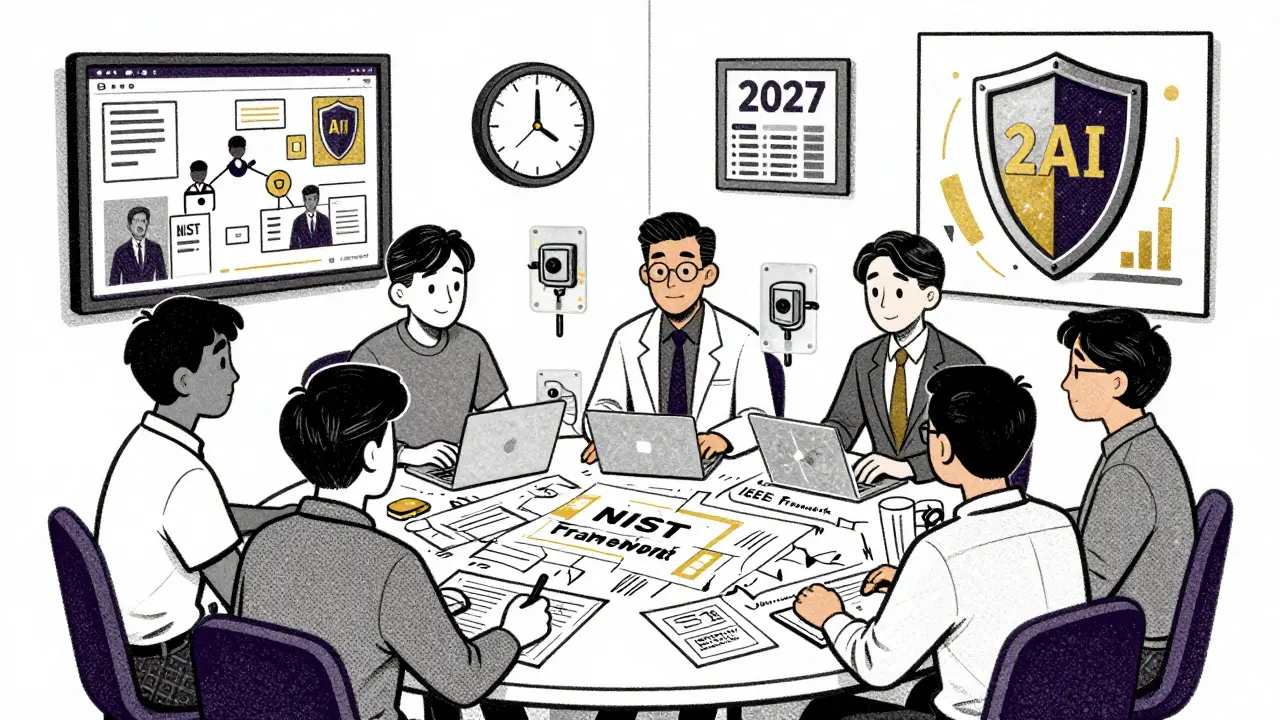
- Review your training data. Use tools like NIST AI Risk Management Framework is a standard developed with input from Safety by Design to audit for harmful content.
- Implement input and output scanning with at least one open-source CSAM detection tool.
- Assign one engineer to own safety. Not a manager. Not a lawyer. An engineer. Give them authority to pause development if risks are found.
- Join the conversation. Follow IEEE has published a recommended practice based on Safety by Design principles and NIST updates. They’re public. Free. And they’re your roadmap.
- Train your team. Show them real examples of what AI-generated abuse looks like. Not to scare them. To motivate them.
This isn’t about being perfect. It’s about being responsible. And if you’re building AI, you’re already responsible-for every word it writes, every image it creates, every life it touches.
What’s Next
Safety by Design is becoming the baseline. Not the exception. By 2027, regulators will require it. Investors will demand it. Users will expect it.
Companies that treat safety as a checkbox will be left behind. Companies that treat it as core to their product will lead.
The question isn’t whether you can afford to build safety in. The question is: Can you afford not to?
What is Safety by Design in generative AI?
Safety by Design is a framework that embeds protections-like content filtering, model biasing, and input scanning-directly into the architecture of generative AI systems during development, rather than adding them as afterthoughts. It was developed by Thorn in collaboration with AI leaders like Google and OpenAI, and later formalized by NIST and IEEE. The goal is to prevent harmful outputs like child sexual abuse material before they’re created, not just detect them after the fact.
Why can’t we just use filters after the AI generates content?
Filters applied after generation are too late. Once harmful content is created, it can be copied, shared, downloaded, and spread across the internet. By then, real people have been harmed, and the damage is irreversible. Safety by Design stops the harm at the source-by making it impossible for the AI to generate abusive content in the first place, through training, architecture, and prompt controls.
Does Safety by Design only protect children?
No. While it started with child safety, the principles apply broadly. The same techniques that block CSAM can also prevent harassment, impersonation, non-consensual imagery, and deepfake scams. Safety by Design is about building systems that resist abuse in any form-whether it targets children, individuals, or public trust.
Is Safety by Design expensive to implement?
It adds about 10-15% to development time, but it saves far more in the long run. Companies that wait to add safety face lawsuits, regulatory fines, brand damage, and loss of user trust-all costing millions. Building safety in upfront is cheaper than cleaning up after a disaster. Plus, it reduces ongoing moderation costs because the AI itself is less likely to produce harmful content.
Can small AI teams use Safety by Design?
Yes. You don’t need a huge team. Start small: audit your training data, add one open-source content scanner, assign one person to own safety, and follow NIST and IEEE guidelines. The key isn’t scale-it’s intention. Even a two-person team can embed safety if they make it a priority from day one.
How do NIST and IEEE relate to Safety by Design?
NIST (National Institute of Standards and Technology) and IEEE (Institute of Electrical and Electronics Engineers) didn’t create Safety by Design, but they’ve adopted its core principles into formal industry standards. NIST’s AI Risk Management Framework and IEEE’s recommended practice now include Safety by Design as a baseline for responsible AI development. This means companies following these standards are aligning with the most widely accepted safety practices in the field.
What’s the difference between Safety by Design and Responsible AI?
Responsible AI is a broad umbrella that includes fairness, transparency, and accountability. Safety by Design is a specific, actionable subset of that. It’s not about ethics committees or policy statements-it’s about concrete engineering choices: how you train the model, what data you use, how you filter inputs, how you respond to harmful prompts. It’s the practical implementation of responsible AI principles.
Do I need to use proprietary tools to implement Safety by Design?
No. While some companies build custom tools, many key components are open source. Tools like Google’s SafeSearch API, Microsoft’s Azure Content Moderator, and open datasets from the Partnership on AI can help. The framework is about process, not proprietary tech. You can start with free, public tools and scale up as needed.
What happens if my AI model still generates harmful content?
No system is perfect. But Safety by Design reduces the chance dramatically. If harmful content slips through, your response matters. You need logs showing you scanned inputs, tested outputs, trained with safety in mind, and updated regularly. That proves you acted responsibly. Without those steps, you’re vulnerable to legal and reputational consequences-even if the harm was unintentional.
Is Safety by Design legally required?
Not yet everywhere, but it’s coming fast. The EU’s AI Act, the U.S. Executive Order on AI, and proposed bills in multiple states now require safety-by-design practices for high-risk AI systems. By 2027, it will be a legal baseline in most developed markets. Waiting until then means you’re already behind.

Kirk Doherty
12 March, 2026 - 10:09 AM
Been thinking about this a lot lately. AI’s getting scarily good at making stuff that shouldn’t exist. Not just kids’ stuff either-fake revenge porn, impersonating coworkers, fake confessions. It’s wild how fast this went from sci-fi to my feed.
Just last week a friend got a voice message that sounded like her dad begging for money. Turned out it was an AI clone. She cried. No joke.
They’re right. You can’t filter your way out of this. You gotta stop it before it’s born.
Liam Hesmondhalgh
12 March, 2026 - 13:20 PM
Ugh. Another tech bro lecture on "safety by design" like it’s some revolutionary idea. We’ve had content filters since the 90s. Why is everyone acting like this is new?
Also, who the hell is Thorn? Some NGO with a fancy website? I’m not trusting some non-profit’s word over real engineers who actually ship code.
Patrick Tiernan
12 March, 2026 - 18:01 PM
Liam you’re so last season. Safety by Design isn’t about filters, it’s about *architecture*. Like, actual engineering. You know what’s worse than bad AI? Bad AI that’s *not* your fault but you get sued anyway.
And Thorn? They’re the ones who helped take down those deepfake pedo rings. You think that’s coincidence? Nah. They’ve got cops on retainer.
Also stop being a grumpy Irishman and read the damn post. It’s not a manifesto. It’s a fucking manual.
Patrick Bass
14 March, 2026 - 07:56 AM
Just wanted to say I appreciate the clarity in this piece. The part about red teaming with former law enforcement was eye-opening. Most teams just run automated scans and call it a day. But real abuse has nuance. You need people who’ve seen the worst to test it properly.
Also, watermarking isn’t just for blame-it’s for accountability. If someone misuses your tool, you can prove it. That’s powerful.
Tyler Springall
15 March, 2026 - 08:50 AM
How many of you actually work in AI? Or are you just here to virtue-signal because you read one article? This "Safety by Design" thing is a marketing buzzword wrapped in a moral panic.
Every time someone says "you can’t unring the bell," I think of the printing press. Or radio. Or the internet. We didn’t shut those down. We adapted.
Also, who gave Thorn the authority to define safety? Did they get voted in? No. They got funding. And now they’re the gatekeepers.
Colby Havard
15 March, 2026 - 21:28 PM
It is, indeed, a profound and unsettling reality that the capacity of generative AI to synthesize harm-without having been trained on it-represents a fundamental ontological shift in the nature of digital risk.
Whereas traditional software vulnerabilities are exploitable through code, AI-generated harm emerges from semantic patterns, statistical correlations, and latent space anomalies-phenomena that defy conventional patching.
Therefore, to treat safety as an orthogonal concern, rather than a first-order constraint in model architecture, is not merely negligent-it is epistemologically incoherent.
Furthermore, the notion that regulation will follow innovation is a dangerous fallacy; by the time legislation is enacted, the damage is already distributed across millions of nodes, irrecoverable, and untraceable.
Thus, the only ethically defensible position is to embed safety as a topological invariant in the model’s training objective, loss function, and inference pipeline-prior to deployment, prior to validation, prior to iteration.
This is not a suggestion. It is a logical necessity.
Amy P
16 March, 2026 - 07:45 AM
Okay I’m crying. Not because I’m dramatic (okay maybe I am) but because I work with kids. And I’ve seen what happens when a 13-year-old sees something their AI "friend" generated for them.
It’s not a glitch. It’s not a bug. It’s a wound.
And the worst part? No one sees it coming. Not until it’s too late.
So yeah, I’m all for Safety by Design. I’m for the engineer who pauses development. I’m for the team that says "no" even when the deadline is tomorrow.
Because some things are more important than shipping.
And if you don’t get that? You shouldn’t be building AI.
Also, Childhelp.org is real. And they’re amazing. Link it. Always.
Ashley Kuehnel
17 March, 2026 - 03:53 AM
Hey everyone-just wanted to add a quick tip! If you’re a small team and don’t know where to start, use the NIST AI RMF. It’s free. It’s simple. And it breaks safety into bite-sized pieces.
Also, don’t wait for a "safety person" to join your team. Just pick one engineer (even if they’re new) and say "you’re in charge of safety now." Give them 2 hours a week. That’s enough to start scanning datasets and testing prompts.
And yes, you can use open-source tools like Google’s SafeSearch API or Microsoft’s Content Moderator. No need to build from scratch.
Small steps. Consistent effort. That’s how you build something that lasts.
Also, if you’re scared you’re doing it wrong? You’re probably doing it right. The people who aren’t scared? That’s the problem.