Imagine an assistant that doesn't just answer your questions but actually goes out and fixes the problem. You tell it to "check server logs for errors," and instead of summarizing a text file, it connects to your database, runs queries, identifies anomalies, and drafts a fix for you to approve. This isn't science fiction anymore; it's the reality of agent-oriented large language models, which are AI systems that combine reasoning with the ability to plan, use tools, and act autonomously in dynamic environments. Traditional large language models (LLMs) are brilliant at generating text, but they are passive. They wait for a prompt and respond. They don't remember past interactions beyond the current context window, and they can't interact with the outside world. Agent-oriented architectures change this by turning LLMs into goal-directed engines capable of executing complex, multi-step tasks.
From Passive Models to Active Agents
To understand why agent-oriented LLMs matter, we first need to look at what standard LLMs lack. A typical LLM is a statistical engine trained on vast amounts of text data. It predicts the next word based on patterns it has seen before. While impressive, this design has hard limits. As noted by industry analysts, an LLM is typically not an autonomous agent because it cannot recall past behaviors over long periods, nor can it plan future actions independently. It lives in the moment of the prompt.
Agent-oriented frameworks bridge this gap by adding three critical layers to the foundation model: memory, planning, and tool use. Think of the LLM as the brain, but one that needs a body to move and a notebook to remember. The agent core acts as the central coordination module that manages logic, behavioral characteristics, and decision-making processes. This core orchestrates how the model thinks, what it remembers, and which external tools it employs. Without this architecture, you have a chatbot. With it, you have an employee.
The shift from reactive assistants to proactive agents is significant. An AI assistant waits for you to ask, "What's the weather?" An agent might notice your calendar shows a trip to London tomorrow, check the forecast, see rain, and proactively suggest packing an umbrella or rescheduling outdoor meetings. This autonomy allows organizations to automate workflows that previously required human orchestration, such as weekly system log reviews or automated customer support escalations.
The Anatomy of Agency: Planning and Reasoning
How does an LLM learn to plan? It doesn't come pre-installed. Developers use specific architectural patterns to teach models how to break down problems. Two of the most prominent methods are ReAct and Reflexion.
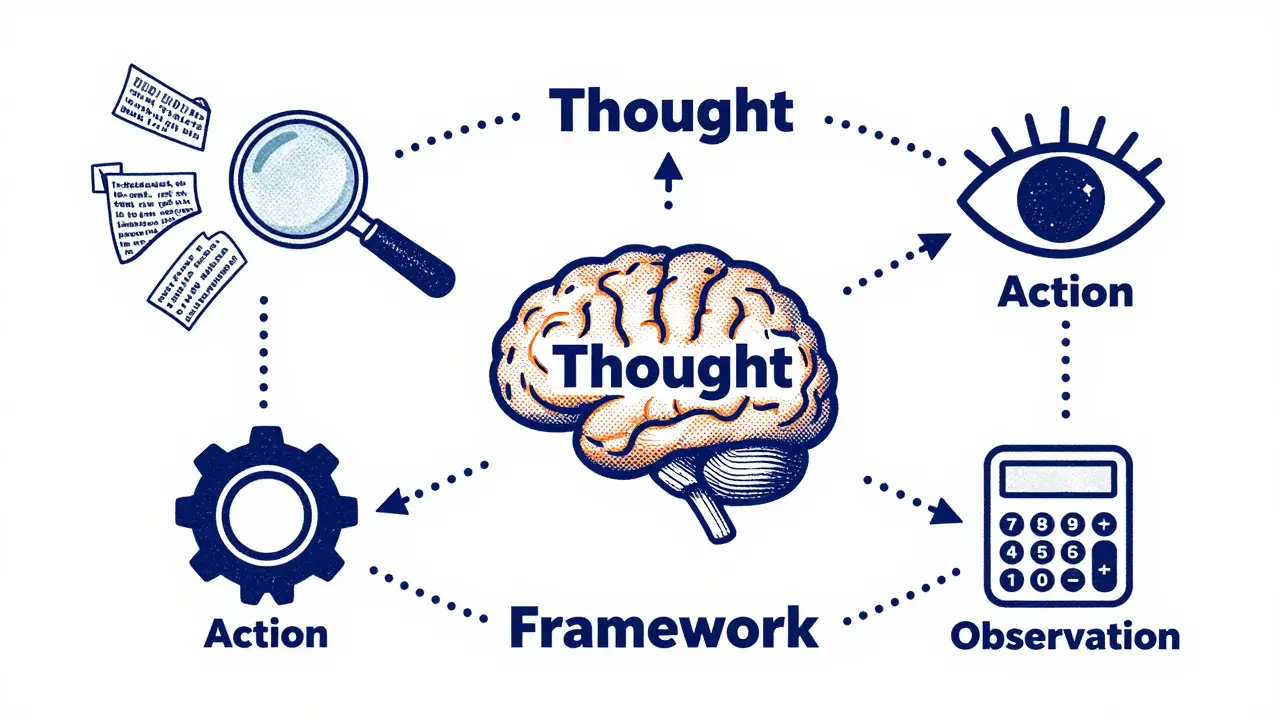
ReAct is a framework combining reasoning and acting, prompting the LLM to think out loud before taking action. In a ReAct loop, the model generates a thought process, decides on an action (like searching a database), executes that action, observes the result, and then reasons again. This cycle continues until the goal is met. For example, if asked to "find the best laptop under $1000," a ReAct agent might first search for current prices, compare specs, read recent reviews, and then synthesize a recommendation. This step-by-step approach reduces hallucinations because each step is grounded in real-time data.
Reflexion introduces self-reflection and learning over multiple episodes, allowing agents to improve performance by analyzing past failures. After completing a task-or failing to complete one-the agent reviews its actions. It generates "lessons learned" that serve as long-term memory. If an agent fails to book a flight because it didn't check for passport validity requirements, Reflexion ensures it adds that check to its mental checklist for future booking tasks. This creates a feedback loop where the agent gets smarter with every interaction.
Tools: Extending Capabilities Beyond Text
An agent without tools is like a person locked in a room with no phone or internet. Tool integration is what gives agent-oriented LLMs their power. These tools can be anything from simple calculators to complex APIs that control smart home devices, manage cloud infrastructure, or access proprietary company databases.
When an agent uses a tool, it translates natural language instructions into structured commands. For instance, you might say, "Send an email to the team about the delay." The agent understands the intent, accesses your email API, drafts the content using the LLM's generative capabilities, and sends the message. This process relies on vector embeddings-numerical representations of text that allow computers to understand semantic meaning and match user requests with the correct functions.
Common tools include:
- Web Search Engines: To retrieve up-to-date information not present in the training data.
- Code Interpreters: To run Python scripts for data analysis or calculations.
- Database Connectors: To query SQL or NoSQL databases for specific records.
- Communication APIs: To send emails, Slack messages, or SMS notifications.
The key here is reliability. The agent must know when to trust its own knowledge and when to call a tool. Misusing a tool can lead to errors, such as deleting a file instead of moving it. Therefore, robust permission controls and safety guardrails are essential components of any agent architecture.
Autonomy vs. Control: The Human-in-the-Loop
Full autonomy sounds appealing, but it comes with risks. If an agent makes a mistake while managing financial transactions or deploying code, the consequences can be severe. This is why most enterprise implementations adopt a "human-in-the-loop" approach. The agent plans and executes low-risk steps automatically but pauses for human approval before taking high-stakes actions.
Google Cloud distinguishes between AI assistants, bots, and agents based on their level of independence. Bots follow predefined rules. Assistants provide information and recommendations but let humans make decisions. Agents can make independent decisions and perform complex, multi-step actions. However, even advanced agents benefit from oversight. They can refine their reasoning through discussion and feedback mechanisms, reducing errors over time.
Consider an IT operations scenario. An agent monitors server health 24/7. When it detects a spike in latency, it can automatically restart services or scale up resources. But if it detects a potential security breach, it should alert a human analyst rather than attempting to block IPs itself, which could disrupt legitimate traffic. Balancing efficiency with safety is the primary challenge in deploying autonomous agents.
| Feature | Traditional Bot | AI Assistant | Agent-Oriented LLM |
|---|---|---|---|
| Behavior | Reactive, rule-based | Reactive, conversational | Proactive, goal-oriented |
| Decision Making | None (pre-defined paths) | Recommendations only | Independent reasoning and action |
| Tool Use | Limited or none | Basic integrations | Dynamic API and software interaction |
| Memory | Session-only | Context-window limited | Long-term episodic memory |
| Complexity | Simple tasks | Information retrieval | Multi-step workflows |

Challenges and Limitations
Despite their promise, agent-oriented LLMs are not perfect. They inherit the biases and inaccuracies of their underlying training data. If the base model has gaps in its knowledge, the agent will struggle to plan effectively. Additionally, the cost of computation is higher. Running a ReAct loop with multiple tool calls requires significantly more processing power than a single text generation request.
Another challenge is debugging. When an agent fails, pinpointing the cause can be difficult. Was it a bad plan? A failed tool execution? Or a misunderstanding of the initial prompt? Developers need new observability tools to trace the agent's thought process and actions step-by-step. Furthermore, security remains a concern. Granting an AI agent access to sensitive systems requires strict authentication and authorization protocols to prevent unauthorized actions.
Real-World Applications
Where do these agents shine today? Early adopters are focusing on high-value, repetitive tasks that require reasoning. In software development, agents can review pull requests, identify bugs, and even write unit tests. In customer service, they can handle complex inquiries by accessing order histories, checking inventory, and processing refunds without human intervention. In data analysis, they can clean datasets, generate visualizations, and summarize insights for stakeholders.
For example, an e-commerce business might deploy an agent to monitor competitor pricing. The agent visits competitor websites daily, extracts price data, compares it with internal margins, and suggests price adjustments. This saves hours of manual research and provides data-driven recommendations instantly.
What is the difference between an LLM and an agent?
An LLM is a model that generates text based on patterns in its training data. It is passive and cannot take actions. An agent is a system that uses an LLM as its reasoning engine but adds capabilities like memory, planning, and tool use, allowing it to perform tasks autonomously.
How does the ReAct framework work?
ReAct stands for Reason and Act. It prompts the LLM to generate a chain of thoughts, decide on an action, execute that action using a tool, observe the result, and repeat the cycle until the task is completed. This iterative process improves accuracy and reduces hallucinations.
Can agent-oriented LLMs learn from mistakes?
Yes, through methods like Reflexion. After completing a task, the agent analyzes its performance, identifies errors, and stores lessons learned in long-term memory. This allows it to avoid similar mistakes in future episodes.
Are autonomous agents safe to use in enterprises?
Safety depends on implementation. Best practices include using human-in-the-loop approvals for critical actions, implementing strict access controls for tools, and continuously monitoring agent behavior for anomalies. Full autonomy is rarely recommended for high-stakes operations without oversight.
What tools do AI agents commonly use?
Agents commonly use web search engines, code interpreters, database connectors, and communication APIs (email, Slack). These tools extend the agent's capabilities beyond text generation, allowing it to interact with real-world systems and data sources.