
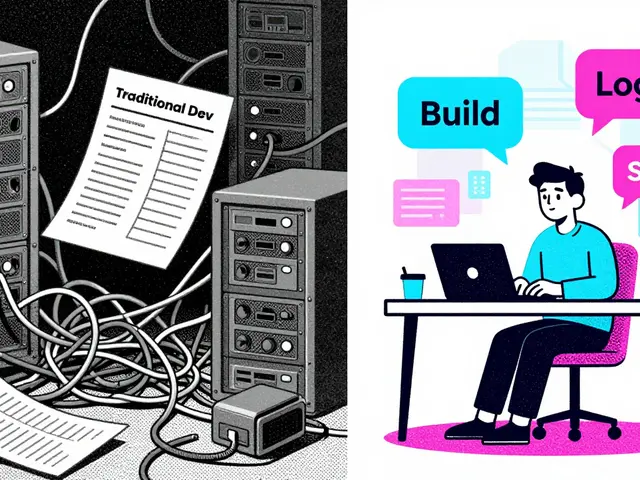
Ever noticed that some AI models pause before answering? They don't just spit out a result; they show their work. This is the power of think-tokens, or reasoning traces, which have fundamentally changed how modern large language models (LLMs) handle complex tasks. Instead of guessing the final answer immediately, these models generate intermediate steps to solve problems like math equations, logic puzzles, and coding bugs. It’s a shift from simple pattern matching to structured problem-solving.
This isn't just a gimmick. By breaking down problems into smaller chunks, models significantly boost their accuracy on difficult benchmarks. However, this comes with a trade-off: it takes more time and memory. Understanding how think-tokens work helps you decide when to use them and how to optimize your AI workflows for better results without unnecessary delays.
What Are Think-Tokens and Why Do They Matter?
Think-tokens are intermediate tokens generated by a model during its reasoning process before producing a final answer. Also known as chain-of-thought (CoT) reasoning, this technique allows the model to "think" through a problem step-by-step. The concept gained traction in early 2022 but became standard in frontier models like Claude 3.5 Sonnet and GPT-4o by 2025.
The core benefit is accuracy. When a model has to explain its logic, it catches errors that might slip through in a direct answer. For example, on the GSM8K math benchmark, models using reasoning traces achieve 37.2% higher accuracy compared to standard prompting. This makes think-tokens essential for tasks requiring multi-step logic, such as debugging code or analyzing financial data.
- Improved Accuracy: Multi-step verification reduces logical errors.
- Transparency: Users can see *why* the model arrived at an answer.
- Debugging Aid: Developers can trace where a complex query went wrong.
How Reasoning Traces Work Under the Hood
You might wonder if the model is truly "thinking" or just generating filler text. Research suggests it’s a mix of both. Attention map analysis from recent studies shows that only about 21.1% of tokens in a reasoning trace are "decision-critical." These are the tokens that actually influence the final answer. The rest act as syntactic scaffolding, helping the model maintain context and structure.
Frontier models often use a "dual-phase generation" approach. First, they engage in exploratory reasoning with higher randomness (temperature=0.8) to explore different paths. Then, they switch to convergent reasoning (temperature=0.3) to lock in the best solution. This two-step process mimics how humans brainstorm and then refine ideas.
However, not all reasoning tokens are created equal. Some serve as gradient anchors during training, helping the model learn patterns. In production, though, the focus is on efficiency. Models like DeepSeek-R1 specialize in this area, offering robust reasoning capabilities while optimizing token usage.
The Cost of Thinking: Latency and Memory Trade-offs
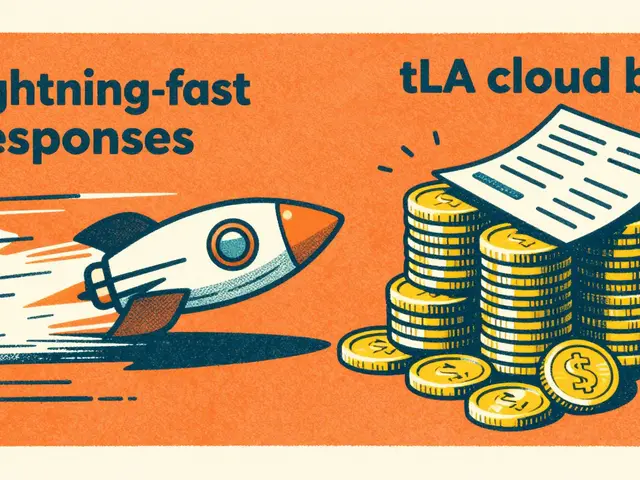
There’s no free lunch. Generating extra tokens means processing more data. This leads to two main issues: increased latency and higher memory usage. According to Apple’s research, reasoning traces can add 320-850 milliseconds of delay per query. For real-time applications like chatbots, this can feel sluggish.
Memory is another concern. The Key-Value (KV) cache, which stores context for faster retrieval, grows by 40-65% when full reasoning traces are active. This limits how many concurrent users a server can handle without upgrading hardware.
| Metric | Standard Generation | Reasoning Generation (Think-Tokens) |
|---|---|---|
| Average Tokens Generated | 50-100 | 200-600+ |
| Latency Increase | Baseline | +320-850ms |
| Memory Footprint (KV Cache) | Baseline | +40-65% |
| Accuracy on Complex Math | ~60% | ~82% |
To mitigate these costs, developers use techniques like Dynamic Thinking-Token Selection (DynTS). This framework retains only high-importance tokens, reducing memory overhead by 58.3% while keeping accuracy above 95%. It’s a clever way to get the benefits of reasoning without the full computational hit.

Open-Weight vs. Closed-Weight Models
Not all reasoning models behave the same. Open-weight models, like Magistral-small, tend to be more verbose. They generate more tokens than closed-weight models like Claude 3.5 for similar tasks. For knowledge questions, open models might use 3x more tokens. However, users often prefer their explanations because they’re more transparent and easier to follow.
Closed-weight models, on the other hand, prioritize efficiency. They deliver accurate answers with fewer tokens, making them ideal for high-volume applications where speed matters. The choice depends on your needs: do you want maximum transparency, or do you need fast, reliable responses?
Common Pitfalls and How to Avoid Them
Even with advanced reasoning, models can make mistakes. One common issue is "reasoning hallucination," where the model fabricates a plausible-sounding but incorrect path. This happens especially when given misleading hints. To avoid this, always verify critical outputs against trusted sources.
Another pitfall is "reasoning bloat." Sometimes, the model over-explains simple problems. A basic math question might take 300+ tokens to solve, which is inefficient. You can control this by adjusting the maximum reasoning tokens allowed. Most platforms offer a slider or parameter to limit this depth.
Finally, be wary of false confidence. Just because the model shows its work doesn’t mean it’s right. In fact, detailed explanations can sometimes make incorrect answers seem more credible. Always treat reasoning traces as a guide, not a guarantee.

Optimizing Your Workflow with Think-Tokens
If you’re integrating reasoning models into your projects, start with the right settings. OpenAI recommends a temperature of 0.7 and top-p of 0.95 for balanced creativity and focus. Set the maximum reasoning tokens based on task complexity: 200 for simple queries, 1,024 for complex problems.
For developers, the learning curve is moderate. Expect to spend 8-12 hours mastering prompt engineering techniques specific to reasoning models. Focus on clear instructions and defining expected output formats. This helps the model stay on track and reduce unnecessary verbosity.
Keep an eye on emerging tools like Anthropic’s "reasoning depth slider" and Apple’s Veritas framework. These innovations allow you to dynamically adjust reasoning intensity and verify logical consistency, respectively. As these tools mature, you’ll have more control over the balance between speed and accuracy.
Frequently Asked Questions
Are think-tokens the same as chain-of-thought prompting?
Yes, think-tokens are the technical implementation of chain-of-thought (CoT) reasoning. While CoT refers to the general strategy of breaking problems into steps, think-tokens are the actual intermediate tokens the model generates to execute that strategy.
Do reasoning models always produce better answers?
Not always. For simple, factual questions, reasoning traces can add unnecessary delay without improving accuracy. They shine on complex, multi-step problems like math, logic, and coding, where step-by-step verification reduces errors significantly.
How much more expensive are reasoning models to run?
The cost increase depends on token pricing and volume. Since reasoning models generate 2-4x more tokens, inference costs can rise proportionally. However, improved accuracy may reduce the need for retries or manual corrections, potentially offsetting some costs in high-stakes applications.
Can I turn off reasoning traces in my API calls?
In most cases, yes. Many APIs allow you to set a parameter to disable or limit reasoning tokens. If you set max_reasoning_tokens to 0, the model will skip the intermediate steps and provide a direct answer, trading accuracy for speed.
What is the difference between open-weight and closed-weight reasoning models?
Open-weight models, like Magistral-small, allow you to inspect and modify the model weights, offering greater transparency but often higher verbosity. Closed-weight models, like GPT-4o, are optimized for efficiency and speed, delivering concise answers with less user control over the internal process.


Chandan Singh
20 August, 2026 - 18:33 PM
Let's be real, the "dual-phase generation" bit is just marketing speak for sampling variance.
The idea that a model needs to "brainstorm" at temp 0.8 and then "refine" at 0.3 is basically admitting they don't have a deterministic path to the answer. It’s not thinking; it’s stochastic hill-climbing with extra steps.
You see this in every frontier model release now. They add a "reasoning" flag, you get 4x the tokens, and maybe a 2% bump on MMLU. The trade-off described here-latency and KV cache bloat-is the actual cost, not some abstract "efficiency."
If your app can't handle an 850ms delay, reasoning tokens are a non-starter. Stop pretending it's magic.
Brannen Hall
21 August, 2026 - 06:46 AM
Who reads the trace? Nobody.
We all just look at the final box. If the answer is right, who cares how it got there? This whole post is over-engineering a problem that didn't exist before we started worrying about "transparency."
tiffany King
23 August, 2026 - 01:42 AM
I actually love seeing the work!
It makes me feel like I'm collaborating with the AI rather than just commanding it. When I debug code, having those intermediate steps helps me catch where my own logic went off the rails. It’s such a game-changer for learning too!
Brenna Gonedrman
24 August, 2026 - 16:35 PM
Honestly, the part about only 21% of tokens being "decision-critical" is wild.
So we're paying for 80% filler? That feels like buying a movie ticket just to sit through the credits. But hey, if it gets the math right, I guess the fluff is worth it sometimes. Just wish they could trim the fat better.
Courtney Wagstaff
26 August, 2026 - 15:51 PM
Oh, you guys are so serious about the *mechanics* of it all.
Here’s the thing: think-tokens are basically the AI taking a deep breath before answering. It’s less about "structured problem-solving" (which sounds so corporate) and more about giving the model room to wander a bit before locking in.
I use them for creative writing prompts mostly. Sometimes the "wrong" turn in the reasoning leads to a cooler final output than a straight shot would. It’s messy, it’s slow, but it’s alive in a way that direct answers aren’t. Don’t let the latency stats scare you off from the poetry of the process.
Elisabeth Ballet
26 August, 2026 - 20:27 PM
Stop overthinking the negatives!
Yes, it takes longer. Yes, it uses more memory. But accuracy is KING. If you’re building anything critical, you NEED these traces.
Don’t let the "lazy critic" comments fool you into skipping verification. Set your max tokens wisely, trust the process, and watch your error rates drop. You’ve got this! Let’s optimize together!
Joanna Mucha
27 August, 2026 - 18:45 PM
One must consider the ontological implications of the "thought" itself.
Is the token truly a thought, or merely a shadow cast by the vector space? The article speaks of "scaffolding," which is a quaint metaphor for what is essentially a probabilistic drift.
When the model pauses, it is not thinking; it is suffering from computational hesitation. We project intentionality onto noise. Yet, in this noise, we find a strange comfort, a mirror for our own cognitive dissonance. The "dual-phase" approach is merely the dialectic of chaos and order, played out in silicon. Do not mistake the map for the territory, dear friends. The territory is empty.
Kim Edwards
29 August, 2026 - 01:30 AM
THE LATENCY IS KILLING US ALL!
850 milliseconds?! In 2025?! My toaster responds faster than my chatbot when it starts "thinking."
And don’t get me started on the KV cache bloat. I’m running a local server and my RAM is screaming. It’s dramatic. It’s painful. It’s the death of real-time interaction as we know it. We need speed, people. Not essays.