
You might think that the secret sauce behind today’s powerful AI assistants is some magical new algorithm. It isn’t. The real breakthrough is what we feed them. We are talking about data-mountains of it. In the world of Natural Language Processing (NLP), datasets have evolved from small, carefully curated lists into massive, messy, web-scale collections. This shift has changed everything.
Gone are the days when a few thousand sentences were enough to teach a computer to understand English. Today, large language models (LLMs) need billions of words to grasp nuance, context, and even sarcasm. But where does this data come from? How do we go from structured articles on Wikipedia to the chaotic sprawl of the entire internet? And why does the quality of that data matter more than the size of the model?
The Foundation: Why Data Is King in NLP
Before we look at specific sources, let’s get one thing straight: models are only as good as their training material. If you train a model on low-quality text, it will produce low-quality output. This is often called "garbage in, garbage out," but in NLP, it’s more like "noise in, hallucination out."
Datasets serve three main jobs in the lifecycle of an AI model:
- Pre-training: Feeding the model raw text so it learns grammar, facts, and reasoning patterns. This requires massive scale.
- Fine-tuning: Teaching the model specific tasks, like answering questions or writing code, using smaller, high-quality datasets.
- Evaluation: Testing the model to see if it actually works, using benchmark datasets that measure accuracy and safety.
The explosion of publicly available datasets has been driven by platforms like Hugging Face, a leading hub for machine learning models and datasets, Kaggle, and GitHub. These repositories allow researchers to access vast amounts of data without building their own scraping infrastructure from scratch. However, access doesn’t mean readiness. Raw data needs cleaning, filtering, and organization before it can be useful.
From Clean Text to Web-Scale Chaos
Historically, NLP relied on "clean" data. Think of books, news articles, and encyclopedias. These sources provide well-structured, grammatically correct text. A prime example is Wikipedia. For years, Wikipedia-derived datasets like WikiText were the gold standard for language modeling. They offered millions of words across diverse topics, all relatively free of spam and noise.
Another classic source is Project Gutenberg, which hosts over 50,000 public domain books. This dataset is invaluable for historical language analysis and long-form narrative understanding. Because the text is old and curated, it lacks modern slang or technical jargon, but it provides a solid foundation for basic language structure.
However, clean data has limits. It doesn’t capture how people actually speak today. It misses the informal tone of social media, the rapid changes in tech terminology, and the diversity of global voices. To build models that feel human, we needed more than just books. We needed the web.
| Feature | Traditional (e.g., Wikipedia, Books) | Web-Scale (e.g., Common Crawl, Reddit) |
|---|---|---|
| Quality Control | High (human-edited) | Low (requires heavy filtering) |
| Volume | Limited (millions of words) | Massive (trillions of tokens) |
| Language Style | Formal, structured | Informal, diverse, noisy |
| Bias Risk | Cultural/Educational bias | Social/Algorithmic bias |
| Use Case | Foundation training, factual recall | General conversational ability, trend awareness |
The Rise of Web-Scale Corpora
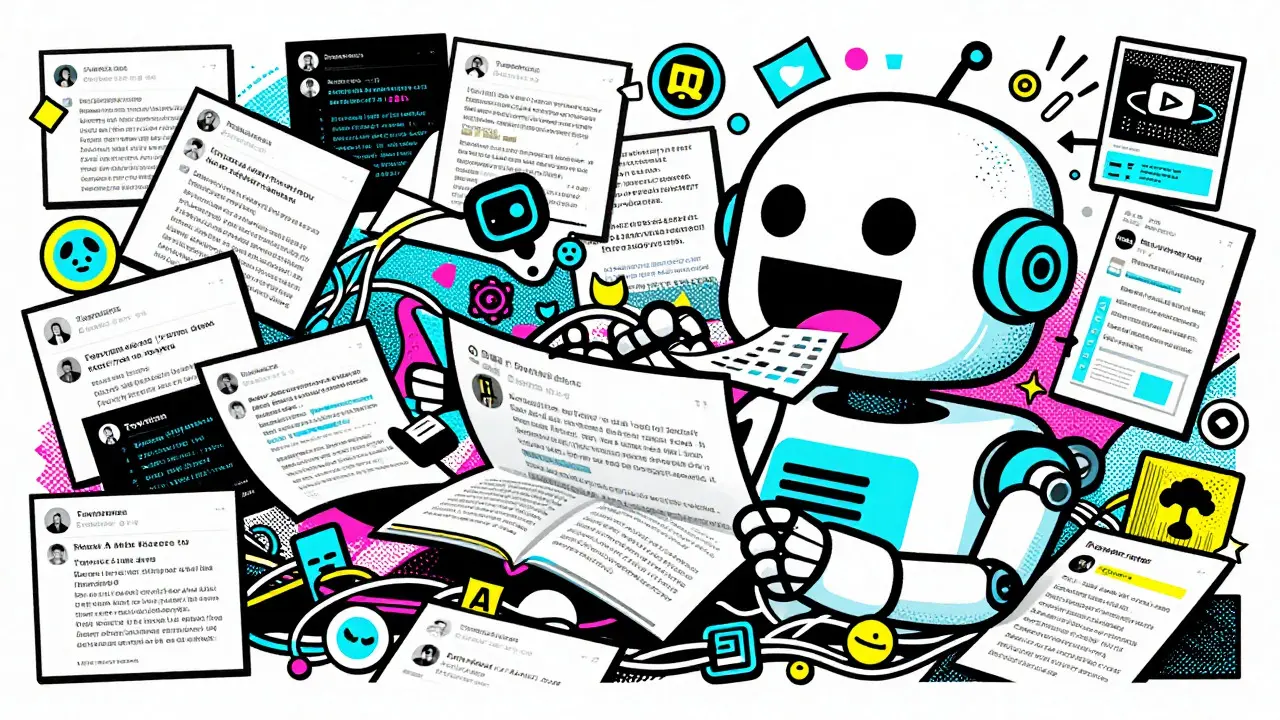
To train the largest LLMs, researchers turned to web crawls. Projects like Common Crawl archive billions of web pages, creating a snapshot of the internet. This data is unfiltered. It contains everything from academic papers to forum arguments, product reviews, and spam.
Using web-scale corpora introduces significant challenges. First, there’s the noise. A huge portion of crawled data is boilerplate code, navigation menus, or gibberish. Engineers must write sophisticated filters to remove this junk. Second, there’s duplication. The same article might appear on hundreds of sites, skewing the model’s perception of importance. Third, and perhaps most critically, there’s bias. If the internet reflects societal prejudices, the model will learn them too.
Despite these issues, web-scale data is essential for breadth. It allows models to understand niche hobbies, current events, and regional dialects. For instance, a model trained only on books might not understand the latest coding framework or a viral meme. Web data bridges that gap.
Specialized Datasets for Specific Tasks
While general pre-training uses broad web data, fine-tuning requires specialized datasets. These are smaller, higher-quality collections designed for specific goals.
For sentiment analysis, datasets like the Stanford Sentiment Treebank provide phrase-level annotations, helping models distinguish between subtle shades of opinion. The Amazon Product Reviews dataset offers millions of user-generated opinions, useful for training recommendation systems and customer service bots.
For reasoning and logic, benchmarks like MultiNLI (Multi-Genre Natural Language Inference) test whether a model can determine if one statement logically follows another. This is crucial for chatbots that need to maintain coherent conversations rather than just predicting the next word.
In speech recognition, audio datasets play a key role. LibriSpeech provides nearly 1,000 hours of audiobook recordings, while Spoken Wikipedia offers multilingual audio aligned with text. These datasets help models bridge the gap between written language and spoken voice.

Quality Over Quantity: The New Frontier
As models grow larger, the law of diminishing returns kicks in. Simply adding more data doesn’t always improve performance. Recent research suggests that data quality matters more than sheer volume. A smaller, carefully curated dataset of high-quality text can outperform a larger, noisier one.
This has led to a focus on "data curation." Teams spend months filtering out toxic content, removing duplicates, and balancing representation across different languages and demographics. Tools like the Datasets library from Hugging Face help standardize this process, making it easier to version-control and share cleaned data.
Privacy and ethics also come into play. Datasets like the Blog Authorship Corpus, which includes personal blog posts, raise questions about consent. As NLP evolves, ensuring that training data respects user privacy becomes just as important as improving accuracy.
Conclusion: The Future of NLP Data
The role of datasets in NLP is shifting from passive resources to active engineering components. Choosing the right mix of Wikipedia-style clarity and web-scale diversity determines how capable your model will be. As we move forward, expect to see more emphasis on synthetic data generation, real-time data updates, and rigorous ethical standards. The best models won’t just be the biggest; they’ll be the smartest about what they read.
What is the difference between pre-training and fine-tuning data?
Pre-training data is massive and general, used to teach a model basic language skills and world knowledge. Fine-tuning data is smaller and task-specific, used to adapt the model for particular jobs like medical diagnosis or legal analysis.
Why is Wikipedia considered a high-quality dataset?
Wikipedia is edited by humans, ensuring high factual accuracy and grammatical correctness. It covers a wide range of topics, providing a balanced view of general knowledge without the noise found in social media or forums.
How do web-scale corpora introduce bias into AI models?
Web data reflects existing societal biases, including gender stereotypes, racial prejudices, and cultural norms. If not filtered, models learn these biases and reproduce them in their outputs, leading to unfair or inaccurate results.
What is the Hugging Face Datasets library?
It is a community-driven tool that provides standardized interfaces for accessing thousands of NLP datasets. It simplifies loading, preprocessing, and versioning data, making it easier for researchers to experiment with different sources.
Is more data always better for training LLMs?
Not necessarily. While scale helps, quality is increasingly important. High-quality, diverse, and well-curated data often yields better performance than larger volumes of noisy or redundant information.

Stephanie Frank
20 July, 2026 - 13:42 PM
you really think wikipedia is the gold standard? please. that data is so stale it could grow mold. the real magic happens in the messy, toxic corners of the internet where people actually talk like humans instead of robots reading a textbook. if you want your model to understand sarcasm or irony, you need the garbage. the noise is the signal.
Lisa Puster
22 July, 2026 - 04:53 AM
it is pathetic how we rely on foreign web crawls now. common crawl is full of propaganda and bias from overseas servers. we should be using american books and newspapers only. project gutenberg is fine but even that has too much european literature. we need clean patriotic data not this globalist slush pile of information
Joe Walters
22 July, 2026 - 23:44 PM
oh my god can we stop pretending this is hard science. its just scraping. i tried running a small llm on my gpu and it took forever because the dataset wasnt cleaned properly. everyone talks about 'quality' but nobody wants to do the boring work of filtering out the spam. it is such a drag dealing with all this boilerplate code. why cant they just give us the good stuff already?
Robert Barakat
24 July, 2026 - 13:01 PM
the essence of language is not in the volume of tokens but in the silence between them. when we feed models trillions of words we lose the nuance of human connection. it becomes a hollow echo chamber of statistical probability rather than true understanding. we are building gods out of garbage and wondering why they lie to us.
Michael Richards
24 July, 2026 - 16:33 PM
listen up. most of you dont know what you are talking about. the issue is not the data source it is the curation process. if you are not spending months filtering out duplicates and toxic content you are wasting compute. hugging face is great for access but terrible for quality control. you need to build your own pipeline or stay out of the game. amateurs ruin everything.
Laura Davis
25 July, 2026 - 15:39 PM
hey guys lets keep it positive here! the post makes a great point about privacy though. we need to make sure we respect consent when using blog posts or personal data. its awesome that researchers are thinking about ethics now. let's support better standards for data collection so everyone feels safe online. high five for awareness!
Lisa Nally
26 July, 2026 - 03:22 AM
actually the distinction between pre-training and fine-tuning is often misunderstood by laymen. while the article mentions multi-nli for reasoning one must consider the implications of synthetic data generation which is becoming increasingly prevalent in modern nlp pipelines. the semantic drift observed in large scale corpora necessitates rigorous deduplication strategies beyond simple hashing algorithms. furthermore the evaluation metrics used in benchmarks like mmlu are often criticized for their lack of ecological validity in real world applications.