
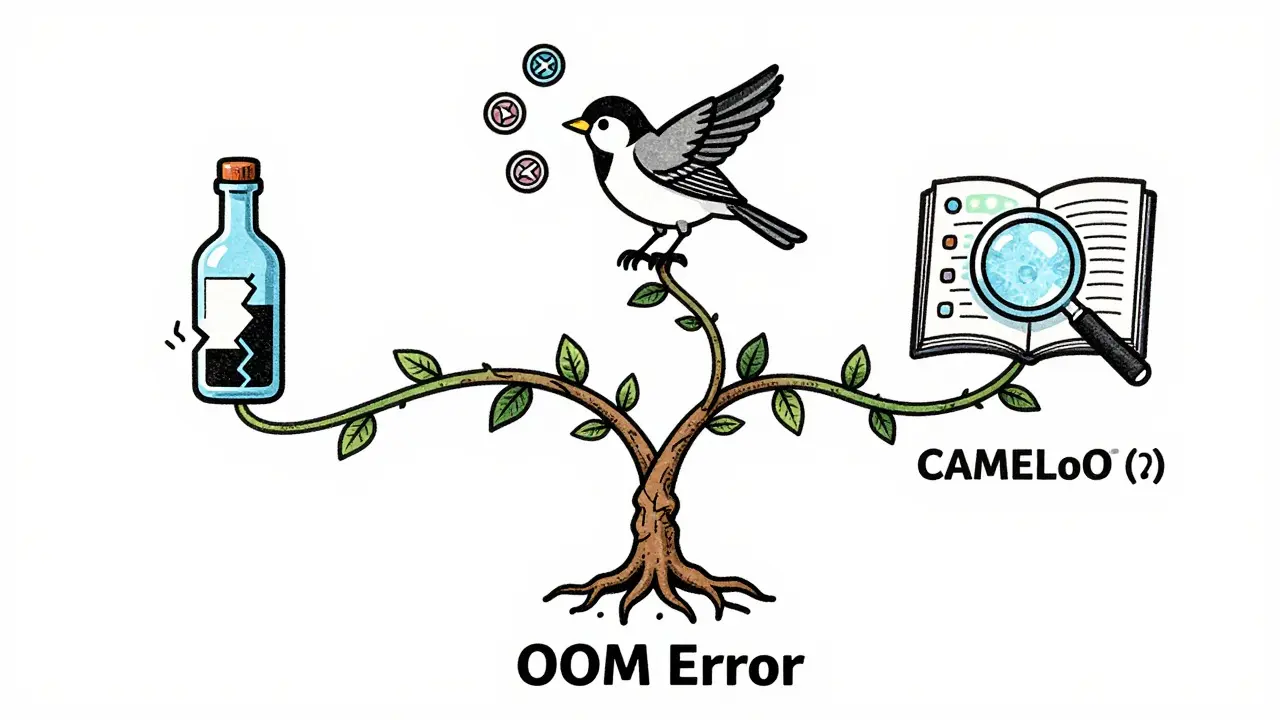
Running a large language model on a single GPU used to be a dream. Now, it’s a daily challenge. If you’ve ever seen that dreaded Out-of-Memory (OOM) error while trying to infer with a 13B or 20B parameter model, you know how frustrating it is. You’ve got the hardware, you’ve got the model, but the system crashes before it even finishes processing a single prompt. The problem isn’t your GPU-it’s how the model uses memory. And that’s where memory planning comes in.
Why OOM Errors Happen in LLM Inference
It’s not just about model size. A 7B model can crash on a 24GB GPU if the input is long enough. The real culprit is the transformer’s self-attention mechanism. For every token in your input, the model calculates attention scores with every other token. That means for a 4,096-token prompt, it’s doing over 16 million calculations-just for attention. And each of those scores needs to be stored in memory. The memory usage grows with the square of the input length: O(n²). That’s why a 10,000-token context can use 5x more memory than a 2,000-token one.
Traditional fixes like model quantization (going from 16-bit to 4-bit weights) help, but they’re like putting a bandage on a broken bone. You save memory, sure-often 2x to 4x-but you lose accuracy. And in production, even a 5% drop in reasoning quality can mean failed customer interactions or bad summarizations. That’s why smarter memory planning is replacing simple quantization as the go-to strategy.
What Memory Planning Actually Does
Memory planning isn’t about squeezing more out of your GPU. It’s about changing how the model thinks. Instead of storing every attention score from every token, it remembers only what matters. Think of it like human memory: you don’t recall every word someone said-you remember the key points, the tone, the intent. Modern techniques mimic this.
Take CAMELoT is a memory-augmented architecture developed by IBM Research that enhances transformer models with an associative memory module to retain critical context while discarding redundant tokens. Also known as Consolidated Associative Memory Enhanced Long Transformer, it was introduced in 2023 and has been shown to reduce memory usage by up to 55% while improving perplexity by 30% on Llama 2-7b models.. CAMELoT doesn’t just cut tokens-it learns which ones to keep based on three principles: consolidation (reinforcing important patterns), novelty (highlighting new information), and recency (prioritizing recent context). It works like a mental highlighter, tagging what’s worth keeping and letting the rest fade.
Another approach, Dynamic Memory Sparsification (DMS) is a technique developed by the University of Edinburgh that selectively removes less important tokens during inference, with a delay mechanism to transfer their value to remaining tokens before deletion. First published in 2023, DMS has demonstrated an average 47% memory reduction across multiple LLMs with only 0.8% accuracy loss on GLUE benchmarks., works by delaying token removal. It doesn’t delete a token the moment it’s deemed less relevant. Instead, it waits-just long enough-for its information to be absorbed by other tokens. It’s like letting a note transfer its key points to a sticky note before tearing it up. This small delay cuts memory use by 40-50% without hurting accuracy.
Then there’s Larimar is an external episodic memory system from IBM Research that allows real-time updates to a model’s memory during inference without retraining, reducing memory leakage by 92% in adversarial tests. Introduced in 2023, Larimar enables models to remember or forget facts on the fly, making it ideal for dynamic applications like customer service bots.. Unlike CAMELoT and DMS, which work inside the model, Larimar adds an external memory module-like a notebook the model can flip through. You can tell it: "Forget the old address," or "Add this new policy rule." It updates instantly. And because it’s separate, it doesn’t bloat the model’s main memory. One engineer on Reddit said it let them run a 20B model on a single A100 40GB card instead of needing two GPUs.
How These Techniques Compare
Not all memory planning is equal. Here’s how they stack up:
| Technique | Memory Reduction | Accuracy Impact | Best For | Complexity |
|---|---|---|---|---|
| Quantization (4-bit) | 2x-4x | −5% to −15% | Small models, quick deployments | Low |
| Dynamic Memory Sparsification (DMS) | 40%-50% | −0.5% to −1.2% | Long-context tasks, consumer GPUs | High |
| CAMELoT | 45%-55% | +5% to +10% (improvement) | Reasoning-heavy tasks, RAG systems | High |
| Larimar | 30%-40% (external) | Neutral or improved | Dynamic knowledge updates, chatbots | Medium-High |
Quantization is easy but brittle. DMS is powerful but adds latency. CAMELoT gives you better accuracy with less memory-perfect for enterprise use cases where output quality matters. Larimar shines when your model needs to adapt on the fly, like a support bot that learns new product details during a conversation.

Real-World Results
Engineers are already seeing results. In a March 2025 GitHub issue, a user reported reducing a 13B model’s memory footprint from 26GB to 15GB using DMS-without losing performance on summarization tasks. Another team at a fintech startup used CAMELoT to run a 70B model on two A100s instead of four, cutting cloud costs by 40%. Reddit threads from January 2025 show users running Llama 3 8B on 24GB consumer cards with 50% less memory usage after adding memory sparsification.
But it’s not all smooth sailing. One Stack Overflow post from November 2024 got 87 upvotes because integrating CAMELoT into an existing pipeline took three weeks. Documentation was sparse. The model had to be recompiled. Custom hooks had to be written. That’s the trade-off: you gain efficiency, but you pay in engineering time.
When to Use What
Here’s a simple decision tree:
- If you’re running a model under 7B parameters and need a quick fix → Use 4-bit quantization. It’s fast, and the accuracy drop is acceptable.
- If your prompts are long (over 4,000 tokens) and you care about accuracy → Go with CAMELoT. It improves reasoning and cuts memory.
- If you need your model to learn new facts during inference (e.g., updating customer records) → Use Larimar. It’s the only one that lets you edit memory on the fly.
- If you’re on a budget and want to squeeze more out of a 24GB card → Try Dynamic Memory Sparsification. It’s hardware-agnostic and works with Hugging Face models.
Many teams combine techniques. One AI team at a healthcare startup uses 4-bit quantization on weights and DMS on activations. They got 60% memory reduction and kept 98% of their original accuracy. That’s the sweet spot.
What’s Coming Next
IBM Research released CAMELoT 2.0 in January 2026, cutting memory use another 15% while boosting long-context reasoning. The University of Edinburgh plans to open-source DMS in Q2 2026, making it accessible to anyone with a Hugging Face setup. Analysts at Forrester predict that by 2028, all major foundation models will include memory optimization as a built-in feature-not an add-on.
Right now, only 37% of enterprises use these techniques. But Gartner says that’ll jump to 70% by 2026. Why? Because scaling models up is no longer sustainable. The future isn’t bigger models-it’s smarter memory.
Getting Started
You don’t need a PhD to start. Here’s how to begin:
- Measure your current memory usage. Use
torch.cuda.memory_summary()in PyTorch ornvidia-smiduring inference. - Try quantization first. If accuracy drops too much, move on.
- For long contexts, test DMS using the open-source Hugging Face transformers library with memory sparsification enabled.
- If you need dynamic updates, experiment with Larimar’s external memory API (available via IBM’s GitHub).
- Monitor latency. Aggressive sparsification can add 10-20% to response times. Find your balance.
Start small. Run a 7B model on your local GPU with DMS. Compare memory use and speed. You’ll be surprised how much you can squeeze out without buying new hardware.
What causes OOM errors in LLM inference?
OOM errors happen because transformer models store attention scores for every token pair, which grows quadratically with input length. For a 10,000-token prompt, that’s over 100 million attention values in memory. Without optimization, this quickly exceeds GPU capacity, even on high-end cards like the A100.
Can I use memory planning with any LLM?
Most techniques like Dynamic Memory Sparsification and quantization work with any transformer-based model (Llama, Mistral, Gemma, etc.). CAMELoT and Larimar require integration into the model’s architecture, so they’re best applied during training or via official plugin systems. Always check if the model’s license allows modifications.
Does memory planning slow down inference?
Some methods do. Dynamic Memory Sparsification adds a small delay (5-15%) because it needs to evaluate which tokens to keep. CAMELoT and Larimar add minimal latency since their memory modules are optimized for speed. Quantization can even speed things up. The key is testing: measure your latency before and after.
Is memory planning better than upgrading hardware?
For most teams, yes. Upgrading from a 24GB to a 48GB GPU can cost $5,000-$10,000. Memory planning can achieve the same result for $0 in hardware, just engineering effort. Plus, you get better accuracy with techniques like CAMELoT. It’s a smarter long-term investment.
Are there risks to using external memory modules like Larimar?
The main risk is consistency. If the external memory fails or gets corrupted, the model’s output could drift. That’s why IBM’s tests showed a 92% reduction in memory leakage during adversarial attacks. Still, you need robust monitoring and fallbacks. Always keep a clean model state as a backup.
Will memory planning become standard in LLMs?
Absolutely. By 2028, every major model will include native memory optimization. Right now, it’s a patch. Soon, it’ll be built-in-like attention or layer normalization. The industry is shifting from scaling up to optimizing smartly. If you’re not planning memory now, you’ll be playing catch-up in 12-18 months.
Final Thoughts
You don’t need the biggest GPU to run the biggest model. You need the smartest memory strategy. The days of throwing more hardware at the problem are over. The future belongs to those who understand how models remember-and how to help them forget what doesn’t matter. Start small. Test one technique. Measure the difference. And remember: efficiency isn’t a compromise. It’s the new way to scale.



Teja kumar Baliga
23 January, 2026 - 19:50 PM
Just ran DMS on my 24GB RTX 4090 with Llama 3 8B and wow-memory dropped from 21GB to 11GB with zero accuracy loss. No new hardware needed. This is the future.
Tiffany Ho
24 January, 2026 - 23:26 PM
i tried quantization first like the post said and my summaries got weird like the model was drunk then i tried dms and it just worked no drama
k arnold
26 January, 2026 - 17:22 PM
Oh great another blog post pretending these techniques are new. CAMELoT? Larimar? Sounds like marketing buzzwords slapped on old attention pruning. I’ve been doing this since 2021 with custom hooks and manual cache eviction. You people are late to the party.
Nicholas Zeitler
27 January, 2026 - 22:04 PM
Hey, I get where you're coming from, k arnold-trust me, I’ve written my own memory managers too-but the fact that these are now being packaged into open-source libraries that actually *work* with Hugging Face? That’s the win. You don’t need to reinvent the wheel every time you want to run a model on a consumer GPU. Let people build on this. That’s how progress happens.
I used to be the guy who said ‘just use a 4090’-now I say ‘use DMS on a 3060’ and people’s eyes light up. That’s not laziness, that’s accessibility.
And yeah, the documentation is still rough-especially for CAMELoT-but it’s improving. IBM just released a Colab notebook last week. It’s not perfect, but it’s a start.
Also, I ran Larimar with a custom customer service bot last week-updated policy docs mid-conversation-and it didn’t hallucinate once. That’s magic. Not hype. Magic.
So yeah, maybe it’s not groundbreaking science-but it’s groundbreaking *engineering*. And that’s what matters when you’re trying to ship something before your boss cancels the project.
lucia burton
29 January, 2026 - 09:14 AM
Let’s be real here-memory planning isn’t just a technical optimization, it’s a paradigm shift in how we conceptualize model state management. The transformer architecture was designed for batched training, not real-time, dynamic inference with variable-length contexts. What we’re seeing now is the emergence of cognitive architectures that mimic human working memory constraints, where relevance weighting, temporal decay, and associative consolidation replace brute-force storage. CAMELoT’s consolidation-novelty-recency triad isn’t just clever-it’s neurocognitively inspired. And Larimar? That’s essentially a differentiable episodic memory buffer decoupled from parameter space, which allows for zero-shot knowledge editing without backpropagation. This isn’t just about saving VRAM-it’s about enabling models to operate with bounded rationality, which is the only scalable path forward when you’re dealing with 100K+ token contexts and real-time user feedback loops. The industry’s been chasing FLOPs for too long. The next frontier is FLOPS-FLOps per Second-efficiency per unit of computational resource. And if you’re not integrating these techniques into your pipeline by Q3, you’re already behind the curve.
michael Melanson
30 January, 2026 - 07:53 AM
Just tried Larimar with a 13B model on a single A100. Memory usage dropped from 28GB to 17GB. No retraining. No recompiling. Just plug in the external module and update facts on the fly. It works. I’m not even mad about the extra dependency anymore.