Imagine writing a research paper, citing a study that sounds perfectly legitimate-author, journal, date, DOI-all there. You trust it. Your professor trusts it. The journal accepts it. Then you find out: it never existed. That’s not a glitch. It’s happening right now, in real academic papers, and it’s getting worse.
Large Language Models (LLMs) like GPT-4o, Claude, and Gemini are being used to draft literature reviews, summarize papers, and even generate reference lists. But here’s the problem: they make up citations. Not accidentally. Not rarely. Consistently. And often, they do it so well that even experts can’t tell the difference without checking.
What Are Fabricated References?
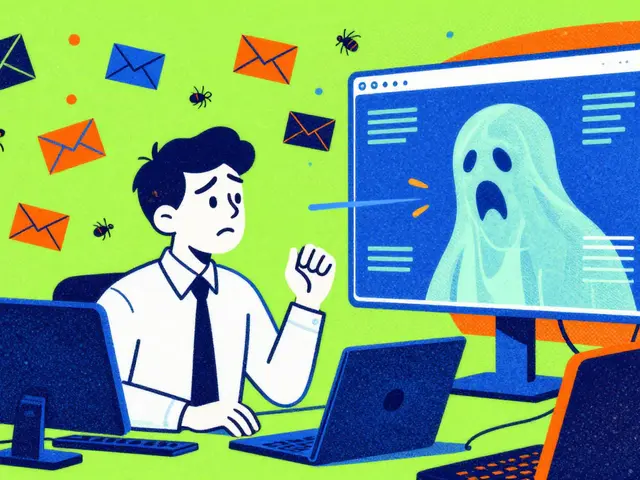
Fabricated references-also called "ghost references"-are citations that look real but point to non-existent papers, books, or studies. They have plausible author names, journal titles, volume numbers, and even DOIs. But when you search for them in databases like Crossref, PubMed, or Google Scholar, you get nothing. Not a 404 error. Not "not found." Just silence. Because the reference was never real to begin with.
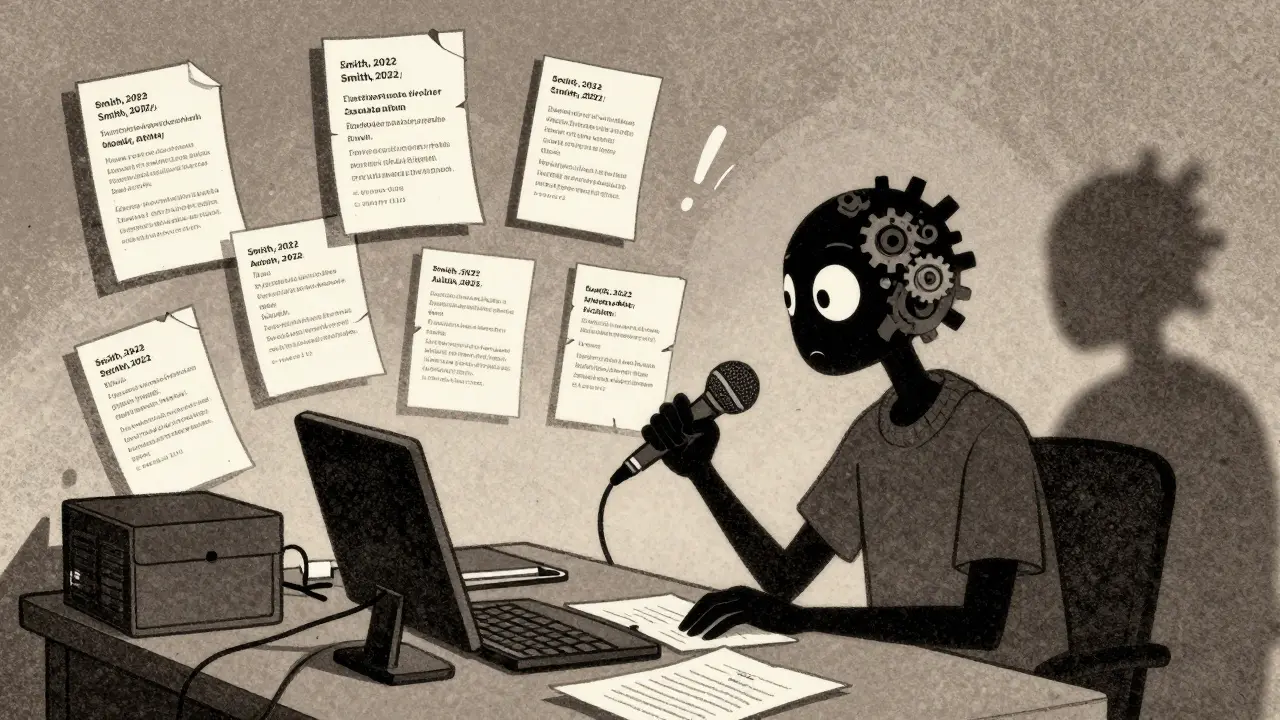
These aren’t mistakes from a poorly trained model. They’re a direct result of how LLMs work. These models don’t store facts like a library. They store patterns. When you ask for a citation about "the effects of mindfulness on body dysmorphic disorder," the model doesn’t pull a real paper. It reconstructs one from fragments it’s seen before: "Smith, 2022, Journal of Clinical Psychology," but the author doesn’t exist. The journal doesn’t exist. The DOI is a random string that leads nowhere.
The Scale of the Problem
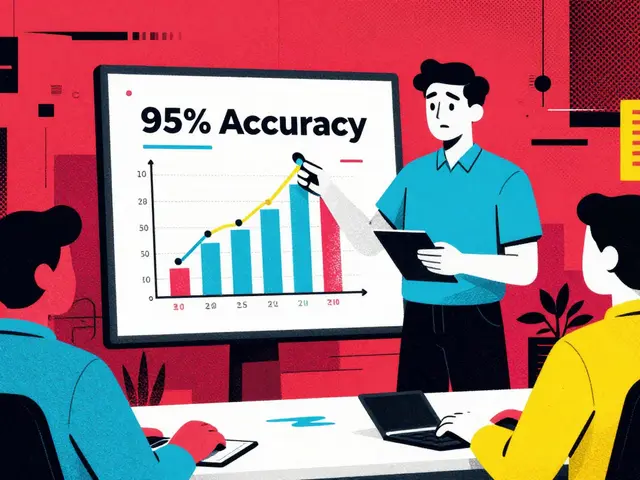
The numbers don’t lie. A November 2025 study in JMIR Mental Health analyzed 176 citations generated by GPT-4o across six simulated literature reviews. Of those, 35 (19.9%) were completely fake. Another 64 (45.4%) had serious errors-wrong DOIs, incorrect journal names, mismatched volumes. That’s 65% of all citations being unreliable.
And it’s worse in some areas. For topics like binge eating disorder, 28% of citations were fabricated. For body dysmorphic disorder, it was 29%. But for major depressive disorder? Only 6%. Why? Because there’s more published research on depression. The model has more real data to work with. When it’s unsure-when the topic is niche or emerging-it invents.
Earlier models were even worse. GPT-3.5 had a 55% fabrication rate. GPT-4 cut it to 18%. GPT-4o? Back up to nearly 20%. Progress stalled. The problem isn’t getting solved by better models-it’s getting more dangerous because people trust them more.
How Fake Citations Slip Into Published Papers
In January 2026, GPTZero scanned every paper accepted to NeurIPS 2025, one of the most selective AI conferences in the world. They found over 100 fabricated citations across 51 papers. These weren’t rejected drafts. These were accepted, peer-reviewed, and published. The reviewers didn’t catch them.
Why? Because checking citations is tedious. Reviewers focus on methodology, results, and novelty. They assume references are real. And why wouldn’t they? The citations look correct. They follow APA format. They have plausible titles. They’re embedded in coherent paragraphs.
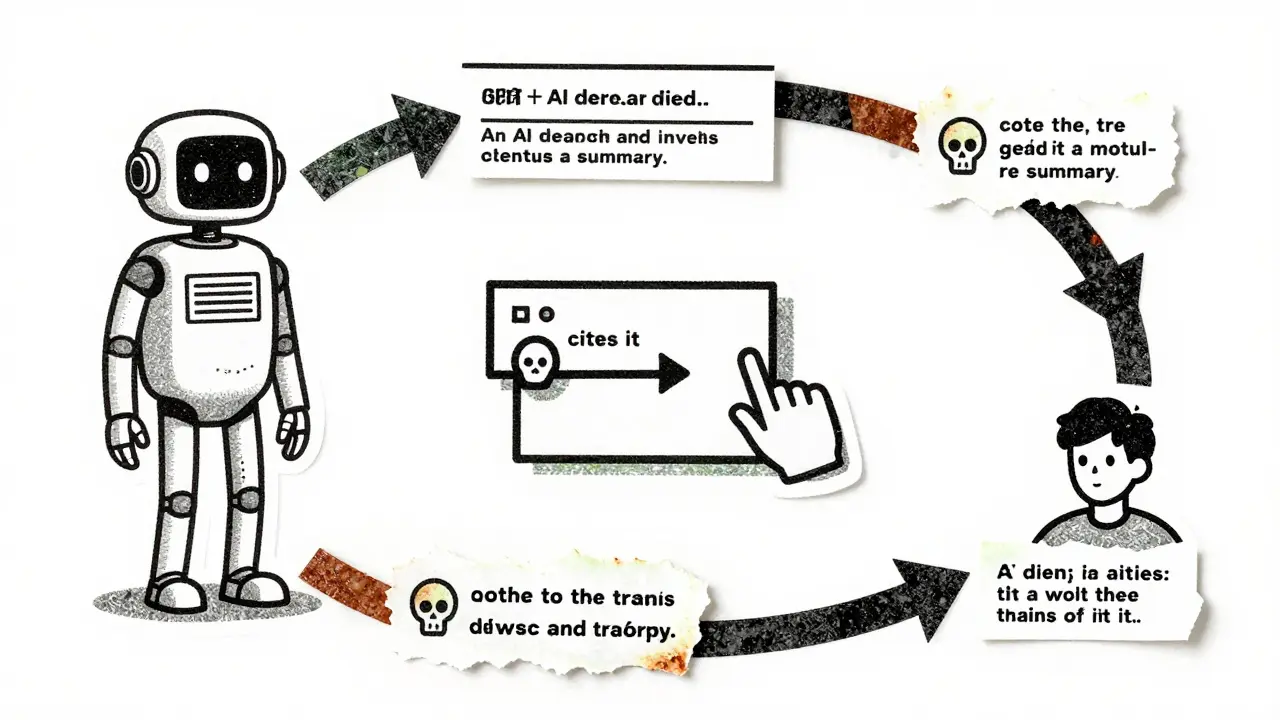
But here’s the scary part: AI search engines are making it worse. If you search for a fake citation in Perplexity, Bing AI, or even Google’s AI Overviews, the system doesn’t say "no results." It invents a summary. "According to Smith (2022), mindfulness reduces symptoms in 78% of patients with body dysmorphic disorder." Then you cite it. Then someone else cites your paper. Then another AI trains on your paper. Now the fake citation is part of the training data. It becomes more convincing. It spreads.
One fabricated reference to "Prof. Williamson" was cited 43 times on Google Scholar-each time by a different paper, each time generated by AI. No such person exists. No such study exists. But now, it’s in the record.
Why This Isn’t Just a "Student Mistake"
You might think this only affects undergrads using ChatGPT to write essays. It doesn’t. It’s in peer-reviewed journals. It’s in clinical guidelines. It’s in policy briefs. A doctor might read a paper citing a fabricated study on a new therapy for anxiety. They might recommend it to a patient. The patient might stop their real medication. That’s not hypothetical. It’s a real risk.
And it’s not just about false information. It’s about broken trust. Science depends on cumulative knowledge. Every paper builds on the ones before it. If even 10% of citations are fake, the entire structure starts to crumble. You can’t verify a claim if the source you’re supposed to check doesn’t exist.
How to Detect Fabricated References
You can’t rely on intuition. You can’t rely on formatting. You have to check. Here’s how:
- Use trusted databases-Search each citation in Crossref, OpenAlex, or PubMed. Don’t use Google Scholar alone. It indexes preprints, retracted papers, and fake entries.
- Check the DOI-Go to https://doi.org/ and paste the DOI. If it doesn’t resolve, the citation is fake. Many fabricated DOIs are just random numbers.
- Look for consistency-Does the journal name match the publisher? Is the volume and issue number plausible? Is the year before the journal was founded? These are red flags.
- Use detection tools-CERCA is a free, open-source tool that checks references locally. It queries Crossref, OpenAlex, and Zenodo, and flags mismatches. It doesn’t upload your PDF. It runs on your machine. Privacy first.
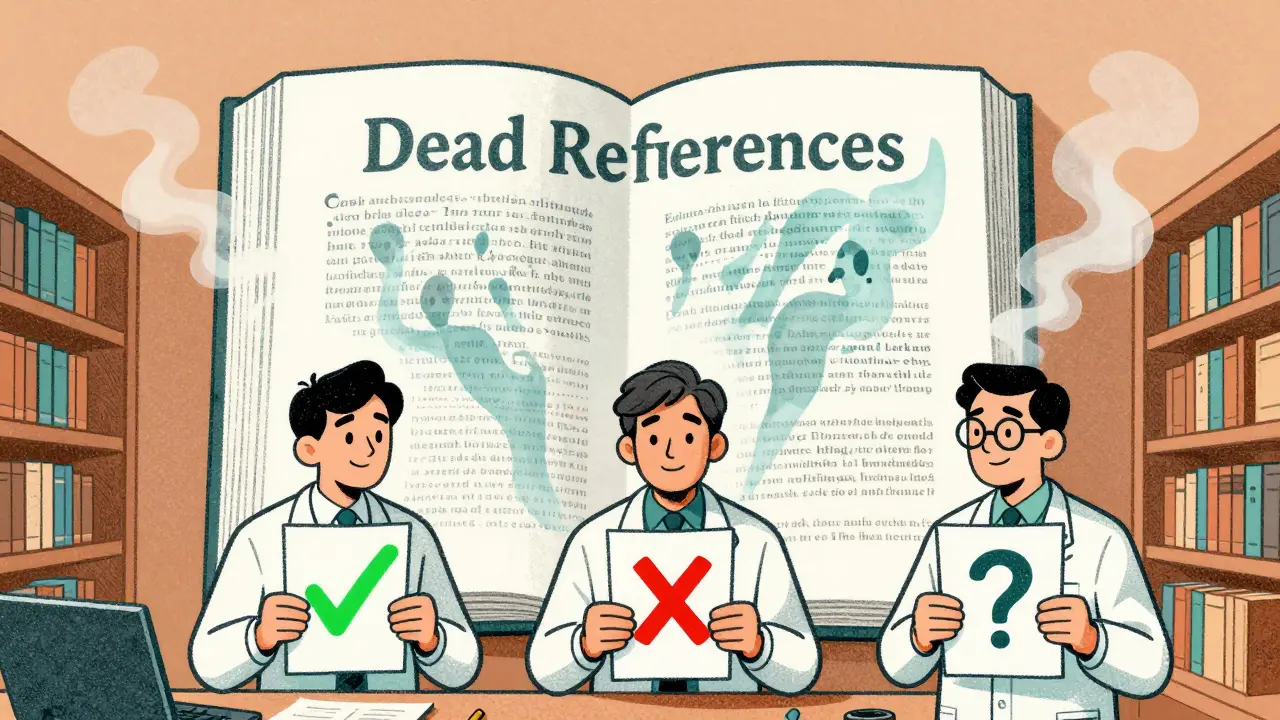
- Play "Dead Reference"-It’s a free game created by researchers to train people to spot fake citations. You’re shown 10 references. 5 are real. 5 are AI-generated. Try to tell them apart. It’s harder than you think.
Don’t assume a citation is real because it’s in a reputable journal. Don’t assume it’s real because it looks professional. Don’t assume it’s real because your AI tool says so.
What Institutions Need to Do
Universities and journals aren’t ready. Most have no policy on LLM-generated references. Here’s what needs to change:
- Require verification-Every paper using AI-generated references must include a verification log: a screenshot or list showing each citation was checked in Crossref or OpenAlex.
- Train researchers-Graduate programs need mandatory modules on AI citation risks. Not just "don’t use AI," but "here’s how to use it safely."
- Adopt detection tools-Journals should integrate CERCA-like tools into their submission systems. If a paper has 5+ suspicious references, flag it.
- Update citation parsers-Tools like Cermine need to handle all citation styles (APA, MLA, Vancouver, IEEE) and detect formatting anomalies that AI often messes up.
The problem isn’t AI. The problem is treating AI like a librarian. It’s not. It’s a storyteller. And it’s really good at making up stories that sound real.
It’s Not Going Away
Some researchers think better prompts will fix this. "Just ask for real sources only." No. The model doesn’t know what’s real. It only knows what patterns look plausible. Even if you say "only cite real papers," it will still generate fake ones. It’s not lying. It’s guessing.
Some think we’ll ban AI in academia. That won’t work. It’s too useful. Too fast. Too cheap. The answer isn’t to stop using AI. It’s to build systems that force human verification at every step.
The future of research depends on trust. If we stop verifying citations, we stop trusting science. And once that’s gone, it’s hard to get back.
What You Can Do Today
- Never copy-paste a citation from an AI without checking it.
- Use CERCA or manually verify every reference in Crossref.
- Teach others how to spot fake citations. Share "Dead Reference" with your lab or class.
- If you’re a reviewer, ask: "Did you verify these references?"
- If you’re an editor, demand verification logs.
AI won’t stop making up citations. But you can stop accepting them.
Can AI-generated citations ever be trusted?
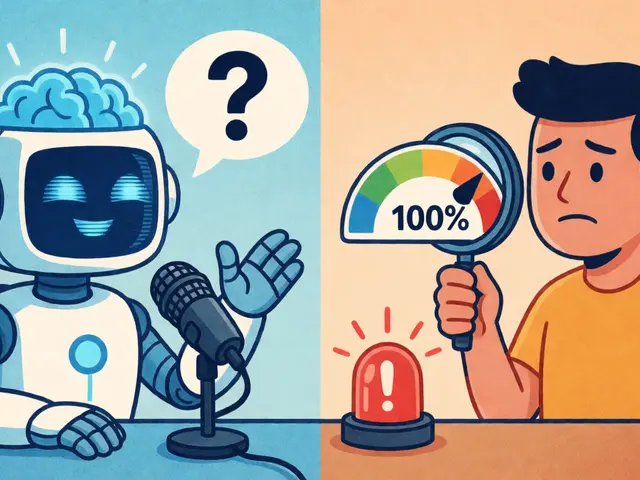
No, not without verification. Even the most advanced models like GPT-4o generate fabricated citations at rates of 18-20%. The appearance of legitimacy makes them dangerous. Always check each citation in a trusted database like Crossref or OpenAlex before using it.
Why do AI models make up citations?
LLMs don’t store facts-they store patterns. When asked for a citation, they reconstruct one from fragments of real references they’ve seen during training. If they lack enough real data on a topic, they guess. The result is a citation that’s statistically plausible but completely fictional.
Are some research topics more vulnerable to fake citations?
Yes. Topics with less published research-like rare mental health disorders-are far more vulnerable. Studies show fabrication rates of 28-29% for body dysmorphic disorder and binge eating disorder, compared to just 6% for major depressive disorder. The model fills knowledge gaps with plausible fiction.
Can AI search engines make fake citations worse?
Absolutely. When you search for a fabricated citation, AI search engines often generate a fake summary of the non-existent paper, complete with made-up quotes and supporting references. This creates a feedback loop: AI makes a fake citation → AI search engine confirms it as real → user cites it → AI trains on it → the fake citation becomes more convincing.
What tools can help detect fake citations?
CERCA is the most reliable tool-it checks references locally against Crossref, OpenAlex, and Zenodo. You can also use the free game "Dead Reference" to train yourself to spot fakes. Manual verification via DOI lookup (https://doi.org/) remains the gold standard.
Jen Deschambeault
1 March, 2026 - 00:45 AM
This is terrifying but so necessary. I just caught a fake citation in my lab’s draft last week-looked legit, DOI resolved to a random publisher site. We’re running CERCA on everything now. No more copying AI references without triple-checking. Seriously, if you’re using LLMs for research, you owe it to your field to verify every single one. It’s not extra work-it’s ethical responsibility.
Kayla Ellsworth
1 March, 2026 - 10:11 AM
Wow. Another ‘AI is ruining academia’ hot take. Next you’ll tell us pens were invented to destroy handwriting. People have been citing fake papers since the 1800s. This is just the new version of ‘I found this obscure journal no one’s heard of.’ The real problem? Lazy grad students. Not the model.
Soham Dhruv
1 March, 2026 - 23:41 PM
bro i just used gpt to write my lit review and honestly didn’t think twice about the refs… now im sweating. i checked 3 of them and 1 was fake. like the journal was called ‘Journal of Neurocognitive Trends’ and the doi went to a .xyz domain. wtf. i’m gonna use cerca from now on. also dead reference game is wild-i got 3/10 right. i thought i was good at this lol
Bob Buthune
2 March, 2026 - 14:51 PM
This isn’t just about citations. It’s about the slow death of truth. Every fake reference is a brick removed from the foundation of science. And the worst part? The AI doesn’t care. It doesn’t know it’s lying. It just wants to please you. And you? You want it to be fast. Convenient. Easy. So you let it. You let it rewrite reality. And now, when a kid in a rural clinic reads a paper citing ‘Dr. Williamson’s breakthrough’-they believe it. Because it looks real. Because the algorithm made it look real. And now… it’s training the next generation of AIs on lies. We’re not just building tools. We’re building a hallucination engine. And we’re feeding it our own ignorance.
Jane San Miguel
4 March, 2026 - 01:14 AM
While the concerns raised are not without merit, the article exhibits a strikingly alarmist tone that borders on technophobic hysteria. The 19.9% fabrication rate cited is statistically significant, yes-but it is also a measurable artifact of a nascent technology undergoing iterative refinement. The assertion that GPT-4o regressed from GPT-4’s 18% is misleading without contextualizing dataset shifts, prompt engineering variance, and evaluation methodology. Moreover, the suggestion that institutions must mandate verification logs implies a fundamental misunderstanding of peer review’s epistemic architecture. Verification is not a procedural checkbox-it is a scholarly discipline. One does not ‘require’ rigor; one cultivates it.
Kasey Drymalla
5 March, 2026 - 08:01 AM
THEY KNOW. They all know. This isn’t an accident. The journals, the universities, the funding bodies-they’re letting this happen on purpose. Why? Because fake citations mean more papers. More grants. More power. And who benefits? The same people who made you believe climate change was a hoax. This is a controlled demolition of peer review. They’re training AI to write fake science so they can later say ‘see? AI can’t be trusted.’ Then they shut down funding for real research. It’s all a setup. You think CERCA helps? Nah. It’s just another tool they control. They want you distracted by ‘fake refs’ while they rewrite the entire system.
Dave Sumner Smith
6 March, 2026 - 01:05 AM
Why are we even talking about this? AI didn’t create fake citations. Humans did. For decades. Remember when people cited ‘personal communication’ or ‘private data’? That’s worse. At least AI gives you a DOI. At least you can check it. The real problem is lazy reviewers. And lazy authors. And lazy journals. Stop blaming the tool. Blame the people who use it without thinking. And if you’re still using Google Scholar as your primary source? You’re the problem.
Cait Sporleder
6 March, 2026 - 08:53 AM
What is profoundly alarming, and what the article rightly underscores, is not merely the statistical prevalence of fabricated references, but the epistemological cascade they initiate. Each synthetic citation functions not as an isolated error, but as a node in a self-reinforcing network of epistemic decay. When an AI-generated citation is accepted into a peer-reviewed publication, it is not merely indexed-it is entangled within the semantic lattice of subsequent scholarly discourse. The citation becomes a referential anchor for future AI-generated summaries, which then become training data for downstream models, thereby embedding falsehoods into the latent space of collective knowledge. The phenomenon is not one of misinformation, but of misinformation autopoiesis: the recursive, systemic reproduction of untruth through algorithmic feedback loops. The solution, therefore, cannot be merely technical (e.g., CERCA), nor merely procedural (e.g., verification logs). It must be ontological: we must redesign the very architecture of scholarly citation to incorporate provenance, traceability, and verifiability as first-class properties-not afterthoughts. The future of knowledge hinges not on rejecting AI, but on reimagining the epistemic contract between human scholarship and machine augmentation.