
Government agencies are no longer just watching artificial intelligence from the sidelines. As of mid-2026, they are buying it, deploying it, and trying to figure out how to keep it honest. The shift has been abrupt. In 2024, federal agencies introduced 59 new AI regulations-more than double the previous year. By late 2025, every U.S. state had some form of policy framework on the books. But having a rulebook is different from knowing how to play the game.
If you work in government IT or vendor sales, you know the pressure. Leaders want the speed of generative AI but fear the backlash of a biased algorithm or a data leak. This article breaks down exactly what the current policies demand regarding procurement, transparency, and accountability. We will look at the specific executive orders driving these changes, the frameworks you need to follow, and the practical steps to avoid compliance pitfalls.
The Regulatory Landscape: From Experimentation to Enforcement
The era of "move fast and break things" is over for the public sector. The current regulatory environment was shaped heavily by two major shifts in 2025. First, the launch of America’s AI Action Plan through Executive Orders 14277 and 14278 established three pillars: accelerating innovation, building infrastructure, and leading international security. Second, and perhaps more immediately impactful for daily operations, was Executive Order 14319, signed in July 2025, titled "Preventing Woke AI in the Federal Government."
While the title of EO 14319 sounds political, its operational requirements are technical and strict. It mandates red-teaming of AI capabilities and requires agencies to comply with OMB Memorandum M-25-22 on efficient acquisition. This means you cannot simply buy an off-the-shelf chatbot. You must prove it doesn’t inject unintended ideological bias into citizen services.
At the state level, Washington State set a precedent with its December 2025 Interim Report. It introduced a risk-based approach that distinguishes between "low-risk" tools (like internal drafting assistants) and "high-risk" systems (those affecting health, safety, or fundamental rights). High-risk systems face stricter scrutiny, including potential bans if safeguards aren’t met. This tiered model is now being copied by other states, creating a patchwork of rules that vendors must navigate carefully.
Procurement: Buying AI Without Breaking the Law
Procurement used to be about price and features. Now, it is about provenance and risk. The General Services Administration (GSA), working with the Office of Management and Budget (OMB), is developing an AI procurement toolbox to standardize this process. Until that toolbox is fully mature, agencies are relying on existing federal mandates.
Here is what buyers are demanding right now:
- Data Disclosure: Vendors must disclose non-proprietary, non-sensitive datasets used during training. If you trained your model on leaked private data, you can’t sell it to the government anymore.
- Talent Access: Under the AI Action Plan, agencies must ensure employees have access to frontier language models. Procurement contracts now often include clauses requiring vendor support for employee training, not just software licenses.
- Interoperability: Agencies are tired of siloed tools. The Advanced Technology Transfer and Capability Sharing Program encourages rapid transfer of AI capabilities between agencies. Your solution needs to integrate with existing federal cloud infrastructure, not create a new walled garden.
A major hurdle remains legacy systems. According to Presidio’s 2025 analysis, about 60% of federal agencies have adopted foundational cloud infrastructure but remain unprepared to integrate AI into production systems. When writing proposals, address this gap. Show how your AI tool bridges the old and the new without requiring a complete system overhaul.
| Risk Category | Typical Use Case | Required Documentation | Vendor Obligation |
|---|---|---|---|
| Low-Risk | Internal email drafting, code completion | Basic security certification | Standard SLA, basic training materials |
| High-Risk | Benefit eligibility decisions, predictive policing | NIST RMF alignment, bias audit reports | Full dataset disclosure, human-in-the-loop design |
Transparency: Showing Your Work
Transparency in public sector AI isn’t just about open-source code; it’s about explainability. Citizens have a right to know why an algorithm denied them a permit or recommended a specific healthcare treatment. The Washington State Task Force recommends mandating that developers disclose how training data is processed to mitigate errors and biases.
This creates a tension with intellectual property. Many commercial AI providers treat their training data as a trade secret. However, the federal mandate for federally funded researchers to disclose non-proprietary datasets sets a high bar. For commercial vendors selling to the government, the expectation is shifting toward "glass box" models where possible, or at least detailed documentation of data lineage.
Consider this scenario: An agency uses an AI agent to triage citizen complaints. If the AI misclassifies a critical safety issue as low priority, the agency must be able to trace back which data points led to that decision. This requires logging mechanisms that go beyond standard application logs. You need to record the context, the prompt, and the reasoning path of the model.
Dr. Lynne Parker, Director of the White House Office of Science and Technology Policy, emphasized the need for a National AI Research and Development Strategic Plan. This plan guides federal investments but also signals that transparency is a national security issue. Opaque AI systems are vulnerable to adversarial attacks. Transparent systems are easier to audit and secure.

Accountability: Who Is Responsible When Things Go Wrong?
Accountability is the hardest part of AI governance because AI systems are probabilistic, not deterministic. They don’t always do the same thing twice. So, who is liable? The developer? The agency that deployed it? The individual officer who trusted the output?
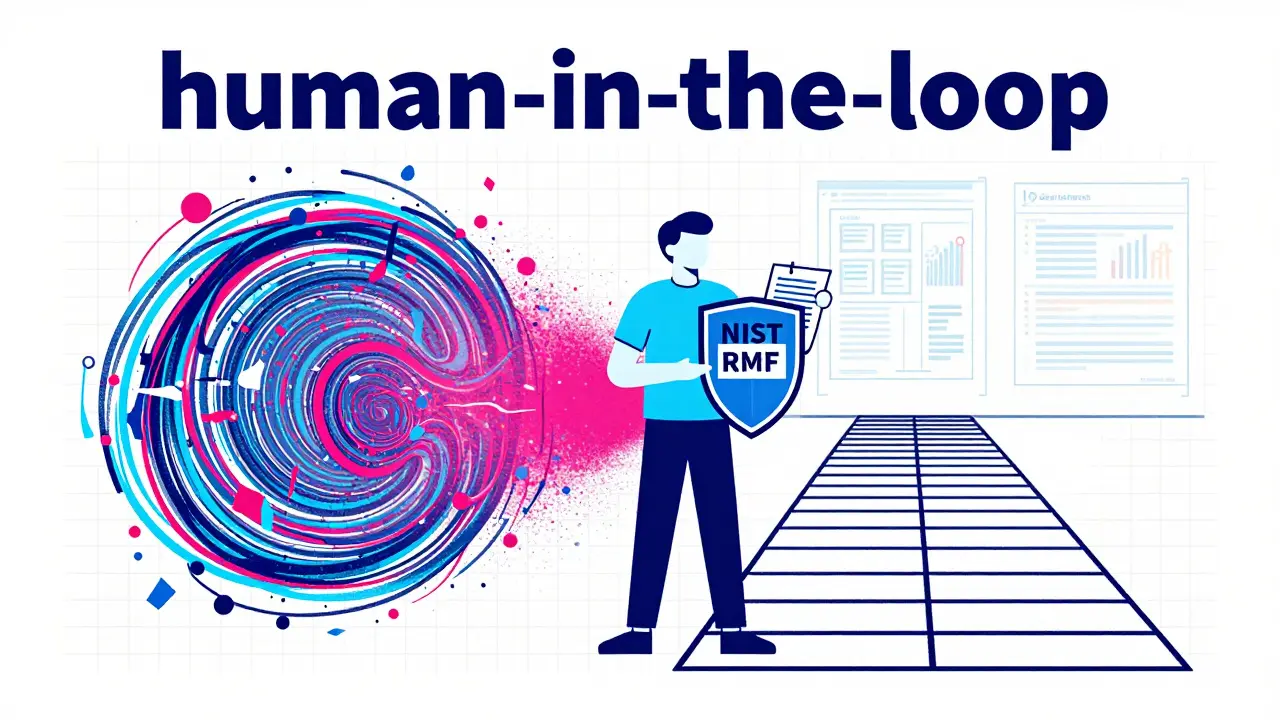
The current legal framework leans heavily on the concept of "human-in-the-loop." For high-risk applications, a human must make the final decision. The AI provides a recommendation, but the human takes the responsibility. This is codified in recommendations from the NIST AI Risk Management Framework (RMF) and ISO/IEC 42001, which Washington State explicitly endorses.
However, this creates a new problem: alert fatigue. If humans are forced to review every AI output, they become rubber stamps. They stop reading and start clicking "approve." To maintain true accountability, agencies need to design workflows where humans intervene only when confidence scores are low or stakes are high. This requires sophisticated monitoring dashboards that flag anomalies in real-time.
Furthermore, accountability extends to workforce management. The AI Action Plan includes a talent-exchange program to move data scientists and engineers between agencies. This ensures that the people managing these systems have the skills to understand them. You can’t hold an accountant accountable for an AI error if they were never trained to interpret model outputs.
Implementation Challenges: The Readiness Gap
Even with clear policies, execution is messy. Presidio’s 2025 report highlights a significant "AI Readiness Gap." Many agencies have the budget and the policy approval, but lack the internal expertise to implement securely. They rely on consultants, which leads to fragmented implementations.
The GovTech analysis suggests that successful agencies are building an "enterprise layer of AI"-a central brain that manages all AI interactions across departments. Instead of each department buying its own separate AI tool, they use a unified platform. This reduces costs, simplifies auditing, and ensures consistent security standards.
Another challenge is the speed of change. AI models evolve weekly. Policies written in 2025 might be obsolete by 2027. Agencies need agile governance structures that can update guidelines without going through years of legislative debate. This means empowering CIOs and CTOs with pre-approved risk thresholds within which they can operate autonomously.
Global Context: Why US Policy Matters Internationally
You can’t view US public sector AI policy in isolation. The Stanford HAI 2025 AI Index Report shows global investment exploding. China launched a $47.5 billion semiconductor fund. France committed €109 billion. Saudi Arabia announced a $100 billion initiative. The US is responding with massive infrastructure pushes, like AWS’s $30 billion investment in AI infrastructure.
This competition drives domestic policy. The US wants to export its AI technology stack, as noted in the July 2025 Executive Order on promoting exports. To do that, US-built AI must meet high ethical and security standards. If American agencies adopt robust transparency and accountability measures, those standards become the global benchmark. Foreign governments looking to buy US tech will expect the same rigor. This gives US policymakers leverage in international diplomacy.
Actionable Steps for Public Sector Leaders
If you are responsible for implementing these policies, here is your checklist for 2026:
- Audit Current Tools: Identify every AI tool currently in use. Classify them as low-risk or high-risk based on impact on citizens.
- Adopt NIST RMF: Align your risk management practices with the NIST AI Risk Management Framework. It is the gold standard for federal compliance.
- Update Procurement Contracts: Add clauses requiring data disclosure, bias mitigation strategies, and ongoing security updates.
- Train Staff: Don’t just train them to use the tool. Train them to question it. Teach critical thinking around AI outputs.
- Build Centralized Monitoring: Implement a dashboard that tracks AI usage, error rates, and user feedback across the organization.
The goal is not to stop innovation. It is to build trust. When citizens trust that government AI is fair, transparent, and accountable, adoption accelerates. Without that trust, even the most advanced technology will fail.
What is the difference between low-risk and high-risk AI in public sector policy?
Low-risk AI typically involves internal efficiency tools like drafting emails or summarizing documents, where errors have minimal impact on citizens. High-risk AI affects fundamental rights, health, safety, or financial well-being, such as determining benefit eligibility or predicting crime. High-risk systems require rigorous auditing, human oversight, and full transparency of training data.
How does Executive Order 14319 affect AI procurement?
EO 14319 mandates that federal agencies prevent ideological bias in AI systems. For procurement, this means vendors must demonstrate that their models have been red-teamed for bias and comply with OMB Memorandum M-25-22. Agencies can no longer buy black-box solutions without proof of neutrality and fairness.
Which frameworks should government agencies use for AI governance?
The primary frameworks are the NIST AI Risk Management Framework (RMF) and ISO/IEC 42001. These provide standardized methods for assessing risks, ensuring transparency, and maintaining accountability. Washington State and many federal agencies explicitly recommend adopting these standards.
What is the "AI Readiness Gap" mentioned in recent reports?
The AI Readiness Gap refers to the disconnect between agencies' desire to adopt AI and their ability to implement it securely. Many agencies have cloud infrastructure but lack the skilled personnel, unified platforms, and updated legacy systems needed to deploy AI effectively in production environments.
Do vendors need to disclose their training data to the government?
Yes, for federally funded research and high-risk deployments, there is a mandate to disclose non-proprietary, non-sensitive datasets used in training. This ensures transparency and allows agencies to verify that the data is free from harmful biases or illegal content.




Keith Barker
16 June, 2026 - 22:05 PM
the bureaucracy moves at the speed of a tectonic plate while ai evolves in nanoseconds. we are trying to put square pegs into round holes using hammers made of red tape. it is not about safety really. it is about control. the illusion of control.
Joe Walters
17 June, 2026 - 14:02 PM
honestly this whole 'woke ai' thing is just political theater dressed up as tech policy. they want to ban tools that don't fit their narrative and call it security. meanwhile the actual security vulnerabilities are wide open because nobody knows how to patch legacy code from the 90s. its a mess. absolute chaos out there
Michael Richards
19 June, 2026 - 10:36 AM
you people need to stop whining and start reading the NIST RMF guidelines. if you cant handle basic risk management frameworks then you dont deserve to be in government IT. accountability means doing your job right the first time. stop looking for excuses and start implementing proper human-in-the-loop protocols. its not rocket science.
Lisa Puster
21 June, 2026 - 10:19 AM
foreign powers are laughing at us while we debate bias in chatbots. china is building infrastructure with billions and we are arguing over punctuation in training data. pathetic. we need to secure our borders digitally before we worry about feelings. this soft approach is weak and dangerous for national security. wake up america
Robert Barakat
23 June, 2026 - 00:04 AM
the concept of transparency is paradoxical when applied to probabilistic systems. one cannot explain randomness only patterns. yet the demand for glass box models ignores the fundamental nature of neural networks. we seek certainty in uncertainty. a futile endeavor perhaps but necessary for public trust.
Lisa Nally
24 June, 2026 - 04:18 AM
let me clarify the semantic distinction here. the article conflates operational transparency with algorithmic explainability which are two distinct epistemological frameworks. furthermore the reliance on ISO/IEC 42001 is insufficient without integrating dynamic ontology mapping for real-time audit trails. most agencies fail to grasp the nuance between static compliance and continuous governance validation.
Edward Gilbreath
24 June, 2026 - 19:10 PM
they say its for security but its really about surveillance. the dataset disclosure requirement is a backdoor for total monitoring. big brother is coming and he wants your prompts too. dont fall for the hype.
Laura Davis
25 June, 2026 - 13:30 PM
we have to balance innovation with ethics! its not about stopping progress its about ensuring no one gets left behind or harmed by biased algorithms. please take the time to train your staff properly so they can question these outputs. empathy matters in tech deployment too!
Edward Nigma
26 June, 2026 - 12:41 PM
actually the entire premise of federal AI procurement is flawed because the vendors are all part of the same oligopoly. they write the rules then sell you the solution. its a closed loop of corruption disguised as regulation. nobody reads the terms of service anyway.
kimberly de Bruin
28 June, 2026 - 06:41 AM
silence speaks louder than words. the void stares back.