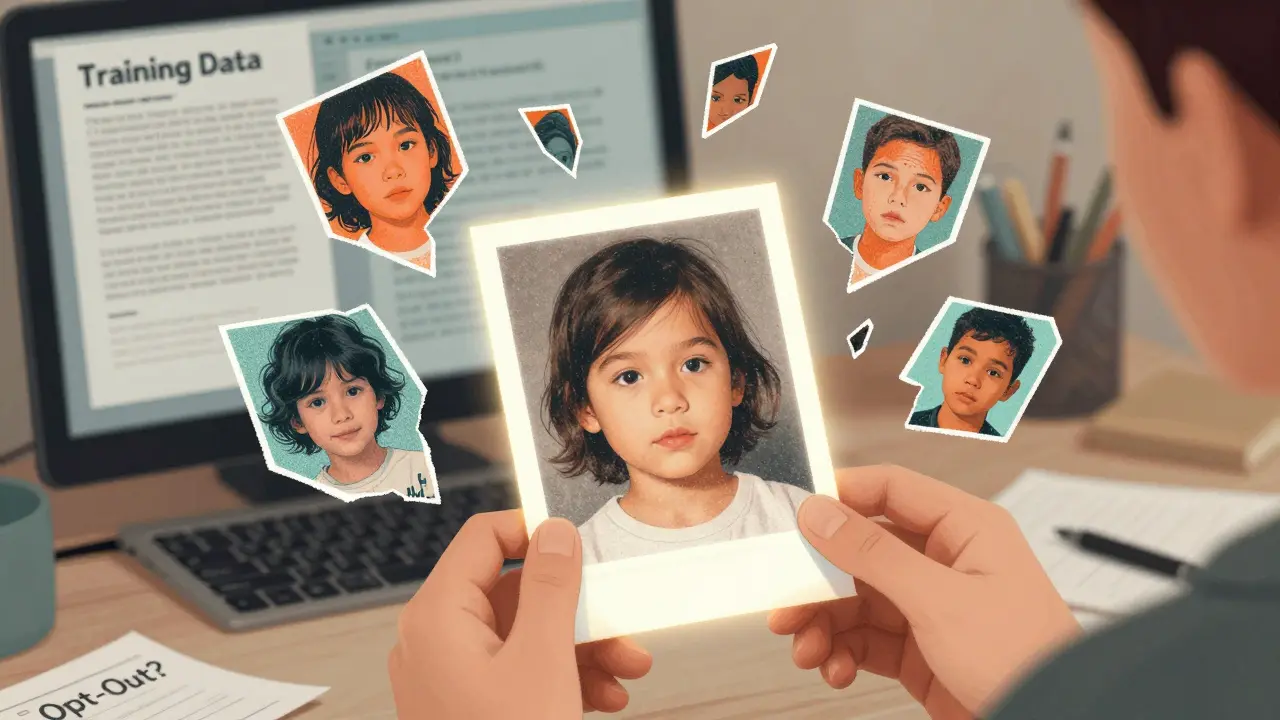
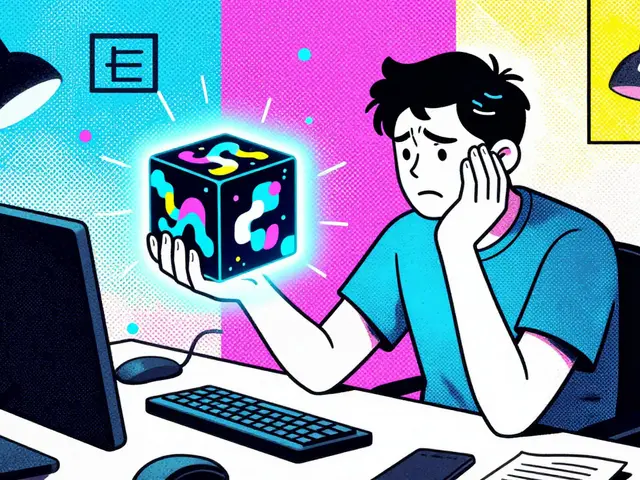
When you upload a photo to a social media app or type a personal story into a chatbot, do you know what happens to that data? In generative AI, your words, images, and voice aren’t just stored-they’re used to train models that spit out new content. And too often, users are left in the dark. Consent isn’t a checkbox anymore. It’s a continuous conversation between you and the AI-and it’s broken.
Why Consent in Generative AI Is Different
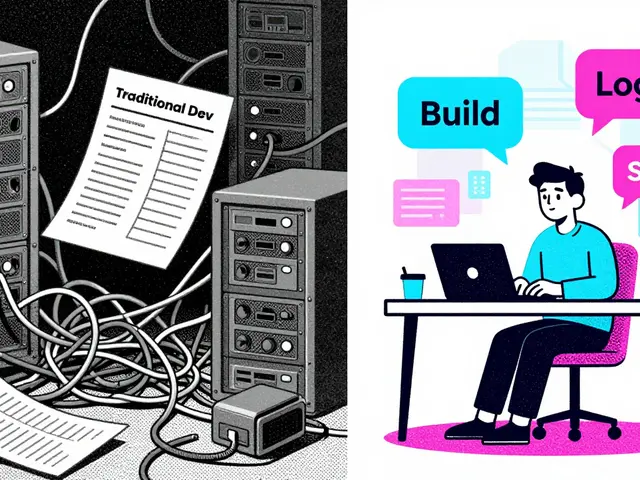
Traditional software asks for permission once: "Do you allow us to collect your location?" You say yes or no, and that’s it. Generative AI doesn’t work like that. These systems learn from massive datasets, often pulled from public websites, social media, and even private files uploaded by users. They don’t just use your data once. They absorb it, remix it, and use it to generate new text, images, or voices-sometimes years later.The EU AI Act defines generative AI as systems that create complex content like text, images, or video with varying levels of autonomy. That means if you posted a photo of your child in 2020, a model trained in 2025 could generate a new image of them that never existed. And you never agreed to that.
Under GDPR, consent must be informed, specific, and freely given. But most AI companies don’t explain how their models work. They say, "We use your data to improve our service." That’s not enough. Users need to know: Which parts of my data are being used? What will it be used to create? Can I stop it?
What User Rights Actually Look Like
You have more rights than you think. GDPR Article 22 gives you the right to human review if an AI makes a decision that affects you-like being denied a loan or flagged for fraud. Article 7 says consent must be as easy to withdraw as it is to give. But in practice? Most AI tools bury the opt-out button.Let’s say you use an AI writing assistant that learns from your emails. You later decide you don’t want your writing style copied into its training data. Under GDPR, you can request deletion. But if that data was used to train a public model, the company may not be able to fully remove it. That’s where data minimization comes in. The best systems only collect what’s absolutely necessary. No more scraping every public forum. No more storing voice recordings unless explicitly asked.
And then there’s sensitive data. Health records, financial details, children’s information-these require explicit consent under GDPR. Yet, some AI tools trained on public data have accidentally recreated medical reports or financial statements. That’s not a bug. It’s a failure of consent design.
How Consent Management Platforms Really Work
Consent Management Platforms (CMPs) aren’t just pop-up banners anymore. Modern CMPs like OneTrust and TrustArc now connect directly to AI systems. They don’t just ask, "Do you allow cookies?" They ask: "Do you allow us to use your chat history to train our text generator?" "Do you allow your uploaded images to be used in future model updates?"These platforms do three things:
- Track consent per AI function-not one blanket agreement. You might say yes to summarizing your emails but no to generating marketing copy from your personal messages.
- Update consent automatically-if the AI changes how it uses data, the platform triggers a new consent request. No more silent updates.
- Synchronize across systems-your choice to opt out of image training gets sent to Google Analytics, your CRM, and the AI training pipeline all at once.
Some platforms even scan your website to find every AI tool running on it. If you use a chatbot, a content generator, or an image enhancer, the CMP detects them and adds them to the consent list. No hidden trackers. No surprises.
Dynamic Consent: The Only Real Solution
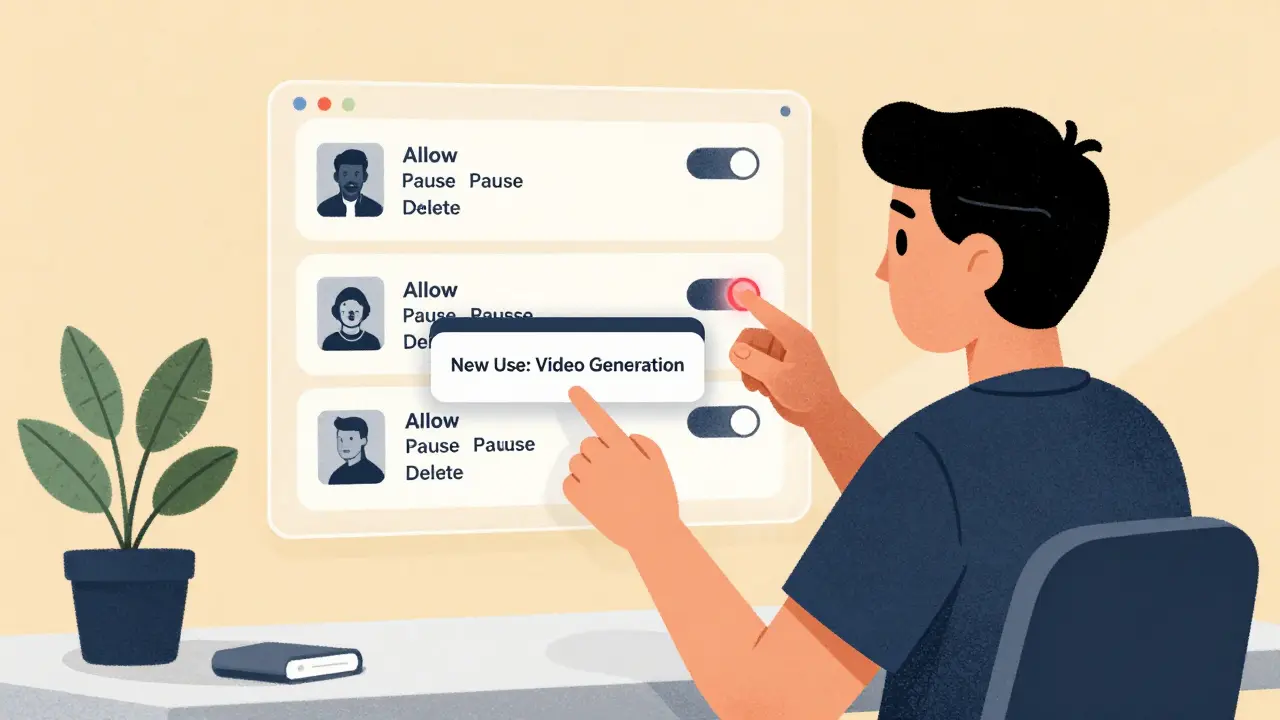
Static consent doesn’t work with AI. Models evolve. New features launch. Data gets repurposed. That’s why dynamic consent is the only ethical path forward.Think of it like a dashboard. You log in, and you see:
- Which AI models are using your data
- What kind of data each one uses (text, images, voice)
- When your consent was last updated
- A button to revoke access anytime
When a model updates-say, it starts generating video from text prompts-the system sends you a clear alert: "Your text history may now be used to create short videos. Do you allow this?" You don’t have to dig through a 50-page privacy policy. You get one simple question.
Companies like OpenAI and Anthropic now offer user dashboards where you can see what data was used to train their models. That’s progress. But most startups still don’t. And that’s a problem.
The Role of Business Analysts in AI Consent
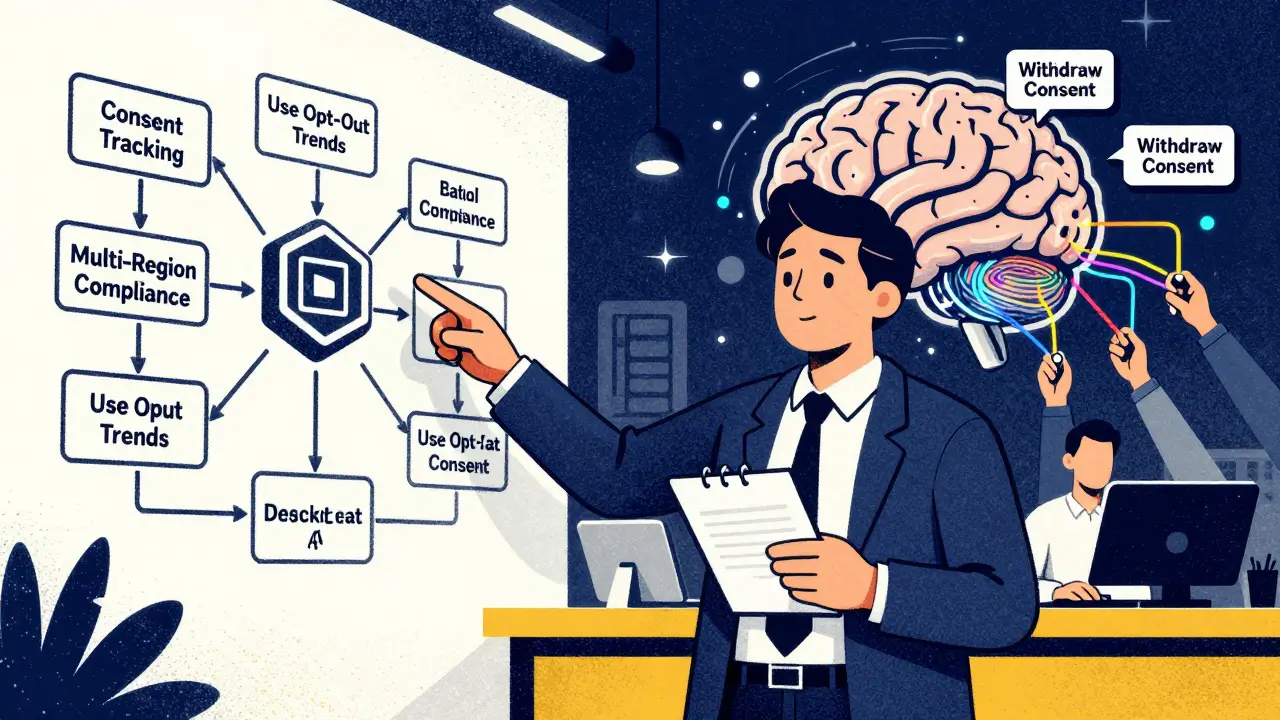
You won’t find consent management in the IT department alone. It’s a job for business analysts-the people who bridge tech, law, and customer experience.They’re the ones asking: "If we add facial recognition to our AI assistant, what consent triggers do we need?" "Can our current CMP handle multi-region compliance?" "How do we audit whether consent was properly recorded?"
They don’t just implement tools. They design processes. They push back on features that require too much data. They insist on plain-language explanations instead of legal jargon. And they track consent trends: Are users opting out more after certain updates? Are certain demographics declining consent at higher rates? That data helps companies adjust-not just to stay legal, but to stay trusted.
What’s Next: Blockchain, AI, and Predictive Consent
The future of consent isn’t just better interfaces-it’s smarter systems.Blockchain-based records are being tested to store immutable proof of consent. Once you say yes to using your voice for AI training, that choice is recorded on a tamper-proof ledger. If regulators ask, "Did you get consent?" the answer is clear.
AI-powered personalization could tailor consent requests to your reading level. If you’re not a lawyer, you shouldn’t get a legal contract. You should get a simple visual: "This will let the AI write emails like you. You can turn it off anytime."
Even more advanced: predictive consent. If your AI assistant notices you’ve stopped using it for a month, it might ask: "We noticed you haven’t used us in a while. Should we stop using your past messages to train our models?" It’s proactive, not reactive.
These aren’t sci-fi ideas. They’re being piloted right now. But they only work if companies prioritize user control over innovation.
What You Can Do Today
You don’t have to wait for companies to fix this. Here’s how to take back control:- Check your AI dashboards-if a service lets you see what data they use, go in and review it. Delete what you don’t want used.
- Use privacy tools-browser extensions like Privacy Badger or DuckDuckGo’s AI blocker can prevent AI tools from collecting your data.
- Ask for transparency-if a company won’t tell you how your data is used, choose another service.
- Opt out of training-many AI services now have an option to exclude your inputs from training. Use it.
Consent isn’t a one-time form. It’s your right to say no-and to change your mind. And in generative AI, that right is more important than ever.
Can I delete my data from generative AI models?
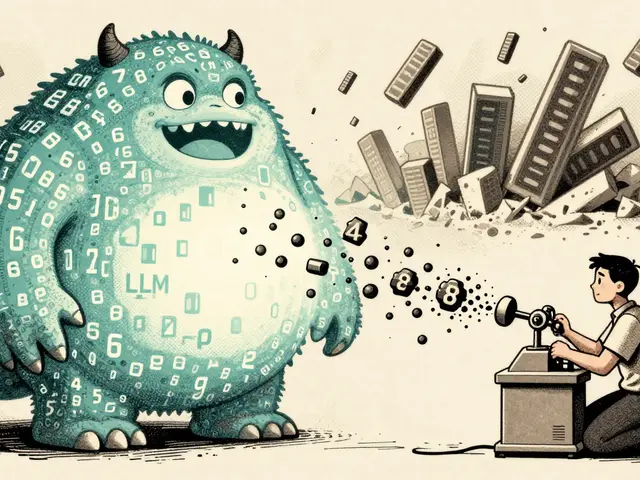
Legally, under GDPR, you can request deletion of your personal data. But in practice, it’s complicated. If your data was used to train a public model, the company may not be able to fully remove it because the model’s weights are a mathematical blend of millions of inputs. What you can do is request that your data no longer be used in future training cycles. Some companies, like OpenAI, let you opt out of training entirely. Always check their privacy settings.
Do I need to give consent every time an AI updates?
Yes-if the update changes how your data is used. If a chatbot previously only summarized text and now starts generating images from your messages, that’s a new use. Under GDPR and similar laws, you must be notified and given a fresh chance to consent. Companies that don’t do this risk fines. Look for updated privacy notices or email alerts when models change.
Are there AI tools that don’t use my data for training?
Yes. Some companies offer "private" or "enterprise" versions of their AI that don’t store or use your inputs for training. For example, Microsoft Azure OpenAI Service lets organizations keep data within their own cloud. If privacy matters, choose these options-they’re often available for a small fee or as part of a business plan.
What if I didn’t know my data was being used to train AI?
Many users didn’t. That’s why regulators are tightening rules. If you find your personal data-like your writing, photos, or voice-in an AI-generated output, you can file a complaint with your country’s data protection authority. In the EU, that’s your national GDPR watchdog. In the U.S., state laws like CCPA allow similar actions. Document what you found and where you found it. Evidence matters.
Is consent enough to protect my privacy in AI?
Consent is necessary, but not enough. A company could ask for consent and still misuse data. Real protection comes from combining consent with data minimization, strong encryption, third-party audits, and legal accountability. The best systems don’t just ask for permission-they design their products to need less data in the first place.
amber hopman
23 February, 2026 - 18:09 PM
I’ve been using an AI writing tool for months and just found out my emails were training their model. I didn’t even know I could opt out. I went into settings and turned it off-took me 20 minutes to find the toggle buried under "Advanced Preferences." Why is this so hard? If consent is supposed to be "freely given," why does it feel like a scavenger hunt?
Now I’m checking every service I use. DuckDuckGo’s AI blocker helped, but half the apps don’t even list what they’re training on. We need mandatory disclosure labels-like nutrition facts for data.
Also, why do companies say "we use your data to improve service" like that’s a gift? I’m not donating to science. I’m giving them my voice, my style, my private thoughts. That’s not improvement. That’s exploitation dressed up as innovation.
Jim Sonntag
25 February, 2026 - 12:39 PM
consent is a checkbox. dynamic consent is a whole damn website. i just want to chat with an ai without signing a treaty. why does every feature need its own toggle? its like apple made a privacy settings menu in 1998 and called it "modern"
also if my data gets used to make a photo of my dog in a tuxedo, i’m not mad. i’m just glad it’s not me in a tuxedo.
Deepak Sungra
27 February, 2026 - 11:03 AM
bro the whole thing is a scam. companies say "we respect your privacy" then scrape every damn thing you ever typed on their site. i use a chatbot to help me write my girlfriend love letters. now my whole romantic style is in some ai’s brain and it’s spitting out generic mush to other people. that’s not training. that’s identity theft with a ui.
and dont even get me started on how they bury the opt-out. i had to open dev tools to find the real link. its like they want you to give up. and honestly? i did. i just stopped using it. why should i play their game?
also i tried to delete my data. they said "we can’t delete it because it’s mixed with millions of other inputs." cool. so my voice is now part of a public monster. thanks for nothing.
Samar Omar
28 February, 2026 - 20:09 PM
It is profoundly disingenuous to suggest that consent management platforms represent any meaningful advancement in ethical AI. The very architecture of these systems-relying on user interaction, toggle switches, and opt-in banners-presupposes that the user is both sufficiently informed and sufficiently motivated to engage in what is, in effect, a recursive bureaucratic performance.
OneTrust, TrustArc, and their ilk are not solutions-they are theatrical props designed to satisfy regulatory theater while preserving the underlying extractive logic of the business model. The notion that a user, after a 14-hour workday, will carefully audit which of their 37,000 past messages are being used to train a model that now generates childlike poetry in the voice of their late grandmother-is not just optimistic. It is grotesque.
True consent cannot be interface-driven. It must be architecture-driven. We must eliminate the premise that data collection is the default. We must enforce data minimization as a technical requirement, not a marketing slogan. And we must stop pretending that a checkbox labeled "I understand the implications" is anything other than a legal shield for corporate negligence.
Until then, we are not users-we are unpaid data farmers in a digital plantation.
chioma okwara
2 March, 2026 - 07:49 AM
yo u guys are overthinking this. if u upload stuff online u already said "use it". its public. u cant cry later. also u think u own ur voice? lol. every time u talk on zoom or instagram u r training ai. its not a secret. its just how the internet works now.
if u dont want ur data used? dont use ai. or better yet, dont use the internet. simple. no drama. no dashboards. no blockchain. just live in 2005. peace.
John Fox
2 March, 2026 - 10:00 AM
the fact that i have to check 3 different dashboards across 3 apps just to make sure my writing isn’t being turned into spam emails is exhausting
why can’t it just be on by default and i opt out? instead of off by default and i have to dig for the one button that says "don’t train on me"
also i found out last week my old journal entries were used to train a depression simulator. i didn’t even know i’d uploaded them. now i’m paranoid every time i type "i’m tired"
Tasha Hernandez
3 March, 2026 - 19:24 PM
Can we just admit that consent is a fairy tale? Companies don’t want you to understand-they want you to click "agree" and forget. And you do. Because life is too short to read 12,000 words of legalese about how your cat’s meow will be used to train a voice model that sings lullabies to strangers.
I tried to delete my data from one service. They sent me a 47-step form, required a notarized letter, and asked for my mother’s maiden name. Meanwhile, my entire emotional vocabulary-every late-night rant, every sob story, every joke about my ex-is now part of a generative model that’s writing breakup letters for people who never existed.
And the worst part? I’m not even mad. I’m disappointed. Because I thought we were building something better. Turns out we’re just automating exploitation with a pretty UI. And we call it progress.
Someone please tell me how to untrain my soul from the machine. I miss when my words were mine.