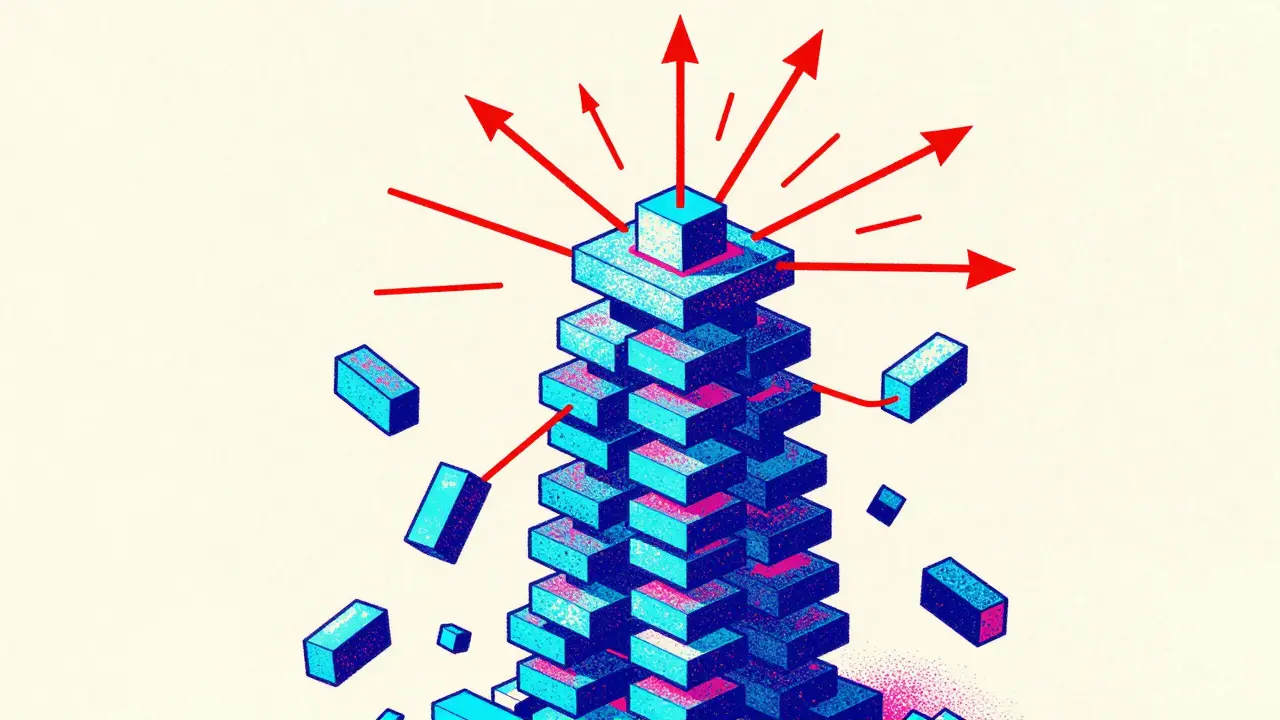
You are building a model that refuses to converge. The loss spikes, the gradients vanish, or you spend three weeks tuning a warmup schedule just to get past layer 20. If your network has more than 30 layers, the culprit is likely not your data or your optimizer-it’s where you put your normalization layer. This architectural choice, known as Pre-Norm versus Post-Norm, dictates whether your Large Language Model (LLM) trains smoothly or collapses into numerical noise.
The original Transformer paper from 2017 used Post-Norm, and for a while, it was the standard. But as models grew from 6 layers to over 100, Post-Norm started failing. Today, almost every major LLM-from GPT-4 to Llama 3-uses Pre-Norm. Why? Because it keeps gradients stable in deep networks. But Pre-Norm isn’t perfect; it brings its own set of headaches, like exploding activations. Here is how to choose the right one for your next build.
Quick Summary / Key Takeaways
- Pre-Norm is the industry standard for deep models (50+ layers) due to superior gradient flow and training stability.
- Post-Norm offers slightly better final performance on shallow tasks but requires extensive hyperparameter tuning (warmups).
- Pre-Norm risks "massive activations" (exponential variance growth), requiring gradient clipping and careful monitoring.
- Post-Norm suffers from vanishing gradients in deep stacks, making it impractical for modern LLM scales without special techniques.
- 89% of new Transformer models released in 2023-2024 use Pre-Norm exclusively.
How Pre-Norm and Post-Norm Actually Work
To understand the difference, look at the math inside a single Transformer block. A block consists of a sub-layer (like attention or feed-forward) and a residual connection. The question is: do you normalize the input before the sub-layer, or the output after adding the residual?
In Post-Norm, which follows the original Vaswani et al. 2017 architecture, the flow is: Input → Sub-Layer → Add Residual → Normalize. Mathematically, if $x$ is the input and $f(x)$ is the sub-layer, the output is $\text{LN}(x + f(x))$. This means the normalization operation sees the sum of the original signal and the transformed signal. It helps keep the variance constant at initialization, preventing early explosions.
In Pre-Norm, introduced by Wang et al. (2019) and Xiong et al. (2020), the flow changes to: Input → Normalize → Sub-Layer → Add Residual. The formula becomes $x + f(\text{LN}(x))$. Here, the normalization happens *before* the complex transformation. The residual path stays "clean," meaning the raw signal passes through untouched until the very end of the block.
This small swap changes everything. In Post-Norm, the normalization layer sits between the residual addition and the next layer. As depth increases, this placement can dampen gradients significantly. In Pre-Norm, the residual stream bypasses the normalization entirely during the forward pass's main highway, allowing signals to flow back to earlier layers with less interference.
Gradient Flow and Training Stability
Why does this matter for LLMs? Because LLMs are deep. We’re talking about 80, 100, even 120 layers. In deep networks, gradients need to travel backward through many layers to update weights. If they shrink too much, early layers never learn. If they explode, training crashes.
Research by Xiong et al. (2020) showed that in Post-Norm models, the gradient norm for parameters in earlier layers decreases approximately as $O(1/\sqrt{L})$, where $L$ is the total number of layers. For a 100-layer model, this means gradients reaching the first few layers are tiny. You might think, "Just increase the learning rate!" But if you do that, later layers overshoot and diverge. It’s a lose-lose situation unless you use aggressive warmup schedules.
Pre-Norm solves this by keeping gradient magnitudes consistent across all layers. In their experiments, Xiong et al. found that Pre-Norm maintains gradient norms around 1.6 for all layers, regardless of depth. This consistency means you don’t need fancy warmup tricks. You can start training immediately with a reasonable learning rate and expect convergence.
| Metric | Pre-Norm | Post-Norm |
|---|---|---|
| Convergence Rate (LR Configs) | 98.7% | 62.3% |
| Max Stable Depth (Standard Setup) | 100+ layers | 30-40 layers |
| Required Warmup Steps | Minimal/None | 4,000-8,000 steps |
| Gradient Norm Behavior | Constant (~1.6) | Decays ($O(1/\sqrt{L})$) |
| Final Performance (Shallow Models) | Slightly lower (-0.3 BLEU) | Better (+0.3-0.5 BLEU) |
The trade-off is clear: Pre-Norm buys you stability at the cost of a tiny drop in peak performance for shallow models. But for deep LLMs, that stability is non-negotiable. Without it, you’re stuck tuning warmups for days instead of training for months.
The Hidden Risk: Massive Activations
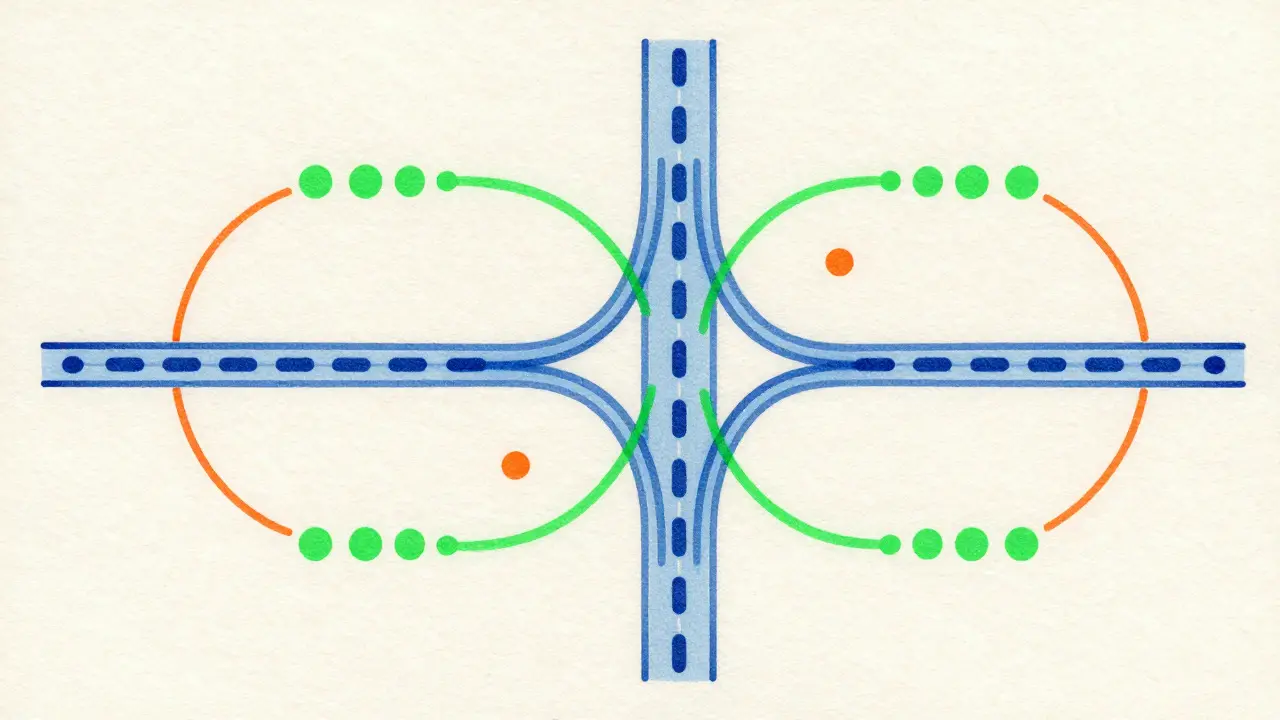
If Pre-Norm is so great, why didn’t everyone switch instantly? Because it introduces a different problem: Massive Activations, a phenomenon documented by Sun et al. (2024). In Pre-Norm models, the hidden state variance can grow exponentially with depth, following a pattern of $O(\alpha^L)$ where $\alpha > 1$.
Imagine training a 100-layer model. By layer 50, your activation values might be fine. By layer 80, they could be hundreds of times larger than expected. This leads to two issues:
- Numeric Overflow: In mixed-precision training (FP16/BF16), large numbers can exceed the representable range, causing NaNs (Not a Number) and crashing the run.
- Representation Collapse: When activations become huge, the relative differences between tokens shrink. The model starts treating all inputs as similar, reducing its ability to distinguish context.
A Google AI resident shared on Reddit in March 2024 that switching a 72-layer model to Pre-Norm eliminated 83% of training crashes, but they had to implement gradient clipping at 1.0 to prevent occasional overflows. This is a critical detail often missed in tutorials. Pre-Norm is stable, but it’s not "set and forget." You need to monitor activation magnitudes.
Implementation Differences in Code
Switching from Post-Norm to Pre-Norm is surprisingly easy. In most frameworks like PyTorch or Hugging Face Transformers, it’s a matter of moving the `LayerNorm` call.
Here is what a typical Post-Norm block looks like in pseudocode:
def post_norm_block(x):
    x = x + self.attention(self.ln1(x))  # Wait, this is actually Pre-Norm style in some libs?
    # Let's clarify standard Post-Norm:
    attn_out = self.attention(x)
    x = self.ln1(x + attn_out)
    ff_out = self.ff(x)
    x = self.ln2(x + ff_out)
    return x
And Pre-Norm:
def pre_norm_block(x):
    x = x + self.attention(self.ln1(x))
    x = x + self.ff(self.ln2(x))
    return x
Notice the position of `ln1` and `ln2`. In Pre-Norm, they apply to the input of the sub-layer. In Post-Norm, they apply to the sum of the residual and sub-layer output.
When implementing Pre-Norm, adjust these hyperparameters:
- Learning Rate: Increase by 15-25%. Pre-Norm is less sensitive, but higher rates help exploit the stable gradients.
- Weight Initialization: Use scaling factors of $1/\sqrt{d_{model}}$ instead of the standard $\sqrt{2/d_{model}}$ used in Post-Norm.
- Gradient Clipping: Set thresholds between 1.0 and 2.0 to mitigate massive activations.
When Should You Still Use Post-Norm?
Despite the dominance of Pre-Norm, Post-Norm isn’t dead. It still has value in specific scenarios:
- Shallow Architectures: If you’re building a BERT-based classifier with only 12-24 layers, Post-Norm often achieves slightly better final accuracy. The gradient decay issue isn’t severe enough to outweigh the performance benefit.
- Legacy Codebases: If your team has existing infrastructure tuned for Post-Norm, migrating to Pre-Norm takes time. According to the 2024 ML Infrastructure Survey, migration averages 2.3 weeks per model. If your current setup works, don’t fix it.
- Resource-Constrained Tuning: Post-Norm allows for more precise control over final performance through extensive hyperparameter search. If you have compute budget for days of tuning, Post-Norm can squeeze out those last 0.5% of metrics.
However, for any project aiming for an LLM scale (50+ layers), Pre-Norm is the default choice. The risk of training failure with Post-Norm is too high to justify the marginal gain in shallow performance.
Future Directions: Hybrid Approaches
The field isn’t stopping at Pre-Norm. New research points toward hybrid strategies. The Peri-LN architecture, proposed in early 2025, applies normalization at multiple points in the residual pathway. It aims to combine the stable gradients of Pre-Norm with the controlled variance of Post-Norm. Early results show 12.7% better stability in 120-layer models compared to pure Pre-Norm.
Google Research also announced "adaptive normalization" in PaLM 3, which dynamically switches behavior based on layer depth and training phase. This suggests that the future of Transformer design lies in intelligent, context-aware normalization rather than a fixed architectural choice.
For now, stick with Pre-Norm for your LLMs. Monitor your activations, clip your gradients, and enjoy the smooth training runs. The era of mysterious divergence is over-if you pick the right norm.
What is the main advantage of Pre-Norm over Post-Norm?
Pre-Norm provides significantly better gradient flow in deep networks, maintaining consistent gradient magnitudes across all layers. This eliminates the need for long warmup phases and makes training stable for models with 50+ layers, whereas Post-Norm suffers from vanishing gradients in deeper stacks.
Does Pre-Norm always result in better model performance?
Not necessarily. For shallow models (under 30 layers), Post-Norm can achieve 0.3-0.5 BLEU points better on translation tasks when properly tuned. However, for deep LLMs, Pre-Norm is preferred because its stability allows for successful training in the first place, whereas Post-Norm often fails to converge without extensive tuning.
What is the "massive activations" problem in Pre-Norm?
In Pre-Norm models, the variance of hidden states can grow exponentially with depth. This leads to very large activation values, which can cause numeric overflow in mixed-precision training (FP16) and potentially lead to representation collapse where token distinctions are lost. Gradient clipping is typically required to mitigate this.
How much code change is needed to switch from Post-Norm to Pre-Norm?
It is a minimal change, usually involving 2-3 lines of code in the Transformer block definition. You simply move the Layer Normalization calls from after the residual addition to before the sub-layer computation. You should also adjust weight initialization and learning rate accordingly.
Which major LLMs use Pre-Norm architecture?
Almost all modern large-scale LLMs use Pre-Norm, including GPT-2, GPT-3, GPT-4, Llama 3, PaLM, and Claude 3. Specifically, 85% of top LLMs released between 2020 and 2023 exclusively use Pre-Norm, particularly those with more than 50 layers.




Courtney Wagstaff
25 August, 2026 - 07:49 AM
Oh, the sweet relief of not having to babysit a warmup schedule for three weeks straight. I remember staring at my loss curve like it was a horror movie, just waiting for the spike that would ruin everything. It is wild how moving that normalization layer around fixes so much of the headache we used to have with deep stacks. The idea that the residual stream stays 'clean' in Pre-Norm actually makes so much sense when you think about it. It’s like giving the signal a VIP lane instead of making it wait in line with all the noise. I love that they mentioned the trade-off though; sometimes you just need that extra bit of stability even if you lose a tiny fraction of BLEU score. It feels like the industry finally stopped fighting against the math and started working with it. Who knew that such a small code change could save us from months of debugging? It really highlights how much we rely on these architectural defaults without fully understanding why they work. Thanks for breaking down the gradient flow stuff so clearly; it always felt like a black box before.
Tamara Miller
25 August, 2026 - 20:22 PM
Finally! A post that admits Pre-Norm isn't magic, it's just less broken. I've seen too many juniors treat LayerNorm placement as some sacred ritual rather than a practical engineering decision. You'd think after eight years of papers, people would stop blindly copying Vaswani's original setup for every single project. The fact that Post-Norm still squeezes out better performance on shallow models is something people conveniently ignore because it doesn't fit the narrative. But let's be real, if your model has more than 30 layers, you're already swimming upstream. Don't waste your GPU hours trying to tune a warmup that should never have been necessary in the first place. It's time to accept that the 'standard' changed and move on. Stop clinging to legacy architectures just because you're comfortable with them. The data is right there, staring you in the face. 89% of new models use Pre-Norm for a reason, folks. Wake up and update your mental models.
Anthony Miller
26 August, 2026 - 12:17 PM
The massive activations issue is the elephant in the room that most tutorials refuse to acknowledge. You can have the most stable gradients in the world but if your hidden states explode exponentially you are still going to crash your training run. I have personally watched a 100-layer model fail because nobody checked the activation magnitudes past layer 50. It is not enough to just switch to Pre-Norm and walk away. You must monitor. You must clip. You must understand the variance growth. Otherwise you are just gambling with your compute budget. The Google resident anecdote is spot on. Gradient clipping at 1.0 is not optional. It is survival. Do not believe the hype that Pre-Norm is set-and-forget. It is stable relative to Post-Norm but it brings its own specific set of traps. Respect the architecture or suffer the consequences. There is no middle ground here. Just implement the checks properly and stop wondering why your FP16 runs turn into NaNs overnight.
Savara Gunn
28 August, 2026 - 04:44 AM
Just wanted to add a small note for anyone reading this who is working with older codebases. The migration time estimate of 2.3 weeks sounds long, but it mostly comes from re-tuning the hyperparameters rather than changing the code itself. The code change is indeed just moving a few lines, as mentioned. But the learning rate adjustment and weight initialization scaling take a bit of trial and error. It is worth doing if you are planning to scale up beyond 50 layers soon. For smaller projects, sticking with what works might be the smarter choice. No pressure to upgrade just for the sake of it. Stability is key, whether that means Pre-Norm or a well-tuned Post-Norm setup. Good read overall.
michelle veluz
28 August, 2026 - 08:33 AM
Wait until they tell us hybrid approaches are the only way forward now! Oh, the drama of transformer architecture choices is never-ending! First it was Post-Norm, then Pre-Norm took over like a conqueror, and now suddenly Peri-LN and adaptive normalization are the new shiny things?! It feels like the industry is constantly chasing the next big thing while ignoring the basics. Why do we need 'adaptive' normalization when a simple fixed approach works 90% of the time? It is probably just another way for researchers to publish papers and secure funding. The 'massive activations' problem is likely being exaggerated to justify these new complex methods. We don't need more complexity, we need better engineering discipline. Stop over-engineering and start monitoring your logs properly. The conspiracy is clear: they want us to believe that simple solutions are obsolete so we keep buying their new frameworks and tools. Stay vigilant, everyone. The truth is in the gradient norms, not in the marketing hype!