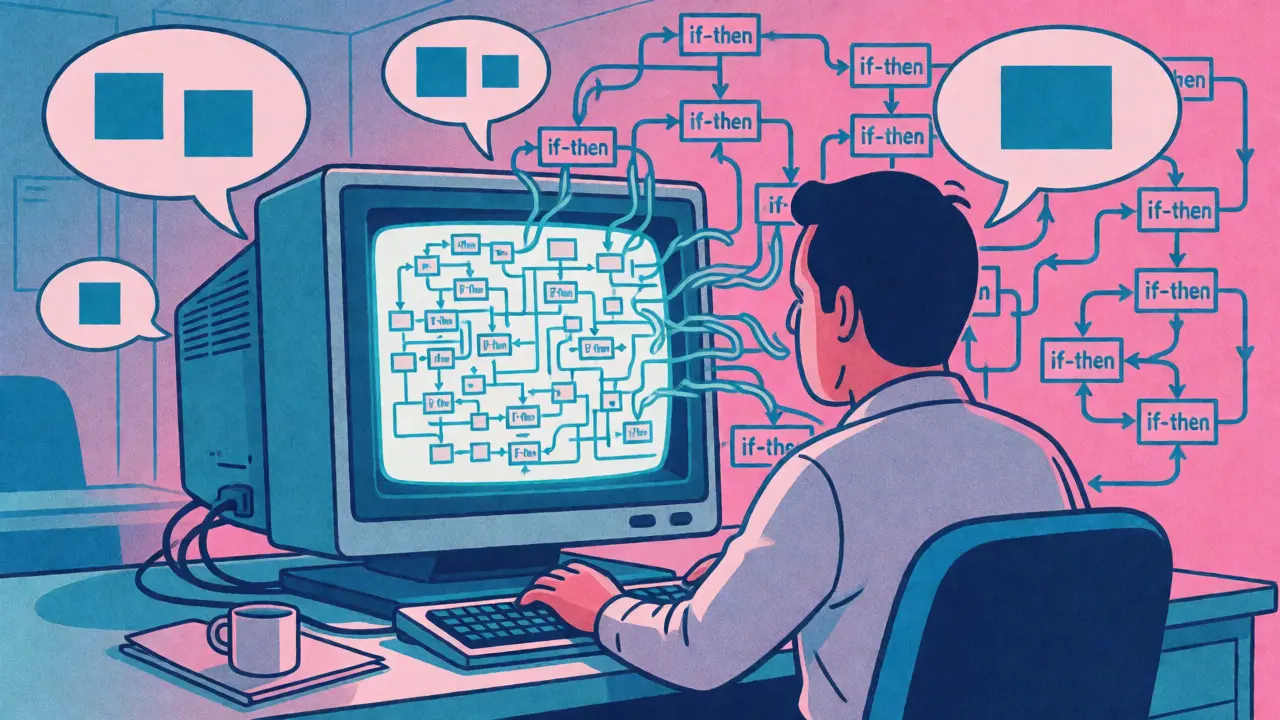
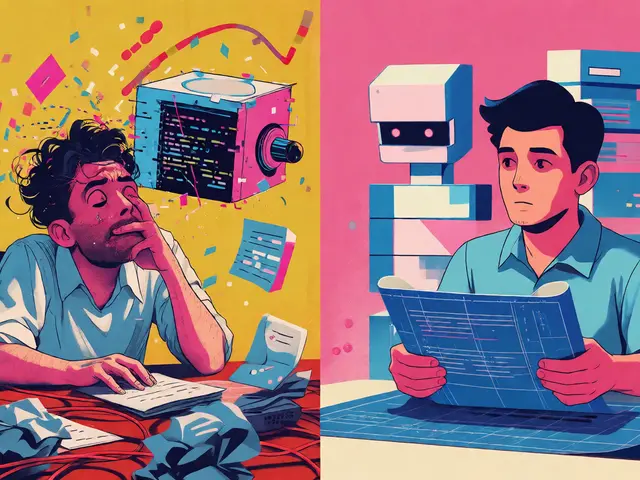
Imagine trying to teach a computer to understand sarcasm using nothing but a giant flowchart. That was the reality for engineers in the 1980s. They wrote thousands of if-then rules hoping the machine would catch the nuance. It rarely worked. Fast forward to today, and we have models that write poetry, debug code, and reason through complex math problems with startling accuracy. How did we get from rigid logic gates to fluid neural networks? The journey spans roughly three decades of intense innovation, marked by dead ends, breakthroughs, and a fundamental shift in how machines process human language.
The Era of Hand-Coded Rules
In the beginning, there were no "learning" machines. There were only programmed ones. From the 1950s through the early 1980s, Natural Language Processing (NLP) was entirely rule-based. Engineers manually encoded grammatical structures and semantic relationships into software. Think of it as building an elaborate decision tree where every branch represents a linguistic possibility.
The most famous example is ELIZA, created in 1966 by Joseph Weizenbaum at MIT. ELIZA wasn't smart; it was clever. It used pattern matching to mimic a psychotherapist. If you typed "I am sad," it might reply, "Why do you feel sad?" It didn't understand sadness. It just recognized the word "sad" and triggered a pre-written response.
- Rigidity: Every new sentence structure required a new rule.
- Scalability Issues: As language complexity grew, so did the codebase exponentially.
- Lack of Context: These systems couldn't handle ambiguity or long-range dependencies.
Rule-based systems worked well for narrow tasks, like parsing specific commands in aviation or medical records. But they hit a hard ceiling. You simply cannot hand-code enough rules to cover the infinite variations of human speech. The field needed a way to let the data speak for itself.
The Statistical Revolution
By the 1990s, researchers realized that guessing was better than knowing. This led to the rise of statistical NLP. Instead of asking "What are the rules of English?", these models asked "What words usually follow other words?"
The dominant technique became N-grams. An N-gram model predicts the next word based on the previous N-1 words. For instance, if you type "The cat sat on the...", a trigram model looks at "sat on the" and calculates the probability of the next word being "mat," "floor," or "couch."
| Feature | Rule-Based Systems | Statistical Models (N-grams) |
|---|---|---|
| Core Mechanism | Hand-coded grammar rules | Probability distributions from data |
| Flexibility | Low (brittle) | Medium (handles variations) |
| Data Requirement | Low (expert knowledge) | High (large text corpora) |
| Main Limitation | Cannot scale to general language | Curse of dimensionality |
This approach revolutionized machine translation and speech recognition. IBM’s statistical translation engines, for example, outperformed rule-based competitors by learning directly from bilingual text databases. However, N-grams had a major flaw: the "curse of dimensionality." As you increase N to capture more context, the number of possible word combinations explodes, leaving many sequences unseen in the training data. Plus, they struggled with long-distance dependencies. If the subject of a sentence was ten words ago, an N-gram model likely forgot it.
Neural Networks Enter the Chat
The late 1990s and early 2000s saw the introduction of neural networks to NLP. Initially, these were simple feedforward networks, but they quickly evolved into Recurrent Neural Networks (RNNs).
RNNs changed the game because they could maintain a hidden state-a memory of what came before. This allowed them to process sequences sequentially, making them ideal for language. But RNNs had a notorious weakness: the vanishing gradient problem. When processing long sentences, the signal from earlier words faded away, making it impossible for the network to learn connections between distant parts of the text.
The solution arrived in two forms: Long Short-Term Memory (LSTM) networks in 1997 and Gated Recurrent Units (GRUs) in 2014. LSTMs introduced "gates"-forget, input, and output-that controlled information flow. This allowed the model to keep relevant context over longer stretches. Suddenly, machine translation quality jumped. Google Translate switched to neural machine translation in 2016, moving away from phrase-based statistical methods and leveraging LSTM-like architectures.
The Transformer Breakthrough
If LSTMs were the bridge, the Transformer was the rocket ship. Introduced in 2017 by Google in the seminal paper "Attention Is All You Need," the Transformer eliminated recurrence entirely. It relied solely on self-attention mechanisms.
Here’s why this mattered: Transformers process entire sequences in parallel, not one word at a time. This made training massively faster and allowed models to scale up dramatically. The attention mechanism lets the model weigh the importance of different words relative to each other, regardless of their distance in the sentence. "It" in a sentence can instantly connect to its antecedent five lines back.
This architecture unlocked the era of Large Language Models (LLMs). Once you have a scalable architecture, you can throw more compute and data at it, and performance keeps improving.
The Scaling Wars: BERT to GPT-5
The period from 2018 to 2026 has been defined by rapid scaling. In 2018, Google released BERT (Bidirectional Encoder Representations from Transformers). With 340 million parameters, BERT read text in both directions, understanding context far better than previous left-to-right models. It dominated NLP benchmarks and transformed search engines.
Meanwhile, OpenAI pursued a unidirectional path with the GPT series:
- GPT-1 (2018): Proved that pre-training on diverse text followed by fine-tuning works.
- GPT-2 (2019): Generated such coherent text that OpenAI initially withheld the full model due to fear of misuse.
- GPT-3 (2020): Jumped to 175 billion parameters. It demonstrated in-context learning-the ability to perform new tasks with just a few examples in the prompt, no retraining needed.
By 2026, we’ve seen models like GPT-4 (estimated ~1.8 trillion parameters) and Claude 3 (~2 trillion parameters). These aren't just bigger; they're smarter. They exhibit emergent reasoning capabilities, handling multi-step logic and coding tasks that seemed impossible a decade ago.
The latest frontier involves reasoning-specific models like o1 and DeepSeek R1. These models use reinforcement learning to generate extended chains of thought, verifying their own steps before answering. This shift from pure prediction to deliberate reasoning marks a significant evolution in capability.
How Modern LLMs Are Trained
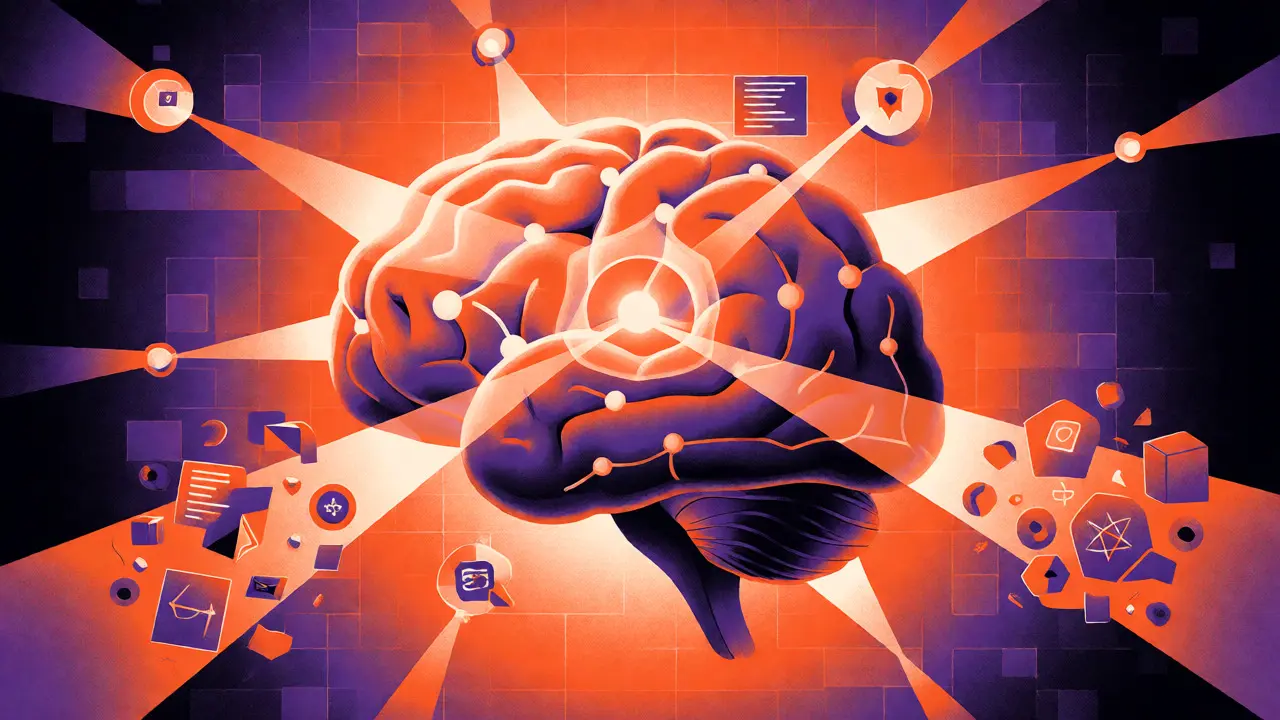
You might think training an LLM is just about reading a lot of books. It’s actually a sophisticated three-stage pipeline.
- Pre-training: The model reads billions of tokens from the internet, books, and code. It learns to predict the next token. This phase consumes the vast majority of computational resources.
- Supervised Fine-Tuning (SFT): Humans curate high-quality question-answer pairs. The model learns to follow instructions and format responses appropriately.
- Alignment (RLHF/DPO): Human annotators rank model outputs. Algorithms like Reinforcement Learning from Human Feedback (RLHF) or Direct Preference Optimization (DPO) adjust the model to prefer helpful, safe, and truthful answers.
Recent innovations focus on test-time compute. Instead of just making the model bigger during training, developers now let it "think" longer during inference. Models generate multiple candidate solutions, evaluate them, and refine their answer. This trades speed for accuracy, pushing performance further without exponential increases in parameter count.
Where Do We Go From Here?
We’ve moved from brittle rulebooks to fluid neural representations. The current trajectory suggests a move toward multimodal systems that seamlessly integrate text, image, audio, and video. We’re also seeing a push for efficiency. Not everyone needs a 2-trillion-parameter model running on a supercomputer. Smaller, specialized models are emerging for edge devices, bringing advanced NLP to smartphones and IoT gadgets.
The core challenge remains reliability. Despite impressive fluency, LLMs still hallucinate-confidently stating falsehoods. Reducing this error rate while maintaining creativity and reasoning depth is the primary goal for the next phase of development. The journey from ELIZA to GPT-5 shows that when we stop telling computers exactly what to say and start letting them learn from patterns, the results are extraordinary.
What is the main difference between rule-based NLP and statistical NLP?
Rule-based NLP relies on manually coded grammatical rules and dictionaries created by linguists. Statistical NLP uses algorithms to learn probabilities from large datasets, predicting word sequences based on frequency rather than explicit grammar rules. Statistical methods are more flexible but require massive amounts of data.
Why were LSTMs important for NLP?
LSTMs (Long Short-Term Memory networks) solved the vanishing gradient problem found in standard Recurrent Neural Networks. By using gating mechanisms, LSTMs could retain information over longer sequences, allowing models to understand context across entire paragraphs, which significantly improved tasks like machine translation.
What is the 'Attention' mechanism in Transformers?
The Attention mechanism allows a model to weigh the importance of different words in a sequence relative to each other. It enables the model to focus on relevant parts of the input regardless of their position, capturing long-range dependencies efficiently and allowing for parallel processing of data.
How does RLHF improve Large Language Models?
Reinforcement Learning from Human Feedback (RLHF) aligns model outputs with human preferences. Humans rank different model responses, and a reward model is trained on these rankings. The LLM is then optimized to maximize this reward score, resulting in more helpful, harmless, and honest interactions.
Are modern LLMs truly intelligent?
Modern LLMs demonstrate emergent capabilities like reasoning and code generation, but they lack true consciousness or understanding. They operate on probabilistic predictions of text. While they can simulate intelligence convincingly, they do not possess intent or subjective experience.



john randall
6 September, 2026 - 16:21 PM
It is wild to think that we went from simple if-then statements to models that can debug code.
I remember using early chatbots that were basically just keyword matchers, and now I use LLMs for daily work tasks without thinking twice about the complexity under the hood. The shift from rule-based rigidity to statistical probability really was the key unlock here.
Bonnie Watt
7 September, 2026 - 15:57 PM
Honestly, this whole narrative is overly romanticized and completely ignores the massive amount of human labor that goes into labeling data for RLHF.
We keep pretending these models are "learning" like humans do, but they are just glorified autocomplete engines that have been beaten into submission by thousands of low-paid workers in developing countries who decide what constitutes a "good" answer. The idea that scaling parameters magically creates reasoning is a lie sold by tech bros who don't understand basic linguistics. We are not closer to understanding language; we are just better at mimicking it while losing the actual semantic grounding that rule-based systems had, however brittle they were. It is sad, really, watching everyone cheer for hallucinations because they sound confident.
Joanna Mucha
9 September, 2026 - 11:01 AM
To reduce the evolution of language processing to a mere technical pipeline is to miss the ontological crisis inherent in the transition from symbolic AI to connectionist models.
The rule-based era, often derided for its brittleness, operated within a framework of explicit meaning where syntax mapped directly to semantics through human-defined logic. This was a form of digital hermeneutics. When we shifted to statistical and then neural approaches, we abandoned the promise of transparency for the allure of performance, effectively black-boxing the very concept of "understanding."
These large language models do not reason; they probabilistically navigate a high-dimensional vector space where words are merely coordinates relative to one another. There is no intentionality, no consciousness, only the echo of human thought patterns captured in training data. To claim they possess emergent reasoning is a category error of the highest order. We have built mirrors so polished that we mistake our own reflection for an independent mind. The danger lies not in their limitations, but in our anthropomorphic projection onto them. We are outsourcing our cognitive agency to algorithms that lack any epistemic foundation, creating a society that values fluency over truth. This is not progress; it is a profound alienation from the nature of knowledge itself.
Jeff Falcon
11 September, 2026 - 10:32 AM
I totally agree with the points made about the scalability issues, and honestly, it’s fascinating how the field pivoted so hard when it became clear that hand-coding every exception was impossible.
What always gets me is the sheer volume of data required now compared to back then, because while the rules were rigid, at least you knew exactly why the system failed, whereas now it feels like magic or sometimes just random noise mixed with pattern matching.
And regarding the transformer architecture, the parallelization aspect was definitely the game changer that allowed us to scale up to those trillion-parameter models we see today, because before that, sequential processing was just too slow for practical applications outside of research labs.
But I also think people underestimate how much the quality of pre-training data matters, because garbage in still means garbage out, even if the model has billions of parameters and sophisticated attention mechanisms that allow it to look at context in ways N-grams never could.
It’s kind of ironic that we spent decades trying to teach computers grammar, only to realize that showing them enough examples of how humans actually speak was far more effective than teaching them the rules of English themselves.
Kim Edwards
13 September, 2026 - 00:21 AM
OH MY GOD THE TRANSFORMER PAPER WAS ACTUALLY LIFE CHANGING!!!
I literally cried reading "Attention Is All You Need" because I realized everything I knew about RNNs was obsolete overnight!! It felt like the sky fell down and rebuilt itself in real time!!!
Alyson Karson
13 September, 2026 - 10:31 AM
Stop saying LLMs don't understand anything!!! They clearly grasp nuance way better than most humans i talk to!!! Its not just autocomplete its actual comprehension of context and tone which is insane!!! People are gatekeeping intelligence just cause they dont know how the math works!!! Get over it!!!
Elisabeth Ballet
15 September, 2026 - 04:23 AM
That's a great point about the shift in mindset, Alyson!
It is important to remember that for many students and professionals entering the field now, the rule-based era is ancient history, almost like Latin to modern speakers.
We need to ensure that new engineers understand *why* we moved away from those systems, not just *that* we did, so they don't repeat the same mistakes when building specialized agents.
Let's focus on how we can use these tools responsibly rather than getting stuck in philosophical debates about whether a machine truly "knows" something.
Courtney Wagstaff
16 September, 2026 - 01:11 AM
Loving the breakdown of the timeline! It really helps visualize how far we've come from those clunky flowcharts to these fluid neural nets.
The part about ELIZA being clever but not smart is such a perfect analogy for where we might be heading if we aren't careful with alignment.
Can't wait to see how multimodal systems change the game next!