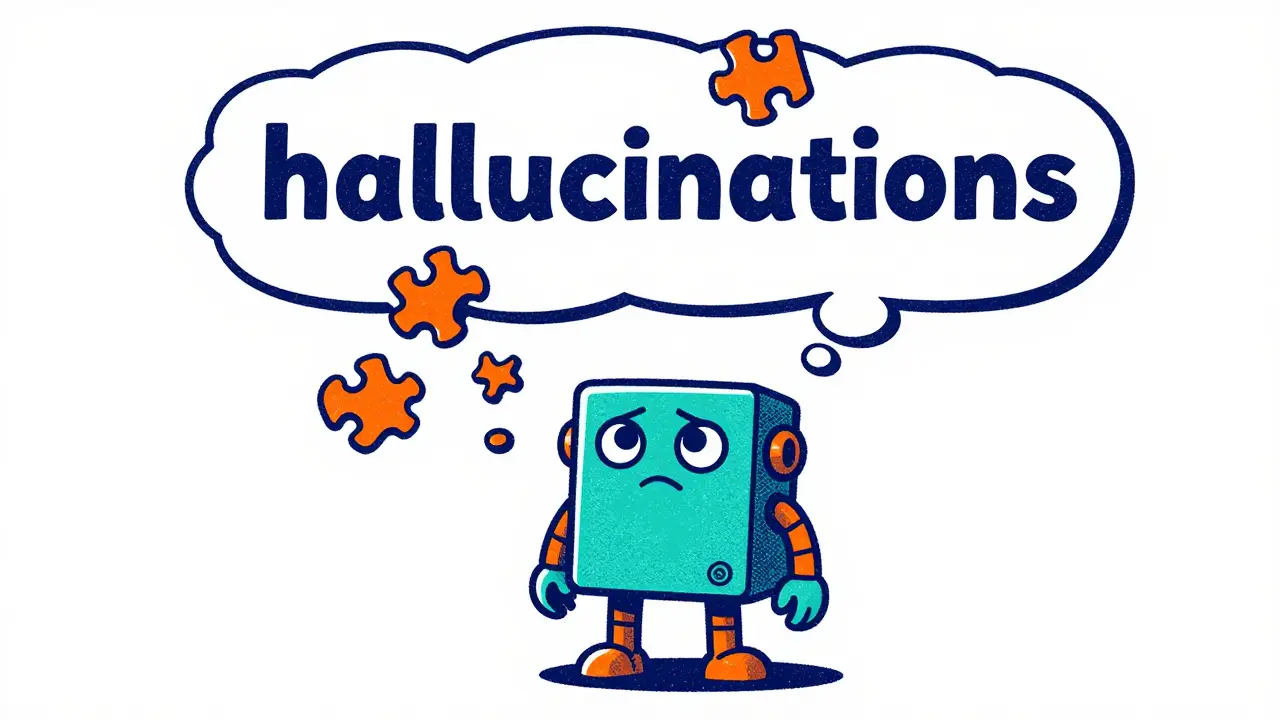
Ever had a chat with an AI that sounded incredibly confident while telling you something completely wrong? That's the classic hallucination problem. While Large Language Models are great at mimicking human speech, they aren't actually "knowledge" engines-they are pattern recognizers. To fix this, developers are moving toward Grounded Generation is the process of anchoring AI responses in real-world, verifiable data sources to ensure outputs are accurate and trustworthy . Instead of letting the model guess the next word based on a statistical blur, grounding forces the AI to look up the facts first.
Why Standard LLMs Fail at Facts
Most people treat an LLM like a search engine, but that's a mistake. A model is trained on a massive snapshot of the internet; once that training ends, its knowledge is frozen in time. If you ask it about a regulatory change that happened last Tuesday, it will either tell you it doesn't know or, more dangerously, it will make up a plausible-sounding answer based on old data. This lack of connection to real-time or verifiable information is what leads to the reliability gap.
By using Structured Knowledge Bases, which are organized collections of data like databases or knowledge graphs, we can provide the AI with a "source of truth." Industry benchmarks show that grounding can slash hallucinations by 30-50%, turning a creative toy into a professional tool suitable for healthcare or finance.
The Engine of Truth: Retrieval-Augmented Generation (RAG)
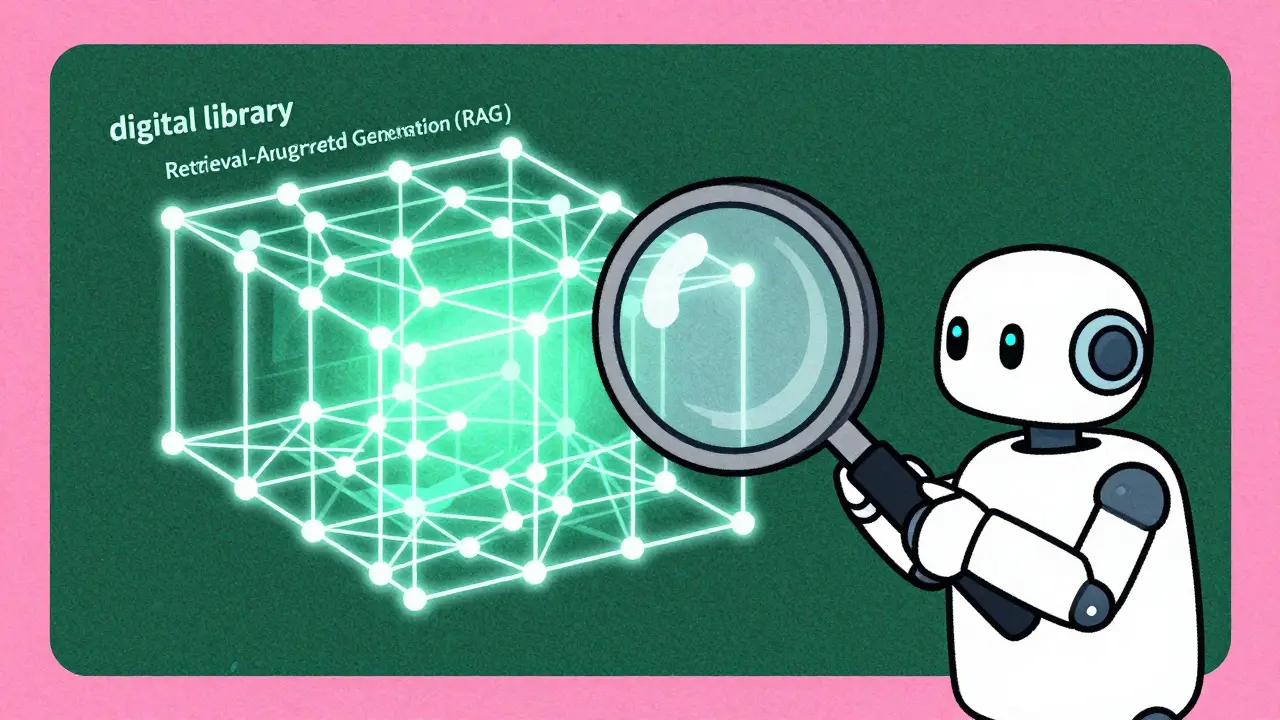
The most popular way to achieve grounding today is through Retrieval-Augmented Generation (often called RAG), which is a framework that retrieves relevant documents from an external source and feeds them to the LLM as context. Think of it as giving the AI an open-book exam instead of asking it to rely on memory.
A typical RAG workflow follows these steps:
- Query Submission: The user asks a specific question.
- Semantic Search: The system searches a Vector Database-like Pinecone or Weaviate-to find chunks of text that are mathematically similar to the query.
- Context Injection: The retrieved text is pasted into the prompt along with the original question.
- Generation: The LLM writes a response based strictly on the provided context.
For enterprise apps, speed is everything. Most companies aim for a latency of under 500ms to ensure the user isn't staring at a loading spinner while the system hunts for data.
Beyond Simple Text: Entity-Based and External Injection
While RAG is great for documents, sometimes you need more precision. This is where entity-based grounding comes in. Instead of searching for "similar sounding" paragraphs, the system looks for specific Entity-Based Data Products. These are structured representations of business-critical concepts-like a specific customer ID or a transaction record-that have unique identifiers.
Another advanced method is External Knowledge Injection. This involves connecting the model to established factual hubs like Wikidata or DBpedia. By querying these knowledge graphs, the AI can verify relationships between entities (e.g., "Who is the CEO of Company X?") with 100% accuracy rather than guessing.
| Method | Primary Source | Best For | Accuracy Gain |
|---|---|---|---|
| Standard RAG | Unstructured Docs / PDF | Company Wikis, Manuals | High (reduces hallucination) |
| Entity Grounding | Structured DBs / APIs | Financial Records, CRM | Very High (exact matches) |
| Knowledge Injection | Wikidata / DBpedia | General World Facts | Medium-High |
Real-World Impact: From Finance to Healthcare
When accuracy isn't just a "nice to have" but a legal requirement, grounding is the only option. In the financial sector, a data scientist reported a 40% drop in incorrect regulatory references after they started grounding their model using SEC filings. When you're dealing with compliance, "close enough" isn't good enough.
Healthcare providers have seen a 25% reduction in medical information errors by using grounded generation. Whether it's checking drug interactions or patient history, having the model pull from a verified medical database rather than its own training weights is a literal lifesaver. Users on platforms like G2 consistently rate these grounded solutions much higher (4.6/5.0) than standard models (3.2/5.0) because they spend way less time double-checking the AI's work.

The Hard Part: Implementing Grounded Systems
It sounds like a magic bullet, but grounding has a steep setup cost. You can't just flip a switch; you have to build a data pipeline. Basic RAG systems can cost anywhere from $15,000 to $50,000 to implement properly because of the data preparation overhead. You need your information in the right format, indexed correctly, and cleaned of duplicates.
One of the biggest technical hurdles is the "context window limitation." Even the best models can only "read" a certain amount of text at once-usually between 4,000 and 8,000 tokens. If your retrieval system pulls too much irrelevant information, you'll crowd out the actual answer. To fight this, experts use hybrid search, combining keyword matching with semantic search, which can boost results by about 30%.
Maintenance is another headache. If your data changes every hour, your vector database needs to refresh just as often. Most professional setups use automated pipelines that update every 24 to 72 hours to keep the AI from citing outdated prices or dead links.
The Future: Self-Grounding and Multi-Modal AI
We are moving away from basic RAG toward "Entity-Guided RAG," which models the relationships between data points more intelligently. Research from Stanford suggests this can improve precision by another 35%. The end goal? Self-grounding models. Imagine an AI that realizes it doesn't know an answer and autonomously searches a trusted database to verify the fact before it even starts typing. Analysts predict this will be the norm by 2027.
We're also seeing the rise of multi-modal grounding. This means the AI isn't just looking at text files but is grounding its answers in images, videos, and sensor data. For a technician fixing a piece of machinery, the AI could ground its instructions in the actual real-time video feed of the engine they are looking at, combining visual and textual knowledge bases into one cohesive answer.
What is the main difference between RAG and fine-tuning?
Fine-tuning is like teaching a student a new subject until they memorize it; it's great for style and jargon but bad for facts because the data gets "baked in" and becomes outdated. RAG is like giving that student a textbook during the exam. RAG generally outperforms fine-tuning by 22-37% in factual accuracy because it uses current, verifiable data.
Can grounded generation completely stop hallucinations?
It doesn't eliminate them 100%, but it reduces them significantly (often by 30-50%). Hallucinations can still happen if the retrieved context is misleading or if the model misinterprets the data it was given. However, the key advantage is that the AI can provide citations, allowing humans to verify the source.
Which vector databases are best for grounding?
The most common choices are Pinecone, Weaviate, and FAISS. Pinecone is popular for managed cloud scalability, Weaviate offers strong hybrid search capabilities, and FAISS is often used for high-performance local indexing. The choice depends on whether you need a fully managed service or an open-source tool you can host yourself.
How long does it take to implement a grounded LLM system?
For developers already familiar with vector databases, the initial learning curve is typically 2 to 4 weeks. However, the full deployment-including data cleaning, indexing, and prompt engineering-usually takes several months of iterative testing to ensure the retrieval quality is high enough for production.
Is grounding required by law?
While not a direct law in every country, regulations like the EU AI Act emphasize the need for technical solutions to minimize the risk of incorrect information. For high-risk applications (like medical or legal AI), grounding is essentially a mandatory requirement to meet these safety and accuracy standards.