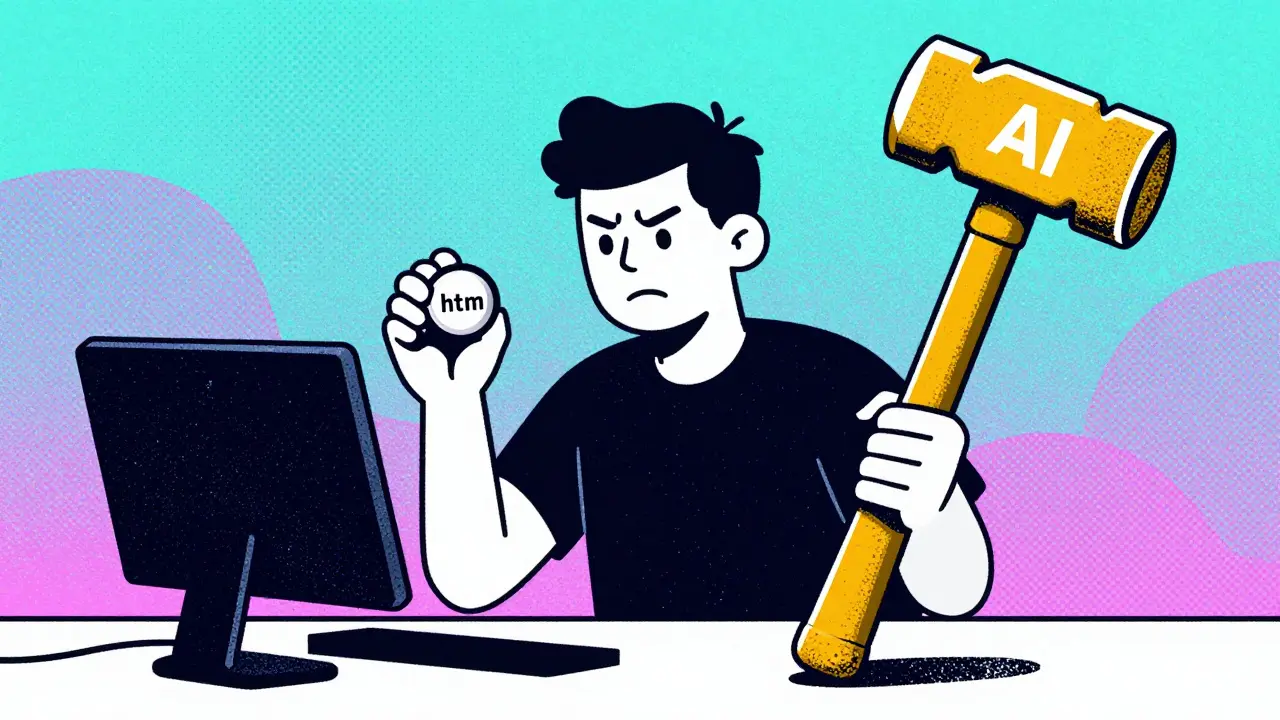
Stop using your most expensive AI model to write basic HTML buttons. It’s like hiring a brain surgeon to fix a flat tire. In the world of vibe coding, which is an emerging software development paradigm where developers describe desired functionality at a conceptual level rather than writing detailed code, with AI models generating the implementation, this mistake costs you time, money, and sanity. The era of "one model fits all" is dead. If you are still feeding every prompt into the same heavy-duty language model, you are leaving thousands of dollars on the table.
By mid-2026, strategic model selection has become as critical to development workflows as version control. The secret isn't finding the single best AI; it's building a tiered system that matches the complexity of your task to the specific strengths of Claude Opus, GPT-4 Turbo, or Gemini Flash 2.0. This guide breaks down exactly how to route your tasks to the right model to cut costs by up to 37% while actually improving your code quality.
The Three Pillars of Modern Vibe Coding
To select the right tool, you first need to understand what each brings to the table. These aren't just incremental updates; they represent distinct philosophies in AI architecture optimized for different stages of the development lifecycle.
Claude Opus 3.5 (released October 2025 by Anthropic) is the heavyweight thinker. With a massive 1.2 million token context window, it excels at complex reasoning and architectural design. It achieved an 87.4% accuracy rate on the HumanEval coding benchmark, making it the gold standard for logic-heavy tasks. However, this power comes at a price: it consumes approximately 20 credits per complex database schema generation task and requires 16GB of RAM for optimal local operation.
GPT-4 Turbo (OpenAI, November 2024) strikes a balance between capability and reliability. It offers a 128K token context window and scores 82.1% on HumanEval. Its standout feature is security-sensitive code generation, where it leads the pack with 91.2% accuracy. It processes tasks at 18 credits per unit and runs comfortably on 12GB RAM, making it a versatile workhorse for general development and secure API endpoints.
Gemini Flash 2.0 (Google, September 2025) is the speed demon. While its HumanEval accuracy sits lower at 73.6%, it operates at a fraction of the cost-just 5 credits per task. It provides a 1 million token context and requires only 8GB RAM. Gemini Flash dominates repetitive tasks, achieving 92% accuracy in generating CRUD operations compared to GPT-4's 85%. It is also 47% faster on simple coding tasks than premium models.
| Feature | Claude Opus 3.5 | GPT-4 Turbo | Gemini Flash 2.0 |
|---|---|---|---|
| Context Window | 1.2 Million Tokens | 128K Tokens | 1 Million Tokens |
| HumanEval Accuracy | 87.4% | 82.1% | 73.6% |
| Cost per Complex Task | ~20 Credits | ~18 Credits | ~5 Credits |
| Best Use Case | Complex Architecture & Logic | Security & General Dev | CRUD & Simple UI Components |
| RAM Requirement | 16GB | 12GB | 8GB |
Building Your Tiered Workflow
The biggest shift in vibe coding since early 2025 is the move from single-model dependency to sophisticated tiered systems. According to Vooster AI's January 2026 analysis, teams that adopt this approach reduce development costs by 37% without sacrificing quality. Here is how to structure your workflow based on task complexity.
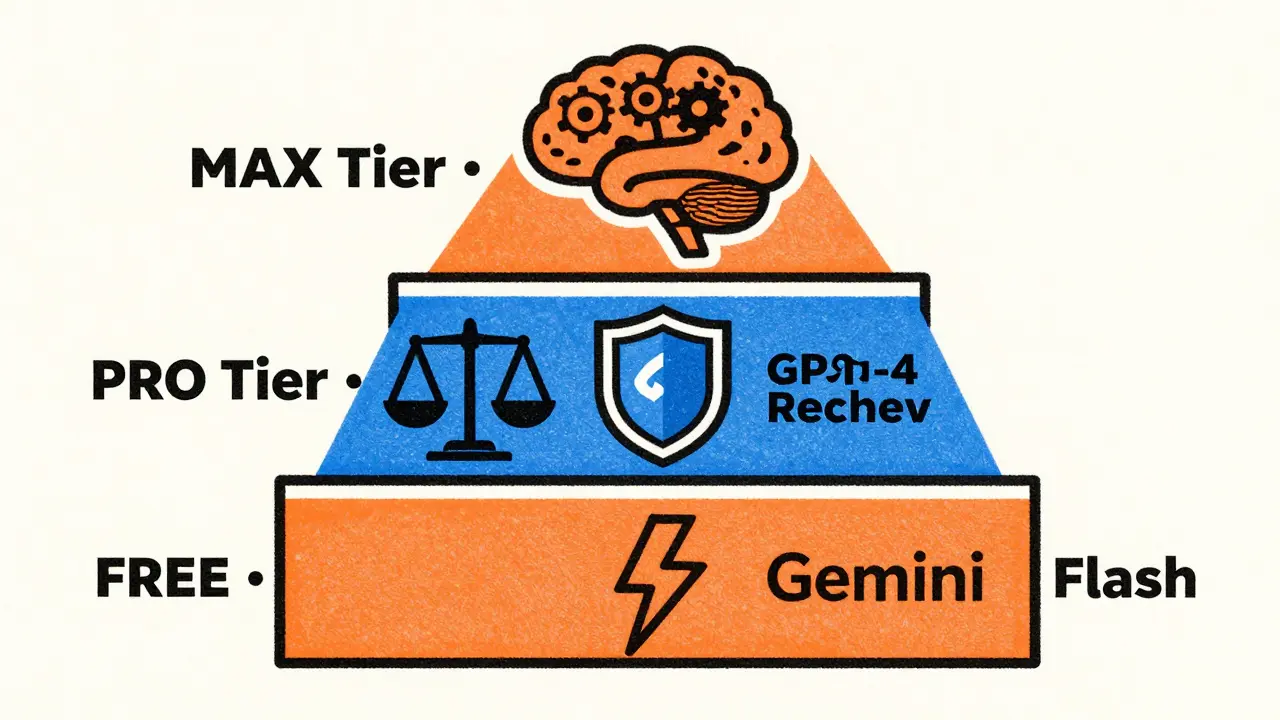
Level 1: Critical Design (The MAX Tier)
Use Claude Opus 3.5 or GPT-4 Turbo for foundational decisions. This includes database schema creation, system architecture, and security protocols. Dr. Elena Rodriguez, Principal AI Researcher at MIT, noted that using lighter models here introduces critical blind spots. For example, when designing a user permission system, Opus might propose a robust 5-table structure with granular controls, whereas a simpler model might suggest a 2-table MVP. While the MVP is faster, the Opus design prevents future refactoring nightmares. Anthropic's whitepaper shows Opus processes 14.7 logical steps per schema versus GPT-4's 11.3, ensuring deeper reasoning.
Level 2: General Development (The PRO Tier)
For product requirement documents (PRDs), task breakdowns, and complex business logic, switch to GPT-4 Turbo or Claude Sonnet 4.5. These models handle the "middle mile" of development where context matters but extreme optimization isn't required. Windsurf's benchmarks show Claude Sonnet achieves an 84.7% success rate in implementing complex business logic, making it ideal for translating high-level requirements into functional modules.
Level 3: Repetitive Tasks (The FREE Tier)
This is where most developers overpay. Use Gemini Flash 2.0 for generating repetitive CRUD operations, simple UI components, and boilerplate code. Gemini Flash hits 93.5% accuracy on simple UI component creation. As one developer on Reddit put it, "Wasted 3 weeks and $800 having Opus write basic API endpoints before realizing Gemini Flash could do it 3x faster and 1/4 the cost." Don't let pride dictate your model choice; let efficiency drive it.
The Power of Multi-Model Verification
No single model is perfect. The most successful teams in 2026 use "multi-model verification" to catch errors. This involves running critical outputs through two different models to identify blind spots. GitHub's case study showed this practice reduced critical errors by 41%.
Here is a practical example: You use Claude Opus to design a database schema because of its superior reasoning. Then, you feed that schema into Gemini Flash with a prompt asking it to critique the design for simplicity and MVP viability. In a Vooster AI case study, this review process revealed that Opus had over-engineered a solution, suggesting 5 tables where 2 would suffice. This feedback loop shortened development time by 2 weeks. It combines Opus's depth with Gemini's minimization focus.

Overcoming Implementation Challenges
Switching between models isn't seamless. Stack Overflow's January 2026 survey found that 63% of developers struggle with context switching, and 57% report inconsistent code styles across model outputs. To mitigate this:
- Use Orchestrators: Tools like Continue (open-source, updated January 2026) manage multiple model contexts automatically, reducing context switching time by 72% according to Windsurf.
- Standardize Prompts: Create template prompts for each model type to ensure consistent output formats.
- Invest in Learning: Teams typically spend 3-5 days establishing their tiered workflow, with a 27-hour average learning curve. Treat "model orchestration" as a core skill, not an afterthought.
Market Trends and Future Outlook
The landscape is shifting rapidly. The AI coding assistant market reached $1.2 billion in Q4 2025, growing at 63% year-over-year. IDC predicts it will hit $2.8 billion by 2027. Currently, 78% of enterprise development teams use multiple models strategically, up from just 29% in Q1 2025.
Looking ahead, specialization will deepen. Anthropic announced Opus 4.6 (March 2026) with enhanced database optimization, while Google's roadmap includes Gemini 2.1 with a 2 million token context for full-codebase analysis. OpenAI's GPT-5.3 focuses on improved multi-model coordination. Gartner predicts the "one model fits all" approach will disappear entirely by 2027. The teams that thrive will be those that treat AI model selection as a dynamic, integral part of their engineering discipline.
What is vibe coding?
Vibe coding is a development paradigm where developers describe desired functionality at a conceptual level ('vibes') rather than writing detailed code line-by-line. AI models then generate the implementation. This approach relies heavily on the model's ability to interpret intent and translate it into functional software.
Which model is best for database schema design?
Claude Opus 3.5 is generally considered the best for database schema design due to its superior chain-of-thought reasoning. It processes more logical steps per schema (14.7 vs 11.3 for GPT-4) and achieves higher accuracy on complex reasoning benchmarks. However, it should be reviewed by a lighter model like Gemini Flash to check for over-engineering.
Is GPT-4 better than Claude for vibe coding?
It depends on the task. GPT-4 Turbo leads in security-sensitive code generation (91.2% accuracy) and architectural decisions. Claude Opus 3.5 excels in complex business logic and deep reasoning. For general development, they are comparable, but GPT-4 often offers better cost-efficiency for mid-tier tasks.
Why should I use Gemini Flash for simple tasks?
Gemini Flash 2.0 is significantly cheaper (5 credits per task vs 18-20 for premium models) and faster (47% faster response time). It achieves 93.5% accuracy on simple UI components and 92% on CRUD operations. Using premium models for these tasks results in a 63% cost inefficiency according to MIT researchers.
How much can strategic model selection save me?
According to Vooster AI's 2026 analysis, optimizing model selection by matching capabilities to task complexity can reduce development costs by 37% while maintaining or even improving code quality. Real-world users have reported cutting monthly AI costs from $1,200 to $450 by adopting tiered workflows.
What is multi-model verification?
Multi-model verification is a best practice where critical code outputs are run through two different AI models to catch blind spots. For example, using Claude for design and Gemini for critique. This method has been shown to reduce critical errors by 41% and helps prevent over-engineering or under-thinking.