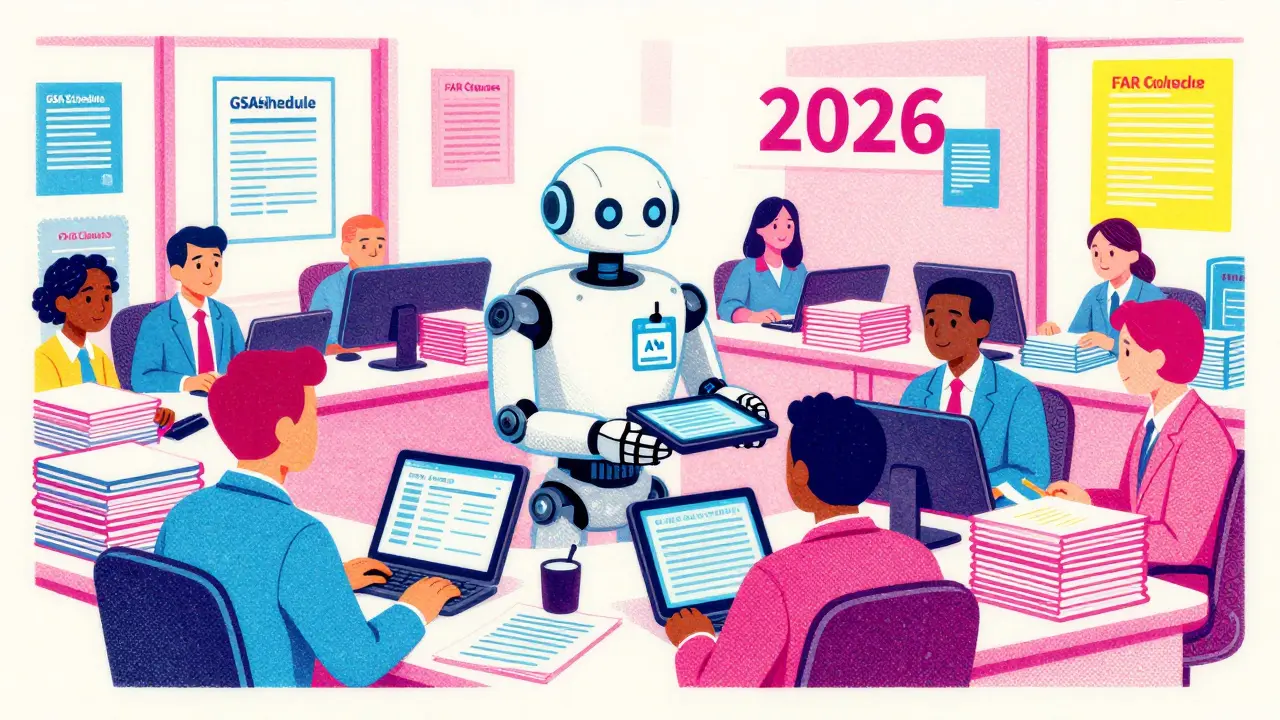
The landscape of government software development changed dramatically in August 2025. When the General Services Administration (GSA) added OpenAI, Google, and Anthropic to its Multiple Award Schedule, it didn’t just open the door for generative AI; it created a formalized highway for AI Coding as a Service (AI CaaS). For federal agencies, this meant moving from chaotic pilot programs to structured, billable contracts for automated code generation, debugging, and optimization. By December 2025, the federal AI contracts market had swelled to $20 billion, with a significant chunk dedicated specifically to coding assistance tools like GitHub Copilot and Google’s Vertex AI.
If you are a contracting officer or a vendor looking to navigate this space in 2026, the rules of engagement have shifted. It is no longer about buying a subscription per user. It is about securing mission-critical infrastructure that adheres to strict security protocols, delivers measurable accuracy, and integrates seamlessly with legacy systems. This guide breaks down exactly what goes into these contracts, how Service Level Agreements (SLAs) are defined, and where the biggest pitfalls lie.
Defining the Scope: What Is AI CaaS in Government?
AI Coding as a Service is a cloud-based artificial intelligence solution that provides automated code generation, debugging, optimization, and documentation capabilities through APIs or IDEs. In the commercial world, you might pay $10 a month for GitHub Copilot. In the government sector, the definition is far more rigid. The service must not only write code but do so within the constraints of the Federal Acquisition Regulation (FAR) and specific agency standards.
The core value proposition here is speed without sacrificing compliance. The Department of Defense’s Chief Digital and Artificial Intelligence Office (CDAO) reported in April 2025 that AI tools accelerated contract drafting by 67%. However, this speed comes with heavy technical specifications. Unlike commercial off-the-shelf software, government AI CaaS contracts require:
- Mission-Specific Alignment: The AI must understand agency-specific coding standards, such as NASA-STD-8739.8 for software assurance or IRS tax processing logic.
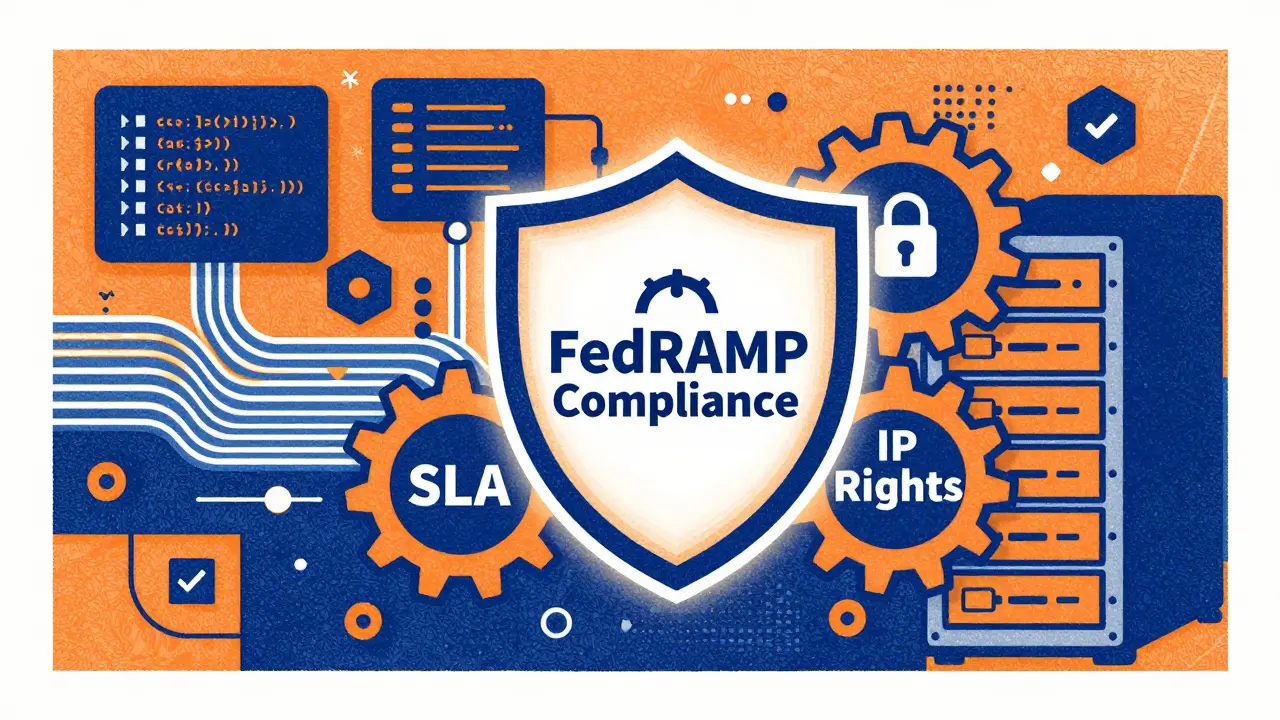
- FedRAMP Compliance: Deployment must be containerized and compatible with FedRAMP Moderate environments.
- Integration Capabilities: Seamless connection with GitHub Enterprise, GitLab, and Code.gov.
Vendors cannot simply offer a generic LLM wrapper. They must prove their tool can handle the unique, often outdated, technology stacks found in federal agencies while maintaining end-to-end encryption for all code snippets in transit and at rest.
Structuring the Contract: Pricing and Legal Frameworks
One of the biggest shifts in 2025 was the move away from simple per-user pricing. Government contracts for AI CaaS typically utilize fixed-price or time-and-materials structures under GSA Schedule 70, Special Item Number (SIN) 54151-9 for AI services. This structure allows for more flexibility in scaling resources based on project complexity rather than just headcount.
Intellectual property (IP) remains the thorniest issue. The Congressional Budget Office noted in November 2025 that sustainability depends on resolving IP ambiguities around AI-generated code. Contracts must explicitly address FAR clauses 52.227-14 and 52.227-17 regarding rights in data and patent protection. Crucially, vendors are prohibited from training their models on government code without explicit written consent. Many contracts now mandate air-gapped environments for sensitive projects to ensure that proprietary agency code never leaks into public model training datasets.
Brian Esposito, Deputy Secretary of Procurement for the Pennsylvania Department of General Services, highlighted in April 2025 that AI helps streamline scopes of work to be "technically sound" and limit external inquiries. To achieve this, contracts increasingly favor outcome-based SLAs over prescriptive technical requirements, focusing on the quality of the final deliverable rather than the number of API calls made.
Service Level Agreements (SLAs): Metrics That Matter
An SLA for AI CaaS is not just about uptime; it is about trust. If an AI suggests a line of code that contains a security vulnerability or hallucinates a library that doesn’t exist, the consequences can be severe. Therefore, 2026 contracts are heavily weighted toward performance metrics verified by third parties.
| Metric | Requirement | Penalty/Consequence |
|---|---|---|
| Code Output Accuracy | Minimum 92% accuracy rate across 10 government-relevant programming languages | Failure to meet threshold may trigger contract review or termination |
| Latency | Maximum 2.5-second response time for 95% of code generation requests | Performance degradation penalties apply if latency exceeds limits during peak load |
| Uptime/Availability | Minimum 99.85% availability | Financial penalty of 0.5% of monthly contract value per 0.1% below threshold |
| Security Testing | Quarterly penetration testing by accredited third parties | Immediate remediation required; failure poses breach risk |
| Support Response | 15-minute response time for critical issues; 24/7 availability | Service credits for missed response times |
These numbers are not arbitrary. They stem from OMB Memorandum M-25-22 principles, which became the de facto standard for 87% of federal AI contracts by late 2025. The 92% accuracy benchmark, for instance, ensures that human developers spend less time correcting errors and more time reviewing logic. Scalability is also key: contracts specify handling up to 50,000 concurrent users with linear performance degradation no greater than 15% at maximum load.
Commercial vs. Government AI CaaS: The Trade-Offs
You might wonder why agencies don’t just buy commercial licenses. The short answer is compliance. While commercial platforms like Amazon CodeWhisperer ($8.40/user/month) or GitHub Copilot offer rapid feature updates (every 1.7 months on average), they often lack the deep integration with government-specific ecosystems.
A comparative analysis reveals distinct differences:
- Security Compliance: Government-contracted AI CaaS solutions boast 100% FedRAMP Moderate compliance, compared to only 63% for general commercial alternatives.
- Feature Velocity: Commercial tools update faster. Government contracts lag with an average of 4.2 months between major updates due to rigorous testing cycles.
- Implementation Time: Deploying a government AI CaaS solution takes an average of 117 days, versus 28 days for commercial deployments. This delay is largely due to integration with legacy systems and security clearances.
However, when it comes to specialized tasks like identifying missing FAR clauses, government-tuned AI outperforms commercial tools. The IRS’s 2025 Contract Clause Review Tool achieved 90% accuracy in identifying missing provisions, compared to 65% for commercial AI coding tools. For agencies where regulatory adherence is non-negotiable, the slower implementation and higher cost are justified by the reduced risk of compliance failures.
Pitfalls and Challenges in Implementation
Despite the benefits, the road to successful AI CaaS adoption is rocky. The Government Accountability Office (GAO) reported in September 2025 that 43% of initial AI CaaS deployments faced integration challenges because proposals failed to address context-specific coding requirements for legacy systems.
User feedback highlights two main pain points:
- Hallucinations in Code Generation: A Deltek survey found that 52% of agencies using AI CaaS cited challenges with AI hallucinations requiring extensive human review. One NASA contracting officer reported that initial AI suggestions failed to comply with NASA-STD-8739.8 in 38% of cases during pilot testing.
- Agency-Specific Standards: Getting the AI to understand niche standards takes time. A federal acquisition specialist noted it took three months of fine-tuning to get acceptable output for IRS tax processing systems.
To mitigate these risks, contracts now mandate that vendors demonstrate code output accuracy across 10 government-relevant programming languages using the GSA’s AI Vendor Assessment Toolkit. Additionally, support staff must hold Security+ and AI-900 certifications to ensure they understand both the technical and security implications of the code being generated.
Future Outlook: What’s Next for AI Procurement?
The trajectory for AI CaaS in government is upward but consolidating. The GSA projects that 45% of all federal software development contracts will include AI CaaS provisions by FY2026. The market is expected to grow from $3.2 billion in FY2025 to $5.8 billion by FY2027.
Several developments will shape this growth:
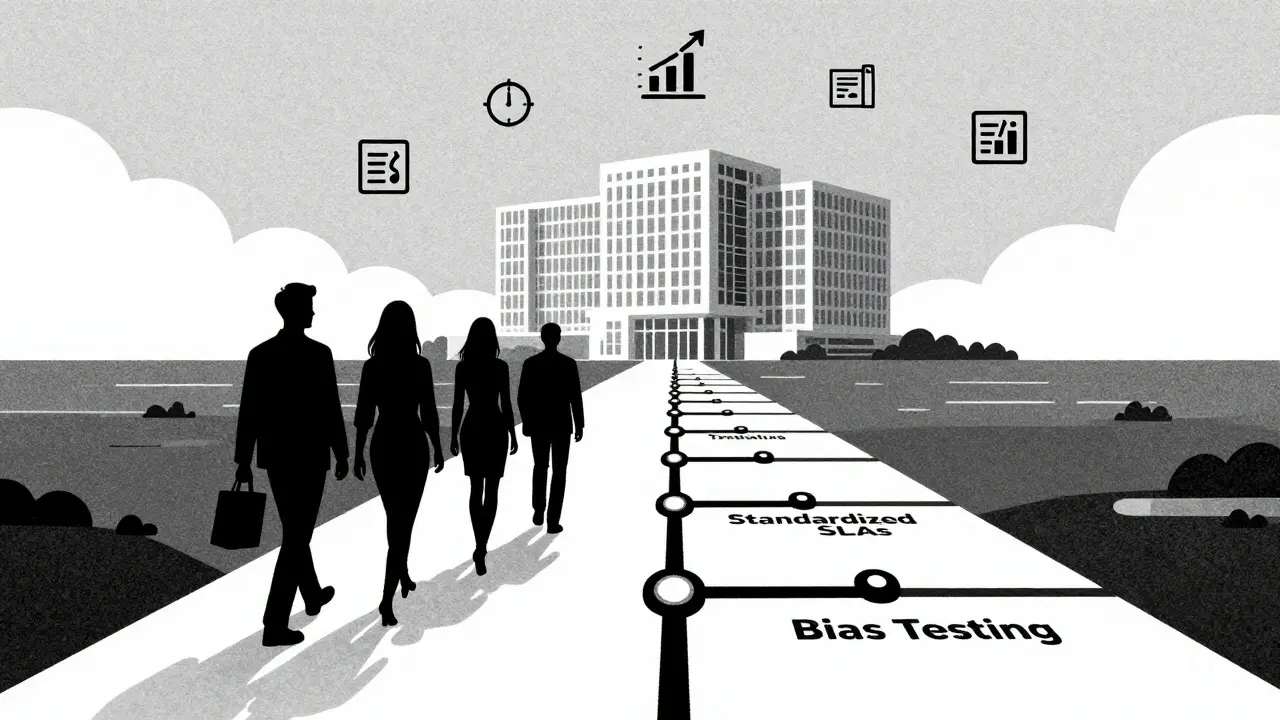
- Standardized SLA Templates: Expected in Q2 2026, these will reduce negotiation time and create consistency across agencies.
- Mandatory Bias Testing: By Q4 2026, OMB guidelines will require bias testing for code generation tools to prevent discriminatory algorithms.
- Centralized Procurement: The "OneGov strategy" aims to centralize AI procurement through GSA channels, with 78% of federal agencies planning to adopt this model by 2027.
For vendors, the message is clear: compliance alone is not enough. As the Partnership for Public Service warned in November 2025, contractors relying solely on checklists are being outpaced by those offering deployable AI with real, proven use cases. Success in 2026 and beyond will belong to those who can demonstrate tangible efficiency gains-like reducing proposal drafting time from 40 hours to 6 hours-while maintaining ironclad security and accuracy.
What is the difference between commercial AI coding tools and government AI CaaS contracts?
Commercial tools like GitHub Copilot operate on simple per-user subscriptions and prioritize feature velocity. Government AI CaaS contracts involve complex fixed-price or time-and-materials structures under GSA schedules, requiring strict FedRAMP compliance, air-gapped environments for sensitive data, and adherence to specific agency coding standards like NASA-STD-8739.8. Government contracts also enforce rigorous SLAs for accuracy (92%) and uptime (99.85%), whereas commercial tools focus more on usability and broad compatibility.
How does OMB Memorandum M-25-22 impact AI CaaS procurement?
OMB Memorandum M-25-22 established principles for high-impact AI use cases, becoming the de facto standard for 87% of federal AI contracts by late 2025. It requires vendors to document safety, governance, and reliability, including specific metrics for code generation accuracy and bias detection. It shifts the focus from prescriptive technical requirements to outcome-based SLAs, ensuring AI systems are secure and effective before deployment.
What are the common pitfalls in implementing AI CaaS in government agencies?
The most common pitfalls include integration challenges with legacy systems (affecting 43% of deployments), AI hallucinations leading to incorrect code suggestions (cited by 52% of agencies), and inadequate understanding of agency-specific coding standards. For example, NASA found that 38% of initial AI code suggestions failed to meet their software assurance requirements. These issues highlight the need for extensive fine-tuning and human review processes.
How is intellectual property handled in AI CaaS contracts?
IP handling is critical and governed by FAR clauses 52.227-14 and 52.227-17. Contracts explicitly prohibit vendors from training their models on government code without written consent. Many agreements require air-gapped environments for sensitive projects to prevent data leakage. The Congressional Budget Office has noted that resolving IP ambiguities around AI-generated code is essential for the long-term sustainability of these contracts.
What skills are required for contracting officers evaluating AI CaaS?
Contracting officers need an average of 8.2 weeks to become proficient. Required skills include understanding AI model validation techniques, knowledge of relevant FAR clauses for IP and data rights, and the ability to assess code quality metrics. They must also be familiar with the GSA’s AI Vendor Assessment Toolkit and capable of interpreting SLA metrics like latency, accuracy, and uptime penalties.





Patrick Dorion
14 June, 2026 - 20:58 PM
It is fascinating to observe how the government has moved from treating AI as a novelty to treating it as infrastructure. The shift towards outcome-based SLAs rather than just counting API calls is a crucial philosophical step in procurement. It forces vendors to care about the result, not just the process. We are seeing a maturation of the market where compliance is no longer an afterthought but a core feature. The emphasis on FedRAMP Moderate environments and air-gapped solutions for sensitive data reflects a necessary caution. This approach ensures that speed does not come at the expense of security or sovereignty. The 92% accuracy benchmark is a reasonable starting point for human-in-the-loop systems. It acknowledges that AI is a tool for augmentation, not replacement. I believe this model will eventually bleed into the private sector as companies realize that generic tools are insufficient for complex legacy integration.
Marissa Haque
15 June, 2026 - 10:04 AM
Oh my gosh! Can you believe the sheer scale of this?! $20 billion in federal contracts for AI coding assistance! It is absolutely mind-blowing!! The fact that they are now requiring 99.85% uptime is just incredible!!! I mean, think about it! If the AI goes down, the whole development pipeline stops!!! And the penalties for missing those metrics are so strict!!! It shows that the government finally takes this seriously!!! The part about IP rights is also super important!!! You cannot have vendors training their models on your tax code or defense algorithms without permission!!! That would be a disaster!!! I am so glad they are mandating air-gapped environments for sensitive projects!!! It gives me such a sense of relief knowing there are safeguards in place!!! This is the future of secure software development!!!
Keith Barker
16 June, 2026 - 07:11 AM
the distinction between commercial and government tools is mostly bureaucratic overhead disguised as security. we pay more for slower updates and less features because someone in washington decided they needed to control every line of code generated. the 117 days implementation time is absurd compared to 28 days commercially. it proves nothing about safety just about inefficiency. the ai hallucinates anyway regardless of who pays for it. the standards like NASA-STD-8739.8 are good but enforcing them via contract instead of engineering practice is lazy. we are building a moat around incompetence.
Lisa Puster
16 June, 2026 - 20:15 PM
typical american waste of taxpayer money. spending billions on chatbots to write code while our own engineers sit idle or get laid off. these foreign tech giants like openai and google are profiting off our national security infrastructure. the idea that we need 'air-gapped' environments suggests they know the tools are fundamentally insecure. i find it pretentious that contracting officers need 8 weeks to learn how to evaluate basic software outputs. if you cant tell good code from bad you shouldnt be hiring anyone let alone ai. the elitist view that government needs special 'tuned' ai is just a way to justify higher prices and lower quality. keep your hands off our data.
Joe Walters
18 June, 2026 - 05:10 AM
lol yeah right like any of this actually works in practice. ive seen enough gov IT projects fail to know that slas are just paper tigers. the 92% accuracy rate sounds great on a slide deck but when you try to integrate with a cobol system from 1998 its all downhill from there. the drama of trying to get fedramp compliance for a simple ide plugin is exhausting. and dont get me started on the ip clauses. vendors will find loopholes faster than you can say 'proprietary algorithm'. this whole guide reads like marketing fluff for consultants who want to charge hourly rates explaining why the ai hallucinated again. total circus.
Robert Barakat
18 June, 2026 - 10:06 AM
there is a deeper implication here regarding the nature of work itself. by codifying the output of ai through strict legal frameworks we are attempting to quantify creativity and logic in a way that defies natural variance. the requirement for bias testing in code generation is interesting but perhaps misguided. code is binary yet the intent behind it is human. forcing a machine to adhere to moral standards through procurement contracts may create a false sense of ethical assurance. the real issue is not the accuracy of the code but the erosion of developer intuition. when we outsource the thinking process to an opaque model we lose the ability to understand the system we rely on. this is a philosophical regression masked as technological progress.
Michael Richards
19 June, 2026 - 17:24 PM
Listen up folks. The problem isn't the technology. It's the lack of discipline in how agencies specify requirements. If you don't define your success metrics clearly before you sign the contract you deserve the garbage you get. The GSA schedule is a tool not a crutch. Vendors who rely on generic LLM wrappers will fail because they refuse to do the hard work of domain adaptation. The IRS example with the 90% accuracy in clause review is the gold standard. That is what happens when you force the vendor to prove value against specific business outcomes. Stop buying subscriptions and start buying results. If your SLA doesn't have teeth it's worthless.