Have you ever wondered how a machine can tell the difference between "The bat flew over the fence" (a baseball) and "The bat flew out of the cave" (an animal)? It sounds simple for us, but for a computer, these are just strings of identical letters. The magic happens inside Large Language Models, or LLMs. They don't read like we do. Instead, they learn by playing a massive guessing game with themselves, a process called self-supervised learning. This method allows them to grasp both the grammar (syntax) and the meaning (semantics) of human language without anyone explicitly teaching them rules.
The Guessing Game: Self-Supervised Learning Explained
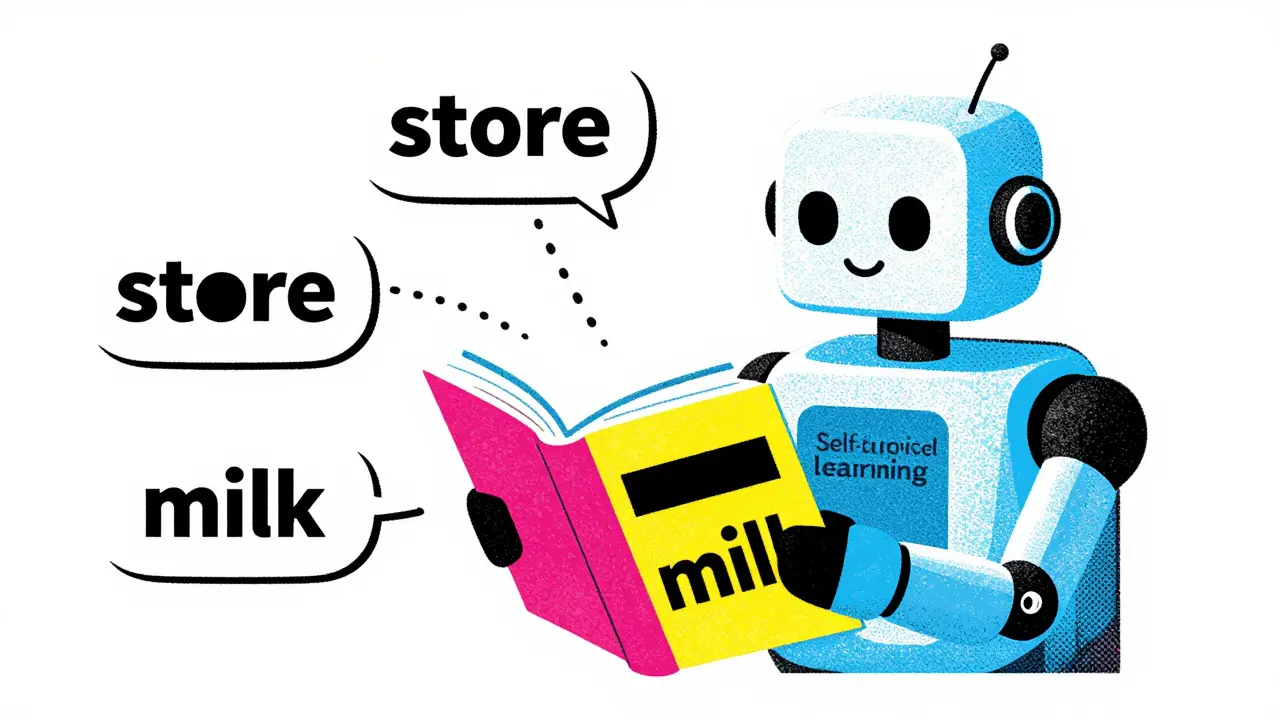
Imagine you have a book where every tenth word is blacked out. Your job is to guess the missing word based on the ones around it. If the sentence is "I went to the __ to buy milk," you probably guess "store." If it's "I went to the __ to see a movie," you might guess "theater." You aren't looking up definitions in a dictionary; you are using context clues.
This is exactly how self-supervised learning works for AI. Researchers feed models billions of pages of text from the internet. Then, they mask random words and ask the model to predict them. When the model gets it right, its internal math stays the same. When it gets it wrong, it adjusts its internal weights to get closer to the correct answer next time. Over trillions of examples, the model builds a statistical map of how words relate to each other. It learns that "milk" often appears near "store" or "refrigerator," and "movie" appears near "screen" or "ticket." This statistical proximity becomes the foundation of its understanding.
The Engine of Understanding: The Attention Mechanism
Predicting the next word is useful, but it doesn't explain how the model understands complex sentences with long-distance relationships. That’s where the attention mechanism comes in. Introduced in the seminal 2017 paper "Attention Is All You Need," this innovation changed everything. Before attention, models processed words one by one, like reading a telegram. With attention, the model looks at all words in a sentence simultaneously, weighing their importance relative to each other.
Think of attention as a spotlight. When the model processes the word "bank" in the sentence "He deposited money at the bank because he was tired after working at the river bank," it shines a light on surrounding words. In the first clause, words like "money" and "deposited" pull the spotlight toward the financial definition. In the second, "river" pulls it toward the geographical definition. The model calculates scores-mathematical weights-that determine which words matter most for understanding the current focus.
Technically, this happens through three vectors: Query, Key, and Value. The Query is what the model is looking for. The Key is a label for each word in the sentence. The Value is the actual information content. By comparing Queries to Keys, the model decides how much of each Value to include in its final understanding. This allows it to capture syntax (who did what to whom) and semantics (what those actions mean) in real-time.

Solving the Order Problem: Positional Encoding
There is a catch. The attention mechanism itself doesn't know order. To a basic transformer, "The cat sat on the mat" is mathematically similar to "The mat sat on the cat" if you ignore position. But we know those sentences mean very different things. Syntax relies heavily on word order.
To fix this, engineers add positional encoding. Imagine adding a timestamp to every word: "The(1) cat(2) sat(3)..." Early methods used fixed numbers, but newer techniques like Rotary Position Embedding (RoPE) use rotating mathematical patterns. Even more advanced systems, like PaTH Attention developed by MIT-IBM researchers, treat the space between words as dynamic paths. These paths adjust based on the content, helping the model track information over thousands of tokens. This ensures that when an LLM reads a long legal contract, it remembers who signed what at the beginning, even when processing the signature page at the end.
Syntax and Semantics Are Not Separate
For decades, linguists debated whether grammar (syntax) and meaning (semantics) were separate modules in the brain. Recent studies on LLMs suggest they are deeply intertwined. Research analyzing attention heads in models like BERT, GPT-2, and Llama 2 found that so-called "syntax-specialized" heads are actually sensitive to semantics.
For example, if a model is tracking a grammatical dependency between a subject and a verb, its attention drops significantly if the semantic connection makes no sense. If you write "The rock ate the pizza," the syntactic structure is fine (Subject-Verb-Object), but the semantic implausibility disrupts the attention pattern. This mirrors human cognition. We don't parse grammar in a vacuum; we check if the sentence makes sense as we go. LLMs capture this integration naturally through self-supervision because they must predict words that are both grammatically correct and semantically plausible to win their guessing game.

Why Model Size Isn't Everything
You might assume bigger models always understand better. While scale helps, research shows that architectural choices and training data quality matter just as much. Studies on Semantic Role Labeling (SRL)-identifying who does what to whom in a sentence-show that some smaller models outperform larger ones depending on how they are prompted. This suggests that capturing structured semantics isn't just about brute force computation. It's about how well the attention mechanisms are tuned to recognize linguistic patterns. A well-trained medium-sized model with efficient attention can often match a bloated giant on specific reasoning tasks.
From Statistics to Reasoning
Critics sometimes argue that LLMs are just "stochastic parrots," repeating patterns without understanding. However, the ability to handle long-range dependencies and resolve ambiguity suggests a form of structural understanding. When an LLM successfully completes a complex coding task or summarizes a novel, it is navigating a high-dimensional map of syntax and semantics built entirely through self-supervision. It hasn't been told the rules of English; it has discovered them by observing how humans use language across the entire internet.
The future of this technology lies in refining these attention mechanisms. Innovations like the combined PaTH-FoX system allow models to selectively "forget" irrelevant old information, mimicking human cognitive efficiency. As these tools evolve, our understanding of how machines capture meaning will continue to deepen, blurring the line between statistical prediction and genuine comprehension.
What is self-supervised learning in LLMs?
Self-supervised learning is a training method where the model generates its own labels from raw data. Typically, this involves masking parts of the input text and asking the model to predict the missing words. By doing this billions of times, the model learns the statistical relationships between words, capturing both syntax and semantics without human-labeled datasets.
How does the attention mechanism help with syntax?
The attention mechanism allows the model to weigh the importance of each word in a sequence relative to others. This enables it to identify grammatical structures, such as subject-verb agreement, even when the words are far apart in a sentence. It dynamically focuses on relevant tokens to build a coherent syntactic representation.
Do LLMs understand meaning or just predict words?
LLMs primarily predict words based on statistical probability. However, to make accurate predictions, they must capture deep semantic relationships and contextual nuances. Research shows that their internal representations align closely with human linguistic concepts, suggesting a functional form of understanding derived from pattern recognition.
Why is positional encoding important?
The core attention mechanism is permutation-invariant, meaning it doesn't inherently know word order. Positional encoding adds information about the location of each token in the sequence. This is crucial for syntax, as changing word order changes meaning (e.g., "Dog bites man" vs. "Man bites dog").
What is the role of Query, Key, and Value vectors?
These are the mathematical components of self-attention. The Query represents what the model is currently focusing on. The Key acts as a searchable label for each word in the context. The Value contains the actual information. The model compares Queries to Keys to determine how much of each Value to incorporate into its final output.