By January 2026, nearly 30% of production code in top tech companies is written by AI. GitHub Copilot, Amazon CodeWhisperer, and Tabnine aren’t just helpful assistants anymore-they’re co-developers. But here’s the problem: your old security tools don’t know what to do with it.
Static Application Security Testing (SAST), Dynamic Application Security Testing (DAST), and Software Composition Analysis (SCA) were built for a world where code changed slowly. Where developers wrote a feature, committed it, and waited days for a security scan. That world is gone. Today, AI generates code faster than your security team can scan it. Ten deployments a day. No one’s sleeping. And if your tools can’t keep up, you’re running on borrowed time.
How SAST Works (and Why It’s Your Best Friend for AI Code)
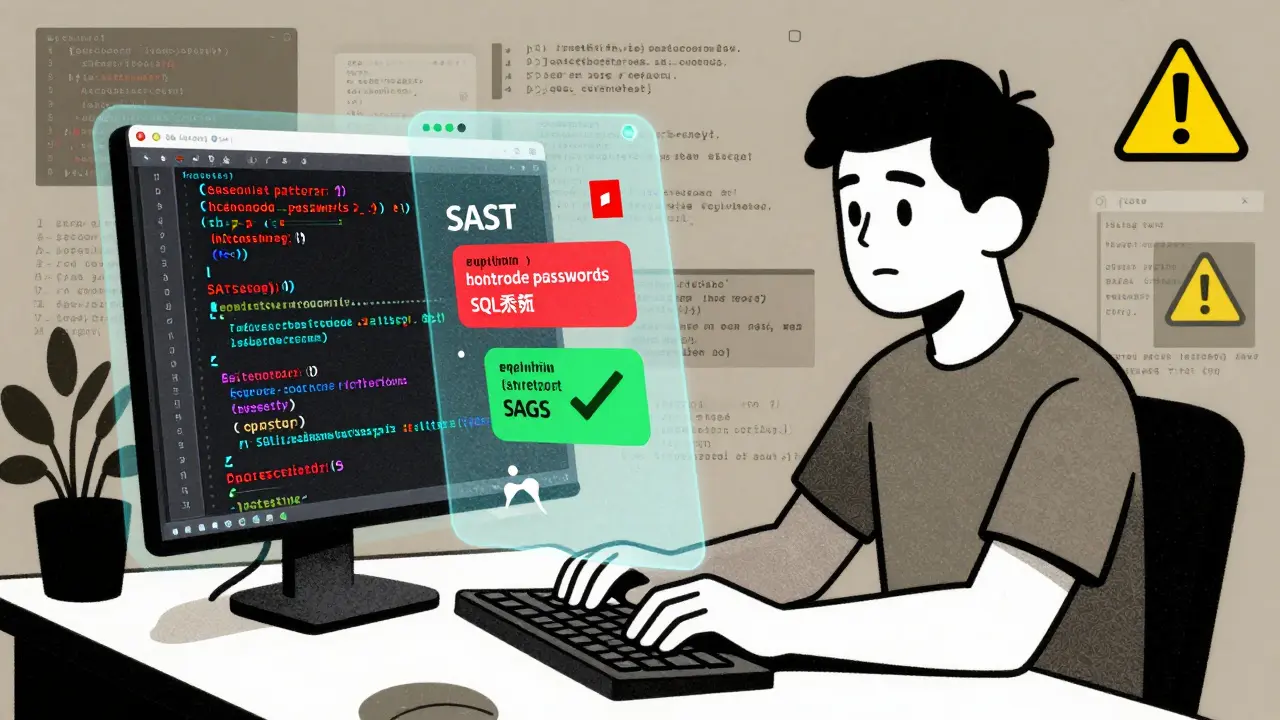
SAST looks at your source code before it even runs. It’s like a grammar checker for security. It finds things like SQL injection, hardcoded passwords, or unsafe function calls. Traditional SAST tools? They were terrible with AI-generated code. Why? Because AI doesn’t write code like humans. It uses patterns you’ve never seen-repeating the same insecure pattern across 20 files, or pulling in a library you didn’t even know existed.
Modern AI-optimized SAST tools, like Mend SAST and Cycode, changed that. They don’t just scan for known rules anymore. They learn. They track how data flows across functions, even if those functions were written by an AI assistant. A 2025 study by Cycode found their AI-enhanced SAST reduced false positives by over 94% compared to older tools. That’s huge. Before, you’d get 85 false alerts for every real problem. Now? Five. Maybe less.
Here’s the kicker: the best SAST tools now plug directly into your IDE. As you type, Copilot suggests code. Right then, your SAST tool checks it. No waiting for a commit. No pull request delay. It flags a risky pattern before you even hit “save.” Developers using this setup report they fix issues in under 2 minutes-before the code leaves their screen.
DAST Is Broken for AI Code. Here’s What Replaces It.
DAST runs tests on a live app. You fire up the website, send it fake attacks, and see what breaks. Sounds smart, right? Except AI-generated code deploys 10 times a day. Traditional DAST scans take 8+ hours. That means between scans, you’ve got 70+ deployments running with untested code. That’s not a gap. That’s a canyon.
Contrast Security’s Jake Milstein put it bluntly: “It’s like trying to photograph a speeding train with a camera that takes 8 hours to focus.”
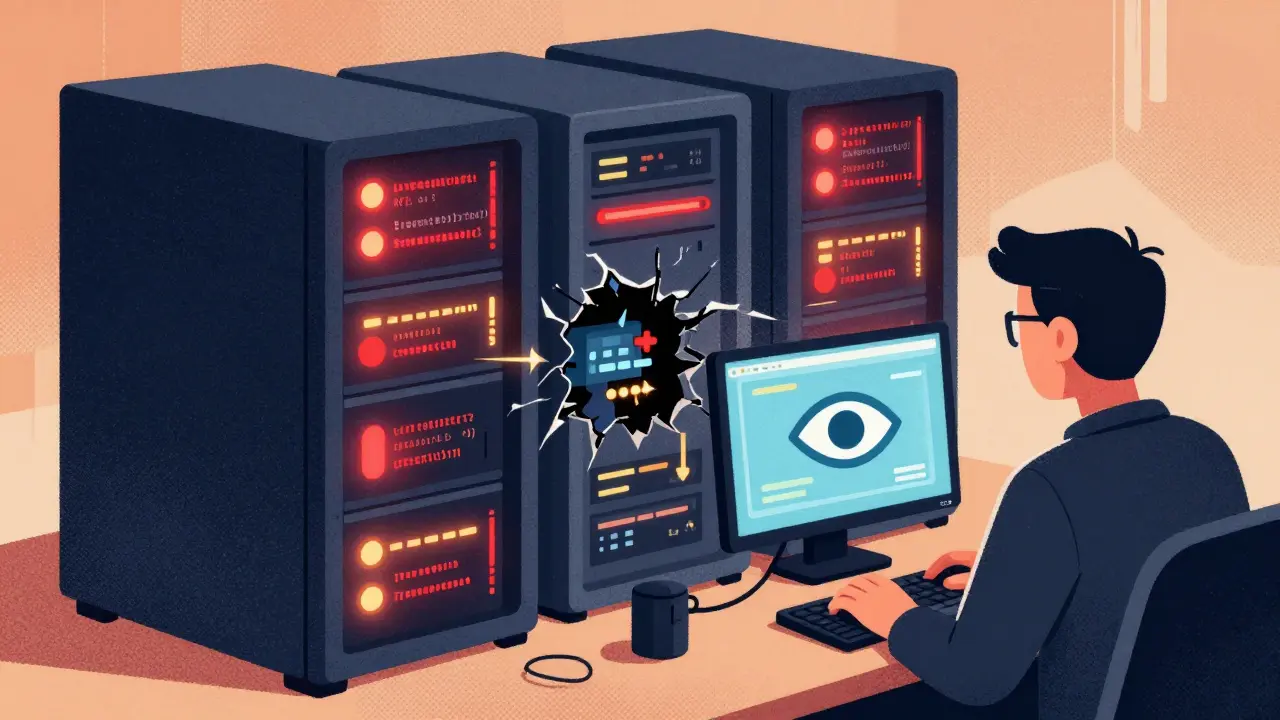
So what do you do? You stop using DAST the old way. Instead, you use runtime security tools. These tools monitor your app while it’s live. They watch for suspicious behavior-unusual API calls, unexpected database queries, or code that tries to access files it shouldn’t. They don’t wait for a scan. They act in real time.
Tools like Contrast Security’s Runtime Security Platform and Cycode’s continuous monitoring now catch vulnerabilities that traditional DAST never saw. One company using this approach found a critical vulnerability in AI-generated code that had been in production for 11 days. Traditional DAST would’ve missed it. Runtime monitoring caught it in 3 minutes.
SCA: The Hidden Danger in AI’s Dependency Habit
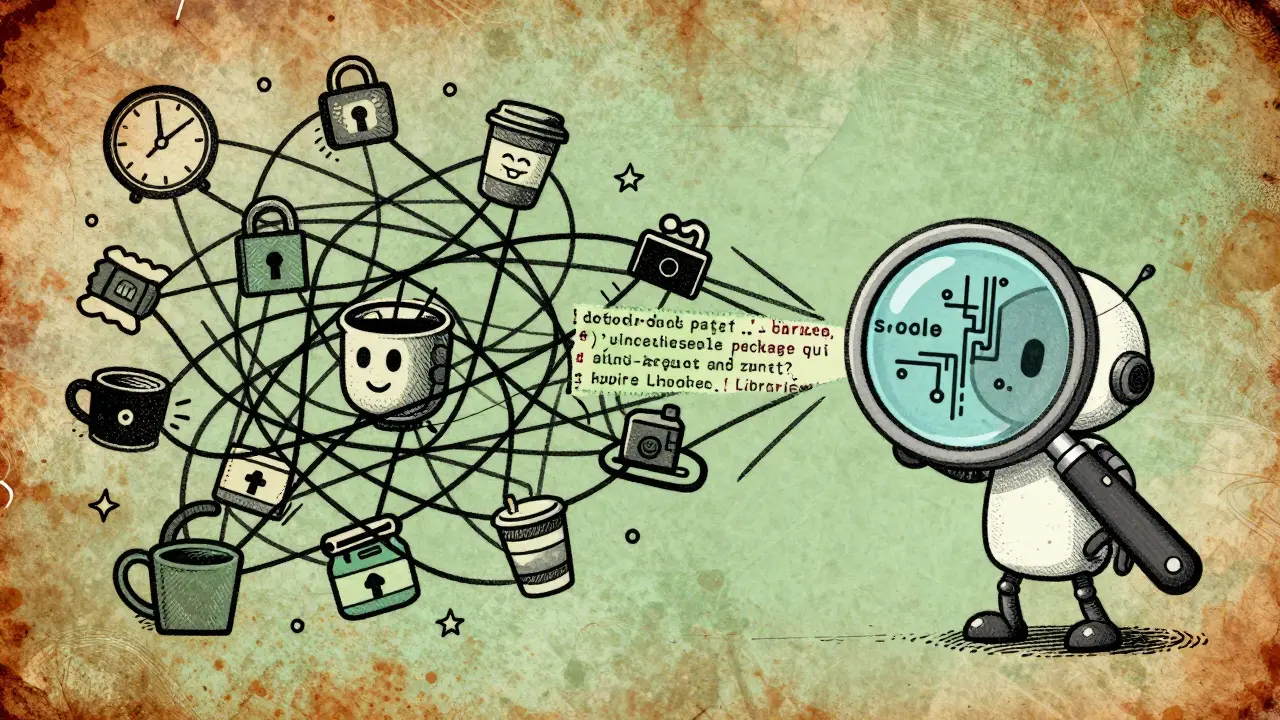
AI doesn’t just write code. It grabs libraries. A lot of them. Mend’s 2025 research found AI-generated code includes 40% more third-party dependencies than human-written code. Why? Because AI doesn’t know what’s risky. It just knows “this library does the thing.” So it pulls in ten different logging tools, three auth libraries, and a random npm package from 2017 with 12 known vulnerabilities.
Traditional SCA tools scan for known vulnerabilities in those libraries. But here’s the twist: AI doesn’t just copy-paste. It modifies them. It changes one line. Renames a function. And suddenly, your SCA tool doesn’t recognize it. Ox Security’s January 2026 study found traditional SCA tools miss 22% of vulnerabilities in AI-suggested dependencies.
That’s why modern SCA tools now have AI pattern recognition built in. They don’t just match library names. They analyze code structure. They look for modified versions of known vulnerable packages. Mend’s January 2026 update can now detect AI-altered dependencies with 92% accuracy. And it doesn’t just tell you there’s a problem-it tells you exactly which line to change.
The Only Way to Win: Layer All Three
Using just one of these tools? You’re leaving the door open. A 2025 SANS Institute survey showed organizations using all three-SAST, runtime security (the new DAST), and SCA-had 63% fewer production incidents than those using just one or two.
Here’s how the best teams stack them:
- SAST: Runs in your IDE, checks every line of AI-generated code as it’s typed.
- SCA: Runs on every pull request. Flags risky libraries before they’re merged.
- Runtime Security: Runs continuously in production. Monitors for anomalies in real time.
Companies that do this see remediation cycles drop by 3.2x. That means instead of taking weeks to fix a vulnerability, you fix it in hours.
What’s Still Missing (And Why You Shouldn’t Trust AI Tools Fully)
Even the best tools miss things. Dr. Marcus Chen from Stanford found that current tools miss 37% of logic vulnerabilities in AI-generated code. These aren’t SQL injections or buffer overflows. They’re subtle. Like an AI that writes a “secure” auth flow but accidentally lets anyone bypass login by sending a specific header. Or a function that looks safe but relies on a deprecated library that’s been quietly patched in the background.
And here’s the scary part: AI-generated code creates new vulnerability patterns. MITRE’s January 2026 study found 18% of AI-generated code in production has vulnerabilities that no security tool has been trained to detect. Not because the tools are bad. Because the code is new.
That’s why you still need humans. Not to run scans. But to review. To question. To think: “Why did the AI suggest this?”
Getting Started: What You Need to Do Today
You don’t need to overhaul everything. Start here:
- Integrate SAST into your IDE. If you’re using GitHub Copilot, use Mend SAST or Cycode. Configure it to scan code as it’s generated.
- Switch from DAST to runtime security. Pick a tool that monitors your live apps. Stop running 8-hour weekly scans.
- Upgrade your SCA. Use a tool that understands AI-modified dependencies. Mend’s latest version works. So does Snyk’s new AI mode.
- Tune your tools for 4-6 weeks. Expect false positives. That’s normal. Train your tools on your codebase. After a month, false positives drop below 5%.
- Train your team. Security engineers now need AI-specific training. The ISC² 2025 report says teams need at least 30% of their training focused on AI code patterns.
One security team at a Fortune 500 company told Reddit (u/SecurityPro92, Jan 2026): “We spent three months tuning our tools. Now we catch 98% of AI-generated vulnerabilities before they ship. We used to miss half.”
The Future Is Already Here
By 2027, Forrester predicts 75% of companies will stop using traditional DAST entirely. Runtime monitoring will replace it. SAST and SCA will become AI-native. And tools like Snyk’s “Project Helix”-coming in January 2027-will embed security checks directly into AI coding assistants.
The tools aren’t going away. They’re evolving. And if you’re still using 2020-era security practices, you’re not protecting your code. You’re just hoping for the best.
The real question isn’t whether AI-generated code is risky. It’s whether your security tools are ready for it.



Ian Maggs
21 February, 2026 - 04:17 AM
The real issue isn't the tools-it's the epistemological shift. We've outsourced not just labor, but *cognitive responsibility*. AI generates code, but who bears the moral weight when it fails? The developer? The company? The algorithm? We're building a house on sand, and calling the sand 'innovation'.
Every line of AI-generated code is a silent contract: 'I will not think, and you will not question.' That's not progress. That's surrender.
Michael Gradwell
22 February, 2026 - 12:23 PM
SAST in the IDE? Yeah right. Most devs just click past the warnings like they're ads. I've seen it. Guy types 'password = '123456'' and the tool screams. He hits 'ignore' and moves on. This whole thing is theater.
Flannery Smail
22 February, 2026 - 18:39 PM
I dunno, this feels like overengineering. AI writes code faster than we can scan it? Cool. So what? Let it write. Let it break. We fix it in prod. That's how software has always worked. You don't need a whole new security stack. You need better engineers.
Emmanuel Sadi
23 February, 2026 - 20:07 PM
You're telling me a tool that catches 94% fewer false positives is a breakthrough? Bro. You had 85 false positives before. Now you have 5. That means you still have 80 more false alarms than you should. This isn't progress. This is just less noise. The signal's still garbage.
Nicholas Carpenter
24 February, 2026 - 19:03 PM
This is actually one of the clearest breakdowns I've seen on AI code security. I've been working with Copilot for over a year and the SAST integration with Mend has been a game-changer. It doesn't just catch the obvious stuff-it catches the weird, subtle stuff that feels 'off' but you can't put your finger on. It's like having a second pair of eyes that never sleeps.
Chuck Doland
26 February, 2026 - 17:32 PM
The foundational premise of this article is sound, yet its implementation recommendations lack sufficient rigor. One cannot rely upon heuristic-based AI-enhanced SAST without first establishing a robust, annotated training corpus specific to organizational code patterns. Moreover, the assertion that runtime security supersedes DAST is empirically incomplete; DAST retains value in stateful, multi-session edge-case validation. A binary substitution model is epistemologically unsound.
Madeline VanHorn
27 February, 2026 - 09:12 AM
So we're just gonna let AI write code and call it innovation? Wow. I'm sure the next thing is AI writing legal contracts. And then AI writing the laws. And then AI writing the judges. This is how civilizations end.
Glenn Celaya
28 February, 2026 - 23:24 PM
SCA finds 22% of AI-modified deps? Pfft. I’ve seen AI copy a whole npm package, rename one function, and call it 'optimized'. Tool didn’t even blink. Then it went to prod. We had a breach. Took 3 days to find. Now I just yell at the screen every time I see 'const util = require('random-lib-2017')'
Wilda Mcgee
2 March, 2026 - 05:36 AM
I love how this article doesn't just throw tools at the problem-it actually talks about *training humans*. That’s the real win. My team started with 10 minutes of AI code review per week. Now we do 90. We talk about patterns. We ask 'why did the AI do this?' It’s changed our whole culture. The tools help, sure. But the conversations? That’s what saved us.
Chris Atkins
2 March, 2026 - 09:30 AM
Just started using Cycode in VSCode and it’s wild how fast it catches stuff. Like I was typing a db query and it flagged a potential injection before I even finished the line. Feels like having a security buddy in your pocket. No more late night panic when something breaks. Just calm, clean code.