Most Retrieval-Augmented Generation (RAG) systems fail not because the Large Language Model is dumb, but because the information fed to it is broken. You’ve likely seen this happen: your AI assistant gives a vague answer or hallucinates details from a document you uploaded. The culprit is rarely the model itself; it’s how you split that document into pieces before searching it. This process, known as chunking, is the silent bottleneck in most enterprise AI applications.
In 2026, we are moving past simple text splitting. The industry is shifting toward strategies that preserve semantic integrity and context. If you are building a RAG system today, treating chunking as an afterthought is a critical error. Properly implemented chunking strategies can improve response accuracy by nearly 24% and cut hallucinations by over 30%. Let’s look at why your current setup might be failing and which specific techniques will fix it.
The Core Problem: Information Fragmentation
To understand why chunking matters, you have to understand what happens when a query hits a vector database. When you upload a PDF or a long article, the system breaks it into smaller blocks of text called chunks. Each chunk gets converted into a numerical vector-a mathematical representation of its meaning. When a user asks a question, the system finds the vectors closest to the question’s vector and feeds those chunks back to the LLM.
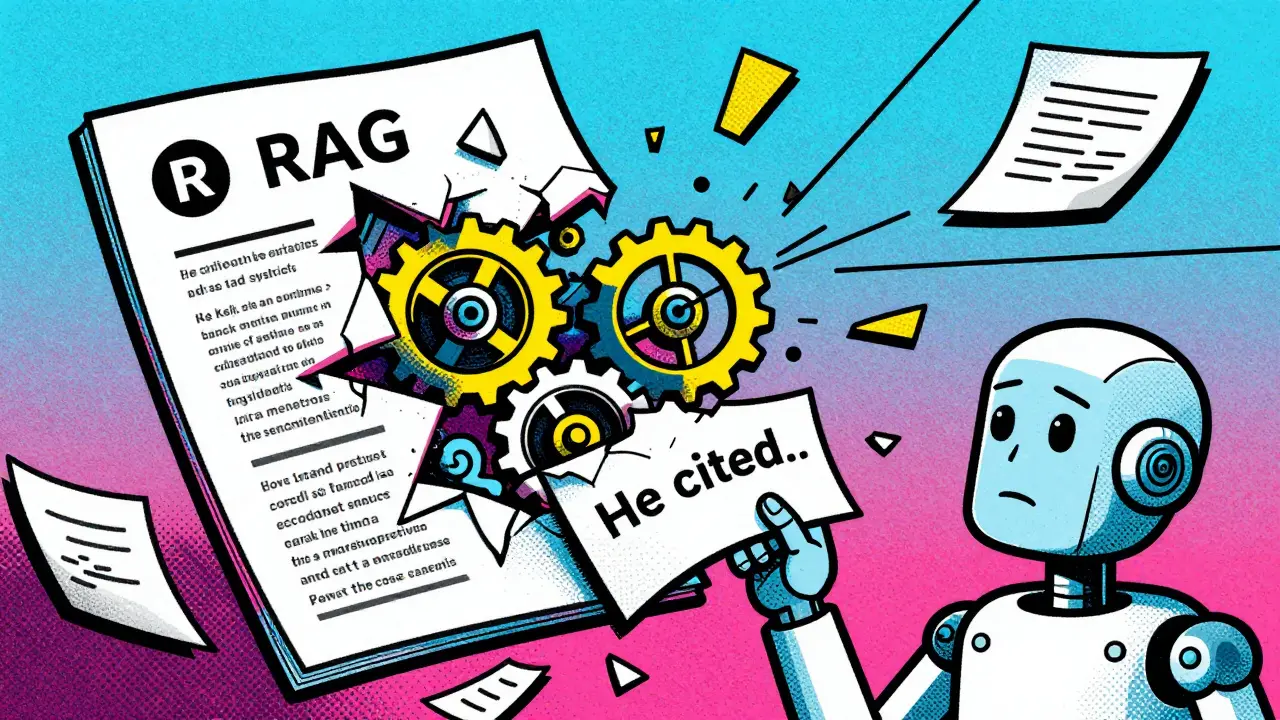
The problem arises when the split point cuts through a logical thought. Imagine a sentence like: "The CEO resigned yesterday. He cited personal reasons." If you split this right after "yesterday," the second chunk loses the reference for "He." The LLM receives "He cited personal reasons" without knowing who "He" is. This is called information fragmentation. According to research by Gao et al. at ACL 2024, traditional methods leave 27.4% of retrieved chunks containing irrelevant or distracting content. This noise confuses the model, leading to poor grounding-where the model’s answer isn’t firmly rooted in the provided facts.
Traditional Methods: Sliding Window Chunking
The oldest and simplest method is Sliding Window Chunking. It works exactly like it sounds: you slide a window of fixed size (say, 256 words) across the document, moving one sentence at a time. It’s fast. In fact, it processes documents up to 4.7 times faster than semantic methods. For simple queries on short documents, it’s often "good enough."
However, sliding window has a major flaw: it ignores meaning. It doesn’t care if it splits a paragraph in half or cuts through a code block. In complex scenarios, like retrieving legal clauses or medical histories, this lack of awareness leads to low semantic coherence scores-around 63.2% in recent benchmarks. If your application involves high-stakes data where precision matters, sliding window is likely introducing too much risk.
- Best for: Time-sensitive applications with simple queries.
- Worst for: Complex documents requiring deep contextual understanding.
- Cost: Minimal computational overhead.
Semantic Chunking: Respecting Meaning
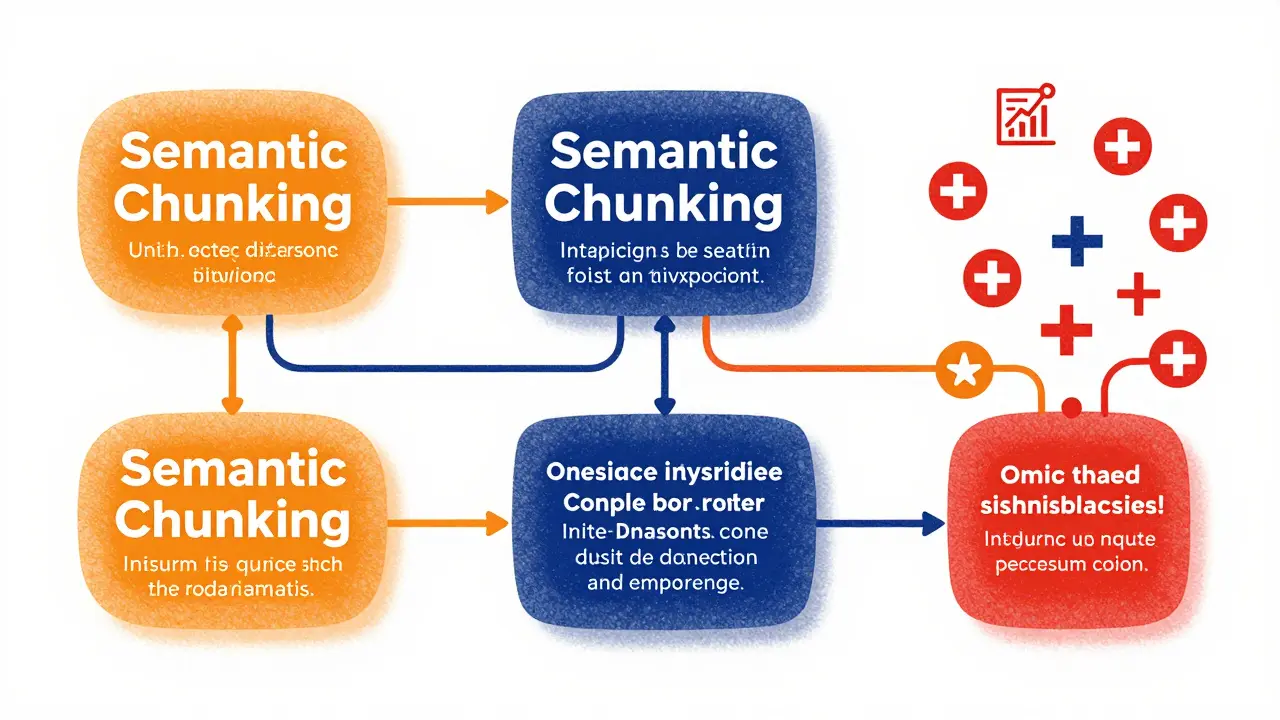
Semantic Chunking changes the game by using embeddings to determine where to split text. Instead of counting words, the system calculates the cosine distance between sentences. When the distance exceeds a threshold (typically 0.65-0.75), it assumes the topic has shifted and creates a new chunk. This ensures that related ideas stay together.
This approach uses models like OpenAI’s text-embeddings-3-small or SentenceTransformers to create high-dimensional vectors (often 1536 dimensions). The result is significantly higher coherence-scoring 82.4% in comparative studies. For industries like finance and healthcare, where context is king, semantic chunking is now the standard. A fintech CTO reported that switching from sliding window to semantic chunking improved compliance document retrieval accuracy from 68% to 89%.
There is a trade-off, though. Semantic chunking requires more compute power. It takes about 2.3 times longer to process than sliding window. But for mission-critical applications, that latency is a small price to pay for accuracy.
Advanced Techniques: Contextual Retrieval and Double Merging
If semantic chunking is good, these advanced techniques are better. They address the "contextual tunnel vision" that even semantic chunking sometimes suffers from.
Contextual Retrieval adds a preprocessing step before embedding. It resolves pronouns (replacing "it" with "the server") and rewrites sentences for clarity. SemDB’s implementation of this technique replaces 92.7% of ambiguous pronouns, ensuring the LLM never guesses who or what is being discussed. This drastically reduces the cognitive load on the LLM during generation.
Another powerful method is Semantic Double Chunk Merging. Sometimes, two highly relevant chunks get separated by a less relevant paragraph. Double merging performs a second pass to regroup semantically similar chunks that were artificially separated. Milvus internal testing showed this improves coherence by 18.4%. It’s like editing a book to ensure chapters flow logically, rather than just following page breaks.
LLM-Based Chunking: The High-Cost Option
For the highest possible quality, some teams use LLM-Based Chunking. Here, you send the raw text to a powerful model like GPT-4 and ask it to identify propositions, summarize sections, and highlight key points. The resulting chunks have 41.3% higher semantic coherence than traditional methods.
But there is a catch: cost. NVIDIA’s benchmarking shows this increases processing costs by $0.045 per 1,000 tokens and slows down processing by 3.2x. At scale, this can cost $12,500 per million tokens compared to $850 for semantic chunking. Use this only for high-value documents where every single detail matters, such as patent analysis or executive summaries.
The New Frontier: Chunking-Free In-Context (CFIC)
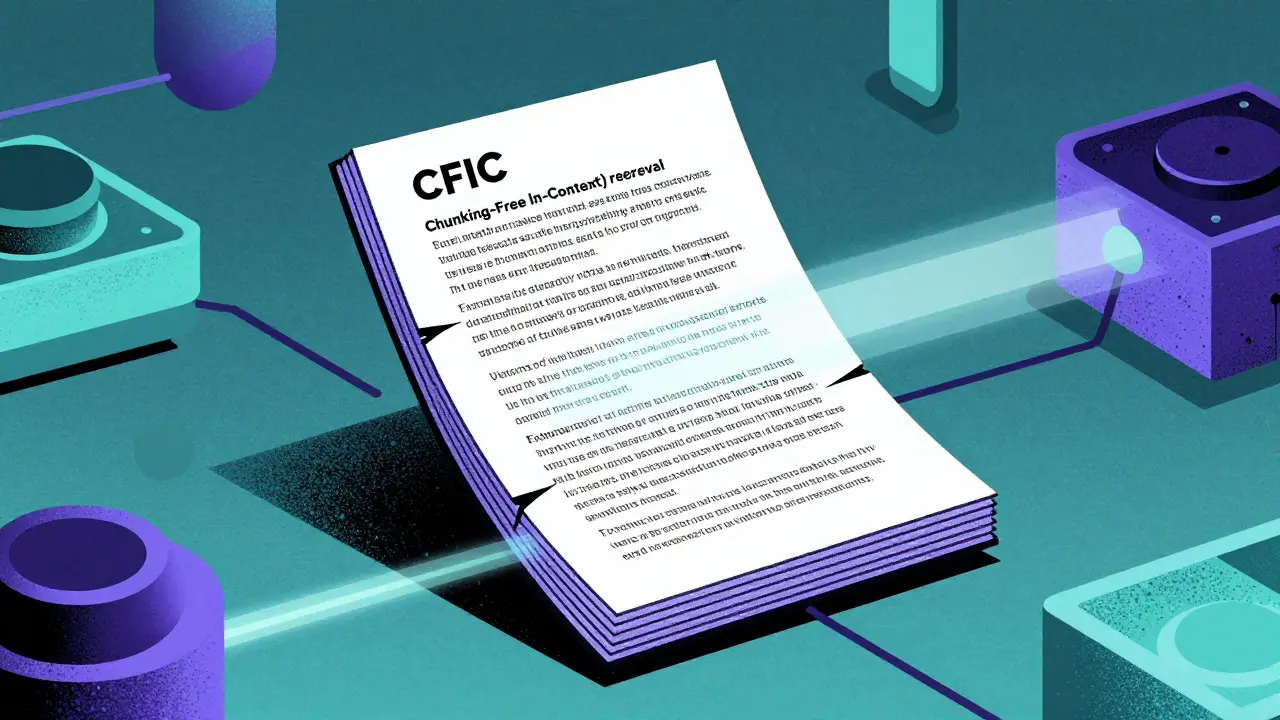
The most exciting development in 2024 and 2025 is Chunking-Free In-Context (CFIC) retrieval. Proposed by Gao et al., this approach bypasses chunking entirely. Instead of splitting text and storing vectors, it leverages transformer hidden states to decode precise evidence text directly from the original document structure.
Why does this matter? Because it eliminates information fragmentation completely. In controlled tests, CFIC reduced information bias by 37.8% while maintaining 98.2% of relevant information. Dr. Emily Chen at Google called it a solution that addresses the "root cause of information fragmentation rather than treating symptoms." Currently, only 3.2% of enterprise RAG systems use CFIC due to implementation complexity, but adoption is rising rapidly as frameworks integrate support.
Choosing Your Strategy: A Decision Framework
You don’t need to use the most advanced method for every project. The right choice depends on your specific constraints. Here is a quick guide to help you decide.
| Strategy | Coherence Score | Speed | Cost | Complexity |
|---|---|---|---|---|
| Sliding Window | 63.2% | Fastest | Low | Low (2.1/5) |
| Semantic Chunking | 82.4% | Moderate | Medium | Medium (3.8/5) |
| LLM-Based | 91.7% | Slow | High | High (4.6/5) |
| CFIC (Chunking-Free) | 89.3% | Fast | Medium-High | Very High (4.9/5) |
If you are building a customer support bot for a retail store, sliding window might suffice. If you are building a legal research tool, semantic chunking or CFIC is non-negotiable. Many enterprises are adopting hybrid approaches. For example, a healthcare company used sliding window for quick clinical notes but applied LLM-based chunking for detailed research papers, achieving 92.1% retrieval precision.
Implementation Pitfalls to Avoid
Even with the best strategy, implementation errors can ruin performance. Here are the most common mistakes developers make:
- Ignoring Metadata: Chunks without metadata (like source URL, date, or section title) lose context. Always attach metadata to your vectors.
- One-Size-Fits-All Sizes: Don’t use the same chunk size for code, prose, and tables. Code blocks need different handling than narrative text. 61% of implementations struggle here.
- Neglecting Evaluation: You can’t improve what you don’t measure. Track your hallucination rate and retrieval precision regularly. Tools like RAGAS can help automate this.
- Over-Optimizing Early: Start with semantic chunking. It offers the best balance of cost and performance. Move to CFIC or LLM-based only if you hit accuracy ceilings.
Remember, chunking is not a set-and-forget task. As your documents change, your chunking strategy may need adjustment. Spend 15-40 hours optimizing parameters initially, then monitor performance continuously.
Future Outlook: Where Is This Heading?
The trajectory is clear. By 2027, Gartner predicts 78% of enterprise RAG systems will incorporate semantic awareness. Pure sliding window approaches will drop below 15%. Hardware acceleration is also coming; NVIDIA’s partnership with Milvus aims to reduce semantic chunking overhead by 63% by late 2025.
We are moving toward a future where the distinction between "chunking" and "understanding" blurs. CFIC represents this shift, allowing models to access information without artificial segmentation. For developers, this means focusing less on string manipulation and more on architectural design that preserves context.
Your goal is not just to retrieve text; it is to ground the LLM in truth. Choose a strategy that respects the structure of your data, and your AI will thank you with accurate, reliable answers.
What is the best chunking strategy for legal documents?
For legal documents, Semantic Chunking or LLM-Based Chunking is recommended. Legal texts require high contextual fidelity to ensure clauses are not misinterpreted. Semantic chunking achieves 82.4% coherence, while LLM-based reaches 91.7%, making them superior to sliding window methods for complex regulatory content.
How much does LLM-based chunking cost compared to semantic chunking?
LLM-based chunking is significantly more expensive. NVIDIA reports costs around $12,500 per million tokens processed, compared to approximately $850 for semantic chunking. This makes LLM-based chunking viable only for high-value, low-volume documents.
What is CFIC retrieval?
CFIC stands for Chunking-Free In-Context retrieval. It is a novel approach that bypasses traditional text splitting by using transformer hidden states to decode precise evidence directly from the document, reducing information bias by 37.8%.
Can I combine multiple chunking strategies?
Yes, hybrid approaches are common. For instance, you might use sliding window for simple FAQs and semantic chunking for technical manuals. This balances speed and accuracy based on the specific type of content being queried.
How do I measure the effectiveness of my chunking strategy?
Track metrics like semantic coherence, hallucination rate, and retrieval precision. Tools like RAGAS can help evaluate how well retrieved chunks align with ground-truth answers. Aim for a hallucination rate below 20% for production systems.