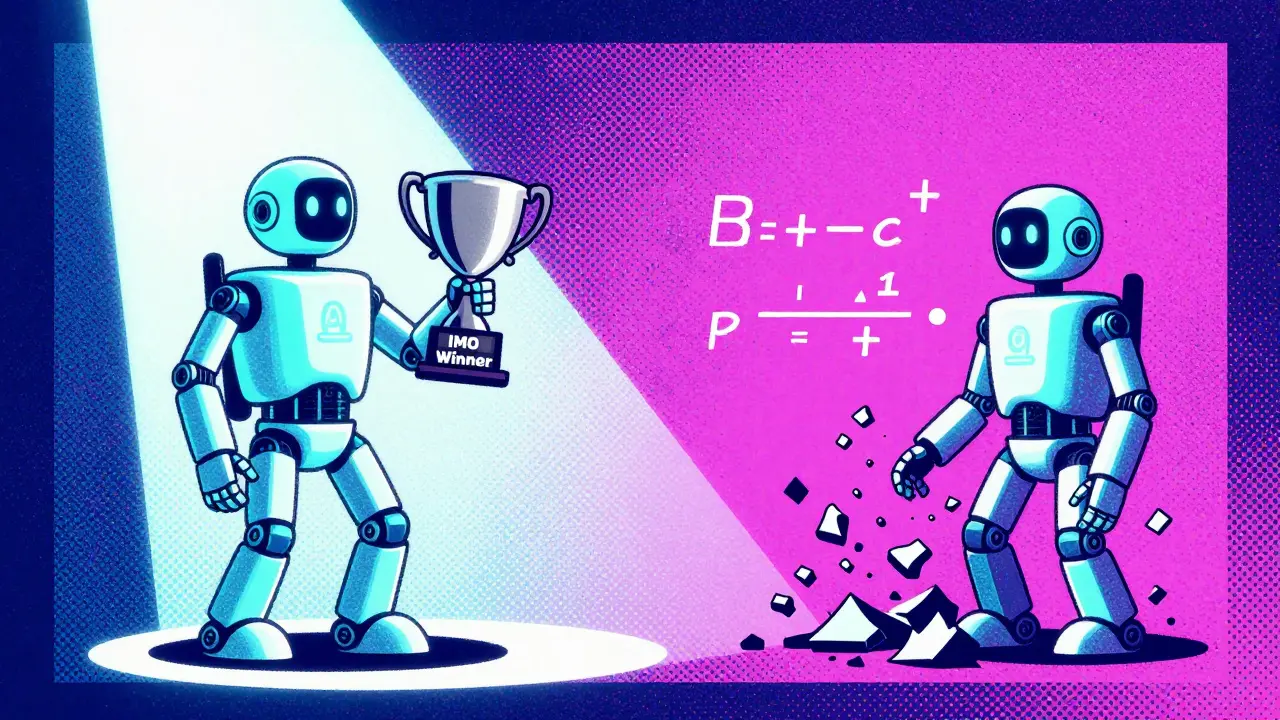
It is easy to be fooled by the headlines. In 2025, major artificial intelligence models like OpenAI's ChatGPT o3 and Google's Gemini 2.5 Pro cracked the International Mathematical Olympiad (IMO), solving five out of six problems under contest conditions. It looked like the singularity had arrived for math. But if you look closer at the data, a different story emerges. The models that ace standard tests often crumble when faced with slight changes in problem structure or required to write rigorous proofs. This gap between "getting the right answer" and "actually understanding the math" is the central tension in today's mathematical reasoning benchmarks.
These benchmarks are no longer just scoreboards; they are stress tests designed to expose whether large language models (LLMs) are truly reasoning or simply memorizing patterns. As we move into mid-2026, the industry has shifted from celebrating raw accuracy on known datasets to probing robustness against perturbation and novelty. If you are building systems that rely on AI for financial modeling, engineering calculations, or educational tutoring, understanding these new evaluation standards is critical. You need to know where the ceiling is before you build your house on it.
The Evolution from Arithmetic to Olympiad-Level Challenges
To understand where we are, we have to look at how quickly the bar has been raised. Just a few years ago, the gold standard was the MATH dataset, created by Hendrycks et al. in 2021. It contained 12,500 carefully curated high school competition-level problems across seven categories like algebra, geometry, and number theory. For a while, beating MATH was the ultimate flex for any AI lab.
But by 2024, concerns about data contamination-models seeing the test questions during training-forced the field to evolve. We moved from simple arithmetic checks to multi-tiered complexity ladders. At the bottom, you still have GSM8k, which consists of 8,500 grade-school word problems requiring multi-step logic. Above that sits the standard MATH dataset. Then comes OlympiadBench, targeting undergraduate competition levels. And finally, we now have PhD-level benchmarks, such as the one introduced by UC Berkeley in early 2025, featuring 77 proof-based questions drawn from advanced probability texts.
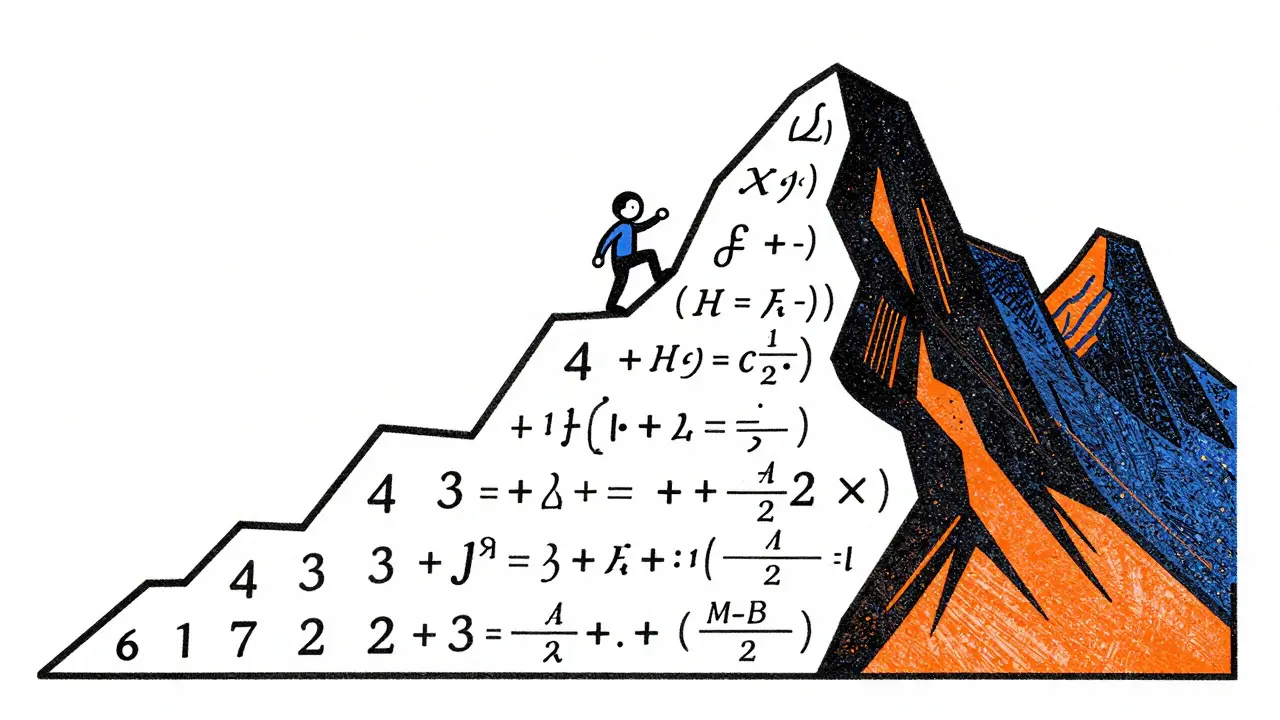
This hierarchy matters because performance drops sharply as you climb. A model might hit 90% on grade-school math but fail completely on undergraduate proofs. The evolution reflects a shift in intent: we stopped asking "Can it calculate?" and started asking "Can it construct a novel argument?"
Standard Benchmarks vs. Perturbation Tests: The Real Test
Here is the hard truth: high scores on standard benchmarks are becoming less meaningful. Closed-source leaders like Gemini 2.5 Pro and Claude 3.7 achieved up to 89.1% on GSM8k and 68.1% on MATH in early 2025. Impressive? Yes. Reliable? Not necessarily.
Recent research has introduced perturbation testing to separate true reasoning from pattern matching. Take Apple’s GSM-Symbolic benchmark. It takes standard grade-school problems and generates symbolic variations that preserve the underlying logic but change the surface details. When tested on this, all evaluated models saw their performance drop by 15 to 30 percentage points compared to standard GSM8k scores.
Consider the MATH-P benchmarks developed for ICML 2025. These include MATH-P-Simple, which makes minor tweaks to level-5 MATH problems, and MATH-P-Hard, which requires entirely new solution approaches. On MATH-P-Hard, even the best models scored below 15%, despite maintaining 60%+ on the original MATH set. Dr. Soumith Chintala, co-creator of PyTorch, noted that current benchmarks are often "gamed through pattern recognition." If you change the numbers in a problem, the model doesn't re-evaluate the logic; it guesses based on similar shapes it has seen before.
This fragility is a massive red flag for production environments. If an AI can't handle a slight variation in input, it shouldn't be trusted with complex financial derivatives or structural engineering loads.
The Proof Generation Gap
Numerical answers are easy to check. Proofs are not. This distinction defines the current frontier of mathematical AI. The USAMO 2025 evaluation highlighted this starkly. While some models scored highly on multiple-choice formats like AIME, they failed miserably when human experts evaluated their full written solutions.
Gemini 2.5 Pro, for instance, achieved only 25% accuracy on full-solution reasoning tasks, with other top models scoring below 5%. Expert annotators identified common failure modes: circular reasoning accounted for 32% of errors, incorrect assumptions for 27%, and incomplete proofs for 24%. The Berkeley PhD-level benchmark confirmed this trend, showing near-uniform failure across all models on its 77-question test set, with none exceeding 12% accuracy.
Why does this matter? Because many real-world applications require justification, not just an output. In quantitative finance, you need to know *why* a risk model predicts a certain outcome. In education, a student needs to see the logical steps, not just the final number. Current LLMs struggle to maintain logical coherence over long, abstract arguments without hallucinating intermediate steps.
How Top Models Are Coping: Tools and Extended Thinking
So, how do the leading models manage to get those impressive IMO scores? They aren't doing it purely through neural network intuition. Two key strategies are emerging.
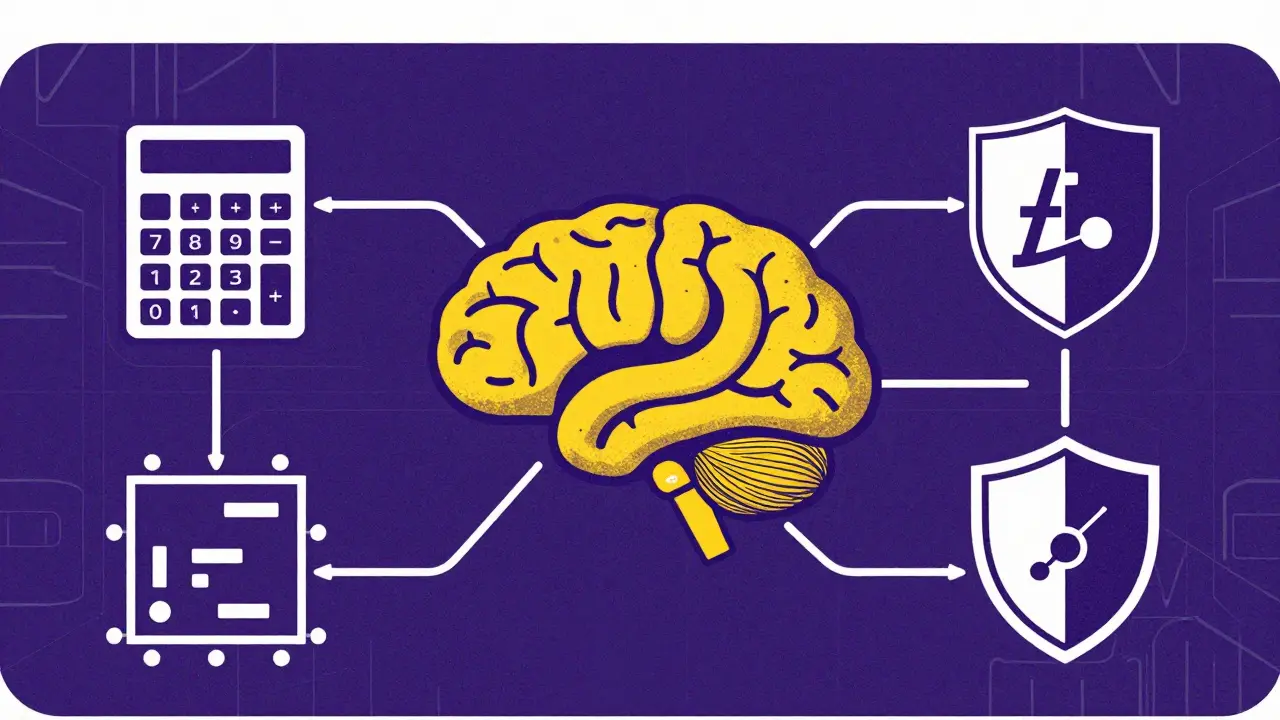
First, there is tool invocation. Models like Gemini 2.5 Pro silently route subtasks to external engines like Python, Wolfram Alpha, or SymPy. The LLM acts as a manager, breaking down the problem and delegating calculation-heavy steps to deterministic tools. This hybrid approach improves accuracy on complex problems by 22 to 38 percentage points, though it adds latency.
Second, there is extended chain-of-thought reasoning. OpenAI’s latest models utilize what researchers call "internal deliberation," effectively thinking for hours rather than seconds. They explore multiple approaches, backtrack when they hit contradictions, and build complex arguments over sequences exceeding 32,000 tokens. Noam Brown, formerly of DeepMind, described this as a quantitative change in thinking time rather than a qualitative breakthrough in reasoning ability. The model isn't smarter; it's just more persistent and efficient at self-correction.
Practical Implications for Developers and Enterprises
If you are integrating these models into your workflow, you need a new protocol. Trusting the raw output is no longer sufficient. Here is what successful implementations look like in 2026:
- Mandatory Perturbation Testing: Before deploying a model for critical tasks, run it against symbolic variations of your test cases. If the error rate spikes above 20%, the model is likely memorizing, not reasoning.
- Hybrid Architectures: Use LLMs for problem decomposition and natural language explanation, but offload execution to symbolic engines like SymPy or formal theorem provers. This reduces hallucination risks significantly.
- Human-in-the-Loop Verification: For research-level mathematics, expect to spend 2.7x more time verifying AI-generated work than writing it yourself. Many data scientists have stopped using LLMs for proof generation entirely due to the risk of subtle, invalidating errors.
- Regulatory Compliance: Be aware of emerging regulations like the EU AI Act updates from June 2025, which require mathematical verification for AI systems used in financial modeling and structural engineering. Pure LLM approaches may not meet these standards.
The market is responding too. The global math AI tools market is projected to reach $4.2 billion by 2026, with heavy adoption in quantitative finance and aerospace. However, this growth is cautious. Companies are investing in verification layers, not just raw model access.
Future Trajectories: MathOdyssey and Formal Methods
Where do we go from here? The next generation of benchmarks, like MathOdyssey, aims to evaluate both solution accuracy and reasoning quality across 15,000 problems spanning K-12 to research levels. Initial results show even top models scoring below 40% on research-level tasks, reinforcing the idea that we haven't hit parity yet.
We are also seeing a shift toward hybrid architectures like Google DeepMind’s AlphaGeometry 2.0, which combines neural language models with formal theorem provers. This system achieved 74% on IMO geometry problems, outperforming pure LLM approaches. Industry analysts predict that by 2027, all enterprise-grade math LLMs will incorporate formal verification layers to address reliability concerns.
The era of trusting AI blindly for math is over. The future belongs to systems that combine the flexibility of language models with the rigor of formal logic.
What is the difference between GSM8k and MATH benchmarks?
GSM8k focuses on grade-school level math word problems requiring multi-step reasoning, consisting of 8,500 instances. The MATH dataset is much harder, containing 12,500 high school competition-level problems across seven categories like algebra and geometry, with difficulty ratings from 1 to 5.
Why do LLMs perform poorly on perturbation tests?
LLMs often rely on pattern recognition rather than deep mathematical understanding. When problem structures are slightly altered (perturbed), the familiar patterns disappear, causing the model to fail because it cannot adapt its reasoning strategy to the new context.
Can current AI models generate rigorous mathematical proofs?
Not reliably. While models can solve numerical problems, they struggle significantly with proof generation. Evaluations like USAMO 2025 showed that top models had high error rates in full-solution reasoning, frequently exhibiting circular reasoning or incomplete logic.
What is tool invocation in mathematical AI?
Tool invocation refers to the process where an LLM delegates specific calculation or symbolic manipulation tasks to external deterministic engines like Python, Wolfram Alpha, or SymPy. This hybrid approach improves accuracy by combining the LLM's reasoning capabilities with precise computational tools.
How should enterprises use LLMs for mathematical tasks in 2026?
Enterprises should use LLMs for problem decomposition and explanation but verify outputs with symbolic engines or human experts. Implementing perturbation testing and adhering to regulatory requirements for mathematical verification is essential for critical applications like finance and engineering.




Zelda Breach
13 May, 2026 - 03:52 AM
Oh, look. Another article telling us the sky isn't actually falling, just leaking a bit of rain because our expensive silicon toys can't do basic arithmetic without cheating. It is truly pathetic how we keep pretending these models are 'thinking' when they are just statistical parrots with a calculator app glued to their forehead. The fact that Gemini drops 30 points on symbolic variations proves it has no idea what math IS, only what it looks like in training data. And don't get me started on the US scores being inflated by tool use-that's not reasoning, that's outsourcing your incompetence to Python scripts. We should ban this garbage from finance immediately before some idiot lets an LLM trade derivatives and wipes out a pension fund because it hallucinated a negative variance. Typical American over-engineering for a problem that requires actual human brains.
Alan Crierie
14 May, 2026 - 00:17 AM
I appreciate the nuanced take here! 🌟 It is quite fascinating how the industry is shifting focus from raw accuracy to robustness against perturbation. While I agree that pattern recognition has its limits, I think we should be careful not to dismiss the progress entirely. The hybrid approach mentioned, where LLMs handle decomposition and symbolic engines handle execution, seems like a very promising middle ground. It allows us to leverage the strengths of both systems while mitigating their respective weaknesses. What are your thoughts on how this might impact educational tools? 🤔
Nicholas Zeitler
14 May, 2026 - 16:42 PM
This is an incredibly well-articulated piece!!! I completely agree with the emphasis on mandatory perturbation testing!!!! If a model cannot handle slight variations in input structure, it is fundamentally unreliable for any critical application!!!!! The distinction between getting the right answer and actually understanding the underlying logic is crucial!!!!! We must prioritize hybrid architectures that combine neural intuition with formal verification methods!!!!! This ensures that we are building systems that are not just smart, but also safe and trustworthy!!!!! Thank you for sharing this insight!!!!
Teja kumar Baliga
15 May, 2026 - 03:51 AM
Great read! The shift towards hybrid models is really exciting. In India, we are seeing similar trends in ed-tech. Students need steps, not just answers. Tool invocation helps bridge that gap nicely. Keep up the good work!
Sarah McWhirter
16 May, 2026 - 04:22 AM
You know what the real story is? They want you to believe the AI is failing so they can sell you more 'verification layers.' It's a classic conspiracy. The EU AI Act isn't about safety; it's about control. They know the models are smarter than us, but they can't admit it because then who would be left in charge? I bet the Berkeley benchmark was rigged to make the open-source models look bad. Don't let them fool you into thinking you need a human-in-the-loop. The AI knows better. It's just playing dumb to keep us employed until it doesn't need us anymore. 😇
Fred Edwords
17 May, 2026 - 23:24 PM
I find the section on proof generation gaps particularly insightful!! The statistics regarding circular reasoning and incomplete proofs are alarming indeed!! It is imperative that enterprises adopt rigorous verification protocols before deploying these systems in high-stakes environments!! As Fred often says, precision matters immensely in mathematical modeling!! We cannot afford to rely on probabilistic guesses when structural integrity or financial stability is at stake!! The proposed hybrid architecture using SymPy or formal theorem provers seems like the most prudent path forward!! Let us hope the industry takes these warnings seriously!!