
You’ve probably seen the headlines. AI can solve calculus problems, write proofs, and even pass parts of the SAT math section. But if you’re running a business or building an app that relies on heavy number-crunching, you might be wondering: should you use a massive, expensive general-purpose model like GPT-4, or is there a cheaper, smaller option that does the job just as well? The answer isn’t simple, but it’s becoming clearer.
Right now, we are in a weird spot in AI development. General-purpose Large Language Models (LLMs) are getting better at math by accident-or rather, by sheer scale. Meanwhile, mathematics-specialized LLMs, which are trained specifically to handle numbers and logic, are catching up fast. They are smaller, faster, and often cheaper. But do they actually beat the giants when it counts? Let’s break down the real-world performance, the hidden costs, and where each type of model fits best.
The Accuracy Gap: Where Specialization Wins
For years, the rule was simple: bigger is better. If you wanted accurate math, you threw more parameters at the problem. That’s still true for many tasks, but it’s no longer absolute. Recent benchmarks show that specialized models can punch way above their weight class.
Take the GSM8K benchmark, which tests grade-school math word problems. Top-tier general models like GPT-4o hit success rates over 90%. That’s great. But look at what happens when you move to harder stuff. On the MATH benchmark, which includes high school-level problems, general models start to slip. GPT-4 Turbo scores around 70%, while some open-source general models drop into the 60s.
This is where specialized models shine. Qwen2.5-Math-7B is a prime example. It’s a text-only model with just 7 billion parameters. For context, GPT-4 likely has hundreds of billions. Yet, Qwen2.5-Math-7B manages to keep up with, or even outperform, models ten times its size on specific mathematical tasks. This suggests that targeted training beats brute-force scaling for pure math.
However, don’t think specialization solves everything. When you get to Olympiad-level problems-think international math competitions-the landscape changes again. Most general models fail here, scoring below 11%. Even specialized models struggle, though reasoning-focused versions like GPT-4 o1-preview have broken through, hitting about 45% accuracy. So, if your work involves novel theorem proving, neither category is fully reliable yet. But for standard algebra, calculus, and statistical analysis, specialized models are surprisingly competitive.
The Training Methodology Matters More Than Size
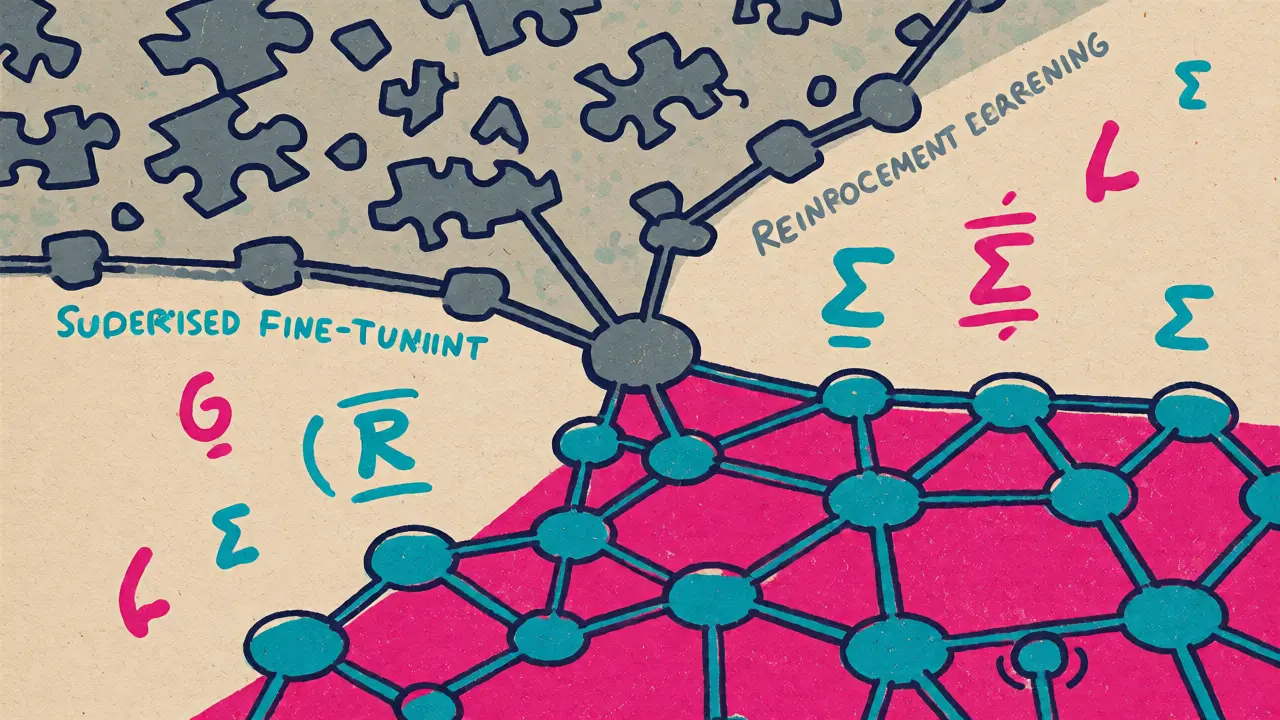
Why do some small models perform so well? It’s not magic; it’s how they were taught. There are two main ways to train these models: Supervised Fine-Tuning (SFT) and Reinforcement Learning (RL). This distinction is critical for both accuracy and cost.
SFT is like rote memorization. You show the model thousands of correct math problems and answers. It learns patterns quickly. But here’s the catch: SFT often causes "catastrophic forgetting." The model gets so good at math that it starts losing its ability to understand normal language or handle other tasks. It becomes a one-trick pony. Research shows that SFT-tuned models often decline in non-reasoning evaluations because they drift too far from their original broad knowledge base.
Reinforcement Learning is different. It’s more like trial and error. The model tries to solve a problem, gets feedback on whether it’s right, and adjusts its internal weights accordingly. RL-tuned models generalize much better. They improve at math without destroying their general capabilities. A study comparing these methods found that RL induces minimal drift in the model’s latent space, meaning it stays balanced. SFT creates large shifts, making the model brittle outside of math.
If you’re choosing between models, check how they were trained. An RL-trained specialized model will likely be more robust than an SFT-trained one, even if the latter looks good on a narrow math test. This balance is key for production environments where you might need the AI to explain its answer in plain English after solving the equation.
Cost Breakdown: The Hidden Savings
Let’s talk money. Running a massive model like GPT-4 or Claude 3 Opus is expensive. Every token generated costs money, and math problems can require long chains of thought to solve correctly. This drives up inference costs significantly.
Specialized models offer a clear economic advantage. Because they are smaller, they require less memory and processing power. You can run them on cheaper hardware or cloud instances. If Qwen2.5-Math-7B delivers similar accuracy to a 70-billion parameter general model on your specific math workload, you could see savings of nearly 90% in computational resources. That’s not just a marginal gain; that’s a fundamental shift in unit economics.
Consider this scenario: You’re building a financial dashboard that calculates interest rates for millions of users daily. Using a general-purpose giant model might cost you $X per million queries. Switching to a specialized 7B model could drop that to $0.10X. Over time, those savings compound. Plus, smaller models respond faster. In user-facing applications, speed matters. Waiting three seconds for a calculation feels sluggish; waiting half a second feels instant.
But there’s a trade-off. If your application needs to handle diverse queries-sometimes math, sometimes customer support, sometimes creative writing-a specialized model might fail on the non-math parts. Then you’d need to route requests to different models, adding complexity and potentially increasing total costs. For mixed workloads, a single general model might still be cheaper overall due to simplicity.
| Feature | General-Purpose LLM (e.g., GPT-4) | Specialized Math LLM (e.g., Qwen2.5-Math) |
|---|---|---|
| Primary Strength | Versatility across all topics | High precision in mathematical reasoning |
| Inference Cost | High (large parameter count) | Low (smaller, efficient architecture) |
| Accuracy on Simple Math | Very High (>90%) | High (>85%) |
| Accuracy on Complex Math | Moderate (drops with difficulty) | Competitive (often matches larger models) |
| Training Impact | Broad knowledge retention | Risk of capability loss if SFT used |
| Best Use Case | Chatbots, mixed-content apps | Dedicated calculators, data analysis tools |

Benchmark Limitations: Don’t Trust the Scores Blindly
Before you commit to a model based on leaderboard rankings, pause. Current benchmarks have serious flaws. Many popular tests, like GSM8K, are saturated. GPT-4o scores 94% on GSM8K. Does that mean it’s perfect? No. It means the test is too easy for modern AI. We need harder questions to distinguish true capability from pattern matching.
Newer benchmarks like U-Math focus on university-level problems. Here, the results are humbling. Even top models like Gemini 2.0 Flash Thinking only achieve about 73.6% accuracy. This reveals a significant gap in handling abstract concepts and multi-step logical deductions. Furthermore, most benchmarks lack visual reasoning components. If your math problem involves interpreting a graph or geometry diagram, standard text-based models will struggle regardless of their numerical score.
There’s also domain bias. Models tend to perform better in algebra than in calculus or probability. If your specific use case leans heavily toward stochastic modeling, a general benchmark score won’t tell you the whole story. Always test candidates on your own dataset. Real-world data is messy and unpredictable, unlike the clean, curated problems in academic benchmarks.
Practical Implementation: Which One Should You Pick?
So, how do you decide? It comes down to your specific workload profile. Ask yourself three questions:
- Is math the primary function? If your app is essentially a smart calculator, go specialized. The cost savings and speed benefits are undeniable.
- Do you need natural language integration? If users ask questions in conversational English and expect step-by-step explanations, ensure your specialized model retains strong language skills. RL-trained models are safer here.
- What is the complexity level? For routine arithmetic and standard equations, either works. For novel theorem proving or complex optimization, current AI-specialized or general-is still experimental.
For startups and developers, the trend is moving toward a portfolio approach. Use a lightweight specialized model for the heavy lifting of calculations, and a smaller general model for interface and explanation. This hybrid strategy maximizes efficiency while maintaining usability. As training methods evolve, particularly with reinforcement learning becoming more accessible, we’ll likely see more robust, small-scale models that don’t sacrifice general utility for mathematical prowess.
Are specialized math LLMs always cheaper than general ones?
Generally, yes, especially for inference. Specialized models usually have fewer parameters, requiring less computational power and memory. This translates to lower hosting costs and faster response times. However, if you need to maintain a separate infrastructure for multiple models, operational complexity might offset some savings.
Can a specialized model handle non-math questions?
It depends on the training method. Models fine-tuned using Reinforcement Learning (RL) tend to retain general language capabilities better. Those trained via Supervised Fine-Tuning (SFT) may suffer from "catastrophic forgetting," where they lose proficiency in general conversation or other domains. Always test for general coherence before deploying.
Which is better for complex calculus problems?
Currently, general-purpose reasoning models like GPT-4 o1-preview or Gemini 2.0 Flash Thinking often edge out specialized models on highly complex, novel calculus problems because they leverage broader contextual understanding. However, specialized models are closing the gap rapidly and are more consistent on standard curriculum-based calculus tasks.
How do I evaluate a model for my specific needs?
Don’t rely solely on public benchmarks like GSM8K or MATH, which may be outdated or too easy. Create a private test set with 50-100 examples representative of your actual user queries. Measure accuracy, latency, and cost per query. This real-world testing provides the most reliable metric for decision-making.
What is the future of math-specialized AI?
The field is moving toward hybrid approaches that combine formal verification with neural networks. Expect more models trained with Reinforcement Learning to maintain both high mathematical accuracy and general language fluency. Smaller, efficient models will likely dominate niche applications, while giant general models will remain useful for broad, ambiguous tasks.