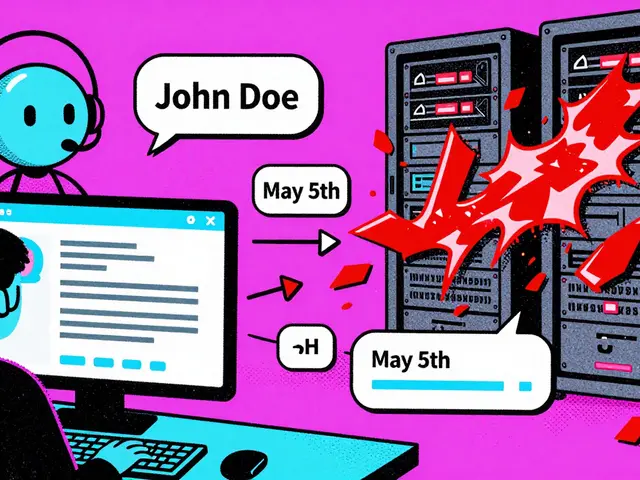
Large language models are impressive, but they lie. Not out of malice, but because their core design is built on predicting the next most likely word, not finding the absolute truth. This creates a gap between what sounds right and what is actually correct. For developers and businesses deploying these models in 2026, this gap is a major risk. A model might confidently fabricate a code library that doesn't exist or miscalculate a financial projection with perfect grammar. The solution isn't just to make the models bigger; it's to teach them how to check their own work.
This is where internal verification comes in. Instead of relying solely on an external human or a separate fact-checking tool, internal verification embeds checking mechanisms directly into the model's reasoning process. It turns the model from a simple text generator into a system that drafts, critiques, and validates its own outputs before showing them to you. By adding these internal checks, we can significantly reduce errors and hallucinations without completely rebuilding the underlying architecture.
Why Internal Checks Are Necessary Now
To understand why we need internal verification, we have to look at how large language models fail. Historically, when researchers asked models like PaLM to answer complex questions, they often got short, direct answers. These answers were frequently wrong because the model skipped the logical steps needed to reach the truth. In early 2022, Google researchers introduced chain-of-thought (CoT) prompting, which changed everything. By asking the model to "think step by step," accuracy on math and logic tasks jumped by more than 10 percentage points.
However, CoT revealed a new problem. While the final answers got better, the intermediate reasoning steps were often messy, inconsistent, or partially wrong. A model might get the right number for the wrong reason, or contradict itself halfway through a paragraph. In 2024, case studies showed that even frontier models produced factually incorrect but confident responses in double-digit percentages of real-world tasks. They fabricated non-existent software functions and misinterpreted data columns. This is known as hallucination. External tools like search engines help, but they add latency and cost. Internal verification solves this by catching errors before the output leaves the model's memory.
The Four Pillars of Internal Verification
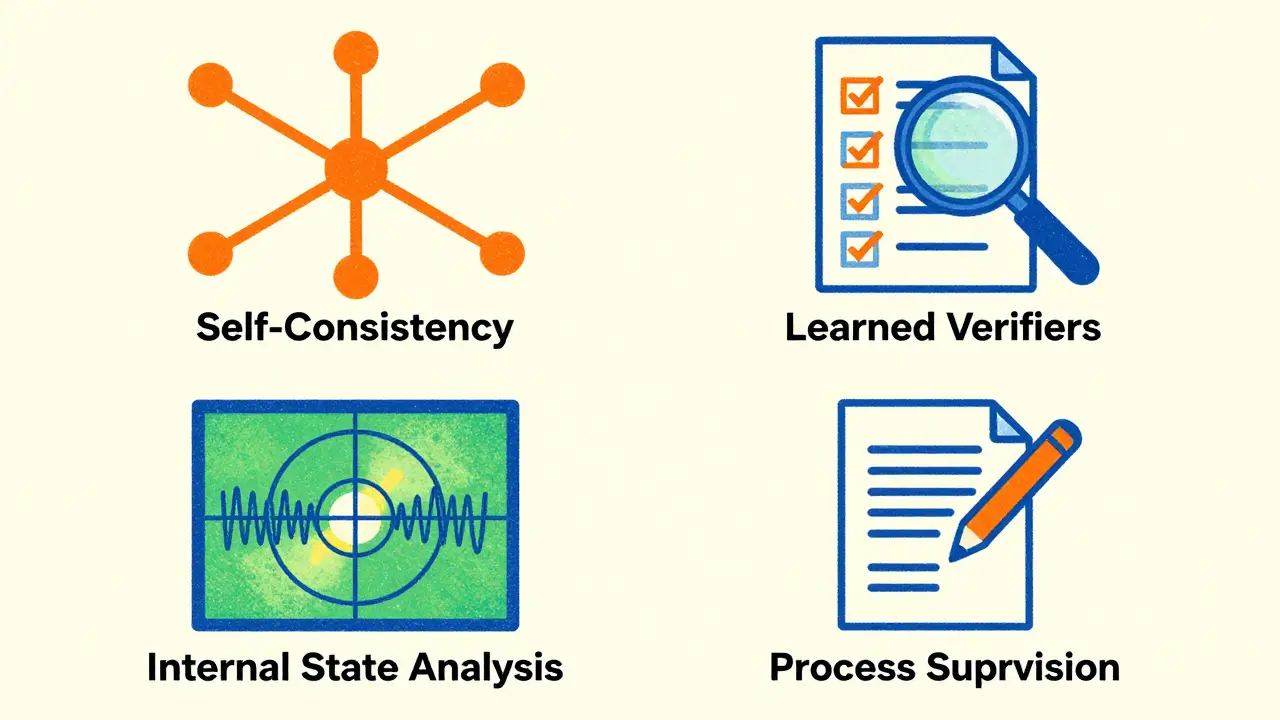
Internal verification isn't one single technology. It is a family of techniques that emerged prominently between 2022 and 2025. We can group them into four main categories based on how they operate inside the model.
- Multi-sample Self-Consistency: The model generates multiple different reasoning paths for the same question and picks the answer that appears most often.
- Learned Verifier Models: A specialized component scores each step of the reasoning process, flagging incorrect logic before the final answer is produced.
- Internal State Analysis: The system monitors the model's hidden activations and confidence levels (logits) to predict if a hallucination is about to happen.
- Process Supervision: The model is trained to critique and revise its own work in additional passes, similar to a writer editing a draft.
Each method has its strengths. Self-consistency is easy to implement but computationally expensive. Learned verifiers are precise but require training data. Internal state analysis is fast but harder to calibrate. Understanding these differences helps you choose the right approach for your specific use case.
Self-Consistency: Voting for the Truth
The simplest form of internal verification is self-consistency decoding. Introduced in March 2022 by Xuezhi Wang, Jason Wei, and collaborators, this method treats agreement among multiple chains of thought as a verification signal. Here is how it works in practice.
Instead of asking the model for one answer, you ask it to generate K distinct reasoning chains. Typically, K ranges between 5 and 40. You set the temperature parameter between 0.5 and 1.0 to encourage variety. After generating all K chains, the system looks at the final answers. If three chains say the answer is "42" and two say "43," the system selects "42."
This works because correct solutions are often more stable under sampling than incorrect ones. In arithmetic tasks with clearly defined numeric answers, self-consistency acts as a "weak verifier." Experiments on benchmarks like GSM8K (which contains 8,500 grade-school math problems) showed that increasing K from 1 to roughly 20 samples could improve exact-match accuracy by more than 10 percentage points. However, there is a trade-off. Increasing K beyond 20-30 samples yields diminishing returns, often less than 1-2 percentage points gain, while multiplying the inference compute cost by up to 20 times. For high-volume applications, this efficiency limit makes pure self-consistency impractical unless used selectively.
Learned Verifiers: Scoring Every Step
Self-consistency is powerful, but it waits until the end to check the answer. What if we could catch errors earlier? This was the goal of the 2023 paper "Let’s Verify Step by Step" by Hunter Lightman, Vineet Kosaraju, and colleagues at Google DeepMind. They proposed training dedicated verifier models to assign correctness scores to each reasoning trace line by line.
In this setup, the base model generates a few candidate solutions (perhaps 4 to 8). Then, a verifier model-often smaller than the base solver-reviews each step. It was trained on datasets like MATH (approximately 12,500 competition-style math problems) using fine-grained labels. Human annotators marked each of the 5-20 steps per solution as correct, incorrect, or irrelevant. This process supervision allows the verifier to intervene before the final answer is produced, preventing error propagation across steps.
The results were significant. A verifier trained on step-level annotations improved final answer accuracy by several percentage points over naive chain-of-thought alone. Interestingly, the study found that verification is often easier than generation. A smaller model, trained specifically to judge reasoning, could outperform a larger model at recognizing correct logic. This mirrors classical proof-checking, where linear-time checkers validate proofs that may take exponential time to find. For developers, this means you don't always need the biggest model to ensure quality; you need a smart checker.
Detecting Hallucinations via Internal States
Sometimes, you don't want to wait for the whole response. You want to know if the model is about to hallucinate mid-sentence. Recent research from 2024 and 2025 focuses on hallucination detection via internal states. This technique examines the model's hidden activations and token-level logits before the output is finalized.
A 2024 paper titled "LLM Internal States Reveal Hallucination Risk Faced With a Query" demonstrated that simple classifiers trained on hidden states at the final decoding step can distinguish correct versus incorrect answers. In some settings, these detectors achieved area-under-ROC curves (AUC) above 0.8, which is significantly better than random chance. This enables risk scores that correlate with actual error rates.
By 2025, preprints extended this approach by incorporating structured representations like extracted entities and intermediate reasoning graphs. Combining token-level internal features with structured output fields boosted detection performance, especially for subtle "sophisticated" hallucinations. These are answers that remain locally fluent but are globally inconsistent. For example, a model might correctly describe a historical event but invent a date that never existed. Internal state detectors can flag this inconsistency by noticing unusual activation patterns associated with factual uncertainty.

Implementation Challenges and Costs
While the science is promising, implementing internal verification in production systems brings real-world challenges. The primary concern is cost and latency. Adding multi-sample decoding or verifier passes increases inference cost by factors of 2-10 times in many deployments. For APIs handling thousands of requests per minute, this overhead can be prohibitive.
To manage this, practitioners recommend selective verification. Don't verify every single query. Use lightweight internal state detectors to identify high-risk prompts first. If the risk score exceeds a calibrated threshold, trigger the heavier verification methods like self-consistency or learned verifiers. This layered defense balances accuracy with efficiency.
Data collection is another hurdle. Training a learned verifier requires labeled reasoning traces. For math tasks, labels can be derived automatically by executing equations. But for open-ended reasoning, human annotators must mark each step as correct or incorrect. This increases labeling costs by factors of 2-5 times compared to labeling only final answers. Companies building these systems often start with narrow domains where automatic verification is possible, such as coding or symbolic math, before expanding to general knowledge.
| Method | Compute Overhead | Best Use Case | Key Limitation |
|---|---|---|---|
| Self-Consistency | High (5x - 20x) | Math, Logic, Coding | Diminishing returns after K=20 |
| Learned Verifiers | Medium (2x - 5x) | Complex Reasoning Traces | Requires labeled training data |
| Internal State Detection | Low (< 1% params) | Real-time Risk Flagging | Hard to calibrate probabilities |
| Process Supervision | Medium-High | Iterative Refinement | Increases latency significantly |
Future Directions and Risks
As we move further into 2026, the focus is shifting toward smarter, more efficient verification. Researchers are exploring adaptive self-consistency, where the model decides in 1-2 steps how many additional samples are needed. This could cut verification compute overhead while preserving most accuracy gains. There is also growing interest in structured verifiers that operate over formal proof objects or executable code, blurring the line between neural networks and symbolic verification systems.
However, there is a risk of overconfidence. If users treat internal risk scores or verifier judgments as perfectly reliable, they may neglect residual errors. Internal verification reduces hallucinations, but it does not eliminate them. In long, complex answers, small undetected errors can still cause harm. The emerging consensus is that internal checks should serve as an abstention mechanism. When internal risk scores are high, the model should decline to answer or request external tools, rather than forcing a potentially wrong output.
For enterprises, this means adopting a multi-layered strategy. Combine internal verification with retrieval-augmented generation (RAG) and human oversight for high-risk workflows. Internal checks act as a first-line filter, rejecting problematic answers before they reach end users. This approach provides a practical safety valve in deployed systems, balancing the speed of AI with the reliability required for business operations.
What is the difference between internal and external verification?
Internal verification uses the model's own reasoning steps, hidden states, or attached verifier heads to check for errors without leaving the system. External verification relies on outside tools like search engines, databases, or human reviewers. Internal checks are faster and work offline, while external checks are better for up-to-date factual information.
Does self-consistency guarantee a correct answer?
No. Self-consistency improves the probability of a correct answer by selecting the most frequent result from multiple samples. However, if the model consistently makes the same error across all samples, self-consistency will reinforce that error. It is a statistical improvement, not a formal proof of correctness.
How much does internal verification increase latency?
It depends on the method. Self-consistency with 20 samples can increase latency by up to 20 times. Learned verifiers typically add 2x to 5x overhead. Internal state detection adds minimal latency, often less than 10%. Selective verification strategies help mitigate these costs by only applying heavy checks to high-risk queries.
Can internal verification stop all hallucinations?
No current method eliminates all hallucinations. Internal verification is particularly effective against intrinsic hallucinations (logical inconsistencies) but may miss extrinsic hallucinations (facts contradicted by reality) if the model lacks the knowledge to detect them. It should be part of a broader safety strategy including retrieval and human review.
Is it worth training a custom verifier model?
If you have a specific domain with clear correctness criteria, like math or code, yes. Custom verifiers can be smaller and more efficient than the base model. However, training requires significant labeled data. For general-purpose tasks, using established self-consistency or off-the-shelf verification APIs may be more cost-effective initially.