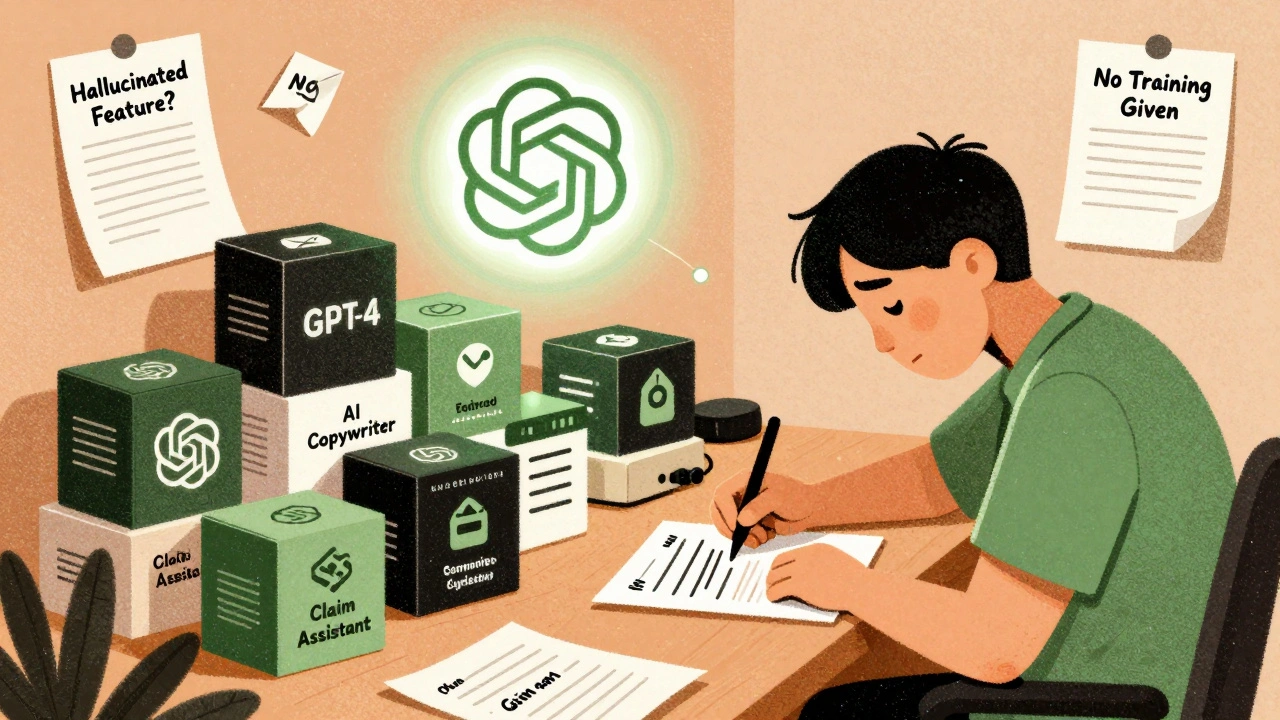
Most companies think the biggest cost of generative AI is buying the tools or paying for cloud compute. They’re wrong. The real expense isn’t in the software-it’s in change management. Training employees, rewriting workflows, and convincing teams to trust an AI that keeps changing its answers? That’s where budgets bleed out.
Why Change Management Costs More Than the AI Itself
In 2024, Gartner found that 70% of generative AI projects failed to deliver ROI-not because the tech didn’t work, but because people didn’t use it. A marketing team got a tool that wrote ad copy in seconds. But instead of adopting it, they kept drafting emails manually. Why? Because no one trained them on how to prompt it right. And no one told them what to do when the AI hallucinated a product feature that didn’t exist.
The AI model might cost $50,000 a year. The training program? $120,000. The process redesign? Another $85,000. That’s not a surprise-it’s the rule. Every successful AI rollout I’ve seen had three things: a clear rollout plan, dedicated change agents, and time built in for people to get uncomfortable before they got good.
Training: It’s Not a One-Time Workshop
Training for generative AI isn’t like teaching someone to use Excel. You can’t just show them a button and walk away. AI doesn’t follow rules-it predicts patterns. That means employees need to learn how to think with it, not just use it.
At a mid-sized insurance company in Portland, they rolled out an AI assistant to draft claims summaries. First training session: one hour. Result? 82% of staff ignored it. They didn’t trust the output. So they redesigned training into a 6-week program:
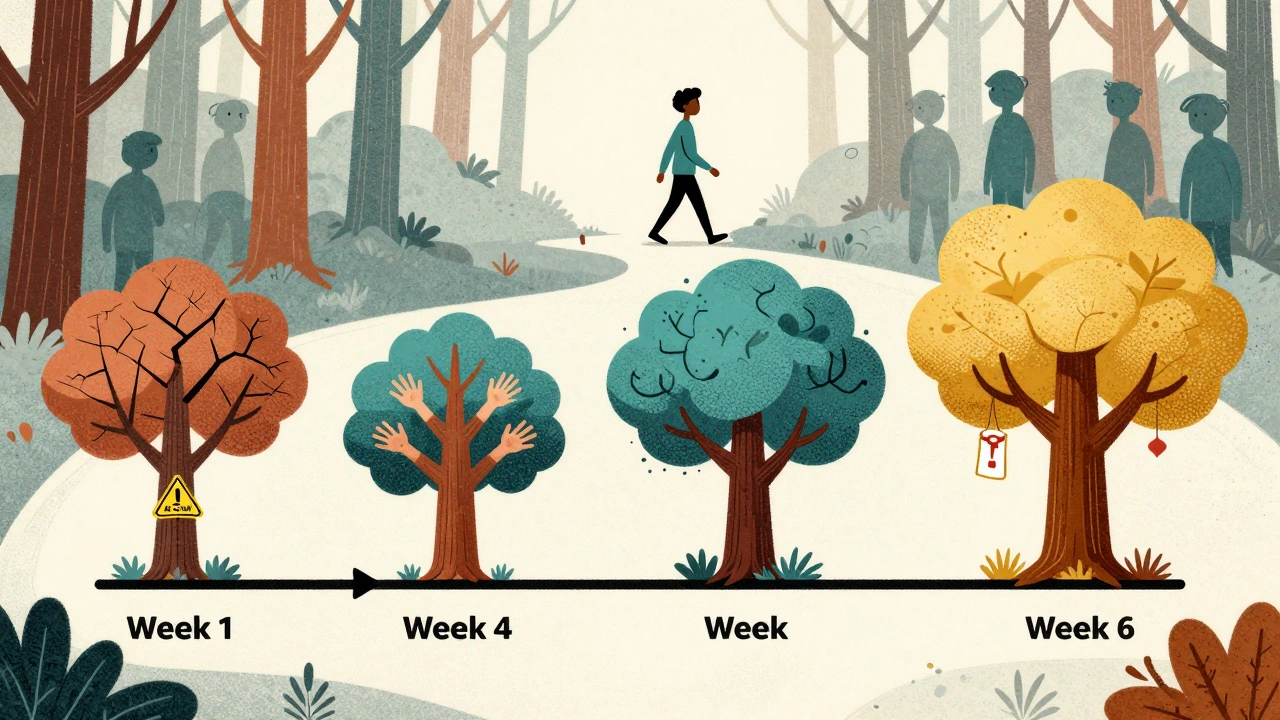
- Week 1: What AI can and can’t do (with real examples of failures)
- Week 2: How to write prompts that get accurate results
- Week 3: Spotting hallucinations in legal or medical text
- Week 4: Hands-on labs with feedback from AI coaches
- Week 5: Peer-led troubleshooting sessions
- Week 6: Certification with a real-world test
By week six, adoption jumped to 91%. The cost? $42,000 for internal coaches, materials, and time off for staff. But claims processing time dropped by 37%. The training paid for itself in 11 weeks.
Process Redesign: When Old Workflows Break
Generative AI doesn’t fit neatly into old systems. It changes who does what, when, and how decisions get made.
A manufacturing firm in Ohio used AI to analyze customer support logs and flag product defects. The old process had engineers reviewing every ticket. The new process? AI flagged 120 high-risk cases per week. But engineers still reviewed them all-because no one had updated the workflow.
They spent six weeks redesigning the process:
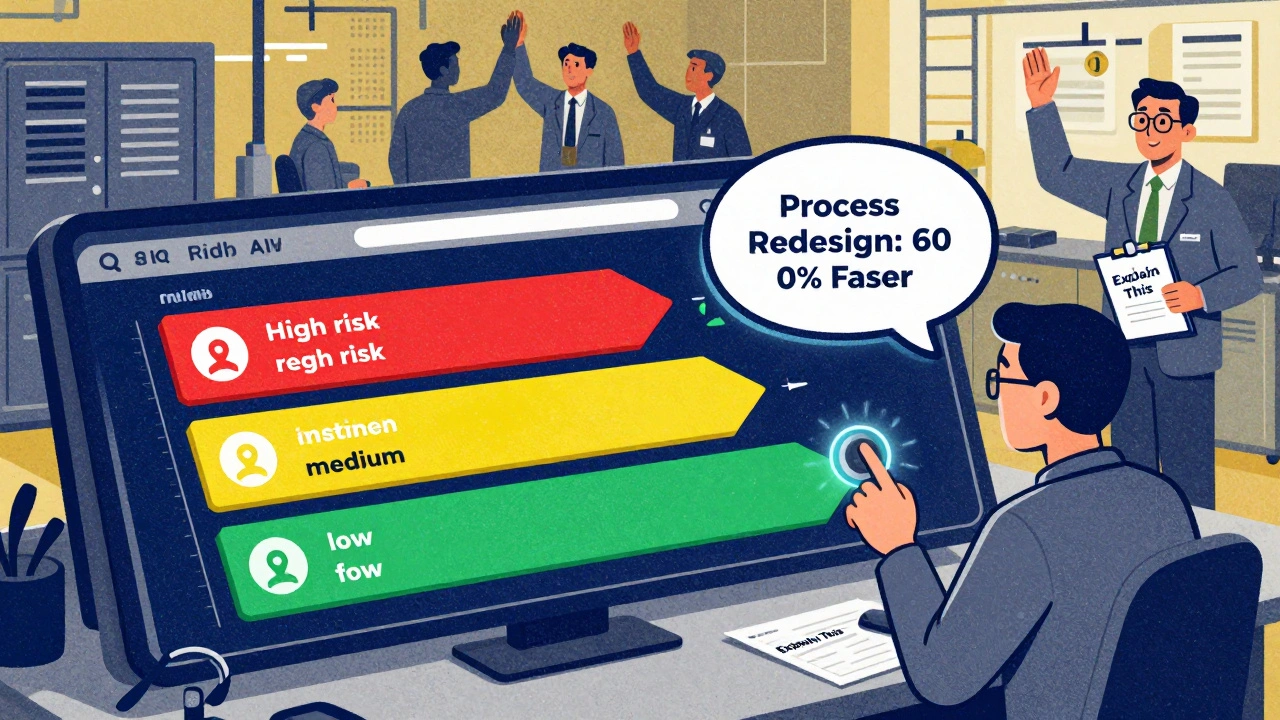
- AI now filters tickets into three tiers: high, medium, low risk
- High-risk: engineer reviews within 2 hours
- Medium-risk: junior technician investigates with AI suggestions
- Low-risk: auto-closed with AI summary, flagged for random audit
They cut review time by 60%. But it took three rounds of feedback from frontline staff to get it right. One technician said, “If the AI says it’s low risk, I need to know why-not just accept it.” So they added a one-click “Explain this” button that pulls up the AI’s reasoning. That small tweak made the difference between resistance and adoption.
The Hidden Costs: Resistance, Revisions, and Relearning
Most cost models ignore three things:
- Leadership time: Managers spend 8-12 hours a month answering questions, calming fears, and explaining AI decisions. That’s not in the budget.
- Revisions: AI outputs change as models update. A marketing team that trained on GPT-4 might get totally different results with GPT-4.5. They need ongoing refreshers.
- Relearning: When a new version rolls out, users forget what they learned. One bank found that after a model update, 40% of staff reverted to old ways within 30 days.
These aren’t bugs-they’re features of human behavior. The best teams build in quarterly “AI refresher” sessions. They don’t call them training. They call them “AI check-ins.” It feels less like homework and more like staying sharp.
Who Pays for This? And Who Should?
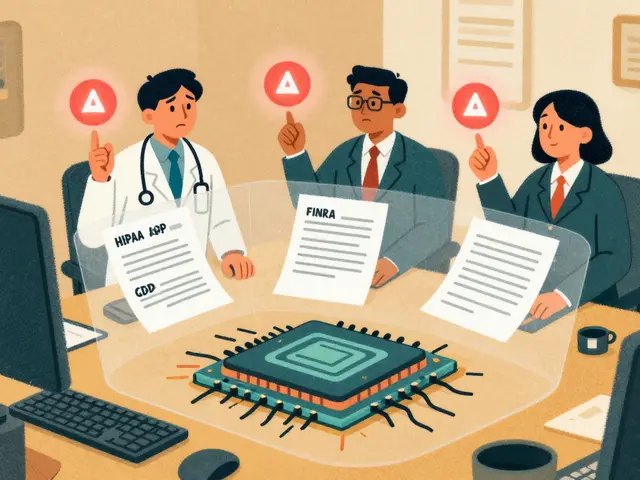
IT teams often get stuck paying for change management. But that’s like making the IT department pay for sales training. The real owners of change are the teams using the AI.
At a healthcare provider in Seattle, they created a simple rule: “The team that uses the AI owns the change budget.” The billing department got $30,000 to redesign their workflow and train staff. The clinical notes team got $25,000. They didn’t wait for IT to decide what to do-they gave them money, autonomy, and accountability.
Result? Adoption rates jumped 50% higher than in departments where IT ran everything. When people feel ownership, they fix problems faster.
What Happens If You Skip Change Management?
You get the “AI graveyard.”
That’s what one Fortune 500 company called the shelf of unused AI tools in their digital transformation office. There were 17 tools there. Only two were active. The rest? Piloted, funded, then abandoned. Why? No one told the staff how to use them. No one changed the process. The tools sat there like expensive paperweights.
One manager summed it up: “We spent $1.2 million on AI. We spent $12,000 on training. That’s like buying a Ferrari and putting it on a bicycle rack.”
How to Budget for Change Management Right
Here’s a real-world cost breakdown for a mid-sized company rolling out generative AI across three departments:
| Cost Category | Estimated Cost (USD) | What It Covers |
|---|---|---|
| Training Programs | $40,000-$80,000 | Workshops, materials, AI coaches, certification |
| Process Redesign | $30,000-$70,000 | Workflow mapping, pilot testing, feedback loops |
| Leadership Time | $20,000-$50,000 | Managers’ hours spent guiding adoption |
| Relearning & Updates | $10,000-$25,000/year | Quarterly refreshers, model update support |
| Tools & Support | $5,000-$15,000 | Feedback apps, AI explainability dashboards |
That’s $105,000 to $240,000 in change management costs-not including the AI license. And yes, it’s more than the software. But if you skip this, you’re not saving money. You’re betting on failure.
Start Small. Think Long-Term.
You don’t need to train everyone on day one. Pick one team. One process. One AI use case. Master it. Measure the cost of change. Then scale.
A local bank in Bend started with one team: loan officers. They trained five people for three weeks. They redesigned how loan summaries were written. After 60 days, they had a 50% time savings and zero errors from AI hallucinations. That team became the proof of concept. The rest of the bank followed-not because they were told to, but because they saw it work.
Change management isn’t a cost center. It’s your insurance policy. The AI might be smart. But without people who know how to use it, it’s just noise.
How much should I budget for change management in a generative AI project?
Plan to spend 1.5 to 3 times more on change management than on the AI software itself. For most mid-sized companies, that means $100,000-$250,000 for training, process redesign, leadership time, and ongoing updates. If your AI license is $50,000, your change budget should be at least $75,000.
Can I outsource change management to a consultant?
You can hire consultants to design the plan, but you can’t outsource adoption. Real change happens when employees inside your company own the process. Consultants can help map workflows or run pilot training, but if your team doesn’t feel responsible for the outcome, the AI will sit unused. The best approach: use consultants to kickstart, then hand control to internal change agents.
What’s the biggest mistake companies make with AI training?
Treating it like a one-time event. Generative AI isn’t static. Models update. Outputs shift. Employees forget. The best companies run quarterly 90-minute “AI refresher” sessions-not as lectures, but as problem-solving circles where staff share what worked, what broke, and what they wish they’d known.
How do I get leadership to fund change management?
Show them the cost of doing nothing. Share stories of failed AI projects in your industry. Point to Gartner’s 70% failure rate. Then say: “We’re not spending money on training-we’re spending money to make sure our $500,000 AI investment actually works.” Frame it as risk mitigation, not an expense.
Do small businesses need change management for AI too?
Even more. Small teams don’t have room for error. One person using AI wrong can cost you a client or a compliance violation. For a team of 10, a $10,000 training and process redesign budget is enough. Focus on one tool, one workflow, and one person who becomes your AI champion. That’s all you need to start.
Next Steps: What to Do Today
If you’re thinking about deploying generative AI, don’t wait for the software to arrive. Start now:
- Identify one team that will use AI first. Not the easiest one-the most critical one.
- Set aside a $20,000-$50,000 change management budget for them.
- Assign one person as the AI adoption lead. Give them authority, not just a title.
- Map out their current workflow. Then sketch how AI changes it.
- Run a 2-week pilot. Measure time saved, errors reduced, and user frustration.
Change management isn’t the final step. It’s the first one. Get it right, and your AI doesn’t just work-it transforms how your company operates. Get it wrong, and you’ll be left wondering why the smartest tool you bought did the least.


Emmanuel Sadi
8 December, 2025 - 21:32 PM
Wow, another ivory tower piece pretending people are dumb machines that need ‘training.’ You think $120k on ‘training’ fixes the real problem? Nah. It’s that managers don’t wanna give up control. The AI’s not the issue - it’s the egos who think they’re the only ones who know how to do their job. Just let the tool work and stop micromanaging prompts. People adapt. Or get replaced. Simple.
Nicholas Carpenter
9 December, 2025 - 20:04 PM
I’ve seen this play out in three different companies, and you’re absolutely right - the tech is the easy part. What kills these projects is nobody’s given the team permission to mess up. The Portland insurance example? That’s gold. The key isn’t the curriculum - it’s that they let people ask dumb questions without shame. That’s culture, not training. If you want adoption, build psychological safety first. Everything else follows.
Chuck Doland
11 December, 2025 - 00:56 AM
It is imperative to recognize that the foundational challenge in deploying generative AI systems lies not in algorithmic complexity, but in the epistemological dissonance between human cognitive frameworks and probabilistic machine outputs. The human tendency to seek deterministic causality is fundamentally incompatible with the stochastic nature of large language models. Consequently, the investment in change management constitutes not an ancillary expense, but a necessary ontological recalibration of organizational epistemic practices. The 70% failure rate cited by Gartner is not an anomaly - it is an inevitable consequence of institutional epistemic inertia. Without structured pedagogical interventions that reconfigure perceptual schemas, AI adoption remains a performative gesture, bereft of substantive transformation.
Madeline VanHorn
12 December, 2025 - 23:32 PM
Of course it costs more than the software. Most people are just too lazy to learn. You can’t hand someone a magic wand and expect them to wave it right. If you need a six-week course to use AI, maybe you shouldn’t be using it at all. This is just corporate babysitting dressed up as innovation.
Glenn Celaya
13 December, 2025 - 10:15 AM
lol so we pay 200k to teach people to not panic when the ai says the sky is green again? i work at a bank we tried this and half the staff just started lying about using it so they didnt look dumb. the ‘explain this’ button? too late. people already quit. the real cost? turnover. not training. and dont even get me started on leadership time - managers are just scared their jobs are next. so they pretend they care about ‘adoption’ while quietly sabotaging it. we spent more on therapy for the team than the ai license. no one talks about that part.