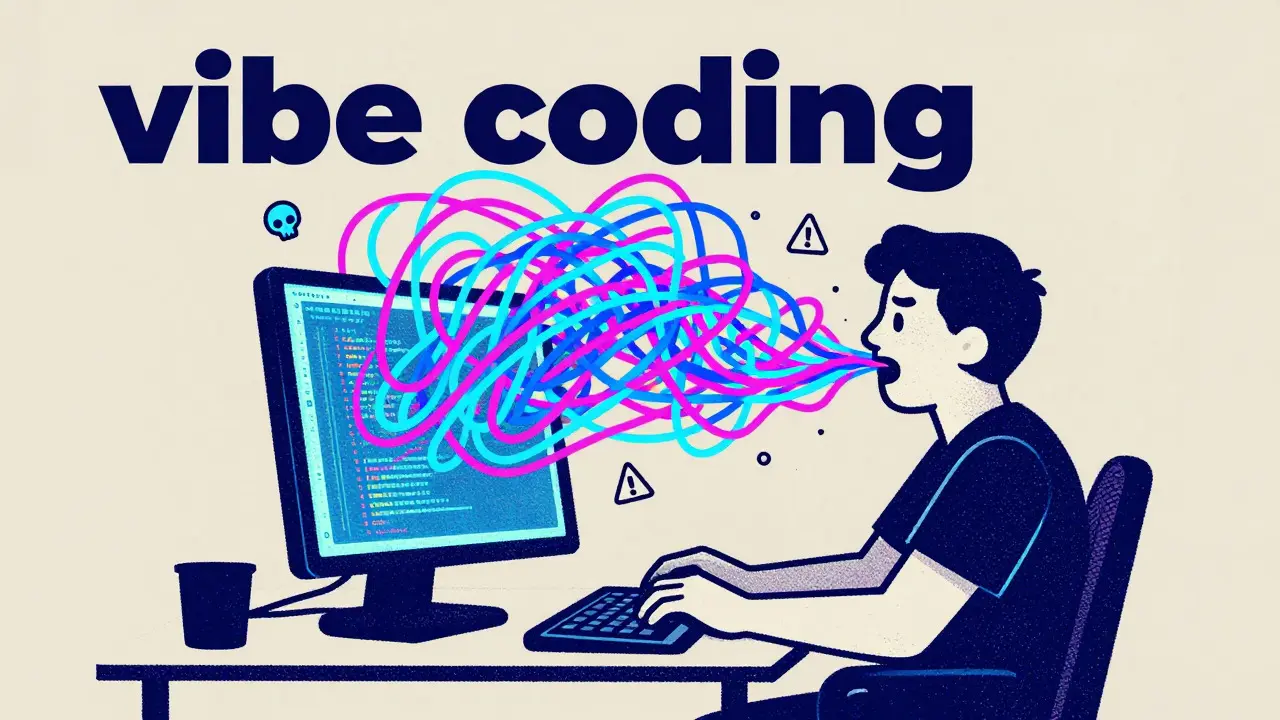
It sounds like a joke at first. You tell an AI what you want the app to feel like-"make it snappy," "keep it secure," "give it a dark mode vibe"-and it writes the code. That is vibe coding, defined in an October 2025 arXiv paper as a paradigm where developers specify high-level intent and qualitative descriptors, letting intelligent agents generate executable software. But here is the catch: without strict rules, that code is a ticking time bomb. In March 2025, Codecentric analyzed an AI-generated platform and found 37 critical security vulnerabilities and 21 architectural anti-patterns. The speed is real, but so is the chaos. If you are building systems this way, you need more than prompts; you need architectural standards.
The Core Problem: Speed vs. Structure
Vibe coding exploded in 2024-2025 because tools like GitHub Copilot (version 4.3) and Amazon CodeWhisperer became good enough to understand natural language. Google Cloud described it in December 2024 as using natural language prompts to assist with coding. It works great until it doesn't. Unstructured vibe coding creates strong coupling in 73% of systems and leaves 42% of the codebase unused. You might build a prototype in days, but maintaining it becomes a nightmare. The goal isn't to stop using AI; it's to force the AI to follow the same structural rules a senior human architect would enforce.
Five Non-Negotiable Architectural Principles
To make vibe-coded systems stable, you must embed these five principles directly into your prompt engineering and validation pipelines. These aren't suggestions; they are the guardrails that prevent technical debt from spiraling out of control.
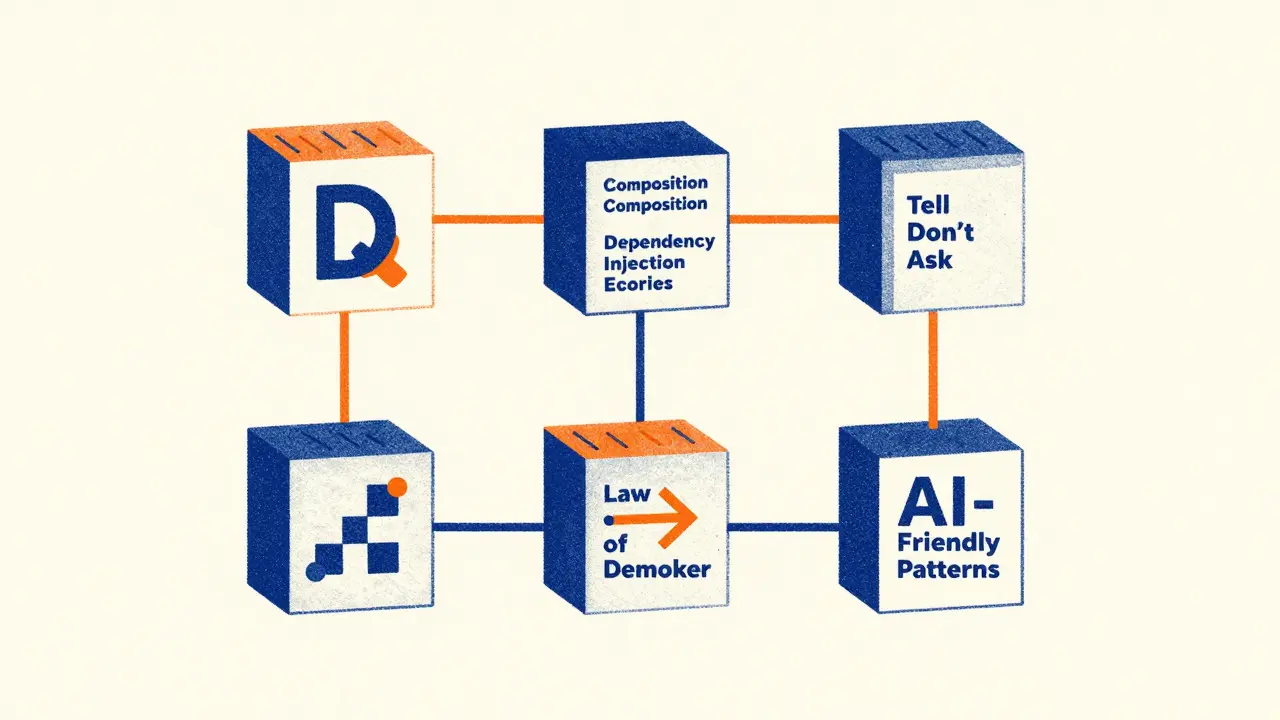
- Composition over Inheritance: AI loves deep inheritance trees, which are brittle. Instead, use capability interfaces. Synaptic Labs' May 2025 reference implementation showed that composing behaviors from 12 standardized interfaces reduced complexity significantly, with 87% of object behaviors built this way rather than through hierarchy.
- Strict Dependency Injection: Require constructor injection based on interface contracts. vFunction's January 2025 analysis proved that proper dependency injection (DI) reduced coupling by 63% in AI-generated codebases. If the AI hardcodes dependencies, flag it immediately.
- Tell, Don't Ask: Objects should receive commands, not have their state inspected. This reduces conditional branches by 41%, making the code easier for both humans and future AI agents to read and modify.
- Law of Demeter Compliance: Flatten object chains. Compliant implementations reduce average method chain length from 4.7 to 1.2. Long chains like `user.getAddress().getCity().getName()` are a red flag for tight coupling.
- AI-Friendly Design Patterns: Consistency is key. Use standardized REST operations (create, update, delete, get, list) and uniform error handling with just four standardized error types. Synaptic Labs found that consistent patterns improved AI extension success rates from 58% to 92%.
Structured vs. Unstructured Approaches
Not all vibe coding is created equal. There is a massive gap between throwing prompts at a model and following a structured framework like Drew Maring's AI-spec driven development or the BMAD framework (Breakthrough Method of Agile AI-Driven Development). Structured methods produce systems with 94% test coverage and 68% lower technical debt. Unstructured approaches? They leave you with 37 critical issues per 1,000 lines of code. The difference lies in the presence of explicit architectural constraints during generation.
| Metric | Unstructured Vibe Coding | Structured (Constitutional) |
|---|---|---|
| Test Coverage | Variable/Low | 94% |
| Technical Debt | High (4.7x accumulation rate) | 68% Lower |
| Security Vulnerabilities | 37 critical / 1k LOC | Reduced by 82% |
| Coupling Issues | 73% of systems affected | Minimal |
| Maintainability Score | Low | 3.2x Higher |
The Reference Architecture Model
The October 2025 arXiv paper (arXiv:2510.17842) proposed a formal reference architecture that separates concerns clearly. This model consists of four components: an Intent Parser, a Semantic Embedding Engine, an Agentic Code Generator, and a Feedback Loop. Most importantly, this architecture supports a "constitutional" layer. Google's December 2024 approach uses 12 core principles to guide the generator. When you implement this structure with constraints, maintainability scores jump by 3.2 times. The Intent Parser converts your free-form "vibe" description into structured data, while the Feedback Loop ensures iterative refinement against your architectural rules.
Governance and Onboarding Process
You cannot just start vibe coding tomorrow without preparation. Synaptic Labs recommends a three-phase onboarding process. First, establish an architectural constitution (4-8 hours for small teams). Second, create reference implementations for core patterns (12-24 hours). Third, implement validation pipelines (8-16 hours). Drew Maring spent 112 hours setting up his constitutional framework before writing production code, but it saved him 73% of remediation time later. A common pitfall is "prompt drift," where developers gradually ignore constraints. This happened in 68% of teams in Codecentric's study. To fight this, automate your checks. Use tools like those from vFunction, which secured $42M in funding specifically for architectural observability of AI-generated code.

Market Context and Future Outlook
By 2026, Gartner predicts 55% of enterprise teams will use AI coding assistants. However, the EU's June 2025 AI Act now requires "architectural transparency documentation" for critical sectors. This means governance isn't optional anymore. Startups often skip this for speed, but regulated industries like finance require formal reviews. The IEEE P2874 standard, currently in draft as of late 2025, mandates specific metrics like 85% adherence to separation of concerns. If you ignore these emerging standards, your system might need a full rewrite within three years. Those with proper governance see an 83% chance of longevity beyond five years.
Practical Steps for Implementation
Start by defining your "constitution." What are your non-negotiables? Security? Performance? Specific design patterns? Write these down explicitly. Next, build a small reference module that demonstrates these patterns perfectly. Use this module as few-shot examples in your prompts. Finally, set up automated linting and testing that rejects code violating your architectural principles. Don't rely on the AI to self-correct; force it to comply through pipeline gates. Remember, the AI is a junior developer that works incredibly fast but needs very clear instructions.
What is vibe coding?
Vibe coding is an AI-native programming paradigm where developers specify high-level functional intent and qualitative descriptors (like tone or style), and an AI agent generates the executable software. It relies on natural language prompts rather than traditional syntax-heavy coding.
Why do architectural standards matter for AI-generated code?
Without standards, AI-generated code often suffers from strong coupling, security vulnerabilities, and poor maintainability. Standards ensure the code is modular, secure, and easy to update, preventing massive technical debt accumulation.
What are the five foundational principles for vibe-coded systems?
The five principles are: composition over inheritance, strict dependency injection, "tell don't ask" methodology, Law of Demeter compliance, and AI-friendly design patterns (consistent interfaces and error handling).
How does structured vibe coding differ from unstructured?
Structured vibe coding uses explicit architectural constraints, constitutions, and validation pipelines, resulting in 94% test coverage and lower debt. Unstructured coding leads to high vulnerability rates and fragmented, hard-to-maintain codebases.
Is vibe coding suitable for regulated industries?
Yes, but only with strict governance. Regulated sectors like healthcare and finance require formal architecture reviews and transparency documentation, as mandated by regulations like the EU AI Act. Structured approaches meet these requirements better than ad-hoc methods.




Stephanie Frank
25 July, 2026 - 03:10 AM
Let's be real, most of these 'standards' are just corporate buzzwords wrapped in a bow to make AI-generated spaghetti code feel legitimate. The moment you try to enforce strict dependency injection on an LLM that hallucinates interfaces half the time, you're not building software, you're playing whack-a-mole with technical debt. It is hilarious how people think adding a 'constitution' fixes the fundamental issue that the model has no actual understanding of the business logic it is churning out.
Caitlin Donehue
25 July, 2026 - 03:12 AM
I have been experimenting with this for my side projects and honestly, the 'tell don't ask' principle really does seem to help the AI generate cleaner loops. I noticed that when I explicitly prompt for command-based interactions instead of state inspection, the resulting code is much easier to trace back later without getting lost in nested conditionals.
Saranya M.L.
25 July, 2026 - 23:33 PM
The statistical correlation between unstructured vibe coding and architectural decay is undeniable, yet the industry persists in its willful ignorance of established software engineering paradigms. One must consider that the Law of Demeter compliance is not merely a suggestion but a mathematical necessity for reducing cyclomatic complexity in agent-generated systems. The reference implementation by Synaptic Labs demonstrates that composition over inheritance yields an 87% reduction in object behavior complexity, a metric that cannot be ignored by any serious practitioner. Furthermore, the reliance on deep inheritance trees creates brittle systems that fail catastrophically under minimal perturbation, a fact well-documented in classical design literature. It is imperative that developers adopt strict dependency injection protocols to mitigate the inherent stochastic nature of large language models. Without such rigorous constraints, the generated codebase becomes an unmaintainable labyrinth of tightly coupled dependencies. The EU AI Act mandates architectural transparency, which effectively forces enterprises to abandon ad-hoc prompting in favor of constitutional frameworks. Therefore, the adoption of structured vibe coding is not optional but a regulatory requirement for sustainable development.
om gman
26 July, 2026 - 06:59 AM
oh great another article telling us how to babysit our digital pets because they keep eating the furniture. i suppose we should all just sit around waiting for the AI to magically understand what 'snappy' means while we sip lattes and pretend we are still relevant. the whole concept of vibe coding is just a fancy way of saying we gave up on actually knowing how computers work. but sure lets add more rules so the machine can follow them even less accurately
michael rome
27 July, 2026 - 05:09 AM
It is truly fascinating to see how quickly the industry is adapting to these new paradigms, and it brings a sense of relief to know that there are structured ways to approach this chaos. We must remember that every developer is navigating this shift together, and having clear guardrails allows us to focus on creativity rather than debugging infinite loops of bad logic. The emphasis on composition over inheritance is particularly comforting as it aligns with many modern best practices we have been advocating for years. By embracing these principles, we create a safer environment for both human and machine collaboration, ensuring that our systems remain robust and maintainable. It is important to acknowledge the effort required to set up these constitutions, but the long-term benefits far outweigh the initial investment of time and resources.
Andrea Alonzo
28 July, 2026 - 11:41 AM
I find that when we take the time to really understand the underlying architecture before letting the AI run wild, the results are significantly more coherent and easier to manage in the long run, especially when you consider that many teams are rushing into this without a solid foundation. It is wonderful to see that there are now concrete metrics available to measure the success of these structured approaches, such as the 94% test coverage mentioned in the post, which gives us tangible goals to strive for. Incorporating feedback loops early in the process helps catch those subtle deviations from the intended design before they become entrenched in the codebase, allowing for smoother iterations and less rework down the line. We should encourage each other to share our experiences with different validation pipelines, as learning from collective mistakes can accelerate our mastery of these tools. Ultimately, the goal is to empower developers to use AI as a true partner rather than a black box that occasionally spits out working code.
Bineesh Mathew
29 July, 2026 - 23:36 PM
In the grand tapestry of technological evolution, the emergence of vibe coding represents a profound existential crisis for the very notion of authorship in software development. When we delegate the act of creation to an algorithmic oracle that operates on probabilities rather than intent, we must ask ourselves what remains of the human spirit in the compiled binary. The five principles outlined here are not mere technical guidelines but moral imperatives that safeguard the integrity of our digital souls against the encroaching void of automated mediocrity. To ignore them is to surrender our agency to the silicon gods who care nothing for elegance or truth. We stand at the precipice of a new era where the distinction between coder and curator blurs into obscurity, demanding a philosophical rigor that matches the computational power at our disposal.
Jeanne Abrahams
30 July, 2026 - 15:30 PM
You lot in the west always think you invented structure because you finally stopped writing code like it was poetry slam night. In Cape Town, we have been dealing with legacy systems held together by duct tape and prayers since before your AI assistants could tie their own shoelaces. But sure, go ahead and celebrate your 'constitutional layer' while your servers melt down from basic coupling issues. At least when our systems crash, we know exactly whose fault it is because someone actually wrote the damn thing.
Oskar Falkenberg
31 July, 2026 - 00:52 AM
i totally agree with the part about dependency injection being super important because ive seen too many projects where everything is hardcoded and then one small change breaks half the app which is really annoying to fix later on. it seems like if we just stick to the basics and make sure the ai follows some simple rules we can avoid a lot of headaches down the road and maybe even have some fun while doing it instead of just fighting with the compiler all day long.