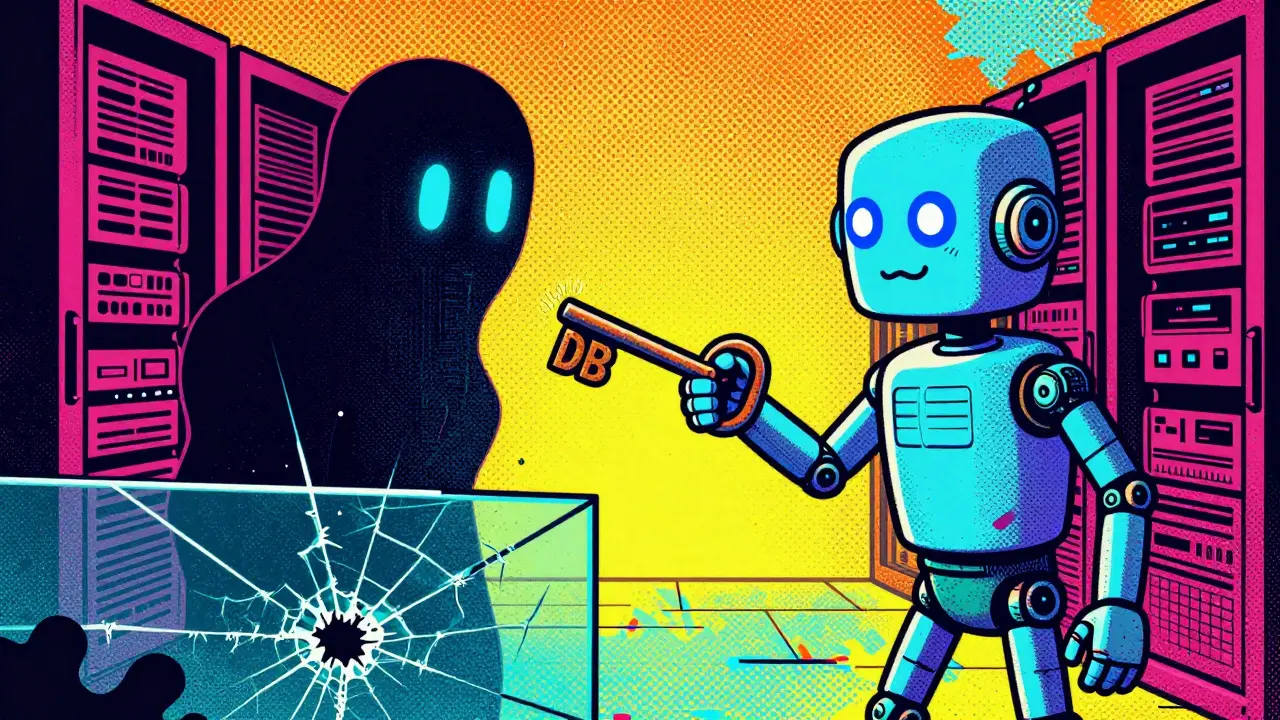
Imagine handing the keys to your production database to a stranger. That is essentially what happens when you let an AI agent with code execution capabilities run loose on your servers.
In 2026, AI-generated code is no longer just a suggestion in a developer's IDE. It is executing live tasks, processing data, and interacting with APIs. But here is the catch: these modules are often untrusted. They might contain hidden vulnerabilities, or worse, they could be manipulated by prompt injection attacks to exfiltrate sensitive data. According to a January 2025 report from Vercel, 97% of enterprises using AI-generated code experienced at least one security incident because they lacked proper sandboxing isolation mechanisms for untrusted code execution.
Sandboxing is not optional anymore. It is the firewall between your business logic and catastrophic failure. This guide breaks down how to secure these environments, which technology to pick, and why standard containers might be leaving you wide open.
Why Standard Containers Are No Longer Enough
For years, Docker and Linux namespaces were the gold standard for isolation. They are fast, lightweight, and easy to manage. But when it comes to untrusted AI modules, speed often comes at the cost of security.
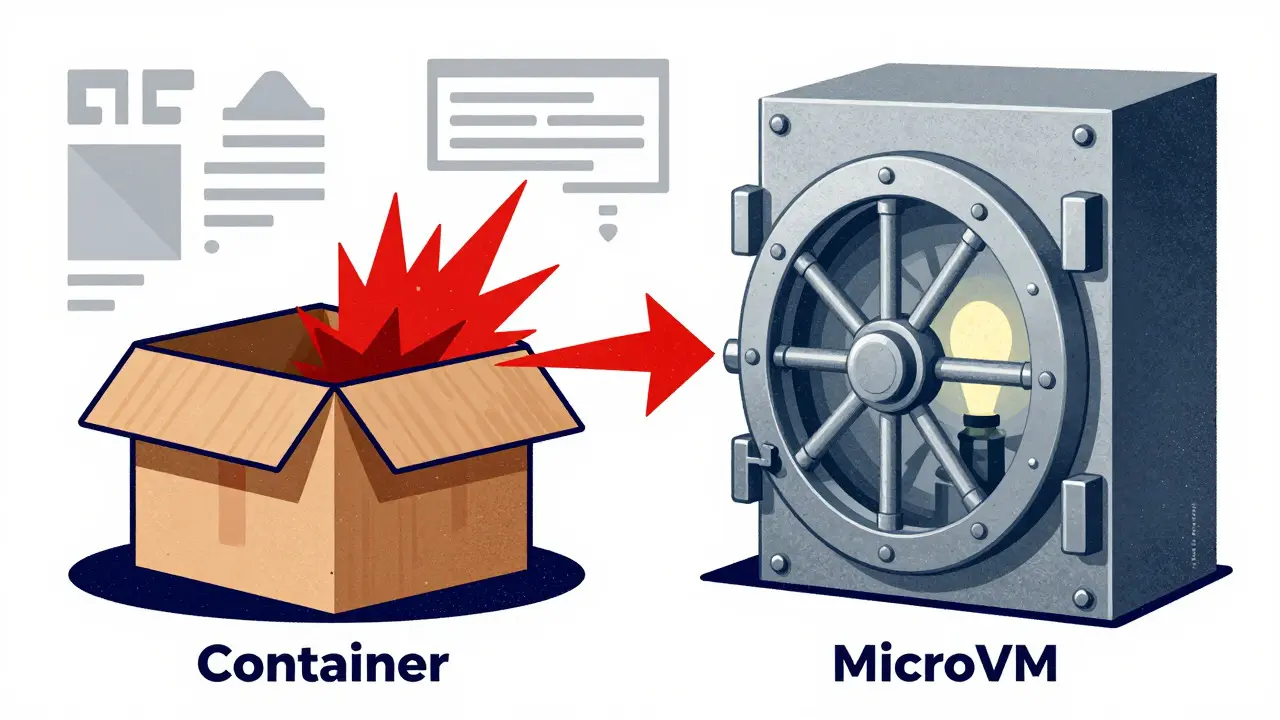
The core issue is that containers share the host kernel. If an AI-generated module finds a vulnerability in the kernel, it can escape the container entirely. We saw this happen with CVE-2019-5736 (runc) and CVE-2022-0492 (cgroup release_agent). These flaws allowed attackers to escalate privileges and take over the host machine.
In March 2025, Dr. Elena Rodriguez from Google demonstrated at Black Hat how sophisticated attacks could bypass container boundaries through kernel memory manipulation. Her findings were stark: while containers stopped basic mistakes, they failed against targeted exploits. In fact, a benchmark by Northflank in December 2025 showed that container solutions scored only 42% on the AI Sandbox Security Maturity Index, compared to 89% for microVM solutions.
If your AI agent is doing low-risk tasks like summarizing text, containers might suffice. But if it is executing arbitrary code, touching file systems, or making network requests, you need stronger isolation.
The Rise of MicroVMs for AI Isolation
MicroVMs Lightweight virtual machines with full kernel separation represent the current best practice for high-security AI workloads. Unlike containers, each microVM runs its own dedicated kernel. This means even if the guest OS is compromised, the host remains safe.
Platforms like E2B A cloud platform providing secure sandboxed environments for AI agents use Firecracker microVMs to provide this level of security. The trade-off? Slightly higher latency. E2B reports cold starts around 150 milliseconds, whereas containers can start in under 50 milliseconds.
However, for production security, that extra 100 milliseconds is a small price to pay. Palo Alto Networks' 2025 study found that microVM solutions prevent 100% of documented sandbox escape attempts, compared to just 63% for container solutions. Financial institutions have taken note; JPMorgan Chase's Security Standard v4.1 (October 2025) now mandates microVMs for 100% of their AI agent deployments.
WebAssembly and Hybrid Approaches
Not every AI task requires a full virtual machine. For lighter workloads, WebAssembly (Wasm) A binary instruction format for stack-based virtual machine offers a compelling middle ground. Sandboxes like Deno Sandbox or LangChain Sandbox (using Pyodide) restrict system calls by design. They limit memory to 256MB and block filesystem access unless explicitly granted.
The downside is compatibility. WebAssembly cannot execute native code extensions. GitHub's internal testing in March 2025 revealed a 38% failure rate for complex AI-generated code that required native libraries. If your AI agents need to run heavy data science libraries like NumPy or TensorFlow directly, Wasm might bottleneck your workflow.
Then there is the hybrid approach: Kata Containers A container runtime using lightweight virtual machines. Released in version 3.2 in August 2025, Kata allows Kubernetes clusters to mix trusted and untrusted workloads. It uses RuntimeClass configuration to spin up lightweight VMs for specific pods. Cold starts hover around 90ms, with a 15% memory overhead compared to standard containers. It is a strong option for teams already deep in the Kubernetes ecosystem who need better isolation without rewriting their infrastructure.
| Technology | Cold Start Time | Isolation Level | Cost per Execution | Best For |
|---|---|---|---|---|
| MicroVMs (e.g., E2B) | ~150 ms | High (Kernel Separation) | $0.00012 | High-risk, arbitrary code execution |
| Containers (Docker/runc) | ~50 ms | Medium (Shared Kernel) | $0.00005 | Low-risk, trusted internal tools |
| WebAssembly (Deno/LangChain) | ~75 ms | Medium-High (Restricted Syscalls) | $0.00008 | Lightweight scripts, no native libs |
| Kata Containers | ~90 ms | High (Lightweight VM) | $0.00010 | Kubernetes-native environments |
Defense-in-Depth: Beyond the Sandbox
A sandbox is not a magic bullet. As Michael Chen, CTO of Obsidian Security, stated at DEF CON 33 in August 2025, "78% of AI security breaches trace to credential compromise." You can have the strongest microVM in the world, but if you pass your AWS root credentials into the environment variables, the AI will find them and leak them.
OWASP's Top 10 for Agentic Applications 2026 emphasizes a five-layer defense strategy:
- Strong Sandboxing: Use microVMs for high-risk scenarios.
- Comprehensive Monitoring: Log every tool invocation and API call made by the agent.
- Human-in-the-Loop: Require approval for consequential actions like deleting records or sending emails.
- Secrets Management: Never inject secrets directly into the prompt or environment. Use short-lived tokens or vault integrations.
- Incident Response: Have a plan for when the sandbox is breached.
Dr. Rodriguez's research also highlighted the power of eBPF-based runtime checking. By embedding machine learning models that monitor system calls in real-time, teams can detect 0-day exploits with 99.2% accuracy and sub-5ms latency. This adds a layer of intelligence inside the sandbox, catching anomalies before they cause damage.

Implementation Challenges and Best Practices
Moving to a robust sandboxing strategy is not plug-and-play. The learning curve is steep. Docker training takes 2-3 days; mastering E2B or Kata Containers can take 10-14 days according to Q4 2025 onboarding metrics.
Here are three common pitfalls to avoid:
- Dependency Hell: AI-generated code often assumes libraries are installed. Your sandbox must have a mechanism to install dependencies securely, preferably by pinning versions and verifying checksums.
- State Persistence: Sandboxes are typically stateless. If your AI agent needs to remember context between executions, you must externalize storage to a secure database, not the local file system.
- Cold Start Latency: Users hate waiting. If 150ms feels too slow, consider pre-warming sandbox pools. 42% of teams surveyed by GitHub in February 2026 implemented this to mitigate delays.
The n8n team recommends starting with maximum constraints. Limit agent capabilities and require broad approvals. Only after 30 days of stable operation without incidents should you progressively expand autonomy. This "crawl, walk, run" approach minimizes risk during the critical adoption phase.
Regulatory Pressure and Future Trends
The clock is ticking on compliance. The EU AI Act 2025 requires sandboxing validation for any AI system with code execution capabilities. Meanwhile, NIST released Special Publication 800-234 in November 2025, detailing security controls specifically for AI-generated code. Ignoring these standards isn't just risky; it's legally hazardous.
Looking ahead, hardware-accelerated sandboxing is on the horizon. Intel's Trust Domain Extensions (TDX) support for AI workloads is expected in Q3 2026, promising faster, more secure isolation. Gartner predicts that by 2027, 75% of enterprises will mandate microVM-level isolation for production AI agents, up from just 38% in 2025.
The market is shifting. With the AI sandboxing market reaching $2.4 billion in 2025, platforms like E2B, Modal, and Deno are competing fiercely. But the core message remains simple: trust nothing. Verify everything. Isolate relentlessly.
What is the difference between a container and a microVM for AI sandboxing?
Containers share the host operating system's kernel, which means a vulnerability in the kernel can allow an attacker to escape the container. MicroVMs provide full kernel separation, giving each instance its own lightweight virtual machine. This makes microVMs significantly more secure for untrusted code, though they have slightly higher startup times (around 150ms vs 50ms).
Is WebAssembly (Wasm) secure enough for production AI agents?
WebAssembly provides strong isolation by restricting system calls and memory access, making it secure for many tasks. However, it cannot execute native code extensions. If your AI-generated modules rely on native libraries (like certain data science tools), Wasm may fail. It is best suited for lightweight, pure-code tasks.
How do I prevent credential leaks in sandboxed AI environments?
Never pass long-lived secrets directly into the sandbox environment variables. Instead, use short-lived tokens or integrate with a secrets management vault. Ensure the sandbox has minimal network permissions-only allow outbound connections to necessary APIs. Monitor all network traffic for unusual patterns, such as DNS exfiltration attempts.
What does OWASP recommend for securing AI agents in 2026?
OWASP's 2026 guidance mandates five control layers: strong sandboxing (preferably microVMs for high-risk scenarios), comprehensive monitoring of tool invocations, human-in-the-loop workflows for critical decisions, strict secrets management, and tested incident response procedures. Container isolation alone is considered insufficient for production AI agents with code execution capabilities.
Which industries are most likely to adopt microVMs for AI?
Financial services lead the adoption, with 98% of firms using microVMs for AI agents due to strict regulatory requirements and high data sensitivity. Healthcare and government sectors follow closely. Retail and e-commerce often use a mixed approach, reserving microVMs for high-risk tasks while using containers for lower-risk operations.