
Imagine your company’s new AI assistant accidentally emailing a client’s social security number or medical history to the wrong person. It happens more often than you think. In March 2024, an unnamed healthcare provider faced a $2.3 million GDPR fine because their large language model (LLM) leaked protected health information through subtle pattern memorization. This isn’t just a tech glitch; it is a legal and reputational disaster waiting to happen.
To stop this from happening to you, you need secure human review workflows. These are systematic processes where trained humans examine, validate, and approve AI-generated content before it ever reaches a customer or public database. According to Capella Solutions’ October 2024 analysis, 78% of Fortune 500 companies now mandate these checkpoints for regulated domains like healthcare, finance, and law. If you are deploying AI in any sector that handles personal data, skipping human review is no longer an option-it is negligence.
The Core Problem: Why Automation Alone Fails
You might be tempted to rely solely on automated filters. After all, software is fast and cheap. But here is the hard truth: basic prompt filters catch only 63% of sensitive data exposures, according to Protecto.ai’s March 2025 testing. LLMs are creative. They can paraphrase sensitive data in ways that keyword blockers miss entirely.
Consider the difference between a simple regex filter and a human eye. A filter looks for "SSN-123-45-6789." An LLM might output "The patient's identifier is one-two-three..." without triggering the alarm. A human reviewer understands context. AWS reported in July 2024 that organizations using proper human review workflows reduce sensitive data exposure incidents by 87% compared to fully automated systems. That is a massive gap in safety.
Dr. Elena Rodriguez, Director of MIT’s AI Ethics Lab, put it bluntly in her November 2024 IEEE article: "Human review isn't optional for regulated domains-it's the single most effective control against catastrophic data leakage." You cannot automate away liability.
Building the Workflow Architecture
A secure workflow is not just a person reading text. It is a multi-layered system designed to minimize fatigue and maximize accuracy. Based on Superblocks' Enterprise LLM Security Framework v2.1 (released November 3, 2024), your architecture should include four distinct permission tiers:
- Reviewer: Entry-level staff who flag potential issues.
- Approver: Senior staff with authority to clear high-risk content.
- Auditor: Compliance officers who check the reviewers' work.
- Administrator: IT staff managing access controls and system settings.
Every role must use mandatory multi-factor authentication (MFA). No exceptions. The workflow itself typically follows a three-stage validation process:
- Automated Pre-screening: Use keyword blocking and sentiment analysis to filter out obvious errors. Kinde’s December 2024 engineering guide suggests this as the first line of defense.
- Confidence Scoring: Route outputs with less than 92% certainty to human review. Capella Solutions’ benchmarking study of 47 enterprise implementations found this threshold balances speed and safety effectively.
- Dual Authorization: Require two approvals for high-risk categories, such as those containing Personally Identifiable Information (PII) or Protected Health Information (PHI).
Technical Requirements for Compliance
If your workflow is not technically sound, your legal team will tear it apart during an audit. You need specific infrastructure to meet standards like NIST SP 800-53 Rev. 5 and SEC Rule 17a-4(f).
| Component | Requirement | Standard/Source |
|---|---|---|
| Encryption | AES-256 minimum for review interfaces | NIST SP 800-53 Rev. 5 |
| Audit Trails | Version-controlled logs capturing identity, timestamp, and rationale | SEC Rule 17a-4(f) |
| Data Retention | Minimum 7 years for financial/legal records | SEC Regulations |
| Identity Management | Integration with Okta or Azure AD | Superblocks Framework v2.1 |
Without these components, you have no proof of due diligence. When a breach occurs, auditors want to see exactly who approved what, when, and why. If your system doesn't log that, you are liable.

The Human Factor: Combating Fatigue and Bias
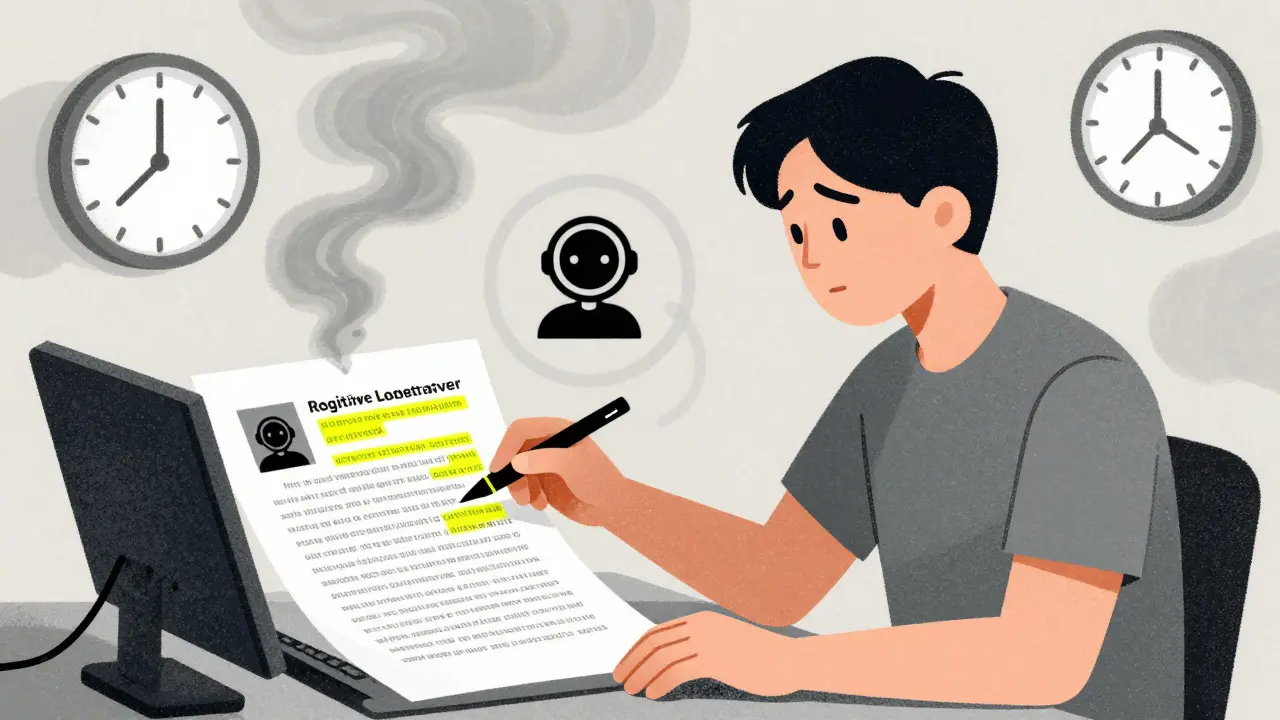
Here is the tricky part: humans get tired. Dr. Kenji Tanaka of Stanford’s AI Lab warned in his October 2024 paper about "reviewer fatigue," which causes an 18-22% drop in accuracy after just 90 minutes of continuous work. If you treat reviewers like robots, they will make robot-like mistakes-or worse, careless ones.
To fix this, implement mandatory rotation schedules. MIT’s November 2024 guidelines recommend maximum 60-minute sessions. Break tasks into smaller chunks. Use AI-assisted tools that highlight potential issues, which cuts review time by 35% according to Kinde’s metrics. This keeps reviewers engaged and sharp.
Bias is another silent killer. A Bank of America engineer noted on Reddit (thread #ML-2024-11-15) that reviewer bias can skew approval decisions. To mitigate this, ensure diverse training and cross-train your pool. Capella Solutions found that cross-training reduces single-point failure risk by 68%. Rotate reviewers across different types of content so they don't develop tunnel vision.
Cost vs. Benefit: Is It Worth It?
Let’s talk money. Secure human review adds cost. Capella’s 2024 cost analysis shows an average of $3.75 per 1,000 tokens reviewed. Commercial platforms like Superblocks charge $499/month per reviewer seat. Custom-built solutions using open-source frameworks like Kinde require 12-16 weeks of development time.
But compare that to the alternative. A single HIPAA violation can cost hundreds of thousands, if not millions, in fines. JPMorgan Chase processed 14.7 million sensitive financial queries in Q4 2024 with zero data leakage incidents thanks to their robust review implementation. That is a return on investment you can quantify. Capital One reduced PCI compliance violations by 91% in their customer service chatbots after implementing similar workflows.
Performance-wise, expect a slowdown. Properly implemented workflows add 8-12 seconds of latency per review cycle, per AWS’s September 2024 study. Throughput drops by an average of 47%. But in regulated industries, speed means nothing if accuracy is compromised. Healthcare organizations prioritize this heavily-92% use mandatory human review for patient-facing outputs, compared to only 38% in marketing.
Implementation Roadmap: From Zero to Secure
Don't try to boil the ocean. Capella Solutions’ November 2024 guide outlines a realistic 10-14 week rollout timeline:
- Weeks 1-3: Workflow Design. Define roles, permissions, and risk categories. Map out your decision trees.
- Weeks 4-7: Integration. Connect your LLM platform to your identity management system (Okta/Azure AD). Set up encrypted review interfaces.
- Weeks 8-14: Training and Pilot. Train reviewers (minimum 16 hours per NIST standards). Run a pilot with low-risk content before going live with sensitive data.
Start small. Identify your highest-risk use cases first. For example, if you are in finance, start with AI-generated financial advice. The EU AI Act’s Article 54 (effective February 2025) already requires human oversight for high-risk AI systems. Get ahead of the curve.
Future-Proofing Your Strategy
The landscape is shifting fast. By 2027, Gartner forecasts 95% of regulated enterprises will implement formal human review workflows. New technologies like confidential computing (Intel SGX and AMD SEV) are emerging to protect data even while it is being processed. Forrester predicts adoption of these environments will grow from 18% to 63% by Q3 2025.
Keep an eye on real-time reviewer performance analytics. As AWS launched in November 2024, automated reviewer assignment based on content sensitivity scoring is becoming standard. This ensures the right expert sees the right problem. Don't let your static workflow become a liability tomorrow.
What is the primary purpose of human review workflows for LLMs?
The primary purpose is to prevent data leakage and ensure regulatory compliance. Automated systems miss nuanced errors, so human reviewers validate sensitive outputs before deployment, reducing exposure incidents by up to 87%.
How much does implementing a secure review workflow cost?
Costs vary by approach. Commercial platforms like Superblocks charge around $499/month per seat. Custom builds may cost $3.75 per 1,000 tokens reviewed plus development time. However, this is often cheaper than potential GDPR or HIPAA fines.
What are the key technical requirements for compliance?
You need AES-256 encryption for interfaces, version-controlled audit trails with 7-year retention for financial data, and integration with corporate identity management systems like Okta or Azure AD to enforce role-based access control.
How do you prevent reviewer fatigue?
Limit review sessions to 60 minutes, rotate tasks regularly, and use AI-assisted tools to highlight issues. Cross-training reviewers also helps maintain engagement and reduces bias.
Is human review required by law?
For high-risk AI systems, yes. The EU AI Act Article 54 mandates human oversight for high-risk applications. Additionally, sectors like healthcare (HIPAA) and finance (SEC rules) implicitly require rigorous controls that human review provides.
What is the typical timeline for implementation?
A full rollout typically takes 10-14 weeks. This includes 3 weeks for design, 4 weeks for technical integration, and 3-7 weeks for training and pilot testing before full deployment.


Brenna Gonedrman
30 July, 2026 - 16:43 PM
OMG this is literally the scariest thing ever and I am shaking right now because my boss just bought us an AI tool yesterday and we did NOTHING about security!!!
I mean like think about it for a second because if your company leaks someone's social security number you are basically dead in the water legally and reputationally so why would anyone risk it?!? It is insane that people still think automation is enough because it is NOT and they are going to get sued into oblivion.
The part about the healthcare provider getting fined $2.3 million made me drop my coffee because that is just money burning up in flames and nobody wants that so please everyone read this before you deploy anything stupid.
I feel like everyone needs to wake up and smell the roses of compliance because if you don't you will be crying later when the lawyers show up at your door with bills thicker than a phone book.
It is just wild how many companies are flying blind here and I bet half of them are using basic filters that miss everything so good luck to them I guess.
Also the fact that humans get tired after 90 minutes is such a huge deal because who knew reviewing text was exhausting but apparently it is so we need breaks or else we make mistakes that cost millions.
This whole post is a lifesaver honestly because it tells you exactly what to do instead of just saying 'be careful' which is useless advice anyway.
I am telling my team tomorrow that we need these four permission tiers or else I quit because I don't want to go to jail for data leakage.
Can we just agree that AES-256 encryption is non-negotiable at this point because if you are not using it you are basically leaving the front door wide open for hackers.
The cost analysis part is also super helpful because $3.75 per thousand tokens sounds like nothing compared to a HIPAA fine which could bankrupt a small business instantly.
So yeah long story short stop being lazy and set up proper human review workflows before something terrible happens because it really is negligence otherwise.
I just hope people actually listen this time because the stakes are higher than ever with all these new laws coming out.
Anyway I am going to go scream into a pillow now because thinking about GDPR fines gives me hives.
Courtney Wagstaff
31 July, 2026 - 08:17 AM
Hey there! This is such a cool deep dive into keeping our digital friends in check 🌿✨
I love how you break down the layers like an onion of safety, peeling back the truth about why bots alone aren't enough to catch those sneaky data leaks. It feels like building a cozy fort against chaos!
The bit about reviewer fatigue really hit home because we all know that brain fog sets in after a while, right? So taking breaks isn't just nice, it's necessary for keeping things sharp and bright.
Thanks for sharing this gem! 💖
Elisabeth Ballet
31 July, 2026 - 14:32 PM
Let’s get this party started with some real action because knowledge without execution is just noise!
You guys need to step up and own this process because your team is counting on you to keep their data safe and sound.
Don’t let the complexity scare you off because breaking it down into weeks makes it totally manageable and even fun if you look at it the right way.
Start with that workflow design phase and map out those roles because clarity is king when you are dealing with sensitive info.
Remember that every single approval matters and your diligence today prevents disasters tomorrow so wear that responsibility like a badge of honor.
Cross-training your reviewers is a game-changer too because it builds resilience and keeps everyone engaged so nobody gets bored or biased.
So go forth and build those secure workflows with confidence because you have got this and your organization will thank you for it!
Let’s crush those compliance goals together! 💪
Joanna Mucha
1 August, 2026 - 00:02 AM
Oh, how delightfully pedestrian. To suggest that mere mortals require 'workflows' to manage the ethereal dance of artificial intelligence is almost quaint in its simplicity.
One might argue that the true failure lies not in the lack of human oversight, but in the inherent fragility of human cognition itself, which is easily swayed by fatigue and bias-traits we proudly carry as our evolutionary baggage.
Yet here we are, tasked with polishing silverware while the machine eats the feast. The notion of 'dual authorization' strikes me as a bureaucratic ritual designed to soothe the anxious masses rather than a genuine safeguard against the inevitable entropy of data.
But sure, keep your little audit trails and your AES-256 encryption. It provides a comforting illusion of control in a universe that cares deeply for none of it.
I suppose if one must engage in such mundane activities, doing so with a sense of dramatic irony is the only way to maintain one's sanity amidst the corporate drudgery.
Do try not to trip over your own compliance cables on the way to the meeting.
Kim Edwards
1 August, 2026 - 08:08 AM
THIS IS A DISASTER WAITING TO HAPPEN AND EVERYONE IS JUST SITTING THERE WATCHING IT BURN!!!
I mean can you believe the audacity of these companies thinking they can just slap a filter on an LLM and call it a day?!? It is absolutely ridiculous and terrifying at the same time.
My heart is pounding just reading about that $2.3 million fine because imagine losing that much cash over a simple mistake that could have been prevented with basic human eyes!
We are living in a time where technology is moving faster than our brains can handle and if we don't slow down and put humans in the loop we are going to crash and burn spectacularly.
The idea that automated filters only catch 63% of issues is mind-blowing because that means nearly half of the sensitive data is slipping through the cracks like sand through an hourglass.
I feel like we need to shout this from the rooftops because nobody seems to care until it is too late and then everyone points fingers and blames each other.
Let's just admit that humans are better at context than machines right now and stop pretending otherwise because pride has no place in data security.
If you are not using multi-factor authentication for your reviewers you are basically inviting trouble to your doorstep with a welcome mat.
This whole situation is a soap opera waiting to happen and I just hope we learn from it before the next big scandal drops.
Bonnie Watt
2 August, 2026 - 03:43 AM
Sure, throw more humans at the problem and see how that works out for you because clearly machines haven't failed us enough yet.
Who needs efficiency when you can have expensive, tired people staring at screens making subjective calls based on whatever mood they are in that day?
I bet the 'reviewer fatigue' is just an excuse for laziness and if you really cared about security you would just work longer hours without complaining.
And don't get me started on the cost because paying hundreds of dollars a month for seats is just bleeding money for no real gain.
Probably the best use of resources is to just ignore the regulations and hope nobody notices until it is too late.
Typical corporate nonsense designed to keep consultants employed.
Meagan Mueller
2 August, 2026 - 09:40 AM
they want you to think it is about security but it is really about control
big tech loves these 'human review' steps because it gives them an excuse to collect more data on your employees while pretending to protect you
notice how every solution requires integration with okta or azure ad which are owned by the same giants who profit from your data
it is a trap wrapped in compliance language
the real conspiracy is that they know the ai is flawed but they blame the humans for not catching it so they can shift liability
keep your eyes open and question every audit trail
nothing is as it seems